

Last March, I watched a classmate stand frozen in a crowded auditorium, envelope in hand, while everyone around her screamed and cried and FaceTimed their families. She just stared at the paper, didn’t open it for almost ten minutes. Not because she didn’t match—but because she was terrified of being the only unhappy one in the room.
If you’re scared that Match Day might be the worst day of your life while everyone else has “the best”… yeah. I’m right there with you.
The Fear You Don’t Want to Admit Out Loud
Let me just say the thing most of us only say in whisper-level group chats:
“I’m scared I’ll match… and still be miserable.”
“I’m scared I’ll open my envelope and have to fake being happy.”
“I’m scared I’ll be the only one holding back tears for the wrong reason.”
Everyone keeps talking about “not matching,” and yes—that’s a real, serious fear. But there’s this other, uglier one that doesn’t get airtime: matching somewhere you don’t want, wrong specialty, wrong city, toxic vibes. Watching everyone else hugging and cheering while you stare at a line on a paper thinking, “I’m stuck for at least three years.”
Here’s the part you probably need to hear:
You are absolutely not the only one scared of that. Not even close.
Most people don’t say it because it sounds ungrateful. Or they’re afraid of jinxing it. Or they know someone who went SOAP and feel guilty complaining about “just” not loving their match.
But quietly? Lots of people are terrified of:
- Matching their “safety” program and feeling like a failure
- Leaving family/partner behind and regretting it
- Being the only one in their friend group who isn’t thrilled
- Opening the envelope and realizing they ranked badly out of fear
You’re not dramatic. This is exactly how a high-stakes, one-shot, no-do-over system makes normal human beings feel.
How Match Day Actually Looks (Not the Instagram Version)
Let me be blunt: that glossy “everyone is crying with joy” photo on school websites? Cropped reality.
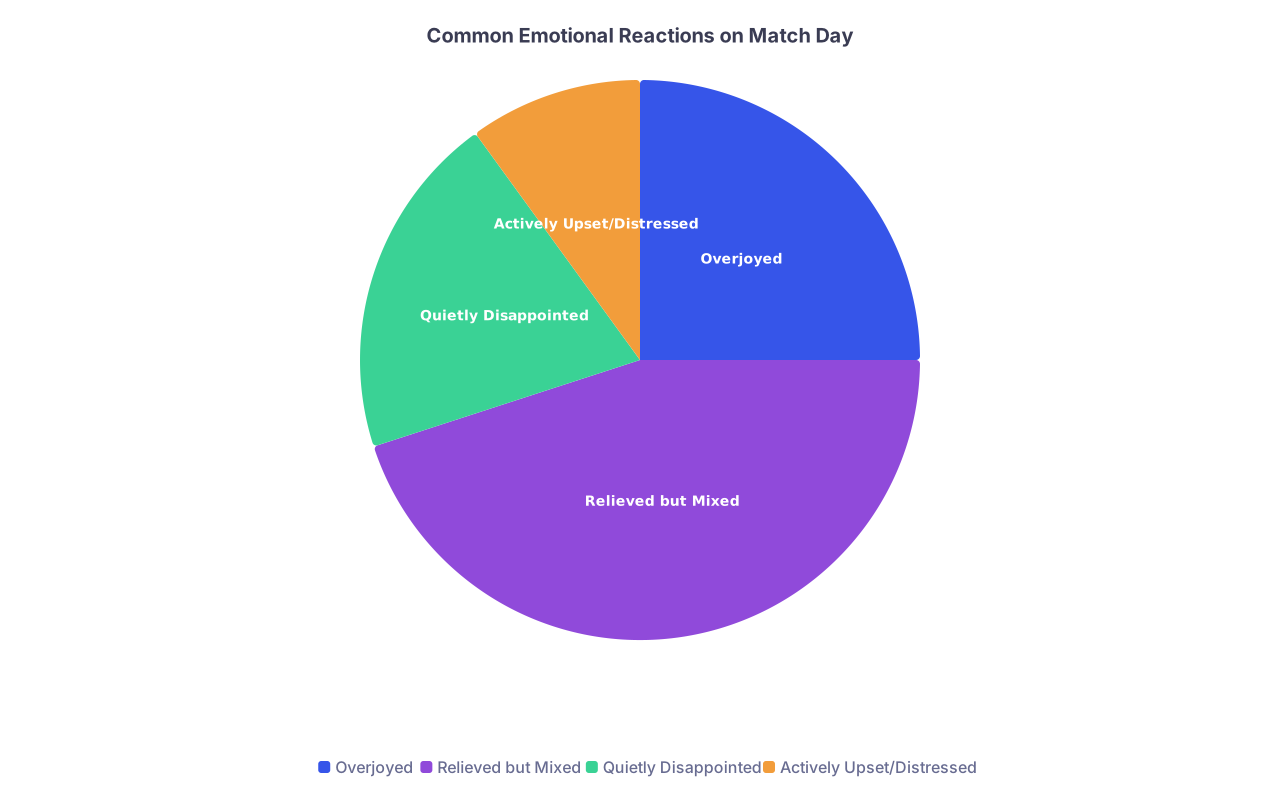
The full picture of a typical Match Day room looks more like this:
- 10–20% of people are screaming, ugly-crying, shaking-with-joy level happy
- A huge chunk are “relieved but complicated” – smiling but with that tight jaw
- Several are quietly disappointed and just doing damage control on their face
- A few step outside, bathroom, stairwell, random parking lot—just to breathe or cry
- Some already know they didn’t match from Monday and aren’t even in the room
| Category | Value |
|---|---|
| Overjoyed | 25 |
| Relieved but Mixed | 45 |
| Quietly Disappointed | 20 |
| Actively Upset/Distressed | 10 |
I’ve seen:
- Someone matching their #6 and saying, “I just need a minute. I can’t pretend right now.”
- A student who got their dream city but not their dream specialty and felt like they couldn’t be openly sad because “at least I matched.”
- A couple where one matched at their #1, the other at #4 across the country—both smiling for photos, then later saying, “I feel selfish for not just being happy.”
This fantasy that you’ll be the lone miserable person in a sea of ecstasy? False. You might be surrounded by people who look ecstatic, but you have no idea what’s happening behind those smiles.
And here’s the nicer truth: the room is big enough for all of it. Joy, relief, numbness, disappointment, confusion. Your feelings will not be the only messy ones.
Preparing for the “What If I Hate My Result?” Scenario
You’re reading this because your brain is already running the worst-case simulation. Good. Let’s actually use that.
Instead of just looping “what if it’s awful?” on repeat, try pre-building scripts and escape routes for Match Day.
1. Decide your “public reaction” plan now
Not because you have to be fake, but because it’s easier to follow a pre-made plan when you’re flooded.
Pick your baseline reaction, regardless of outcome:
- “I’m going to open my envelope, take 10 seconds, then say, ‘I matched’ out loud, even if I don’t say where yet.”
- “If it’s bad, I’ll just say, ‘I matched—processing it, will share later,’ and step out.”
- “I’ll open it on FaceTime with family somewhere quieter, not in the main room.”
You don’t owe the room a performance.
2. Create an exit strategy
Literally. A physical one.
- Know where the nearest bathroom / stairwell / hallway / outside door is
- Decide what you’ll say if you need to leave: “I’m gonna step out and call my family” works for every scenario
- Tell one trusted friend ahead of time: “If I walk out, don’t chase me. Text me instead.”
It sounds small, but having this planned calms that “I’ll have a meltdown in the middle of the room” fear. Worst case, you leave. You can always re-enter. No one’s chaining you to a chair.
3. Choose your audience carefully
You do not have to be surrounded by 80 people when you open that envelope. You can:
- Stand with just your closest friend or partner
- Ask to open it in a side room with your advisor
- Open it in your car and walk in after, once you’ve processed
- Tell your family in advance, “I might not want to be on live video when I open it—can we talk right after instead?”
Match Day is technically about you, but the whole thing can quickly become a spectator event. You’re allowed to control the camera angle.

| Step | Description |
|---|---|
| Step 1 | Before Match Day |
| Step 2 | Stand with 1-2 friends |
| Step 3 | Ask staff for quiet space |
| Step 4 | Join after opening |
| Step 5 | If overwhelmed, step out and text trusted person |
| Step 6 | Where to open? |
If You Match Somewhere You’re Not Excited About
This is the nightmare playing in your head: opening that paper, seeing your lower-ranked program, feeling your stomach drop while everyone else screams.
Let’s walk through what happens in real life when that occurs.
Phase 1: Shock / “I can’t believe this is it”
Totally normal. You might feel numb. Or angry. Or stupid for how you ranked. Or like you did something wrong. You didn’t.
Programs move up and down your list for a hundred reasons that don’t make it into the Match algorithm. Bad interview day, weird vibe, fear about location, pressure from mentors.
Phase 1 script (for yourself):
“I matched. This is where I’m starting my career. I don’t have to love it today.”
Phase 2: The comparison wave
Everyone will be posting on Instagram. Your group chat will blow up:
“OMG I GOT MY #1!!”
“Going to [prestigious place]!”
“Staying home!! Couldn’t be happier!!”
You will be tempted to read all of it. Don’t. At least not right away.
My advice: mute social for at least 24–48 hours if you’re hurting. People are posting the highlight reel; they are not posting:
- “I matched at my #4 and I’m trying so hard to be okay with it.”
- “I ranked for a partner who ended up not matching and now I’m stuck somewhere I don’t want alone.”
- “Everyone expects me to be thrilled because it’s a ‘good’ name and I’m… not.”
You won’t see those posts, but those people exist.
Phase 3: The meaning-making
In the days to weeks after Match, the story people tell themselves matters more than the line on the envelope.
I’ve watched three versions play out:
- “This is a punishment / proof I’m not good enough.”
- “This is neutral. It’s not what I wanted, but it’s where I am.”
- “This might end up being a hidden win, even if it sucks right now.”
Option 1 will suck the life out of the next three years.
Option 2 at least lets you breathe.
Option 3 is where people eventually land when they see the residents are actually kind, the attendings care, and they’re operating or managing their own patients way earlier than a big-name place.
You don’t have to jump to “gratitude” on Day 1. That’s fake. But don’t lock yourself into “I’m doomed.” You’re not.
The Truth About “Dream Programs” vs “Real Life”
Your brain is probably running this script: “If I don’t get my top choice, my career is over. Everyone will know I wasn’t competitive. I’ll never get the fellowship/position I want.”
Here’s the ugly little secret from watching this play out over multiple cycles: a “dream program” that looks shiny from the outside can feel very different living inside it.
| Aspect | What We Imagine | What Often Actually Matters |
|---|---|---|
| Program Name | Prestige, status | Culture, support, how attendings treat you |
| Location | Cool city, fun | Cost of living, commute, safety, proximity to support |
| Rank on List | #1 means perfect | Fit, workload, co-residents, mentorship |
| Research | Endless options | Protected time, someone actually willing to mentor you |
I’ve seen:
- People match their #1 “dream” and then quietly wish they’d gone to their smaller, friendlier #3 because the toxicity and malignant vibes weren’t obvious on interview day.
- Residents at “average” community programs absolutely crush their boards, get competitive fellowships, and actually like their lives.
- Friends who stayed at their home institution thinking it was safe and familiar, then realized they never get the procedural volume they wanted.
Your match does not lock in your life satisfaction. It sets the stage. You still have a ton of agency in how you build the next chapter: mentorship, research, fellowships, side projects, geography later on.
I won’t lie and say program doesn’t matter at all. But it matters way less than your brain is making it seem at 3 a.m.
You Won’t Be the Only One Struggling—You Just Won’t See It All
This is the part that really messes with your head: suffering on Match Day is weirdly private.
People don’t usually collapse dramatically in the middle of the room. They go quiet. They:
- Grip their envelope a little tighter
- Take longer to open it
- Walk to the edge of the room and make a call
- Put on a smile that looks fine in photos but dies the second the camera is down

You don’t see that on social because:
- No one posts their worst moment
- People don’t want to look ungrateful
- Some are still processing and don’t even know how they feel
So your brain fills in the gaps: “I’m the only one who’s not thrilled. I’m broken. Everyone else is better, happier, more successful.”
It’s false. You just have less data.
I promise you: someone will be crying in a stall. Someone will be outside sitting on a curb. Someone will be quietly Googling housing in a city they didn’t want. Someone will be smiling because their parents are watching, then texting a friend, “I feel sick. I don’t want to go there.”
You’re not alone. You’re just surrounded by good actors in a very high-pressure play.
Concrete Ways to Protect Your Mental Health Around Match Day
Let’s get painfully practical.
1. Decide your “inner circle” for that day
Pick 1–3 people who get to hear the unfiltered version. Tell them now:
“If I’m unhappy with where I match, I need you to:
– Not tell me to ‘just be grateful’
– Let me be sad before we talk about silver linings
– Remind me I’m still a good applicant and future physician”
That might be:
- One classmate who “gets it”
- A partner or sibling
- A mentor you actually trust to be real, not just “congrats!!” you to death
2. Script boundaries in advance
You’re allowed to say:
- “I don’t want to talk about where everyone ranked right now.”
- “I’m taking a social media break for a bit.”
- “I’m happy for you, but I’m still processing my own result.”

3. Plan a post-Match “debrief” with yourself
Give it a week. Then sit down and ask:
- What exactly am I sad/angry about? (Location, program rep, distance from support, culture fears?)
- What parts of this are fixed vs flexible?
- Who at this program can help me get what I want long-term?
Then schedule a call or email with your new program’s PD or APD once the dust settles. Ask about:
- Research or niche interest opportunities
- Fellowship match history
- Support systems, mentorship, wellness resources
It’s not instantly healing, but shifting into “how do I make this work for me?” is way better than living in “I’m trapped.”
You Don’t Have To Pretend This Is Pure Joy
Match Day is a milestone, not a verdict on your worth, intelligence, or future. It’s loud, chaotic, and emotionally loaded. For some, it’s incredible. For others, it’s surreal, bittersweet, or downright painful.
You’re allowed to have mixed feelings. You’re allowed to say, “I’m grateful I matched and I’m disappointed.” Both can be true at the same time.

The fear that you’ll be the only unhappy one? That’s just your anxiety trying to isolate you. Match Day is messy for a lot of people—you just can’t see all the mess.
You’re not the only one worrying you’ll hate your result.
You’re not the only one scared of faking a smile.
You won’t be the only one with complicated emotions in that room.
And no matter what that envelope says, it’s one step in a long, twisty career. Not the final judgment on who you are or the doctor you’ll become.
FAQ: Match Day Anxiety – You’re Not the Only One
| Category | Value |
|---|---|
| Match Week Monday | 60 |
| Tuesday | 70 |
| Wednesday | 85 |
| Thursday | 90 |
| Match Day Friday | 95 |
1. Is it normal to be more scared of being unhappy than of not matching?
Yes. A lot of us think, “I’ll probably match somewhere… but what if it’s truly wrong for me?” That’s a very real fear, especially if you ranked places you didn’t love out of pressure or fear. Both anxieties can coexist: fear of not matching and fear of matching poorly.
2. What if I open my envelope and I actually start crying?
It happens. More than people admit. If you’re worried about that, don’t stand in the middle of the crowd. Open it at the edge of the room, near a door, or in a quieter spot. And if the tears come? Step out. No one’s tracking your every expression as closely as your brain thinks they are.
3. Is it wrong or ungrateful to feel disappointed if I still matched?
No. Matching doesn’t cancel your right to have real feelings. You can be grateful to have a residency spot and still be sad it’s not what you hoped for. Anyone who tells you otherwise either forgot what this feels like or is lying to themselves.
4. Should I even go to the Match Day ceremony if I’m this anxious?
You don’t have to. Some people open their envelope at home or in a quiet hallway and go in later. Others skip the in-person event entirely and celebrate (or process) with just their closest people. If being there feels like more harm than good, it’s okay to protect your mental health and do it your way.
5. How do I handle people asking, “Where did you match?!” if I’m unhappy?
Use a stock phrase: “I matched in [specialty] at [city]. I’m still processing everything, but I’m glad to have a spot.” Then change the subject or excuse yourself. You don’t owe anyone your emotional guts on that day, especially not classmates you barely know or random attendings.
6. Will matching somewhere I’m not excited about ruin my long-term career?
No. It might change the path a bit, but it doesn’t end it. People match at lower-ranked or less-desired programs all the time and still get strong fellowships, academic positions, or great jobs. The things that end up mattering most are: your work, your relationships, your reputation, and how you use the opportunities you do have—not whether you were thrilled on Match Day.
Key points:
You’re not the only one terrified of being unhappy on Match Day—far from it.
You’re allowed to protect yourself with a plan, boundaries, and real feelings, whatever that envelope says.


