

It’s Match Day morning. Your phone is face down on the desk because you can’t look at it. You’ve triple‑checked that your NRMP email is correct, that your rank list actually certified, that you didn’t somehow withdraw by accident at 11:59:59 pm.
You know the email is coming. Or it’s already here. And you’re just…frozen.
You’re terrified to tap it because your brain has already played out every worst‑case scenario: didn’t match, matched at your “nightmare” program, or matched in a city you swore you’d never live in. You’re scared that the second you open it, your entire life locks into place and there’s no undo button.
You’re not crazy. This is exactly what it feels like for a ton of people. They just don’t all admit it out loud.
Let’s walk through how to make opening that email actually bearable. Not fun. Not magical. Just…survivable.
First: What You’re Actually Afraid Of (It’s Not Just The Email)
You’re not just scared of an email. You’re scared of:
- Being trapped somewhere you’ll hate for 3–7 years
- Feeling publicly embarrassed if you don’t match
- Disappointing your family, partner, mentors
- Confirming every insecurity you’ve carried since M1 (“Maybe I really am not good enough”)
And Match Day compresses all of that into one moment. One subject line.
Your nervous system knows this. That’s why your heart rate spikes every time your phone buzzes the week before. That’s why you’re doom‑scrolling Reddit and looking at last year’s “I didn’t match” posts like some messed‑up form of exposure therapy.
Let me tell you something blunt: the dread before you open the email is almost always worse than what’s actually in it.
I’ve watched people shaking, crying, hyperventilating before opening. Same people are walking around 10 minutes later, either tearful‑happy or tearful‑shocked, but functioning. The anticipatory terror is the real monster here.
So the goal isn’t to become magically chill. The goal is to put some structure around the moment so you don’t free‑fall.
Decide Now How You Want To Open It (Not In The Panic of That Morning)
If you wait until the email hits your inbox to decide how you’ll open it, panic will decide for you. And panic is a terrible project manager.
You need a plan that answers three things:
- Where will you be?
- Who (if anyone) will be with you?
- How exactly will you open it?
Let’s talk through each, like actual options, not some Instagram‑worthy fantasy.
1. Where You’ll Be
There is no “right” answer. There’s just what you’re least likely to regret.
Some people want the full auditorium, balloons, champagne, screaming families scene. Some people would rather open it sitting on the floor of their closet with the lights off. Both are valid.
Ask yourself honestly:
- If I don’t match, where would I not want to be?
- If I match somewhere I’m not excited about, do I want 50 people staring at my face?
- Do I want pictures/videos of the exact moment, or would that feel like a trap?
I’ve seen people regret going to the big ceremony when they knew they were at high risk for SOAP (borderline Step scores, few interviews, competitive specialty). I’ve also seen people who opened alone and then felt weirdly isolated even with a happy match.
Pick one, and commit now. “I’ll see how I feel that morning” is code for “I will melt down and flip a coin.”
2. Who Will Be With You
Here’s where people mess up: they think Match Day is about maximizing celebration. It’s not. It’s about protecting your nervous system from getting obliterated.
You do not owe anyone access to that moment.
You can tell your parents, “I’ll call you 10 minutes after I open it.” That’s allowed. You can tell your partner, “I love you, but I think I need to open it alone and then grab you right after.” Also allowed.
Think about:
- Who can handle you in full meltdown mode without making it about them?
- Who tends to say things like “No matter what, it’s okay” vs. “But you will match, don’t be negative”? The first group is safe. The second group is emotionally exhausting.
Your circle for that exact moment should be brutally small. One to three people max. Everyone else gets the update after.
3. How You’ll Open It
Mechanics matter because when your anxiety spikes, simple tasks get weirdly hard.
Decide details:
- Phone or laptop?
- Sit or stand? (Sit. Trust me. People’s knees actually give out.)
- Count down or just click?
- Do you want someone to read it out loud, or do you want to read it first and then say it?
If you’re truly terrified, here’s a method that works shockingly well:
- Have someone you trust hold your phone or sit at the laptop.
- They open the email while you look away.
- They say one word first: “Okay.” (No theatrics. Just “Okay.”)
- Then they either read it or hand it to you.
Why this helps: your brain isn’t getting hit with the unknown + reading comprehension + emotional processing all at once. There’s a buffer.
Create a Step‑By‑Step Plan For Match Morning
You’re anxious. So your brain is going to try to simulate 10,000 scenarios. The way to calm it isn’t fake positivity. It’s structure.
Here’s a sample timeline you can steal and modify. Adjust the times for your actual email release, but keep the sequence.

| Step | Description |
|---|---|
| Step 1 | Wake up |
| Step 2 | Short walk or shower |
| Step 3 | Eat something small |
| Step 4 | Set up space to open email |
| Step 5 | Grounding exercise 3 minutes |
| Step 6 | Open email with chosen method |
| Step 7 | Immediate reaction 10-15 minutes |
| Step 8 | Contact key people |
| Step 9 | Next steps based on result |
And yes, do the basic human stuff:
- Shower. Your body will feel slightly more like it belongs to you.
- Eat something small with protein. You don’t want to almost pass out because you haven’t eaten since yesterday.
- Limit caffeine. You’re already tachycardic. You don’t need to DIY SVT.
This isn’t about “self care.” This is about physiological damage control.
What If It’s Good News…But You Feel Weird?
People assume the only bad scenario is “didn’t match” or “matched in a disaster location.” That’s not true.
There’s another, quieter version: you match… and you feel numb. Or disappointed. Or guilty that you’re not more excited.
Maybe you matched at a solid program but not your top three. Maybe you matched in your partner’s dream city but not yours. Maybe you matched in your specialty, but part of you was secretly hoping for a “do‑over.”
If that happens, your brain immediately goes to:
- “I’m ungrateful.”
- “Everyone else is so happy—what’s wrong with me?”
- “Did I make the wrong choice ranking this way?”
Here’s the truth: you’re reacting to the death of the life you didn’t get. Even if the match is good.
That’s grief. Not failure.
Give yourself permission to have mixed feelings. Tell one person you trust, “I matched and I’m relieved, but I’m also kind of sad/confused.” If they respond with “But you should just be happy!” put them on the “not for emotional conversations” list for a while.
You’re allowed to feel complicated about a 3–7 year commitment. That’s…normal.
What If It’s the Nightmare Scenario?
This is the one that plays on loop at 3 AM: you open it, and it’s the email that starts with “We regret to inform you…”
Or you match, but it’s at the bottom of your list in a place you were praying to avoid.
Let’s separate those two, because they’re very different.
If You Don’t Match
I’ve seen people get that email in crowded auditoriums and still somehow paste on a smile. Then they go home and fall apart.
Here’s the sequence that actually helps in the first few hours:
- Get physically away from crowds. Bathroom, stairwell, car, anywhere you can breathe.
- Text or call exactly one person who knows what SOAP is and has a functioning prefrontal cortex. “I didn’t match. Can you help me think next steps?”
- Cry, swear, collapse. Whatever your body does, let it. You’re not “wasting time.” You’re discharging shock.
- Then—and this is key—shift into “tiny next step” mode, not “what does this mean for my WHOLE career” mode.
SOAP is a brutal process, but it’s also a structured one. There are concrete steps, with deadlines. You do not need to figure out The Meaning Of Your Life That Morning. You only need to figure out: “What’s the next form, call, or decision?”
Set a 10–15 minute timer to feel everything. Then one small action. Then another.
Your career is not over. I know you don’t believe that when the email hits. But I’ve watched unmatched people land in programs they love a year later. The path is messier, not nonexistent.
If You Match, But It Feels Like the Worst Option
This is more common than people admit. Your brain immediately screams:
“I’m stuck there for years.”
“I’ll be miserable and burned out.”
“I ruined my life with my rank list.”
Stop.
You did not ruin your life with a rank list you built under limited information, biased interview days, and the pressure of a national algorithm. You made the best call you could with what you had. That’s it.
In those first hours, your brain is doing catastrophic forecasting: it’s taking a program name and turning it into a 7‑season dystopian series about your future.
Do this instead:
- Don’t post anything on social media for a few hours. You don’t owe the internet your raw reaction.
- Talk it out with someone who won’t fix, won’t spin it, just listen.
- Ask yourself: “What do I actually know about this program beyond my fear narrative?” Pull up your interview notes if you have them.
You can be upset and still end up okay there. Those two things can coexist.
Reality Check: You’re Not Alone In This Terror
Your brain likes to tell you, “Everyone else is excited. I’m the only one this scared.” That’s just not true.
Look at this breakdown of what students report feeling the week before Match Day in a typical class I’ve worked with:
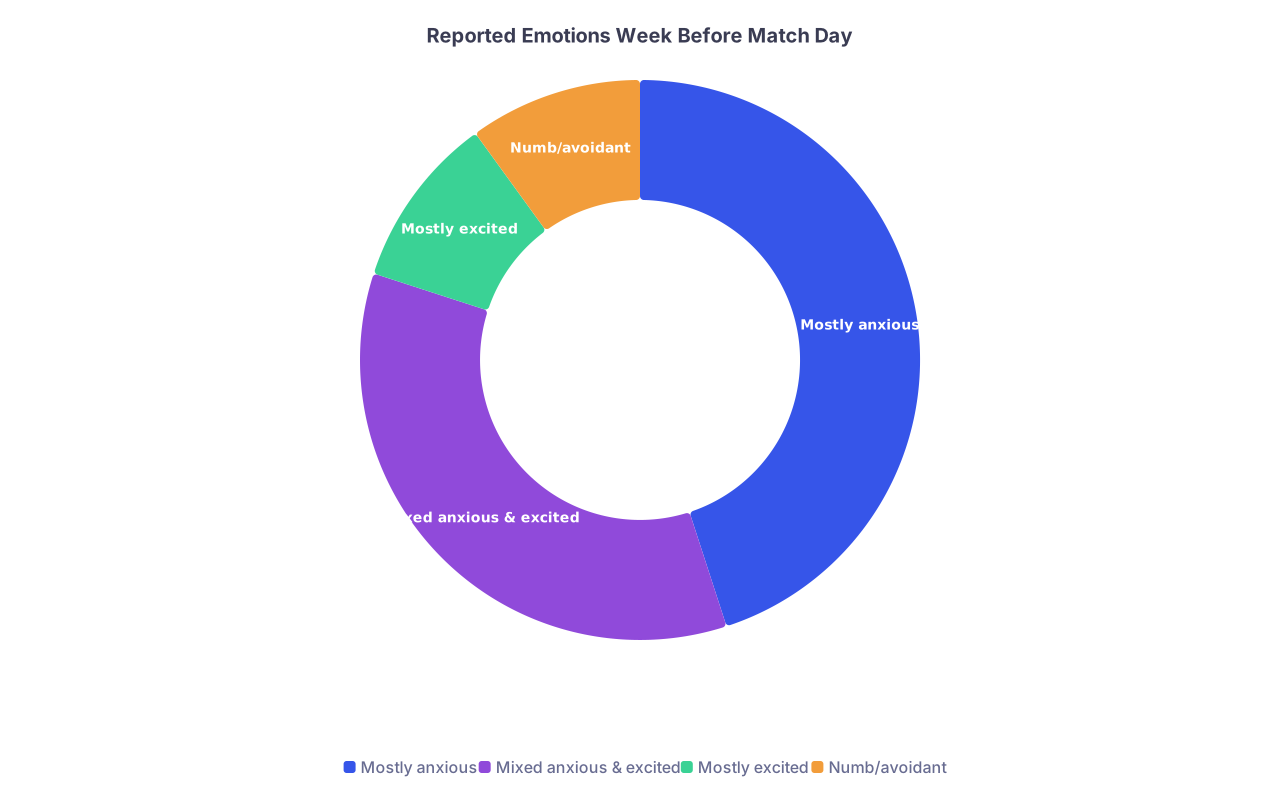
| Category | Value |
|---|---|
| Mostly anxious | 45 |
| Mixed anxious & excited | 35 |
| Mostly excited | 10 |
| Numb/avoidant | 10 |
Most people are anxious or mixed. Very few are floating around on pure joy. A decent chunk is so overwhelmed they feel nothing until the email hits.
You’re in the statistical majority, not the broken minority.
A Quick Grounding Script To Use Right Before You Open
Right before you open the email, your body will try to sprint away from your skin. Here’s a fast, non‑corny script you can literally read to yourself or have someone read out loud.
- “My heart is fast because this matters, not because I’m in danger.”
- “In 60 seconds, I will know. In 10 minutes, I will still be breathing.”
- Look around and name: 5 things you can see, 4 things you can feel, 3 things you can hear, 2 you can smell, 1 you can taste. Yes, the classic 5‑4‑3‑2‑1. It works because it drags your brain out of the horror movie in your head and back into your actual body.
- Put your feet flat on the floor. Unclench your jaw. Drop your shoulders once.
Then open it. Do not wait 30 more minutes “to feel more ready.” You will not feel more ready. You will just feel more tortured.
After the Email: Give Your Brain a Buffer Before You Broadcast
Whether it’s joy, shock, grief, or that weird combination of all three—your nervous system needs buffer time before you perform the moment for others.
If you’re at a big ceremony: step out after you see it. Go to a hallway, bathroom, outside. Just five minutes where no one is taking pictures of your face.
If you’re alone: don’t immediately shove it onto Instagram. Give yourself some time to fully register what happened.
You can always post later: the picture with the envelope, the city skyline, the “I matched at X!” post. But you can’t get back the chance to actually feel your own reaction without an audience.
Quick Comparison: Solo vs Ceremony Opening
If you’re still stuck on where/how, here’s a blunt little comparison to sanity‑check what fits you.
| Option | Best For | Risk Factor |
|---|---|---|
| Alone at home | High anxiety, worst-case thinkers | Can feel isolated |
| With 1–2 people privately | Want support but privacy | Their reactions affect you |
| School ceremony | Social energy, extroverts | Public if bad news |
| Partner/family only | Strong, safe relationships | Can feel pressured |
If you’re a worst‑case thinker (you are, you’re reading this), I lean toward: open privately or with 1–2 trusted people, then join whatever public thing after you know.
FAQ (Exactly 5 Questions)
1. What if I physically can’t make myself tap the email?
Then don’t do it alone. Hand your phone to someone you trust and say, “Open it and tell me what it says.” You’re not weaker or less brave for needing that. I’ve seen residents—full grown, competent residents—ask a co‑resident to open their board score email for them. This is the same energy. Do what gets you through.
2. I’m convinced I didn’t match. Should I even go to the ceremony?
If you’re genuinely high risk for not matching and you know public bad news would demolish you, skip the big reveal ceremony or stand in the back with the option to slip out. You can still show up later for pictures once you’ve processed. There is no prize for “most composed while getting devastating news on stage.”
3. What do I say to people if I don’t match?
Keep it short and scripted so you don’t have to improvise while raw. Something like: “I didn’t match this cycle. I’m working with my dean/program on next steps.” That’s it. You don’t owe details. You don’t need to defend yourself. Anyone who pushes for more is being inappropriate, and you’re allowed to say, “I’m not ready to talk about it yet.”
4. What if I matched somewhere I don’t want to go and everyone around me is thrilled?
You’re allowed to smile for photos and still feel conflicted inside. Find at least one person you can be honest with and say: “I’m grateful I matched, but I’m also struggling with where it is.” Keep both truths: gratitude you matched, grief for the life you didn’t get. Over the next weeks, you can collect real information about the program and city instead of only listening to the doom channel in your head.
5. How long will this intense feeling last after I open the email?
The absolute peak—heart racing, tunnel vision, shaking—usually lasts minutes, not hours. By 30–60 minutes out, most people are in a more stable (still emotional, but coherent) state. By that evening, the dominant feeling is usually either relief, exhaustion, or a quieter sadness. You will not feel this raw forever. Your nervous system calms down faster than your fear tells you it will.
Here’s your next step for today: decide, very specifically, how and where you want to open your Match email, and who—by name, not in theory—you’d want there (if anyone). Write it down. Text those people and tell them your plan.
Don’t wait for Match morning to make those decisions while your hands are shaking.


