

What’s your plan for the moment someone cheerfully asks, “So… where did you match?” and your stomach just drops?
Because it’s coming. Classmates. Attendings. Relatives. Random people from undergrad you barely remember. And what you’re really scared of isn’t just the question—it’s that you’ll freeze, say something awkward, and feel even worse than you already do.
Let’s talk about scripts. Real words you can actually say when:
- You matched, but not where you wanted
- You scrambled into SOAP
- You didn’t match at all
- Or you just… don’t want to talk about it with every human you’ve ever met
I’m going to give you actual phrases. Short, memorizable lines you can pull out when your brain goes blank and your heart rate hits 150.
First: The Ugly Truth About “Where Did You Match?”
No one prepares you for this part. They prep you for ERAS, for interviews, for rank lists. Then Match Day shows up and suddenly it’s a social minefield.
Here’s what’s really going on:
- People ask because they’re curious, not because they’re trying to hurt you.
- But that doesn’t make it less painful when you’re not thrilled with your result.
- The worst conversations usually happen in the first 48 hours, when emotions are raw and you haven’t figured out your story yet.
You’re scared of three things (be honest):
- Sounding defensive or bitter.
- Looking like you “failed” compared to classmates.
- Breaking down emotionally in front of people you don’t even like that much.
All of that is normal. I’ve watched people literally hide in bathrooms on Match Day to avoid the “So? Where?!” barrage.
So you need a plan before that moment hits you.
Step Zero: Decide Your Boundaries Now
Before scripts, you have to pick your zones:
What are you comfortable sharing with:
- Close friends
- Classmates
- Faculty
- Family / random acquaintances
What topics are off-limits?
- Your rank list
- That you didn’t match
- That you went through SOAP
- Why you didn’t get your top choice
You’re allowed to set limits. You’re not obligated to give a full debrief to every person who asks.
Think of it like this: you’re writing 2–3 “versions” of your story.
| Audience Type | Detail Level | Emotion Level |
|---|---|---|
| Inner Circle | High | High |
| Classmates/Peers | Medium | Low-Med |
| Attendings/Staff | Medium | Low |
| Distant Acquaint. | Low | Very Low |
If you don’t decide this ahead of time, you’ll overshare with the wrong people and under-share with the ones who’d actually support you.
Scripts If You Matched… But Not Where You Wanted
This one hurts because everyone expects you to be purely happy. Meanwhile you’re smiling through gritted teeth.
Basic, neutral script
For classmates / acquaintances:
“I matched into [specialty] at [program]. I’m grateful to have matched and I’m looking forward to starting residency.”
That’s it. Simple. Factual. It signals “conversation over” without sounding rude.
If they push: “Was that your top choice?” you can use:
“It was on my list and I think it’ll be a really solid place to train.”
You’re not lying. It was on your list. And you don’t owe them your actual rank number.
Script when you feel yourself getting emotional
For people you don’t want to cry in front of:
“I matched in [specialty] at [program]. It’s been a pretty emotional week so I’m still processing everything, but I’m glad to have a spot and I’m trying to focus on what’s ahead.”
If they sense weird energy and ask, “Are you okay?”:
“Yeah, just a lot to process. Match is intense. I’ll be okay though.”
Short. You don’t need to unpack your crushed dreams in the hallway outside the auditorium.
Script for faculty / attendings who expected you to go “higher”
This one is awkward. Especially if they were like, “You’ll be at MGH or Hopkins for sure.”
“I ended up at [program]. I think it’ll be a good fit for me—strong [insert something specific: ‘clinical volume,’ ‘operative experience,’ ‘community focus,’ ‘autonomy’]. I really appreciate all your support along the way.”
Hit three beats:
- Where
- One specific positive
- Gratitude
You’re steering the conversation away from prestige and toward fit.
Scripts If You Went Through SOAP
This is what keeps people up at night: the idea you’ll have to say, out loud, “I SOAPed.”
Let me be blunt: far fewer people care than you think. Most barely understand what SOAP actually is. But the shame is real.
You don’t have to tell everyone you SOAPed. You can decide who gets the full story.
For classmates / acquaintances
“I’m going to be doing [specialty or ‘a transitional year’] at [program]. It was a wild week but I’m relieved to have a spot and to keep moving forward.”
Notice what this does:
- It tells them what you’re doing next year.
- It acknowledges the week was rough without inviting interrogation.
- It ends on “relieved” and “moving forward,” not “I’m a disaster.”
If they pry: “Wait, did you SOAP?” you’re allowed to shut that down.
“Yeah, this year was rough for a lot of people. I’m just really grateful to have something lined up and trying to focus on that.”
If they keep going with detailed questions (and you don’t want to talk):
“It was a lot. I don’t really want to rehash all of it right now, but I’m happy to talk later once I’ve had more time to decompress.”
That’s a polite “back off.”
For people you do trust
With your real friends:
“I didn’t match initially and went through SOAP. It was absolutely brutal, but I ended up in [program/situation]. I’m still wrapping my head around everything, but I’m glad I at least have a spot.”
You’re allowed to be honest. You’re allowed to say it was brutal. You just don’t have to do that with everyone.
Scripts If You Didn’t Match At All
This is the scenario your brain keeps looping because it’s the scariest: Match Day arrives and… nothing. No email. No envelope.
You’re terrified that people will ask, “So where did you match?” and you’ll feel like you have to say: “I didn’t.”
You don’t. You don’t owe every person full disclosure in real time.
For acquaintances / distant people
“I’m still working on my plans for next year. This cycle was tough for a lot of us. I’m talking with mentors and figuring out the best next step.”
If they push: “So… did you match?” you can say:
“It didn’t work out this cycle, which has been a lot to process. I’m working with my advisors on a plan and trying to take it one step at a time.”
Short. Honest. Does NOT invite them to conduct an autopsy on your application.
And if someone still keeps prying into scores, number of programs, etc.? You can absolutely say:
“I’m not really up for going into details right now, but I appreciate you asking.”
That line is your shield.
For family (who might be disappointed/confused)
Family can be worse because they often don’t understand how broken this process is.
You can try:
“I didn’t match this year. It’s really competitive and there were more applicants than spots. My advisors and I are working on a plan for next steps, whether that’s a research year, another degree, or reapplying. I’m not ready to go into all the details yet, but I’ll let you know once I have a clearer path.”
You’re doing three things:
- Stating the fact
- Framing it as a systemic issue, not “I’m a failure”
- Setting a boundary: “not ready to go into all the details yet”

And yes, you may have to repeat yourself. Scripts help when you’re emotionally exhausted and don’t have the energy to reword things nicely ten times.
Scripts If You Just Don’t Want To Talk About It (Even If You Matched Fine)
This is the underrated problem: even people who matched well can feel weird about broadcasting it. Maybe you feel guilty around friends who didn’t match. Maybe you’re just socially drained.
You’re allowed to protect your energy.
Short deflection script
“Oh yeah, Match was a whirlwind. I’m happy with how it turned out. I’m trying not to blast all the details everywhere though—this year was rough for a lot of people.”
That covers:
- Yes, I matched.
- No, I don’t want to have a long talk.
- Yes, I have empathy for others.
If they ask “Wait, but where?”:
“I’m happy with it, but I’m trying to be low-key about specifics out of respect for classmates who had a harder time. How did your match go?”
Flip it back to them.
Hard boundary script
If you really don’t want to talk at all:
“I actually don’t feel great talking about Match right now—lots of mixed feelings. I’d rather just hang out and not think about it if that’s okay.”
If they’re a decent person, they’ll get it.
Social Media: Scripts For Posts (Or Not Posting At All)
The other nightmare: Instagram/GroupMe/Facebook exploding with “I MATCHED!!!” graphics while you’re spiraling.
Here are your options, all valid:
If you matched and want to keep it low-key
“Grateful to have matched into [specialty]. Excited for the next chapter in [city/state]. Thinking of everyone for whom this week was more complicated than expected.”
No hashtag soup. No humblebrag.
If you SOAPed or had a complicated match
“Match week was not straightforward, but I’m grateful to have something lined up for next year and for the people who supported me through a very intense process. Sending a lot of love to classmates whose paths are still unfolding.”
You’re not obligated to explain everything publicly.
If you did not match and don’t want to say anything yet
You can say nothing. You don’t owe social media a statement.
If you want to say something without details:
“This year didn’t go how I hoped with applications. I’m taking some time offline while I sort out next steps with my mentors. Appreciate everyone who’s reached out.”
That will stop most of the “So where are you going???” DMs.
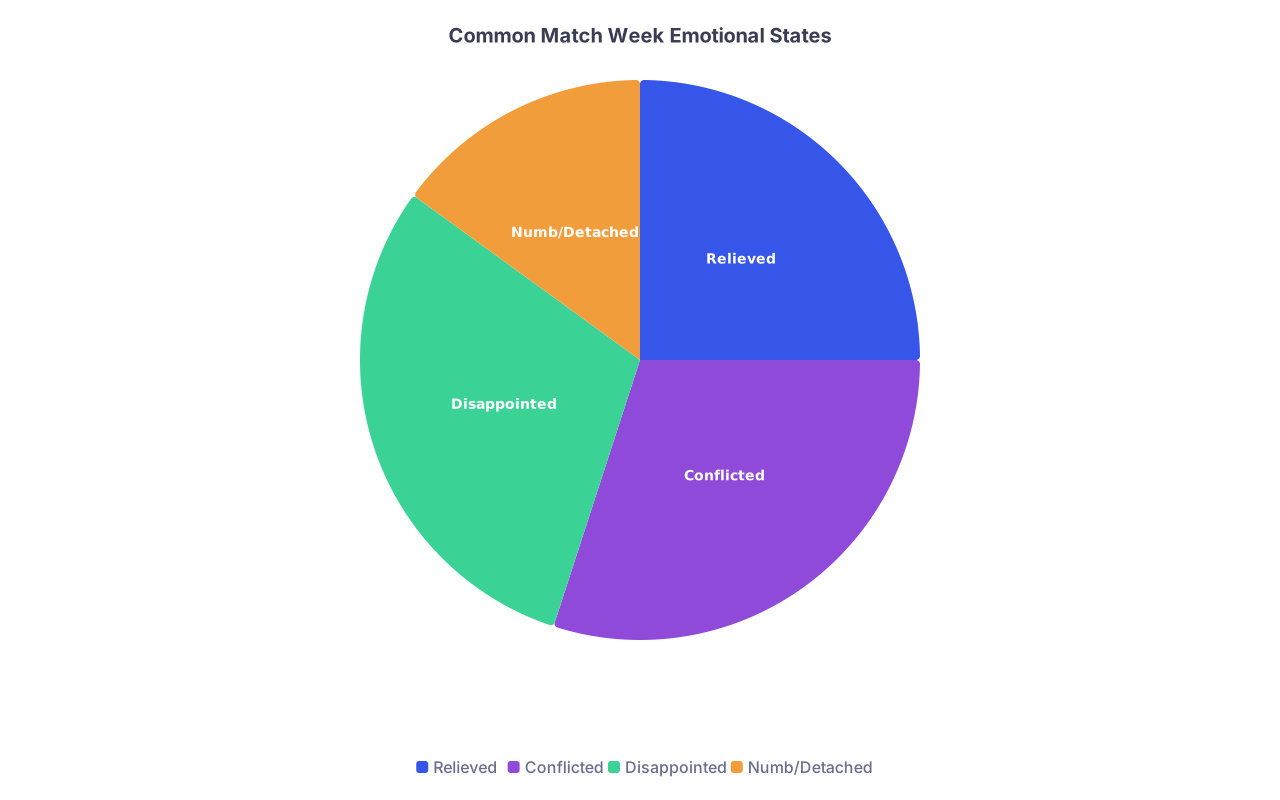
| Category | Value |
|---|---|
| Relieved | 25 |
| Conflicted | 30 |
| Disappointed | 30 |
| Numb/Detached | 15 |
Handling Match Day In Person (The Chaos Zone)
Match Day in a big auditorium is basically:
- People screaming and crying
- Parents shoving phones in your face
- Faculty wandering around asking “So where are you headed?” on loop
If you’re dreading that, you’re not alone.
Pre-plan your “loop script”
Have one 1–2 sentence answer ready that you repeat like a broken record.
For example:
“I’m going to [program] for [specialty]. It’s been a really emotional morning, but I’m excited to start the next step.”
That’s your auto-response. You don’t have to improvise every time. You’re not on stage; this isn’t an improv class.
If you’re not ready to open your envelope in public? You can:
- Step out and open it privately in a hallway / bathroom / parked car
- Text 1–2 trusted people before talking to anyone else
- Wait to rejoin the group until you’ve processed enough to say your loop script without crying
You’re not “overly dramatic” for wanting some privacy. You’re human.

How To Answer Attendings / Letter Writers Later
Another round of anxiety: when your letter writers, mentors, or research PIs ask where you matched.
They mostly want to know for two reasons:
- They care about you
- They track outcomes for their own mental spreadsheet
Here’s a clean template, especially if it wasn’t your dream outcome:
“I matched into [specialty] at [program]. I really appreciate all your help and support throughout this process. I’m planning to [insert one future-oriented thing: ‘focus on building a strong clinical foundation,’ ‘keep up my interest in research,’ ‘stay involved in medical education’].”
If you didn’t match or had to SOAP:
“This cycle didn’t go how I hoped—I ended up [SOAPing into X / not matching]. I’m working with advisors on a plan for next steps and I’d really appreciate your advice when you have time.”
Most good mentors will be kind. If they’re not? That’s about them, not you.
Quick Scripts You Can Memorize Right Now
I’m going to give you a few “pocket sentences” you can literally copy into your notes app.
For “Where did you match?” when you DID match:
“I matched into [specialty] at [program]. It’s been a really emotional week, but I’m grateful to have a spot.”
For when you SOAPed:
“I went through SOAP and ended up at [program/position]. It was a stressful week, but I’m relieved to have something lined up.”
For when you did NOT match:
“I didn’t match this year. I’m working with my advisors on next steps and trying to take it one day at a time.”
For when you don’t want to talk about it:
“I’m not really up for talking about Match in detail right now—it’s been a lot. I’d rather focus on something else if that’s okay.”
Put those somewhere you can see them. Your brain won’t function normally in the moment. Scripts stop you from word-vomiting or shutting down completely.

| Step | Description |
|---|---|
| Step 1 | Get asked where did you match |
| Step 2 | Use did not match script |
| Step 3 | Use full match script |
| Step 4 | Use brief honest script |
| Step 5 | Use boundary script |
| Step 6 | Did you match? |
| Step 7 | Happy to share? |
| Step 8 | Trust this person? |
FAQ (exactly 4 questions)
1. What if I start crying when someone asks where I matched?
You’re not a robot. You’re allowed to have feelings. If you feel tears coming:
You can say, quickly:
“Sorry, it’s just been a really emotional week. I need a minute.”
Then step away. Bathroom, hallway, outside, whatever. Most people will feel bad for pushing, not for you crying. And honestly, Match is set up to create breakdowns. You’re not weak for reacting like a human in an inhuman system.
2. Do I have to tell people I SOAPed or didn’t match?
No. You do not owe your full match history to everyone who asks. You can be honest without going into procedural detail. Saying “This year was complicated, but I have a plan for next year” or “I’m still working on next steps” is not lying. It’s protecting your mental health while you’re still processing.
3. How do I deal with feeling ashamed of my result, even if no one says anything mean?
Shame fills any silence. Your brain will invent criticism even if no one is actually judging you. One practical thing that helps: write out a neutral, factual description of your match story and practice saying it aloud. It feels less like a confession and more like reporting a fact. Also remember: in 6 months, everyone will be too busy as interns to care where anyone matched. Programs become names on a badge. No one walks around the hospital listing your rank list order.
4. What if I matched somewhere great and I’m scared I’ll hurt friends who didn’t match?
You can be happy and gentle. When you talk to friends who had a hard match, lead with them, not you:
“How are you feeling about this week? I know it was rough for a lot of people.”
If they ask about your match, you can be honest but low-key:
“I ended up at [program]. I know this week is complicated, so I don’t want to be obnoxious about it—but if you ever want to vent or process anything, I’m here.”
You don’t have to dim your whole life, just avoid celebratory monologues in front of people who are still in crisis.
Open your notes app right now and type out your “loop script” for when someone asks, “So where did you match?”—one sentence you can live with, even on your worst emotional day. That’s your armor. Use it.


