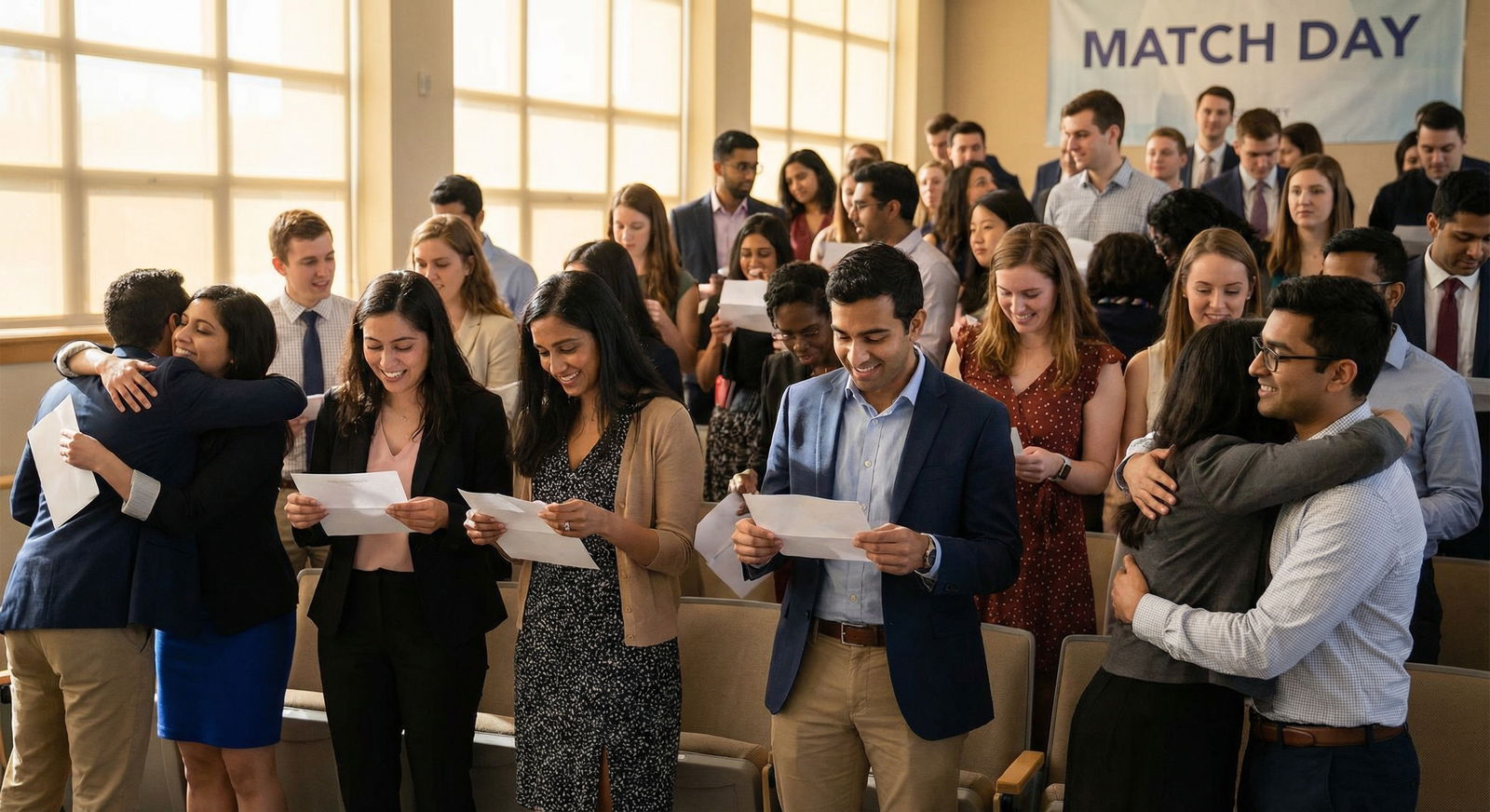
You’re imagining the worst possible Match Day already
It’s Match Week. Your phone keeps buzzing with friends texting about “manifesting their #1” and your group chat is full of talk about big coastal programs, dream cities, and fancy academic hospitals.
Meanwhile, you’re lying in bed thinking about a different version of Match Day.
You open your email. You matched. So technically, the nightmare everyone talks about didn’t happen. But then reality starts to bite: you scroll through Instagram and see your classmates matching at “top 10” programs, big-name places, in cool cities. And you… didn’t. You’re at a community program. Or a smaller academic place nobody outside your region has heard of. Or your second (or fifth) choice. Or a last-minute “safety” you added when panic kicked in.
You’re happy for them. But also? You feel like you lost. Like you somehow failed a test that everyone else passed.
And the thought you keep circling back to is ugly and simple:
“What if my friends all match ‘better’ than I do… what does that say about me?”
Let’s sit in that discomfort for a minute and actually dissect it, because this one wrecks people quietly every single year.
The brutal social comparison part nobody prepares you for
Everyone talks about “what if I don’t match.” Almost nobody talks about “what if I match… but feel like I didn’t do as well as everyone else.”
It’s the quiet shame scenario. You did match, so you feel like you’re not allowed to be upset.
Here’s what usually happens:
Your friend group has been hyping up big programs all year. Names like Mass General, UCSF, Mayo, Hopkins, Columbia, Stanford. People talk about “rank lists” like they’re fantasy football drafts. You all send each other lists and say things like, “You’re 100% getting your top 3 dude” even though nobody actually knows anything.
Match Day comes. Someone matches at one of those big places. Another person gets their #1 at a major academic center. Someone else posts a perfect couples match in a big city. There are matching T-shirts, champagne bottles, those cringey “OMFS at Mayo!!!” captions with 50 exclamation points.
You matched… but:
- Maybe your program is solid but not flashy.
- Maybe it’s in a smaller city you’re low-key dreading.
- Maybe it wasn’t your #1. Or your #5.
- Maybe it’s not “prestigious” and you know your aunt is going to ask if that hospital is “as good as Johns Hopkins.”
You start rewriting the story in your head:
“If I were really competitive, I would’ve matched where they did.”
“If I’d just gotten a few more points on Step 2, maybe I wouldn’t be here.”
“They must think I’m the weak one in the group now.”
I’ve watched people on Match Day go from excitement to shame in under ten minutes, simply because they heard someone else’s result first. Not even joking.
And honestly, it’s messed up. Because the Match was never designed to rank your worth as a future physician. It matches people to jobs under a bunch of constraints no one on Instagram can see.
But yeah, that logical part of your brain is not in the driver’s seat on Match Day. The cortisol is.
The “better program” myth you’re secretly buying into
Let me be blunt: the whole idea that your friends “matched better” is built on a pile of half-truths and ego traps.
You’re probably equating “better” with some mix of:
- Name recognition
- City desirability
- NIH funding / research reputation
- Number of fellowship matches at shiny places
- What your classmates or attendings talk about like it’s the promised land
Here’s the problem: none of that directly measures whether you will learn well, grow, or be happy there.
Let me show you how this plays out in real life.
| Factor | What You See Match Week | What Actually Matters Later |
|---|---|---|
| Program name | Prestige, flex value | PD support, culture |
| City | Cool factor, lifestyle | Cost, commute, support |
| Research output | CV clout | Protected time, mentorship |
| Fellowship matches | Bragging rights | Your own fit and effort |
I’ve seen:
- A friend match “better” at a big-name IM program and spend intern year drowning in malignant scut, zero teaching, and attending screams. On paper? Impressive. In person? Miserable.
- Another friend at a mostly unknown community program who had attendings actually know their name, fought for their fellowship, and tailored schedules so they could get the cases they wanted.
Guess which one ended up with a stronger letter and more confidence by PGY-3.
You’re scared your program is “less than” because your brain’s using med school logic: prestige = success. That worked (kind of) for undergrad and med school. But residency is a job. Your actual life. And the spectrum of what makes it “good” is much messier than a US News ranking.
The ugly jealousy/relief combo you’ll probably feel
Nobody talks about this part either.
On Match Day, you may feel:
- Genuine happiness for your friends
- Deep relief that you matched
- Jealousy so sharp you feel sick
- Shame about that jealousy
- Fear you’ll be “left behind” socially
- A weird pressure to pretend you’re thrilled
You might catch yourself thinking, “I wish I had what they got” in one breath and “But thank God I matched at all” in the next. It’s confusing and you’re going to judge yourself for it.
Here’s my stance: you’re allowed to feel every single one of those things.
You’re not a bad friend because you saw someone’s “Matched at MGH!!!” story and had a 2-second pang of “why not me.” You’re a human who’s been graded, ranked, and compared your entire adult life. Your brain is running the same old script. It’s not morally failing. It’s conditioned.
The only real mistake is pretending you’re fine and then quietly letting that shame calcify into a story about your worth:
“They all surpassed me. I’m just average. I’ll always be the one who barely made it.”
That story? That’s the actual damage.
What people won’t see about your match from the outside
Programs aren’t just names. They are specific combinations of schedule, culture, support, and chaos. Your friends matched to a name. They also matched to:
- Call schedules
- Night float patterns
- ICU intensity
- PD personality
- Fellow-resident dynamics
- City rent and traffic and isolation
You matched to all of that too.
Someone may have gotten the “dream city” but end up:
- Paying half their PGY-1 salary in rent
- Commuting 45 minutes each way post-24-hour-call
- Rotating with 20 other residents and 8 fellows, barely touching a procedure
- Living 2,000 miles away from any real support system
You might be at a “less sexy” program but:
- Walk to work
- Actually know your PD and chief residents
- Get hands-on early because there’s less competition for procedures
- Have attendings from day one who ask you, “What do you want for fellowship? Let’s make a plan.”
On Match Day, you will not see that. You will see logos on slides, balloons, and champagne.
I’ve watched classmates light up matching at mid-tier programs near their support systems while other people quietly spiraled at “top” places that didn’t fit them at all. Name alone doesn’t predict your life.
Will my career be permanently capped if I didn’t match “high-tier”?
This one lives in the back of everyone’s head: “If I don’t match at a big academic name, am I doomed?”
Short answer: no. Long answer: your path may look different, but that’s not the same as worse.
People land competitive fellowships and dream jobs from “non-elite” programs every year. What changes is how much you have to own your development.
Let me be concrete:
- At a huge name-brand program, you might get “pulled” into projects easily, with built-in pipelines to certain fellowships.
- At a smaller place, you may have to actively seek out mentors, ask for research, and hustle more for external connections.
But programs care about:
- Strong letters that actually describe your ability, work ethic, and growth
- Evidence that you can do the work and think independently
- Fit with their culture and specialty focus
They do not sit in a room saying, “We only want people from these 5 programs ever.” Even for competitive subspecialties, I’ve seen fellows from every kind of background—big academics, community, international grads, osteopathic.
If you’re still convinced your entire future hinges on this:
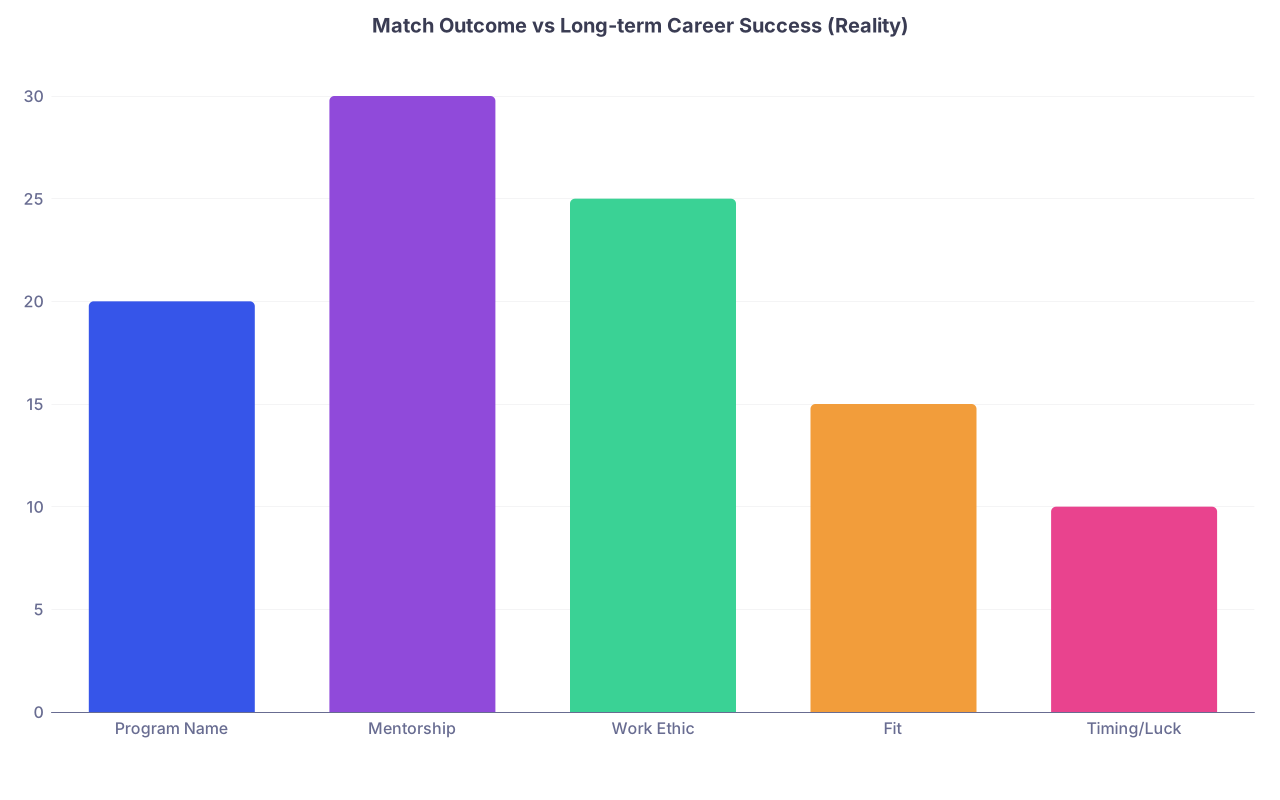
| Category | Value |
|---|---|
| Program Name | 20 |
| Mentorship | 30 |
| Work Ethic | 25 |
| Fit | 15 |
| Timing/Luck | 10 |
That’s obviously not precise “data,” but it’s closer to the truth than “Program name = 90% of everything.”
Program helps. But it’s not destiny.
How to emotionally brace yourself before Match Day
If you’re already spiraling about this, you can at least reduce the whiplash.
A few things I’d actually do:
First, get brutally honest with yourself about your rank list. If your #1 was a reach and you knew it, don’t walk into Match Day pretending anything less means failure. You took a swing. That’s allowed. You knew the risk.
Second, plan in advance what you’re going to do with social media. Are you going to:
- Post your news right away?
- Wait a few hours?
- Not post at all and just tell your close people?
All are valid. If you know seeing everyone else’s news will wreck you, give yourself permission to mute Instagram for 24 hours. You’re not required to perform joy on command.
Third, decide your inner circle. The 2–5 people who get the real version: “I matched. I’m relieved. But I’m also disappointed/conflicted.” If you’ve got at least one friend you can say that to, you’re already ahead.
And then, this is key: think through what you’ll say if someone low-key judges your program.
Because it might happen. The classmate who says, “Where’s that?” with that tone. The relative who asks, “Is that a good hospital?” The attending who says, “Oh, interesting choice.”
You do not owe them vulnerability. You can default to:
“Yeah, I’m excited. It’s a great fit for me.”
And save the real processing for people you trust.
What if my friend group drifts because of this?
That’s another fear no one likes to say out loud: “If they’re all headed to big coastal programs and I’m not… am I just the small fish they forget?”
Sometimes friend groups drift after Match. Not always, but it’s common. Different cities, different schedules, different time zones. Some of that has nothing to do with where you matched and everything to do with being worked to death as an intern.
What I’ve seen is this:
- The friendships that were mostly built on shared stress and competition tend to fade.
- The ones built on genuine care tend to survive, even if your paths look completely different.
You might also find a weird relief in not being constantly surrounded by the same people you’ve compared yourself to for four years. Residency is its own fresh ecosystem. You’ll form new comparisons, sure, but you’ll also have a chance to redefine yourself without your med school “rank.”
If a friend becomes weirdly condescending or distant because they think they “outmatched” you? That tells you more about them than you.
A quick reality check on what actually matters once you start
Within about 2–3 months of residency, the conversation shifts.
People stop caring about:
- Who matched at #1 vs #3
- Which city seems cooler on Instagram
- Flexing their program name at every opportunity
And start caring deeply about:
- Whether their seniors are kind or toxic
- How often they get yelled at on rounds
- If they feel safe asking questions
- Whether they can sleep more than 4 hours on call
- How much support they have when something traumatic happens
The hierarchy of misery and joy in residency is not the same as the hierarchy of prestige.
Someone at a top-tier program may be crying in their car between shifts. Someone at a mid-tier place may be exhausted but supported, learning a ton, and weirdly… okay.
Your Match Day narrative is not your permanent narrative. It’s one snapshot.
How to talk to yourself on Match Day if this happens
Let’s say the scenario you fear actually happens. Friends “match better.” You feel small. You’re staring at your email feeling a mix of gratitude and shame.
Here’s what I’d want running in the back of your head:
First, “I matched” is still a big deal. That’s not toxic positivity, it’s just math. Many people don’t. You beat huge odds to even be here.
Second, your disappointment is allowed to exist alongside your gratitude. You’re not ungrateful for wanting more. You’re just human.
Third, this isn’t the last time your path will diverge from your friends. It’s just the first big visible one. And I promise, 5–10 years out, nobody is keeping score of who “started higher.” They’re looking at who’s burned out, who’s bitter, who changed specialties, who found balance, who still loves medicine at all.
If you can, write down your actual thoughts that day. The raw, unfiltered insecurity. And then check back in a year. People are often shocked at how much of it just… faded once they were actually living the reality instead of fearing it.
Quick recap before you go back to spiraling
Three things I want you to walk away with:
- “Better program” is mostly a social construct on Match Day. Your real life will be shaped way more by culture, mentorship, and fit than logo prestige.
- Feeling jealous, ashamed, or “less than” if friends match at bigger-name places doesn’t make you awful. It makes you normal. Just don’t turn those feelings into a permanent story about your worth.
- Matching anywhere is not the final verdict on your career ceiling. Plenty of people from quieter programs build incredible careers. Your trajectory will come from what you do once you get there, not just where you start.
You don’t have to love your Match Day result instantly. You just have to give yourself enough time and grace to see that it’s one chapter, not the whole book.