
You should share far less about your rank list than people will pressure you to share.
Let me be blunt: oversharing your rank list is one of the easiest ways to create awkwardness, resentment, and drama after Match Day. And it helps you exactly zero.
This isn’t about being secretive or shady. It’s about protecting yourself, your relationships, and your reputation in your new program.
Here’s how to think about it.
The One-Sentence Rule
If you remember nothing else, remember this:
After you match, you should usually share:
- That you’re happy where you matched
- One or two genuine reasons why
- And not the exact position you ranked that program or how you ordered other programs
That’s it. That works for:
- Friends
- Classmates
- Family
- Faculty and advisors
- Co-interns and attendings later on
The more specific you get about your full rank order list, the more you invite problems you do not need.
Why Oversharing Your Rank List Backfires
I’ve seen this play out every year:
Someone joyfully says, “I matched at Program X! It was my third choice, but I’m still really happy!”
Two hours later, this has happened:
- Their future PD has seen a screenshot in a group chat
- A co-intern at that same program heard they were “only” ranked third
- Their “still happy” sounds like “settled” to everyone else
Here’s what too much detail can do to you.
1. It can poison first impressions at your new program
Do program directors literally get your rank list? No. But word travels.
Common scenarios:
- A current resident knows someone at your med school. Screenshots fly.
- A co-intern hears, “Yeah, she really wanted Program Y but ended up with us.”
- A chief resident hears, “He talked a lot about how X was ‘really just my backup.’”
Result? People start you in a mental bucket: “didn’t really want to be here.” That’s not fair, but it happens.
Your first reputation in residency should be: “Glad to be here. Hard worker. Team player.”
Not: “Kind of bummed they didn’t match higher.”
2. It stresses out your classmates for no reason
After the Match, everyone is doing mental math:
- “Was my program higher on your list than mine?”
- “Did I ‘settle’ more than you did?”
- “If your #5 is my #1, what does that say about my choice?”
You do not need to feed that neurosis.
If someone starts fishing for rank numbers, it’s completely fine to say:
“I’m really happy with how it turned out. I’d rather not go into exact ranks but I think you’ll love where you landed too.”
That’s not rude. That’s healthy.
3. It creates unnecessary tension with couples and close friends
You share:
- “Honestly, I only ranked [your best friend’s program] as my safety.”
Who hears about it?
- Your friend. Their co-residents. Their PD eventually. Maybe with some spice added.
Or with couples:
- One partner says they ranked the joint program #1
- The other admits they ranked it #3
I’ve seen that turn into real fights. Not theory. Real, tears-in-the-hallway fights.
Less detail = fewer landmines.
What You Can Safely Share (And What You Should Keep Quiet)
Here’s a clean framework.
| Topic | Safe to Share? | Suggested Approach |
|---|---|---|
| Where you matched | Yes | Share openly |
| That it was “high on your list” | Yes | Vague but positive |
| Exact numerical rank (e.g., #1, #3) | Usually No | Avoid or deflect |
| Full rank order list | No | Do not share |
| Why you like your matched program | Yes | Be honest and positive |
| Where you ranked others | No | Politely decline to answer |
Safe answers that don’t create drama
Use phrases like:
- “It was one of my top programs.”
- “I’m really happy with where I landed.”
- “I could genuinely see myself at a few places. This one feels like a great fit.”
- “I think it’ll be a good place for me to grow.”
These are honest without handing people ammunition.
Things to avoid saying (even if true)
- “It was just my backup.”
- “I really wanted [bigger name program], but I’ll make this work.”
- “I ranked it low but it’s fine.”
- “Honestly, I didn’t think I’d end up here.”
You think you’re just venting. What people hear:
- “I don’t respect this program.”
- “I don’t want to be here.”
- “You, who matched here as your #1, made a worse choice than I did.”
Not worth it.
Different Audiences, Different Levels of Detail
Let’s split this by group, because that’s where people get confused.
1. Talking to classmates and friends
General rule:
- Share happiness.
- Share program.
- Do not share specific rank positions.
What’s fine:
- “I’m thrilled, it was one of my top three.”
- “I’m really excited about the training and the location.”
What to dodge:
- “So where did you rank it?”
- “What was actually your #1?”
- “Can I see your full list for comparison?”
You can simply say:
“I’m keeping my exact ranks private, but roughly I ended up in the range I hoped for.”
If they push? That’s on them, not you.
2. Talking to family
Family loves numbers: “Was this your first choice??”
You can decide your own boundary, but here’s what I recommend:
If it was your #1:
- Feel free to say so if you want. That usually causes no harm.
If it was not:
- Don’t lie, but don’t invite drama.
Something like:
“I had a few programs I really liked at the top, and this was one of them. I’m happy with how it turned out.”
Your parents don’t need your whole NRMP list. They wouldn’t know what to do with it anyway.
3. Talking to faculty and letter writers
Faculty may ask variants of:
- “Did you end up at your top choice?”
- “How did the list shake out for you?”
Here’s the move:
- Be concise
- Be grateful
- Stay positive
If it was your top choice:
“Yes, I matched at my first choice. I’m really grateful for your support.”
If it wasn’t:
“I matched at one of my top programs and feel really good about the fit.”
They do not need your full list either. Their job is done. Thank them and move on.
4. Talking to future co-residents and attendings
This is where people really shoot themselves in the foot.
Once you’ve matched and start connecting with your future program (group chats, socials, orientation events), you should essentially treat all rank-list details as off-limits.
Do not:
- Tell co-residents which spot their program held on your list
- Complain about how “I really thought I’d be at [other program]”
- Compare your rank position to theirs: “Oh, this was my backup but my dream city was X”
You gain nothing and might quietly lose respect.
Your script here is simple:
“I’m really happy to be here and excited to work with you all.”
That’s all they need.
How Much Does It Matter If You Didn’t Match Your #1?
Here’s the part nobody tells you on Match Day:
Within 3–6 months of starting residency, nobody will care what number you ranked that program. Including you.
Look at this realistically:
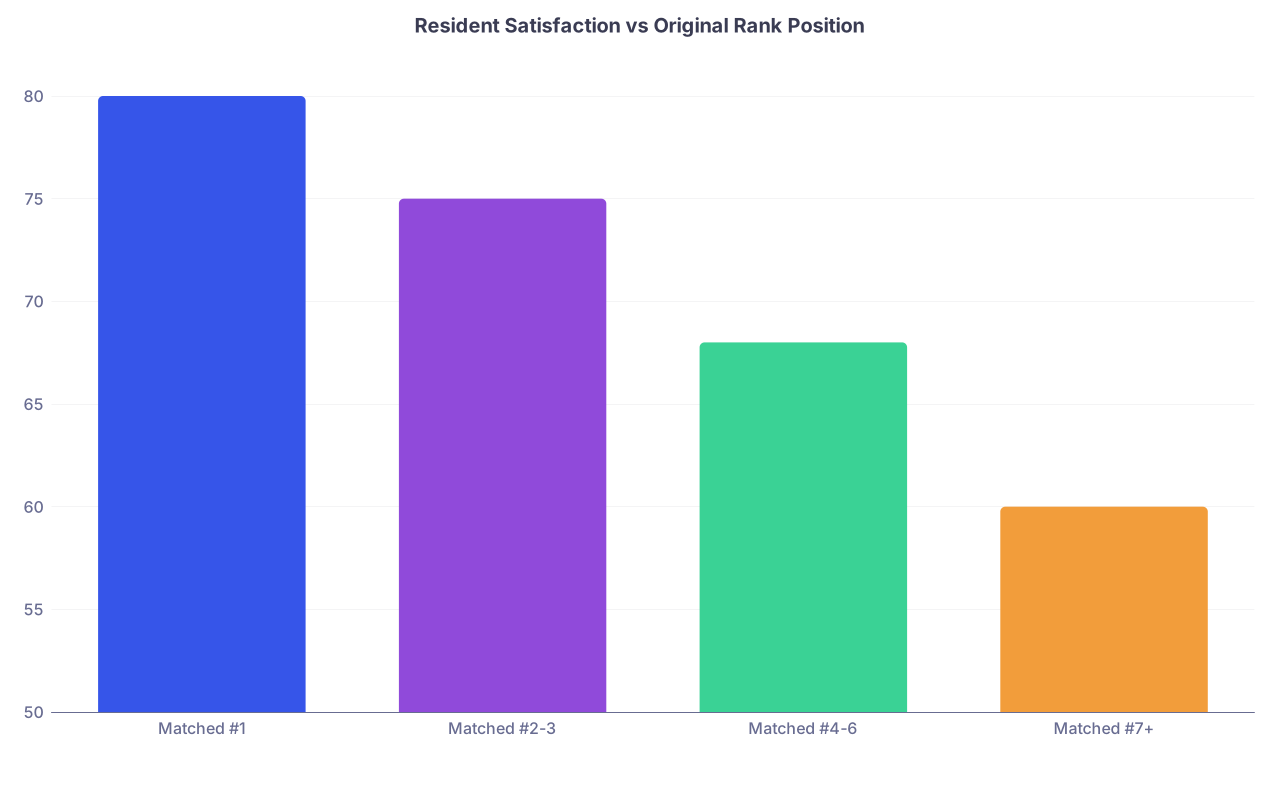
| Category | Value |
|---|---|
| Matched #1 | 80 |
| Matched #2-3 | 75 |
| Matched #4-6 | 68 |
| Matched #7+ | 60 |
Do people who matched at #1 on their list tend to be happier early? Sure. But those numbers compress fast as real life kicks in: coworkers, teaching quality, call schedule, support culture.
I’ve met residents who:
- Matched their #1 and were miserable
- Matched their #5 and were thriving
So if someone tries to equate “rank number” with “career success,” ignore them. That’s pre-clinical thinking applied to the real world. It doesn’t hold.
Scripts for Common Awkward Situations
You’re going to get cornered with questions. Here’s exactly what to say.
Situation 1: Classmate asks, “What number was that program on your list?”
Response:
“It was high enough that I was really happy to land there. I’m not sharing exact numbers, but it worked out well.”
If they push:
“I decided I’m not comparing rank numbers with people. Just trying to enjoy Match without that stress.”
Clean. Firm. You’re done.
Situation 2: Parent insists, “Was it your first choice? Just tell me.”
If it was:
“Yes, it was my top choice and I’m excited.”
If it wasn’t:
“It was in the top group of programs I really liked. I’m honestly happy with it.”
You do not owe them a ranking spreadsheet.
Situation 3: Current resident at a different program asks, “Where did we fall on your list?”
This is a trap. Be gracious.
“You all were definitely in my top group. I really liked your program. I ended up picking based on a combination of fit, location, and gut feeling.”
Then change the subject to something program-neutral.
Situation 4: Future co-intern says in the group chat, “Anyone else rank this #1??”
Respond with:
“I’m just really glad to be here and excited to start.”
If you want to be a bit warmer:
“I had a small group of programs at the top and this was one of them. Very excited to work with you all.”
What you don’t do: “This was actually my #3 but I’m still happy!”
How Programs Actually See You After the Match
Here’s what programs concretely know:
| Item | Does Program Know? |
|---|---|
| Your exact rank list | No |
| If you ranked them #1 | No |
| That you ranked them somewhere | Yes (obviously) |
| If you tried to cancel interviews elsewhere | Sometimes indirectly |
| Your references and interview performance | Yes |
They don’t know you ranked them #4.
They can know you spoke about them dismissively in a group chat that someone screenshotted.
That’s the real risk.
Your PD’s mental model of you should be:
- Shows up positive
- Clearly wants to be here
- Not obsessed with prestige games
Everything you say about rank lists, especially online, should support that version of you.
Recommended Policy: Keep the Numbers to Yourself
Let me just spell it out, because people like clear rules:
Personal policy I’d recommend you adopt:
- Never share your full rank list with anyone after the deadline
- Don’t share exact ranks with classmates, co-residents, or online
- It’s fine to tell very close family or partner “this was my #1” if true
- If it wasn’t, group it vaguely: “one of my top programs”
- Online (Reddit, Discord, group chats): never post rank positions tied to identifiable details
Think of your rank list like your USMLE score:
- A few carefully chosen people can know the number
- Everyone else just gets the general story
Quick Decision Guide
Use this mental flowchart every time someone asks about rank details:

| Step | Description |
|---|---|
| Step 1 | Someone asks about your rank list |
| Step 2 | You may share exact rank if you want |
| Step 3 | Do not share exact rank |
| Step 4 | Give positive but vague answer |
| Step 5 | Say - One of my top programs |
| Step 6 | Say - I am keeping exact ranks private |
| Step 7 | Do they need to know exact rank? |
| Step 8 | Partner or very close family? |
That’s as complicated as it needs to be.
Visual: What People Usually Ask vs What You Should Answer
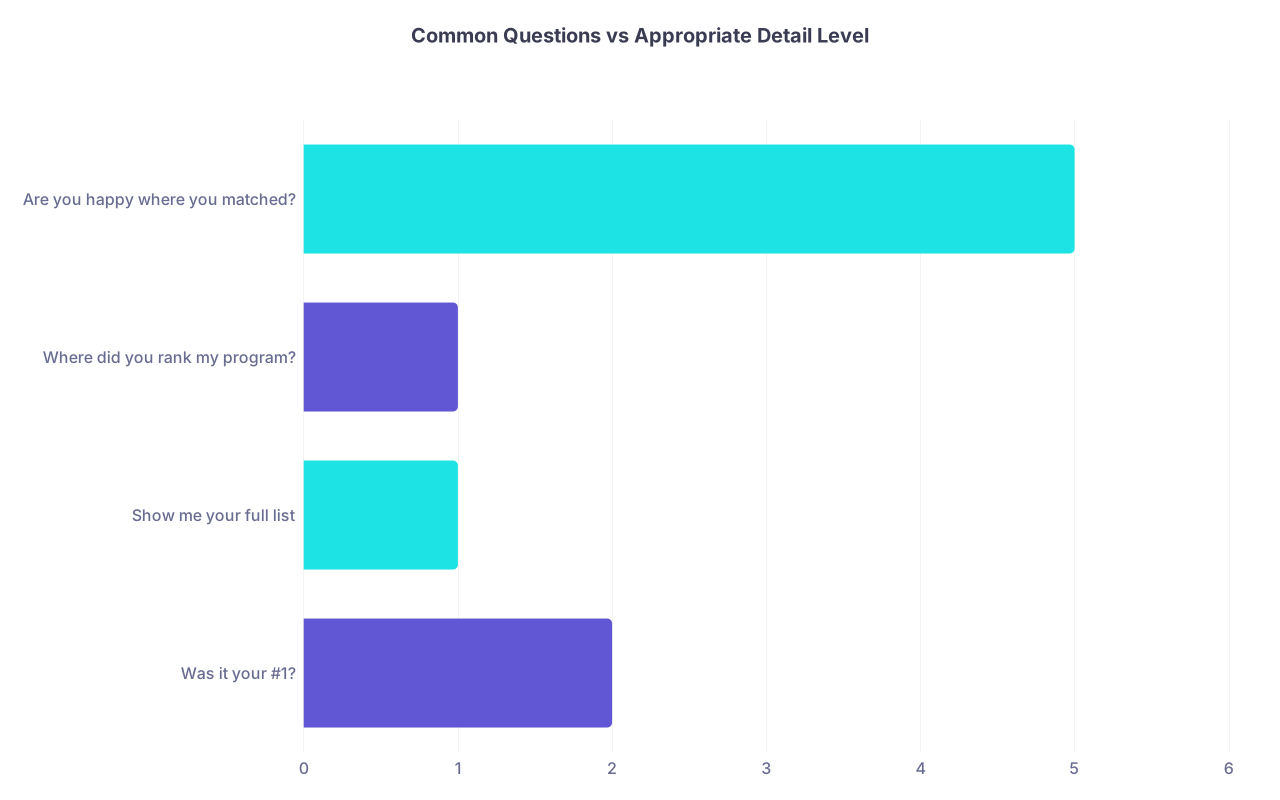
| Category | Value |
|---|---|
| Was it your #1? | 2 |
| Show me your full list | 1 |
| Where did you rank my program? | 1 |
| Are you happy where you matched? | 5 |
(Scale 1–5: how much detail you should give.
“Are you happy where you matched?” is the only one that deserves a full, open answer.)