The fear of calling an attending at 3 AM ruins more call nights than actual emergencies.
The Real Fear: It’s Not the Patient, It’s the Phone
You’re not actually asking, “What if the attending yells at me?”
You’re asking, “Will this one angry phone call ruin my reputation, my evals, my career, my fellowship chances, my life?”
Let me answer that first, bluntly:
No. It won’t.
Can it feel humiliating? Yes.
Can it wreck your night? Also yes.
Can it destroy your residency career? Not unless something is seriously dysfunctional in your program, and even then, you have more power than you think.
But I know that doesn’t stop the spiral.
So let’s walk through this like you’re actually on call, it’s 2:47 AM, your patient is crumping, and you’re staring at the phone thinking, “What if they scream at me?”
We’ll talk about:
- What actually happens when an attending yells
- The realistic “worst case” versus the horror movie in your head
- How this plays out with evaluations and reputation
- What to say if they snap at you
- When to document or escalate
- And why not calling is almost always the truly dangerous move
You’re not the only one terrified of this. I’ve watched PGY-1s hover over the phone for ten minutes while a septic patient got sicker. Not because they didn’t know what to do. Because they were afraid of the reaction on the other end of the line.
Let’s kill that monster properly.
, Placing orders alone](https://cdn.residencyadvisor.com/images/articles_svg/chart-resident-night-call-anxiety-triggers-1970.svg "Resident Night Call Anxiety Triggers")
| Category | Value |
|---|---|
| Calling attending | 80 |
| Managing unstable patient | 65 |
| [Dealing with families](https://residencyadvisor.com/resources/residency-on-call-tips/anxious-about-managing-families-after-overnight-bad-news-as-a-resident) | 40 |
| Placing orders alone | 55 |
What Actually Happens When You Call at Night
Strip away the fear and here’s what the typical range of responses looks like.
| Reaction Type | How Common | Actual Impact |
|---|---|---|
| Sleepy but helpful | High | Neutral/positive |
| Mildly annoyed | High | Neutral |
| Clearly irritated | Medium | Minor, short term |
| Snaps or yells | Low | Emotional, rarely career-harming |
| Truly abusive | Very low | Serious, reportable |
Most calls fall into one of these categories:
The “Sleepy but Fine” Call
They sound groggy. You feel guilty for waking them. They ask a few questions, give a plan, maybe come in, maybe not.
You hang up thinking, “Oh my god I woke them,” but they forget this call 20 minutes later.The “Slightly Irritated” Call
Tone is short. Maybe a sigh. A “Why are you calling me for this?” line.
Still, they give you a plan. You feel like trash. You replay every word for the next week. They don’t.The “Snaps at You” Call
Raised voice. Sharp comments. Things like:- “This could’ve waited until the morning.”
- “You should know how to handle this by now.”
- “Don’t call me again for something like this.”
It stings. You hang up shaky. You question your competence.
Impact on your long-term life? Usually close to zero.
The “This Is Not Okay” Call
This is where it crosses into unprofessional or abusive:- Swearing at you personally (“What the hell is wrong with you?”)
- Berating you for minutes
- Threatening your career (“I’ll make sure everyone knows you’re incompetent”)
That’s not “normal attending crankiness.” That’s reportable behavior.
Here’s the key: the acceptable range in medicine is unfortunately…wider than it should be. People being stressed, short, grumpy? Common.
Actual screaming and personal attacks? That’s not standard, and you don’t just have to eat it.
But either way: if the patient needs help, you call.
The Realistic Worst-Case Scenario (Emotion vs Outcome)
Your brain goes straight to apocalypse:
- “They’ll yell at me.”
- “They’ll think I’m stupid.”
- “They’ll trash me in my eval.”
- “I’ll never match into fellowship.”
- “I’ll be that resident everyone whispers about.”
Here’s what actually tends to happen when an attending yells at you once on a night call:
- You feel awful for 24–72 hours. Sometimes longer.
- You vent to co-residents, everyone says “Yeah, they’re like that.”
- You get hypervigilant about calling them again.
- You tell your chiefs or a trusted senior; they shrug and say, “That’s [Dr. X]. Don’t take it personally.”
And then:
- Your other attendings still evaluate you fine.
- Your day with that yelling attending weeks later is…surprisingly normal.
- Your “reputation” is far more influenced by: do you show up, work hard, not be a jerk, try to learn.
I’ve seen residents have absolute blow-ups with attendings and still match into competitive fellowships. Why? Because everyone in this field knows: tension happens, fatigue happens, people snap.
They don’t sit around a table during CCC going, “Remember that one night in October when they called me at 2:30 AM and I was annoyed?” That’s not how this works.
The Bigger Risk: Not Calling
Here’s the part that makes me clench up: residents are so scared of being yelled at that they delay calling.
That’s the real danger.
If you:
- Sit on a blood pressure of 70/40 because “maybe they’ll improve after this bolus”
- Ignore rising lactate because “I’ve already bothered them once tonight”
- Don’t escalate new chest pain because “I don’t want to sound dumb”
…you’re actually moving into unsafe territory.
Hospitals will forgive:
- Calling too early
- Calling for something that turned out minor
- Calling for reassurance
Hospitals will absolutely not forgive:
- Failing to escalate a deteriorating patient
- Hiding information because you were scared of vibes
- Letting badness happen quietly
If a bad outcome happens and there’s a review, the question is never “Did the attending get woken up too much?”
It’s: “Did the resident recognize the problem and call?”

| Step | Description |
|---|---|
| Step 1 | Notice change in patient |
| Step 2 | Stabilize ABCs |
| Step 3 | Call senior |
| Step 4 | Call attending |
| Step 5 | Monitor and reassess |
| Step 6 | Significant concern? |
| Step 7 | Senior agrees to escalate? |
Default rule: If you think “Should I call?” the answer is 99% yes.
How This Actually Hits Your Evaluations
Let’s pick apart the evaluation paranoia, because that’s where the anxiety usually lives.
What you fear:
- Attending writes: “Resident is incompetent and woke me unnecessarily multiple times. Would not recommend.”
- Program leadership reads it and thinks, “Liability. Problem child. Maybe they shouldn’t graduate.”
What more commonly happens:
- They write, “Needs to work on independent decision making,” maybe
- Or nothing about that call at all
- Or they don’t remember the details well enough to weaponize it
Bad evals come more from patterns than from one 2 AM interaction.
Patterns like:
- Chronically disorganized
- Repeatedly misses critical issues
- Poor communication with team and nursing
- Persistent unprofessional behavior
One tense call? Low-yield data point.
Also, if an attending is known as “that person who gets mad when called,” everyone—including program leadership—discounts their nighttime complaining heavily. I’ve literally heard a PD say, “Oh, [Dr. Y] thinks everyone calls too much. I ignore that part.”
If an eval truly feels retaliatory or unfair because you did the safe thing and called, you can talk to your chief or PD about it. You’re not powerless data on a form; you’re a person they actually want to see succeed.
What To Do In The Moment If They Yell
Okay, it’s 3:18 AM. You finally called. And they bite your head off.
What do you do while your heart is racing and your throat feels tight?
Practical script:
- Let them vent for a few seconds.
- Anchor back to the patient.
Something like:
- “I understand. I’m sorry to wake you. The reason I called is that their blood pressure has dropped from 110/70 to 78/40 despite fluids, and they’re more lethargic.”
- “I hear you. What I’m worried about is that their oxygen requirement has gone from 2L to 6L in the last hour.”
You keep connecting back to: patient is unstable, I need your help.
If they keep snapping:
- “I understand you’re frustrated. I’d still really appreciate your guidance on how to manage this safely.”
Then write down exactly what they tell you to do. Repeat it back:
“So just to confirm: you want me to start pressors, draw cultures, and call you back in 30 minutes if no improvement?”
If it calms down, great.
If it doesn’t, you still got what you needed: a plan and/or their presence.
When You Should Document or Escalate
Most of the time, you shrug it off, maybe vent to co-residents, move on.
But there are times you shouldn’t just swallow it.
Red flags for documenting or escalating:
- They refused to come in or help when the patient was clearly unstable
- They explicitly told you not to call again even if the patient worsened
- They used personal, demeaning language about you
- Nursing felt scared to call them as well
- This is part of a pattern, not a one-off bad night
You can:
- Send a brief message to your chief: “Had a difficult call with [Dr. X] overnight. Patient was unstable, I called appropriately, but response was concerning. Can we chat?”
- Talk to your PD or APD in person later
- If it felt truly abusive, ask about reporting mechanisms (usually anonymous options exist)
No, doing this doesn’t brand you as “the troublemaker” in a decent program. In a toxic program, honestly, they’ll already be showing other red flags long before this.
The Psychological Fallout (You’re Not Overreacting)
You’re not weak for being shaken by someone yelling at you. You’re human. You’re sleep-deprived. You’re carrying massive responsibility with limited power.
Common emotional side effects:
- Ruminating about the call all day post-call instead of sleeping
- Avoiding calling that attending next time even when you should
- General increased anxiety on all future nights
- Doubting your own judgment, even when it’s been good
This isn’t drama. It actually affects patient care.
One thing that helps: debrief with someone who gets it. A senior, a co-intern, a mentor. Literally say:
“I called about X. They got mad and said Y. I can’t tell if I actually messed up or if they were just tired and cranky.”
Most of the time, you’ll hear:
- “You 100% did the right thing.”
- “They’re always like that.”
- “Next time, page me too and we’ll call together if you want.”
You need that reality check, because in your head it feels like, “I committed a major professional crime.”
In reality, you woke up a grumpy surgeon.
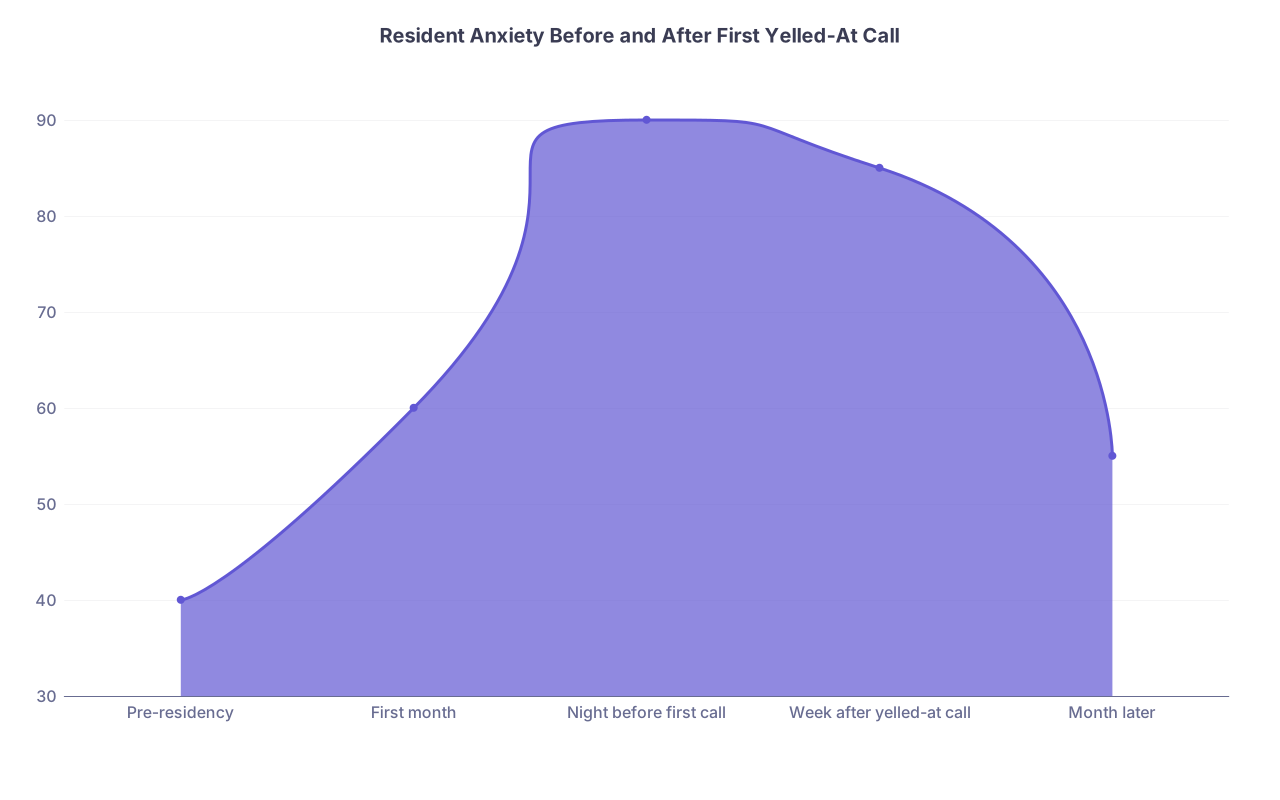
| Category | Value |
|---|---|
| Pre-residency | 40 |
| First month | 60 |
| Night before first call | 90 |
| Week after yelled-at call | 85 |
| Month later | 55 |
How to Decide If You Should Call (A Quick Mental Rule)
Because the hesitation is half the misery, here’s a rough mental algorithm I see good residents use:
- New chest pain? Call.
- New neuro deficit? Call.
- Airway/respiratory change? Call.
- Hypotension not fixed with your immediate measures? Call.
- Rapidly rising O2 needs? Call.
- Sepsis concerns? Call.
- You feel that internal “this is bad” alarm and can’t shake it? Call.
For the more gray-area stuff:
- Ask the nurse what they think. If they’re worried, that’s another reason to call.
- Call your senior first and run it by them. If they say, “Yeah, call,” then you are doubly justified.
Fear-based rule that will quietly wreck you: “I’ll only call if I’m 100% sure it’s serious.”
Better rule: “If I’d feel sick to my stomach explaining later why I didn’t call, I’m calling now.”
Reality Check: Your Career Is Not This Fragile
You’re scared because residency already makes you feel like you’re constantly one mistake away from total failure.
But the system, for all its flaws, isn’t judging you on a single night call.
They care about:
- Do you show up?
- Do you improve?
- Do you take ownership of your patients?
- Do you ask for help when you’re over your head?
Calling at night, even if it annoys someone, actually hits the “asks for help appropriately” box.
Not calling when you should? That’s the thing that actually scares program leadership.
Years from now, you probably will remember the one attending who yelled at you. Their words will echo a bit longer than they deserve to. But you’ll also remember the patient who got the ICU bed in time because you swallowed your fear and picked up the phone anyway.
And that’s the part that will matter.