

Last week, a fourth-year med student told me she woke up at 3:12 a.m., heart racing, convinced she’d just ruined her couples match rank list. Her fiancé was asleep next to her, blissfully unaware she was mentally running through 37 worst‑case scenarios in under a minute.
If you’re reading this, I’m guessing some version of that sounds uncomfortably familiar.
You’re trying to do something hard: line up two lives in a system that already feels brutal for one person. So your brain starts asking: What if we don’t both match? What if we end up in different states? What if we tank each other’s chances?
Let’s walk through this like two people sitting at the same messy table, staring at the same terrifying NRMP screen.
The Big Question: How Often Do Both Partners Actually Match?
Let me rip off the band-aid with real numbers, not vibes.
Historically, the NRMP data show this: couples are actually very likely to match somewhere together.
Most recent cycles (for US MD/DO seniors in the couples match) hover in this zone:
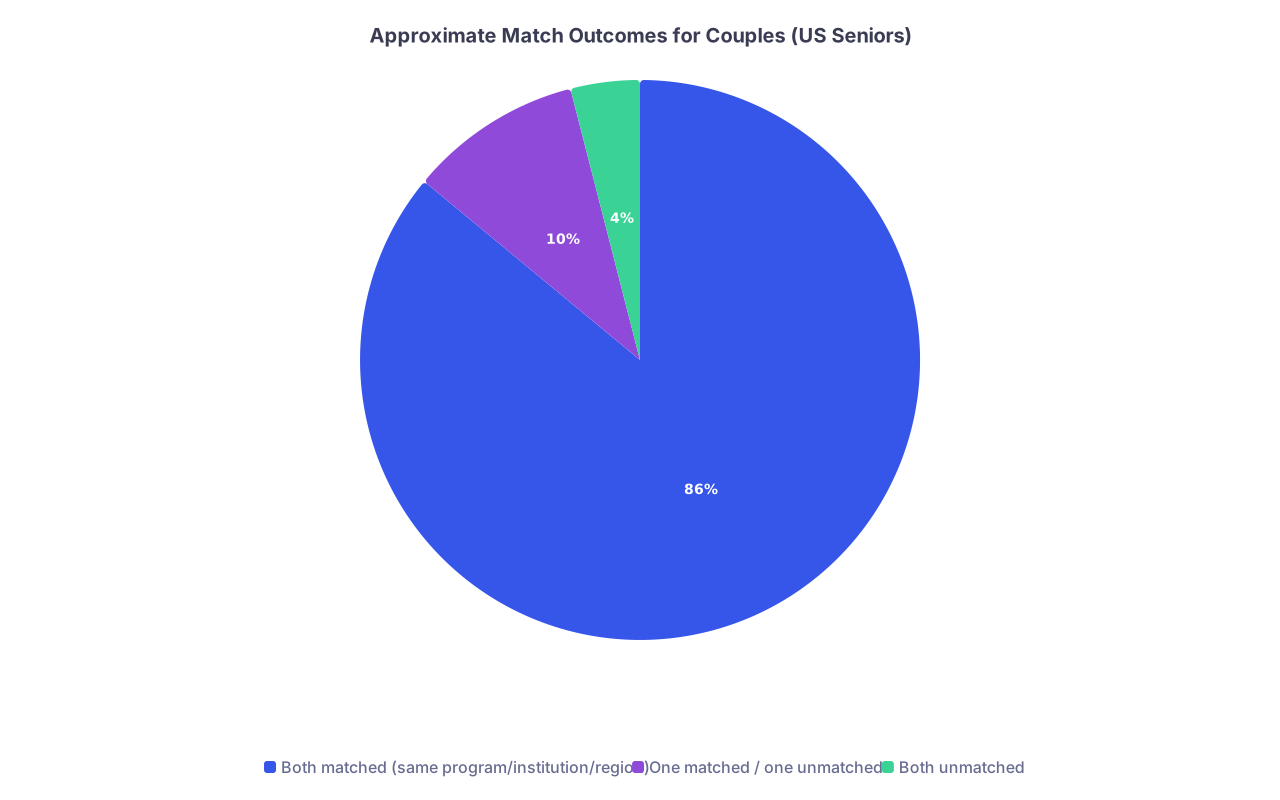
| Category | Value |
|---|---|
| Both matched (same program/institution/region) | 86 |
| One matched / one unmatched | 10 |
| Both unmatched | 4 |
No, those aren’t exact current-year numbers, and they vary slightly year to year. But the pattern is stubbornly consistent:
- The overwhelming majority of couples match both partners.
- A minority end up in the painful one‑matched / one‑unmatched scenario.
- A small fraction don’t match either partner.
Here’s what programs and advisors almost never say clearly:
You are more likely to both match together somewhere than to blow up both careers by coupling. The system is literally designed to try to place you as a unit.
The nightmare scenario your brain keeps replaying—“we couples match → we both don’t match → we’ve destroyed our lives”—is way less common than your 2 a.m. thoughts suggest.
Is there risk? Yes. Can you pretend it doesn’t exist? No.
But “we will definitely blow this up” is not what the data say.
What “Match Together” Actually Means (Your Brain Is Probably Lying to You)
Your brain is probably picturing only one version of success:
Both of you. Same program. Dream city. Near Trader Joe’s. Perfect co-residents. Cute little apartment courtyard with string lights.
That’s one scenario. But it’s not the only way to “match together.”
In NRMP language, “couples matched” means: both partners match to positions on the same line of their pair rank list. That line might be:
- Same program, same hospital
- Same institution, different programs
- Same city, different hospitals
- Same geographic area within commuting distance
Not just “we’re in the exact same building every day.”
You can structure your pairs to widen what “together” looks like. That matters for probability. A ridiculously narrow definition of “together or nothing” will obviously increase your risk.
Let me put this bluntly: couples who define success as “this one exact program combo or we’d rather be unmatched” are playing residency roulette.
Couples who say “same city or 45‑60 min commute is acceptable for us” are dramatically less likely to crash.
How The Couples Algorithm Actually Works (And Why It Feels So Scary)

| Step | Description |
|---|---|
| Step 1 | Start with Rank #1 Pair |
| Step 2 | Couple matched to this pair |
| Step 3 | Move to Rank #2 Pair |
| Step 4 | No match for one or both |
| Step 5 | Can both match here? |
| Step 6 | Any acceptable pair left? |
The algorithm doesn’t “punish” you for being a couple. It just treats each line you rank as a unit:
- It looks at Pair #1: Partner A choice 1 + Partner B choice 1.
- If both can match there, you’re done.
- If not, it moves to Pair #2.
- And so on.
Here’s the catch that drives everyone insane:
If Partner A could have matched to Program X as a single applicant, but in all the pairs where A ranks X, Partner B can’t match to their side… then A doesn’t get X either. Because the algorithm is honoring the couple tie.
That’s why your brain keeps saying, “I’m tanking their chances.”
And yes, technically, coupling means you both give up some individual “maximal” outcomes in exchange for trying to land somewhere together.
The key question isn’t: “Does couples match lower your individual ceiling?”
It does.
The real question is: “Are you willing to give up 5–10 fantasy programs to avoid long‑distance for 3–7 years?”
Most people who couples match are. That’s kind of the point.
When Couples Don’t Both Match: The Patterns I Actually See
I’m not going to sugarcoat it. I’ve seen couples blow up in the match. I’ve also seen couples do absolutely everything “right” and still end up in that hideous one‑matched / one‑unmatched limbo.
But it’s not random chaos. There are patterns.
Here’s when the risk spikes:
One or both in a hyper‑competitive specialty with a weak application
Example: Derm + anything, Ortho + anything, ENT + anything.
And the applicant is already borderline solo: low Step 2, no strong home program, minimal research.Very small geographic window
“We’ll only live in Boston or NYC”
Or, “Only within 15 minutes of this exact hospital”
In other words, you’re asking the algorithm to do miracles, not math.Short, top‑heavy rank list
This one’s brutal.
People rank 8–10 pairs, mostly super competitive academic programs in the same 2 cities.
Then stop because “we don’t really want anything else.”
That’s amateur hour in couples matching.One partner insists on an unrealistic program tier
Like a mid‑tier applicant ranking almost entirely top‑10 programs because “I worked really hard” and their partner is too scared to push back.
Then they’re shocked when reality bites.Extremely asymmetric competitiveness
Example: One is a rockstar IM applicant; the other is a below‑average neurosurgery applicant with red flags and limited interviews.
They rank them as if their odds are similar. They aren’t.
Notice what’s missing here:
“I’m just generally anxious so we’ll probably fail.”
That’s not a real risk factor. That’s just your amygdala doing laps.
What You Can Do To Tilt The Odds In Your Favor (Without Pretending Everything’s Fine)
Let’s talk strategy like someone who’s already imagined the worst 100 times and is still willing to do the work.
1. Be brutally honest about competitiveness
Not vibes. Not feelings. Data.
You both need to know where you stand in your specialty:
| Factor | Strong Signal | Borderline / Risky |
|---|---|---|
| Step 2 CK | ≥ 245 | ≤ 230 |
| Class rank | Top third | Bottom third |
| Research (for competitive fields) | 5+ pubs/abstracts | 0–1 low‑impact |
| Home program support | Strong PD/Chair letter | Lukewarm or none |
| Number of interviews | 15+ (less competitive) / 12+ (competitive) | <10 or <8 respectively |
If one of you is clearly more competitive, the less competitive partner should be treated as the limiting factor when building the list. If that sentence makes your chest tighten, good. You’re hearing the real stakes.
2. Build a long, tiered rank list
The couples who sleep the night before Match Day are not always the most competitive. They’re the ones who played the long game.
Think in layers:
- Layer 1: Ideal combos – same program, dream locations, top choices.
- Layer 2: Solid but less glamorous programs in same city or region.
- Layer 3: Safety net – community programs, less “prestigious” places, bigger geographic radius, but still acceptable to you both.
Your rank list shouldn’t read like Instagram. It should read like a risk‑management document.
I’ve seen couples go from “we only want big academic centers in three cities” to “we’re willing to do community + academic combos in 8–10 states” and dramatically lower their stress.
3. Use distance creatively, not dramatically
60–90 minutes commute each way is rough. I won’t pretend it isn’t.
But 60 minutes of driving is not the same as 3 years in totally different states.
You can create pairs like:
- Partner A: Program in City X
- Partner B: Different hospital an hour away in City Y
Not romantic. But survivable. And way better than SOAPing solo into a program 3 time zones away.
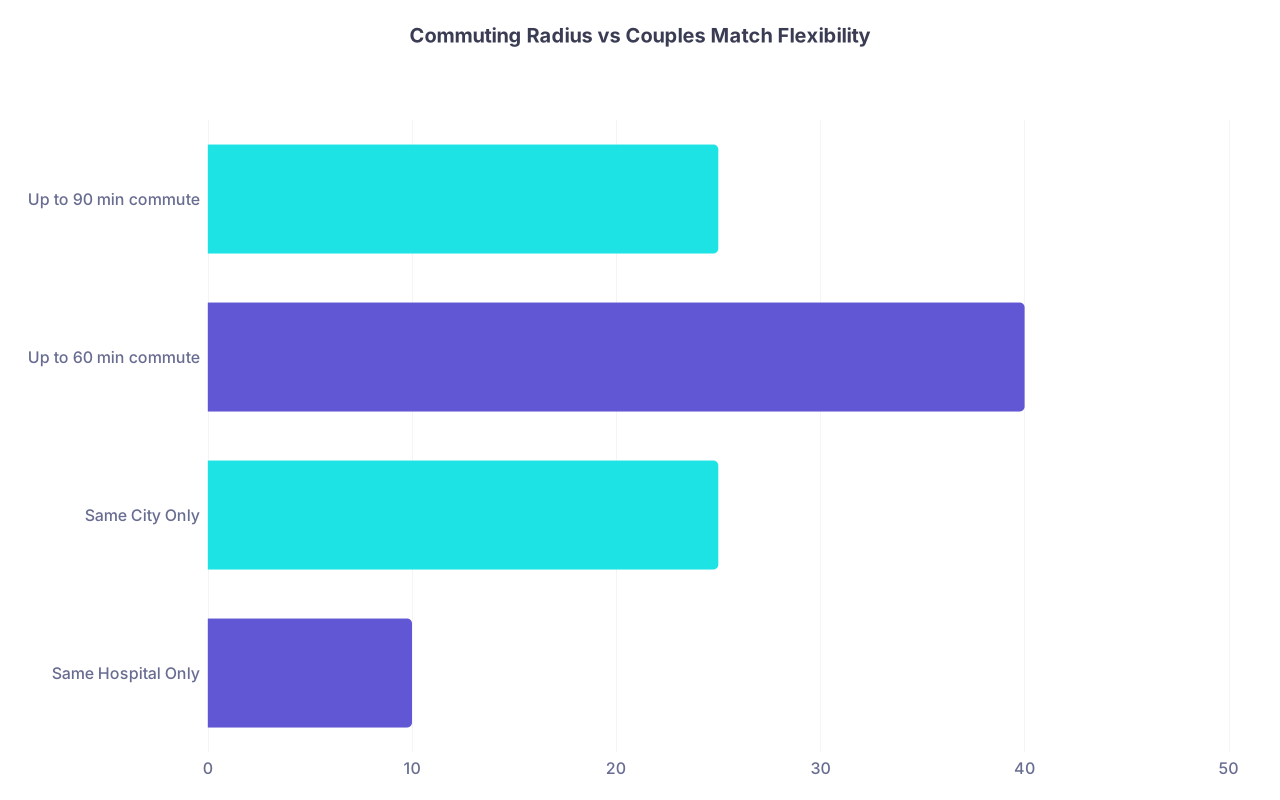
| Category | Value |
|---|---|
| Same Hospital Only | 10 |
| Same City Only | 25 |
| Up to 60 min commute | 40 |
| Up to 90 min commute | 25 |
Those are illustrative, not actual NRMP numbers—but the idea holds: the more you stretch your “together” radius, the more lines you can safely rank.
4. Don’t confuse “prestige” with “future happiness”
Here’s one I say every year that people ignore until it’s too late:
I’ve never heard a couple say, “I’m so glad we ranked apart so I could be at a slightly more prestigious program.”
But I have heard:
“We should’ve just sucked it up and ranked those less shiny programs together. The long‑distance almost broke us.”
You’re building a life, not a CV line. Your ego will scream. Let it. Then choose the rank sequence that protects both careers and the relationship.
The Emotional Side: What No Spreadsheet Can Fix
You can do everything “right” strategically and still feel awful. The couples match is psychologically violent. It combines:
- Fear of failing someone you love
- Fear of ruining your own career
- Zero control after you hit “certify and submit”
So your brain tries to bargain: If I just keep redoing the list, maybe I can find the magical ordering that guarantees success.
You can’t. There is no configuration that erases all risk. There are only:
- Reckless lists
- Reasonable lists
- Extremely careful, honest, and flexible lists
Once you’re in that third category, your insomnia isn’t fixing anything; it’s just making you miserable.
One thing that actually helps: spell out, together, what you’ll do if the worst happens.
- If one of us matches and the other doesn’t, do we SOAP aggressively in the same region?
- Are we okay with one person taking a research year near the other?
- Do we try again next cycle as a couple?
Talking about this feels like inviting disaster. It isn’t. It’s disaster‑proofing your relationship.
Red Flags That Your Rank List Is Too Risky
If you see yourself in more than two of these, you probably need to rethink:
- You’re only ranking 10–12 pairs.
- Most of your pairs are top‑tier academic programs in 1–2 cities.
- One partner has <8–10 interviews in a moderately competitive specialty.
- You have almost no “safety” programs ranked, because “we wouldn’t be happy there.”
- You’re totally unwilling to accept up to a 60–90 minute commute for either of you.
- You’re banking on “we interviewed well; they loved us” as your main comfort.
If you’re wincing reading that, it’s fixable. More pairs. More diversity. More humility.
You’d rather be slightly over‑matched than tragically under‑ranked.
What Your Anxiety Gets Right — And What It Gets Wrong
Your anxiety is right about a few things:
- This is high stakes.
- You can’t fully control the outcome.
- One person’s application can pull the other’s options down.
- There are couples every year who don’t both match.
But it’s dead wrong about these:
- “Couples almost never both match.” False. Most do.
- “We’re doomed because we’re not perfect applicants.” Also false. Imperfect applicants match all the time with solid lists.
- “If we just uncouple, we’ll both magically match in better places.” Often false. The limiting partner doesn’t suddenly become a superstar solo.
The real move isn’t pretending you’re safe. It’s building a rank list that would make your future, calmer self say, “We did everything reasonably possible with what we had.”
FAQs About Couples Match Anxiety (Because Of Course You Have More Questions)
1. Does couples matching actually lower our chances of matching at all?
For most reasonably competitive pairs with sane rank lists, it doesn’t drastically lower your chance of both matching somewhere. It absolutely lowers your chance of each of you independently hitting your single highest‑prestige option. You’re trading some individual upside for joint stability. If your lists are short, top‑heavy, and geographically tiny, that’s when your overall match risk jumps.
2. Is it safer if we don’t couples match and just “hope” to end up near each other?
Usually no, unless one of you is in a tiny specialty that almost never couples matches successfully. Without coupling, the algorithm doesn’t care about keeping you within 500 miles of each other. Some couples get lucky and wind up close anyway, but many end up across the country. If your relationship is a real priority, formally coupling is usually more rational than silently gambling.
3. How many ranked pairs should we have to feel reasonably safe?
There’s no magic number, but if you’re stopping under ~20 pairs when you could reasonably create more combos (same city, nearby cities, slightly farther commute, community programs), you’re probably under‑protected. I’ve seen very anxious but realistic couples go into Match Week with 30–50 pairs because they systematically listed all plausible combinations. That doesn’t guarantee success—but it definitely cushions bad luck.
4. What if one of us has a red flag (fail, leave of absence, professionalism issue)?
Then your list needs to plan around the weaker application, not the stronger one. Ignore this and you’re playing fantasy match. That might mean ranking more community programs, broader geography, and making peace with less glamorous options. It hurts the ego, but it massively improves the odds you’re not sitting there in March asking, “How did we not both match?”
5. Is it “giving up” to rank backup cities or community programs just to stay together?
No. It’s being an adult. Prestige fades shockingly fast once you’re actually a resident dealing with 28‑hour calls and EMR passwords. Being in the same home, same city, supporting each other through intern year—that does not fade. I’ve seen couples rank “lesser” programs together and, three years later, they’re thriving, matched into fellowships, and very obviously relieved they didn’t choose long‑distance misery for a name‑brand line on a CV.
6. How do I know when to stop editing the list and just submit?
When three things are true:
- You’ve honestly calibrated to the weaker application.
- You’ve included a decent number of less‑competitive but acceptable options, with wider geography or commute.
- If you imagine your future self, post‑match, you’d be able to say, “We used the information we had and didn’t let pride write our list.”
Once you hit that point, more tinkering is just fear disguised as productivity. Certify it. Walk away. Let the algorithm do its thing.
Years from now, you won’t remember which line was #7 and which was #14 on your couples rank list. You will remember whether you treated each other like partners facing a hard thing together, or like opponents fighting over prestige and fear.


