

It is late January. Your ERAS is long gone, you have survived multiple Zoom rooms of awkward smiles, one faculty member who clearly did not understand what a triple board program is, and at least two interview days where you were the only applicant on the call who knew the difference between “Peds‑Psych‑Child” and “Triple Board.”
Now NRMP rank list certification is creeping up. Your generic “rank the vibes” approach that worked for categorical pediatrics is not cutting it here. These tracks are rare, structurally weird, and the usual Reddit advice is either wrong or written by people who have never met a triple board grad.
Let me break this down specifically.
You are not ranking “programs” in the usual sense. You are ranking:
- An accreditation Frankenstein of pediatrics + general psychiatry + child and adolescent psychiatry (CAP)
- Two or three different departments that may or may not like each other
- A 5‑year (sometimes 6‑year) training and life commitment with very little lateral escape if you hate it
So we are going to talk about how to rank these programs in a way that is actually tailored to joint Peds‑Psych‑Child training, not generic “look for supportive culture” fluff.
1. First: Get Your Terminology and Structure Straight
Before ranking anything, you need to be crystal clear on what you are applying to and what the training actually looks like. A surprising number of applicants cannot explain it cleanly on interview day. Programs notice.
What you are actually ranking
There are three main combined routes people confuse:
Triple Board (Pediatrics / General Psychiatry / Child & Adolescent Psychiatry)
Classic 5‑year integrated program. You graduate board‑eligible in all three:- ABP (Pediatrics)
- ABPN (Psychiatry)
- ABPN (Child and Adolescent Psychiatry)
Training is heavily front‑loaded with pediatrics, then psychiatry, with CAP integrated or concentrated later. Think Brown, Cincinnati, Utah, Tulane, etc.
Peds‑Psych Combined (without guaranteed CAP)
Pediatric and general psychiatry combined, usually 5 years, but CAP is not guaranteed or fully integrated. Some have strong CAP access, some do not.Child track add‑on or early‑ID CAP from Psych
Some psychiatry programs have a “child track” or early acceptance to CAP, sometimes with pediatric experiences, but this is not the same as a triple board or true Peds‑Psych‑Child. These often sit on your list next to the combined programs.
You need to know which are which on your rank list. If you treat them as interchangeable, you will mis‑rank them.
| Track Type | Length | Boards Eligible At Graduation |
|---|---|---|
| Triple Board | 5 yrs | Peds, Adult Psych, Child Psych |
| Peds‑Psych (no CAP guaranteed) | 5 yrs | Peds, Adult Psych |
| Psych + Early‑ID CAP | 5–6 yrs | Adult Psych, Child Psych |
| Categorical Peds | 3 yrs | Peds |
| Categorical Psych | 4 yrs | Adult Psych (CAP separate) |
If a program director cannot give you a one‑sentence accurate description of what boards you are eligible for at graduation, that is a red flag. You are ranking the structure as much as the name.
2. Decide Your True Endgame Before You Touch Your Rank List
This is the piece most people skip. Then regret.
There are three realistic “endgame identities” for most Peds‑Psych‑Child applicants:
Truly integrated career
You want to practice as a physician who moves flexibly between pediatrics and child psychiatry. Examples:- Medical director of a pediatric consult‑liaison or integrated behavioral health service
- Running combined neurodevelopmental / autism / complex behavior clinics
- Leadership in pediatric hospitals building mental health programs
Primarily Child Psychiatry with strong pediatric literacy
You like peds, but you know your day‑to‑day will be mostly CAP. The pediatric background is an asset, not your core identity.Primarily Pediatrics / Complex Care with strong psychiatry literacy
You imagine yourself as a complex care pediatrician, developmental peds‑adjacent, or inpatient pediatrics with deep psych skills.
Now, here is the blunt part: not all triple board programs support all three endgames equally well, even if they say they do.
- Programs heavily dominated by pediatrics with weak psych leadership will accidentally push you toward complex peds, away from strong CAP identity.
- Programs with strong CAP and marginalized peds department presence may give lip service to “integrated” but almost all their grads work essentially as CAP with some medical nuance.
- Programs that constantly treat triple board residents as free swing labor to cover service gaps will not protect your integrated identity at all. You will become “the extra FTE.”
When you rank, anchor everything against your endgame. Ask yourself program‑by‑program:
“Given how they train and how their grads practice, which of my three endgames does this place naturally push me toward?”
If that does not match what you actually want, they go lower. No matter how friendly the residents are.
3. The Unique Structural Questions You Must Ask (That Categorical Applicants Never Think About)
You sit in three worlds. Which means your rank strategy has to interrogate three departmental cultures and their relationships, not one.
3.1 Balance of training: Peds vs Psych vs Child Psych
Do not just ask, “How many months of each?” That is step one. Step two is the pattern over time and the sequence.
Key questions for ranking:
- How many total months of pediatrics inpatient vs outpatient? Is this enough to actually pass the peds boards and feel safe covering bread‑and‑butter pediatrics unsupervised?
- How much core adult psychiatry before you touch CAP? Too little and you will feel lost in child fellowship; too much and your CAP time gets squeezed or rushed.
- How is CAP integrated?
- Early exposure during intern year (e.g., consults, co‑loc clinics)?
- Or essentially all concentrated in PGY‑4/5 as a block?
The more your career goal is true integration, the more you want CAP exposure early, not just dumped at the end.
3.2 How the departments actually see you
On interview day, everyone says they “value” triple board. That is cheap. You need to parse reality.
Look for these specific patterns:
- Do pediatric chiefs talk about triple board residents as “our people” or as “they belong more to psych”?
- Do psychiatry chiefs say things like, “We really appreciate your flexibility, we use you to plug holes when needed”? Translation: you are service coverage.
- Does CAP leadership explicitly talk about your schedule, your projects, and your protected time? If they cannot describe what triple board PGY‑5 looks like, they are not used to advocating for you.
You want aligned ownership: all three see you as theirs. Programs where you are psychologically “owned” by no one become miserable quickly.
4. Red Flags that Should Drop a Joint Track Down Your List
Let me be direct. There are some features that are much bigger problems in triple board than in a standard program.
4.1 Fragmented identity and isolation
If there are:
- Only 1 triple board resident per year,
- No or minimal recent graduates, and
- No real cohort of dual‑training or integrated‑care faculty,
you will be inventing your role from scratch. Some people like that. Most do not.
Ask:
- “How many current residents in the combined track are above and below me?”
- “What are the last 5 graduates doing now?” Names and jobs, not generalities.
- “Who are your faculty that trained in combined or triple board programs?”
If they cannot name faculty who truly understand this pathway from the inside, that matters.
4.2 Hidden or informal “extra” requirements
Common in some programs:
- “You can do your CAP clinic, but it will be on your own time after peds clinic.”
- “We count your extra call shifts as ‘great experience’ instead of adjusting duty hours.”
- “You can finish CAP in 5 years if you do X, Y, Z extra research and call.”
When that kind of thing appears on interview day, drop them down your list. It does not get better after you match.
4.3 Boards and certification games
Some programs play loose with board eligibility timing. That is not a small issue for triple board.
Concrete questions:
- “When do most residents sit for their pediatrics boards? Psychiatry boards? CAP boards?”
- “Have any triple board grads had trouble being board‑eligible on time?”
- “Do you explicitly schedule protected time for board study for triple board residents?”
If you get fuzzy answers, that is a problem. You have three boards to pass. You do not want to be the person cramming peds boards while trying to finish your CAP thesis and cover adult psych nights.
5. The High‑Yield Positives That Deserve Extra Weight
Now the good side. Here is where a program shoots up your joint‑track rank list, even if their categorical reputation is “only” mid‑tier.
5.1 True integrated clinical sites
Not “we send you to peds sometimes” but places where your combined skill set is the point.
Things to listen for:
- Dedicated pediatric consult‑liaison service where triple board residents are core, not afterthought coverage
- Embedded behavioral health in general pediatrics or subspecialty clinics (autism, neurodevelopmental, adolescent medicine, eating disorders)
- Joint supervision: peds + psych faculty attending together, not “you get one note from each.”
If you hear phrases like “triple board clinic,” “combined neurodevelopmental/behavioral clinics,” or “integrated autism or gender care programs,” that is a very good sign.
5.2 Leadership that has actually trained triple board or combined
Programs where the PD or associate PD has either:
- Trained in triple board / combined themselves
- Or clearly mentored several triple board residents through to graduation and beyond
Those people understand the micro‑frictions: scheduling battles, being left off group emails, being the only one doing peds notes in a psych EMR template, etc. They will pre‑empt problems instead of waiting for you to complain.
5.3 Protected CAP identity in the senior years
For ranking, I put disproportionate weight on how PGY‑4/5 look, not just the glowing PGY‑1/2 description.
Questions to ask explicitly:
- “On your PGY‑5, how much of your time is functionally CAP vs peds vs adult?”
- “Do triple board PGY‑5s have their own continuity panel in child psych?”
- “Are capstone projects for triple board residents treated the same as for standard CAP fellows?”
You want a program where, by PGY‑5, you are not still doing routine peds ward coverage while your CAP peers are building a real child psych identity.
6. How to Integrate Categorical and Joint Programs in One Rank List
Most applicants to these tracks are also ranking:
- Categorical pediatrics
- Categorical psychiatry
- Straight adult psych + early CAP
- Occasionally Med‑Peds if they got spooked early
So the stress becomes: where do these go relative to each other?
Here is the honest framework I use when I advise people.
6.1 The “regret test”
Ask yourself, for each paired choice:
- “If I match here in categorical pediatrics, and a triple board spot at X was one rank higher, will I be relieved or absolutely sick about it?”
- Repeat the same for categorical psych vs your top combined program.
Your gut answer is more accurate than any pros/cons list. If losing the triple board slot would feel like a deep loss, that combined program goes higher than all categoricals, even “prestige” ones.
6.2 How much you value flexibility vs laser focus
- If you are 70–80% sure you want a truly integrated Peds‑Psych‑Child career, you should rank your top one or two triple board programs above your categorical backup, assuming they meet baseline safety: sane call, no obvious abuse, decent board pass rates.
- If you are genuinely 50/50 between pure peds and pure psych, it may be safer to rank high‑quality categorical programs higher and keep combined as “nice if it happens.”
But be honest. I have seen too many people who were “50/50” talk themselves into categorical peds at a big‑name place, then realize in PGY‑2 that they are actually a psychiatrist at heart. Backtracking into psych and CAP becomes longer and messier than if they had just committed to a triple board program.
7. Special Considerations: Location, Lifestyle, and the 5‑Year Reality
For joint programs, geographic and life factors matter more, not less. You are there longer.
7.1 Location fatigue
You are signing up for 5 years in one place. Not 3. That changes how you should weight geography.
Think beyond “fun city” energy and ask:
- “Is this somewhere I can stand, not just as a 26‑year‑old, but also as a 30‑year‑old maybe with a partner or child?”
- “Are there enough non‑medical people and spaces that I can step out of the hospital identity?”
If you already know you hate winters, for example, do not kid yourself into ranking a brutal‑winter city #1 solely because they have an impressive autism clinic.
7.2 Call and schedule load over five years
A triple board setup that does 100% of categorical peds call + most psych call + CAP call with no meaningful adjustment will destroy you.
Ask each program:
- “Compared with categorical peds interns, how many calls do triple board interns take?”
- “As a senior, do you take adult psych nights at the same rate as categorical psych?”
- “Is there any reduction to account for the fact that we are covering three boards?”
Look for programs that explicitly say, “We adjust call expectations down a bit; otherwise triple board would be unsafe.” That is a green flag.
8. Information to Track Systematically (Not Just “Vibes”)
You should not be trying to remember 8 different program structures from memory when you sit to rank.
Make yourself a very simple table after interviews. Something like this:
| Program | Peds Strength | Psych/CAP Strength | Integration Quality | # Triple Board Residents | Endgame Fit |
|---|---|---|---|---|---|
| A | Strong | Strong | High | 3 per year | Integrated |
| B | Strong | Moderate | Low | 1 per year | Peds‑heavy |
| C | Moderate | Strong | Moderate | 2 per year | CAP‑heavy |
Do not overcomplicate it. But do write down:
- Actual structure: months, order, timing of CAP
- Who “owns” you culturally: peds vs psych vs CAP
- Where recent grads are working (and whether those jobs look like something you want)
Then look at where your endgame and the actual outcomes line up.
9. Concrete Ranking Scenarios: How I’d Think Through Them
Let me put this into some realistic patterns I have seen.
Scenario 1: Strong categorical safety vs excellent but “unknown” triple board
- Program X: Top‑tier peds name, middle‑of‑the‑pack psych, brand‑new triple board with 1 resident, no grads yet
- Program Y: Mid‑tier city, long‑running triple board with 3 residents per year, strong CAP reputation, grads doing exactly what you say you want (consult‑liaison, complex care clinics)
If your endgame is integrated Peds‑Psych‑Child, Program Y goes above X. I do not care that X has a big‑name children’s hospital. A new, untested triple board track with no clear CAP outcomes is riskier than a “mid‑tier” place that has been reliably producing the kind of clinicians you want to become.
Scenario 2: Your partner’s job vs your ideal integrated program
- Program A: Dream integrated setup, but in a city with no work for your partner and minimal support.
- Program B: Solid, not stellar triple board, but in a region where your partner can build a sustainable career and you can actually live.
For a 5‑year commitment, I rank B above A unless A is truly once‑in‑a‑generation perfect. Burnout and home instability will blunt whatever professional advantage A had. I have seen this more than I would like.
Scenario 3: You are secretly 90% CAP‑focused
- Triple board Program C: Reasonable enough, but pediatric department is clearly the main driver; CAP exposure is fine but not stellar.
- Psych + early‑ID CAP Program D: Gold‑standard CAP, integrated peds consult exposure, multiple faculty doing pediatric‑adjacent work.
If your heart is mostly CAP with pediatric literacy, I rank D above C. Triple board is not inherently superior. It is superior only if it aligns with what you want to practice.
10. How to Use Post‑Interview Communication Without Fooling Yourself
You will get:
- “We loved meeting you” emails
- Occasional “You are ranked to match” wink‑wink messages (often against NRMP rules, but it happens)
- Silence from some places
Here is how I treat that in the joint‑track world:
- A warm, thoughtful follow‑up from a PD who clearly references your specific interests and talks concretely about your path? That is mild positive signal—shows they actually paid attention and imagine you there.
- Vague flattery without details? I ignore it in ranking.
- Silence? Neutral. Some programs are strict about contact policies.
Do not lower a program that you genuinely liked and that structurally fits you, just because they did not send you a gushy note. Some of the most functional, resident‑protective programs will not play that game.
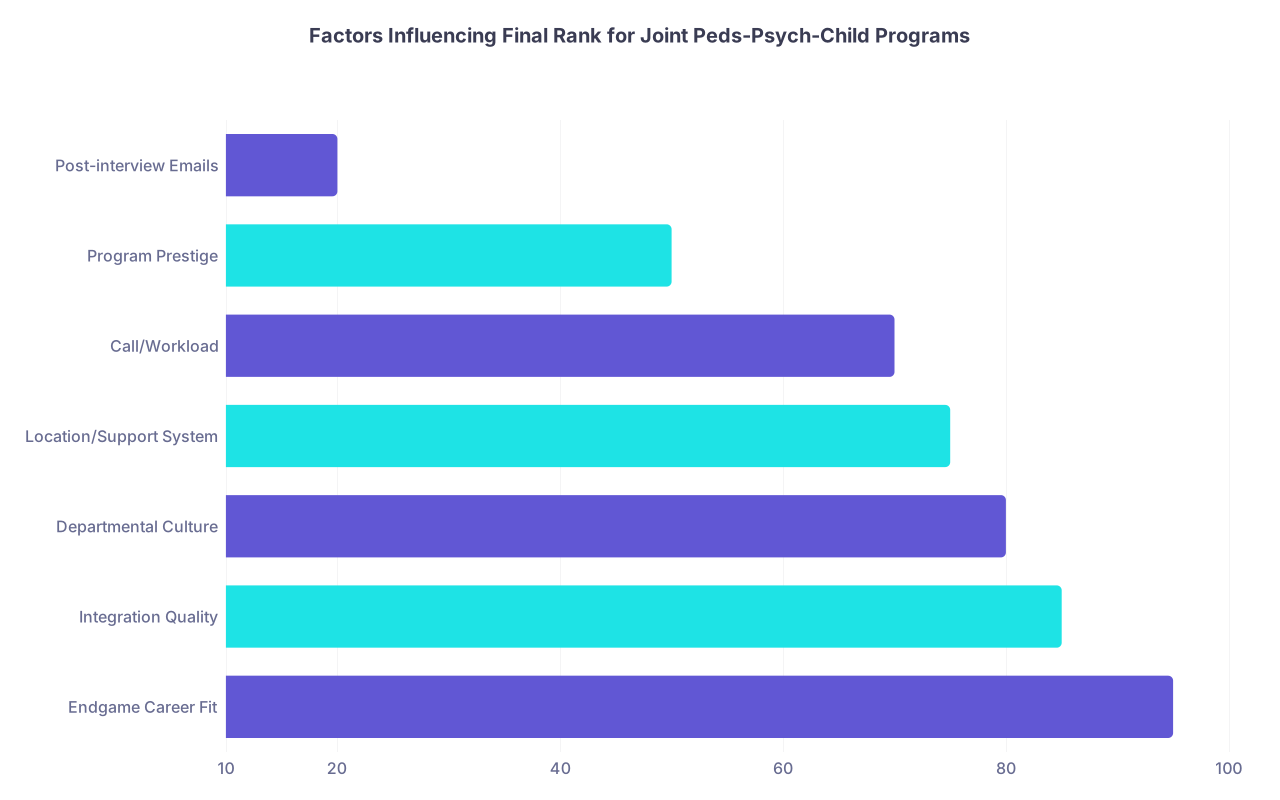
| Category | Value |
|---|---|
| Endgame Career Fit | 95 |
| Integration Quality | 85 |
| Departmental Culture | 80 |
| Location/Support System | 75 |
| Call/Workload | 70 |
| Program Prestige | 50 |
| Post-interview Emails | 20 |
11. Putting It All Together: A Practical Ranking Workflow
You are a week out from NRMP rank deadline. Here is the stripped‑down process I recommend:
Write your endgame in one explicit sentence.
Example: “I want to practice primarily as a child psychiatrist with deep comfort managing medical and developmental complexity in pediatric settings.”Do a first pass 'gut list'.
Put programs in rough order based purely on your internal pull, not the name brand. Do not show anyone yet.Overlay the structural data.
For each program, annotate:- Boards guaranteed and timing
- Peds / psych / CAP strength
- Triple board graduate outcomes over last 5–10 years
Check for mismatches between gut and data.
If a program you “loved” is churning out grads doing things you would never want to do, move it down.
If a program felt a little boring but consistently produces exactly your target careers, consider moving it up.Slot in categorical backups.
Decide clearly where your “if I match here instead of any triple board, I can live with that” threshold lies.Leave it for 48 hours, then re‑read.
If you still feel vaguely sick about having a categorical above your best‑fit combined program, flip them.

| Step | Description |
|---|---|
| Step 1 | Define Endgame |
| Step 2 | Initial Gut Ranking |
| Step 3 | Add Structural Data |
| Step 4 | Move Program Down |
| Step 5 | Consider Moving Up |
| Step 6 | Integrate Categoricals |
| Step 7 | 48-Hour Recheck |
| Step 8 | Finalize Rank List |
| Step 9 | Career Outcome Match? |
Key Takeaways
- You are not just ranking hospitals. You are ranking a 5‑year, three‑board identity, and the actual career patterns of graduates matter more than brand names.
- Anchor every decision to your real endgame: integrated Peds‑Psych‑Child, primarily CAP with peds literacy, or primarily peds with psych literacy. Rank programs by how reliably they produce that outcome.
- Prioritize programs with true integration, clear ownership from all three departments, sane workload over five years, and a track record of triple board residents doing exactly the kind of work you want to be doing ten years from now.


