
Most residents are exhausted at night because they “prepare for rounds” the wrong way.
Efficient residents do less. But they do the right things, in a repeatable system, every single night.
If you’re staying up late clicking through every lab, reading every note, and rewriting the entire H&P before bed, you’re doing too much of the wrong work. And you’ll still feel unprepared on rounds.
Here’s how efficient residents actually prep the night before – in a way that saves time, protects your sleep, and makes you look sharp in front of attendings.
The Core Rule: Prepare for Questions, Not for Documentation
Let me start with the mindset shift.
Your goal at night is not:
- To finish every note
- To read every single study in detail
- To know every lab value by heart
Your goal is:
- To know what happened today
- To know what matters tomorrow morning
- To anticipate 3–5 likely questions per patient and have the answers (or the plan to get them)
Rounds are about:
- Overnight events
- Today’s plan
- Big picture trends
They are not about:
- Reciting every lab
- Reading the chart to your attending
So you build your evening routine around that.
Step 1: 10-Minute “Big Picture” Pass Before You Leave
Do not walk out of the hospital without a quick systems check on your list. Efficient residents do one last sweep before sign-out, not at 11 pm from their couch.
Here’s the bare minimum to confirm before you leave:
Discharge and procedure status
- Who is actually going home tomorrow? Are meds, follow-up, and transport set up?
- Any procedures/consults that still need to be placed or clarified?
- Anyone NPO? For what? When?
Outstanding time-sensitive tasks
- STAT labs/imaging that actually matter tonight
- Time-sensitive meds/pressors/infusions – are they ordered and started?
- Any “please page team with result” requests from consultants?
High-risk patients
- Who are your “if this goes bad, I’m not surprised” patients?
- Make mental notes: code status, escalation plan, ICU threshold
Most people skip this and then “discover” problems at 6:30 am. That’s how you start rounds behind.
Step 2: Build a Smart Patient List (Your Real Tool for Rounds)
Your printable/digital list is your weapon. Efficient residents design it to make morning rounds almost automatic.
At night, you’re not documenting; you’re curating.
At minimum, your list should have:
- Demographics: name, age, bed
- One-liner: “62M with decompensated cirrhosis admitted for variceal bleed”
- Active problems: 3–6 bullets, not 20
- Key data pointers:
- Yesterday’s and today’s creatinine (for trends)
- Most recent WBC, Hgb, platelets
- Last vitals summary (e.g., “soft BP, high HR”)
- Plan bullets space for AM updates
What efficient residents do at night:
- Update the one-liner if needed (e.g., initial suspicion vs final diagnosis)
- Prune problem lists: drop resolved nonsense (e.g., “mild hypomag 4 days ago” that’s now fixed)
- Highlight “must talk about tomorrow”: new dx, big management decisions, new imaging
You’re essentially pre-formatting your mental script for rounds.
Step 3: Night-Before Chart Review – A 3-Part Filter
This is where most people waste time. They click every tab. Efficient residents use a strict filter:
Events & trajectory
- Skim vitals: any fevers? hypotension? tachycardia trends?
- Skim I/Os for patients where it matters (CHF, AKI, cirrhosis, post-op)
- Read nursing and overnight notes for active issues only (pain, confusion, desats, falls)
New objective data
- Labs: focus on deltas and what changes management
- Creatinine went from 1.1 → 1.7 in 24 hours? That’s a story.
- Sodium 135 → 134? Likely not the star of tomorrow.
- Imaging: read final reports for anything you haven’t already integrated into your plan
- Micro: any new cultures, susceptibilities, or key neg/pos tests?
- Labs: focus on deltas and what changes management
Consult notes
- Only read:
- New consults
- Major plan changes
- Pull out 1–2 top recommendations per service and put them in your own words on your list
- Only read:
If you’re scrolling through every progress note from each consultant, you’re wasting time. Most of the good stuff is in the most recent note and the orders they placed.
Step 4: Build “Rounds-Ready” Mini-Plans Per Patient
This is the part efficient residents never skip, even when tired.
For each active patient, you want a 3-part micro-plan written on your list:
Status summary (1 sentence)
- “Now HD stable, pressors weaned, on 2L NC, pain controlled.”
- “Still febrile despite 48 hours of vanc/zosyn, WBC up, lactate improved.”
Today’s agenda (bullets)
- Labs we care about in the morning (and why)
- Imaging/procedures scheduled or needed
- Discharge barriers (SNF bed, PT eval, insurance, home oxygen)
Anticipated questions (with answers or plan) Examples:
- “Can we de-escalate antibiotics?” → Know culture data and clinical trend.
- “Can we switch to PO?” → Know if tolerating diet, no nausea, normal gut function.
- “What’s the discharge plan?” → Have a realistic day or criteria (“discharge once room air x24h, tolerating PO, pain controlled on PO meds”).
You’re not writing full notes here. Just prepping the spine of what you’ll say in 30 seconds.
Step 5: Prioritize: Not All Patients Deserve Equal Time
Efficient residents triage their prep.
Here’s the rough time budget for a 12–15 patient list:
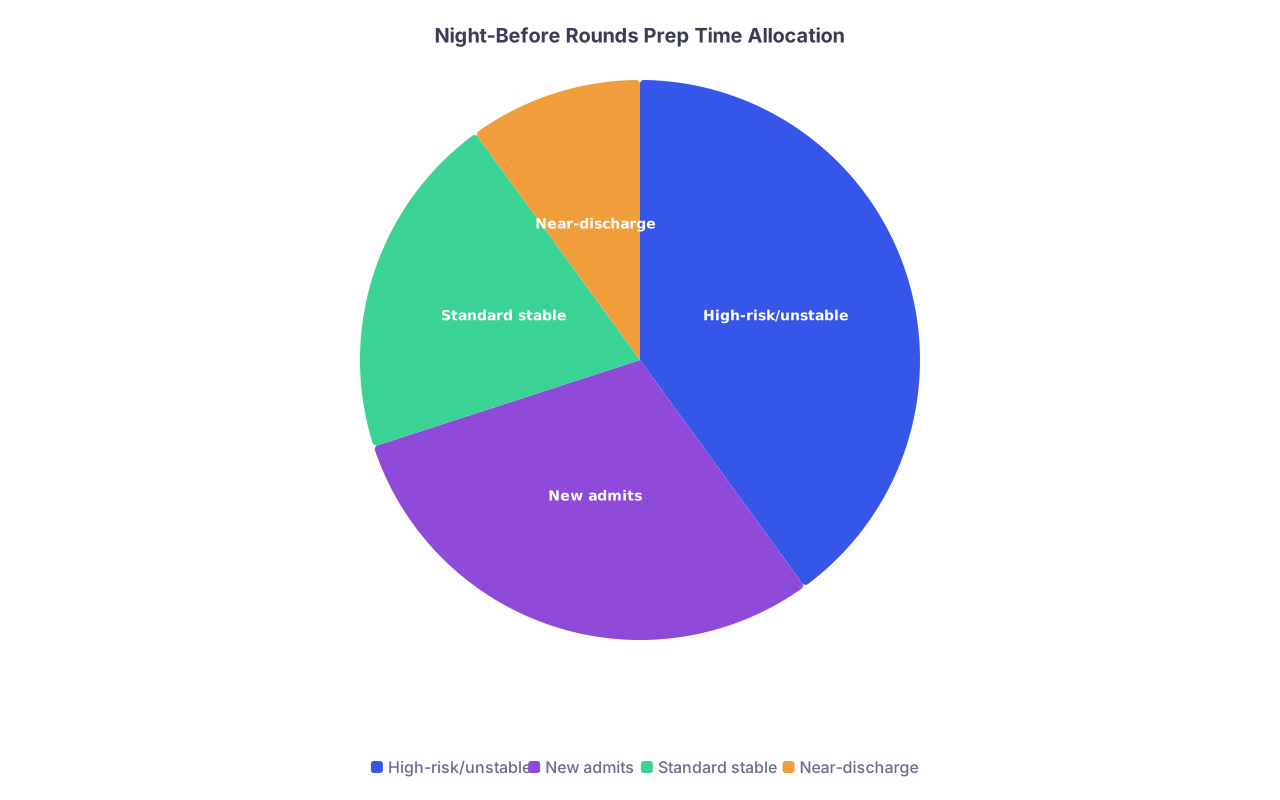
| Category | Value |
|---|---|
| High-risk/unstable | 40 |
| New admits | 30 |
| Standard stable | 20 |
| Near-discharge | 10 |
What that means practically:
- High-risk/unstable: 3–5 minutes each
- New admits: 4–6 minutes each (history, story, plan coherence)
- Stable chronic patients: 1–2 minutes each
- Obvious discharges: 30–60 seconds – just confirm they’re truly ready and what’s pending
If you’re spending 15 minutes per rock-stable cellulitis patient who is going home tomorrow, you’re doing this backwards.
Step 6: Have a Template for New Admits
New patients are where you can look either very put together or very lost.
Efficient residents do a tight, focused night-before review using the same structure every time.
For each new admit, make sure you can answer, out loud, in under 60 seconds:
- Why is this person in the hospital and not at home?
- What are the 1–2 dangerous things we’ve ruled out or still need to rule out?
- What are the top 3 active problems and our plan for each?
- What will “ready for discharge” look like?
Write ONE clean one-liner: “54F with poorly controlled DM2 and HTN admitted with DKA likely precipitated by pneumonia, now resolving DKA, treating CAP, evaluating for home insulin and follow-up.”
If you can’t say that sentence, you’re not ready for rounds on that patient.
Step 7: Protect Your Sleep With a Hard Stop Time
This part people ignore until they burn out.
Efficient residents set a night prep cutoff, usually:
- For a 7:00 am start: stop around 10:00–10:30 pm
- For earlier starts: move earlier, but keep at least 6 hours in bed
Anything you didn’t get to:
- Star those patients on your list
- Do focused, rapid updates on them first thing in the morning at the computer before pre-rounding
- Accept that 80–90% prepared + rested beats 100% prepared + half-awake
Clinically, your brain function and attitude on rounds matter more than knowing a chloride from memory.
Step 8: Morning “Micro-Update” Before Pre-Rounds
The night-before prep is only half of the system. Efficient residents use a 10–15 minute morning micro-update to close the loop.
Before you start walking:
- Refresh vitals for everyone – new fevers, overnight hypotension?
- Check overnight labs for patients where the trend matters (creatinine, Hgb, troponin, lactate, WBC)
- Quickly scan new imaging reports that resulted after you left
- Confirm orders actually happened: diuresis, transfusions, procedures
This is when you convert your night-before micro-plans into finalized plans.
Example: What This Looks Like for One Patient
Let me show you what a “good enough” night-before prep could look like on your list.
Patient: Mr. R, 68M, CHF exacerbation, hospital day 3
On your list at 9:45 pm:
- One-liner: 68M with HFrEF (EF 25%), CKD3, HTN admitted for acute decompensated CHF with hypoxic respiratory failure.
- Status: now on 2L NC, sat 94–96%, net –2.8L last 24h, BP soft but tolerating IV diuresis.
- Key data:
- Cr: 1.6 → 1.9 today
- BNP high, stable
- CXR yesterday: improved pulmonary edema
- Plan bullets for tomorrow:
- Reassess need for IV vs PO diuretic
- Titrate O2, goal room air ambulation
- Daily weights, strict I/O
- Cardiology recs on optimization of GDMT
- Dispo: likely 1–2 more days if stable on oral diuretic and room air
- Anticipated questions:
- “Are we over-diuresing with that rising creatinine?” → Need AM Cr, exam for JVP/edema, lungs, blood pressure.
- “Can we switch to PO today?” → Check oral intake, urine response to IV dosing, overall status.
You can prep that in under 3 minutes. But it makes you sound like you live in this patient’s chart.
Tools That Make This Easier
A few practical helpers I’ve seen residents use well:
| Tool Type | Example Use |
|---|---|
| Custom list view | Auto-pull last Hgb, Cr, WBC |
| Sticky notes | One-liner & key plans per pt |
| Text expanders | Standard plan templates |
| Checklist card | Night-before review steps |
| Shared doc | Team discharge planning notes |
You do not need fancy software. You do need consistency.
What Efficient Residents Don’t Waste Time On
Let me be blunt about common time-wasters:
- Re-reading every prior note from the last 7 days “to be thorough”
- Manually copying full lab panels into your list
- Perfectly formatting every SOAP section in your progress notes at midnight
- Reading every detail of an echo report when the cardiology note already tells you what matters
- Writing full H&P-level assessments again in your progress note templates
You’re not writing a novel. You’re getting ready to answer: “What happened, where are we now, what’s the plan?”
Quick Visual: The Prep Process in One Flow

| Step | Description |
|---|---|
| Step 1 | End of Day Check |
| Step 2 | Update Patient List |
| Step 3 | Night Chart Review |
| Step 4 | Write Micro-Plans |
| Step 5 | Set Hard Stop Time |
| Step 6 | Sleep |
| Step 7 | Morning Micro-Update |
| Step 8 | Pre-Round Exams |
| Step 9 | Run Rounds |
That’s the loop. Once you internalize this, you’ll stop reinventing your routine every night.
How to Start This Tomorrow (Without Overhauling Your Life)
If your current system is chaos, don’t try to fix everything tonight. Do this:
- Pick 3–4 sickest patients and apply the full micro-plan method to them.
- For everyone else, just:
- Confirm major overnight issues
- Make sure your list has a one-liner and 2–3 problem bullets
- Set a non-negotiable stop time. Close the laptop at that time.
Next week, expand the full system to your whole list.
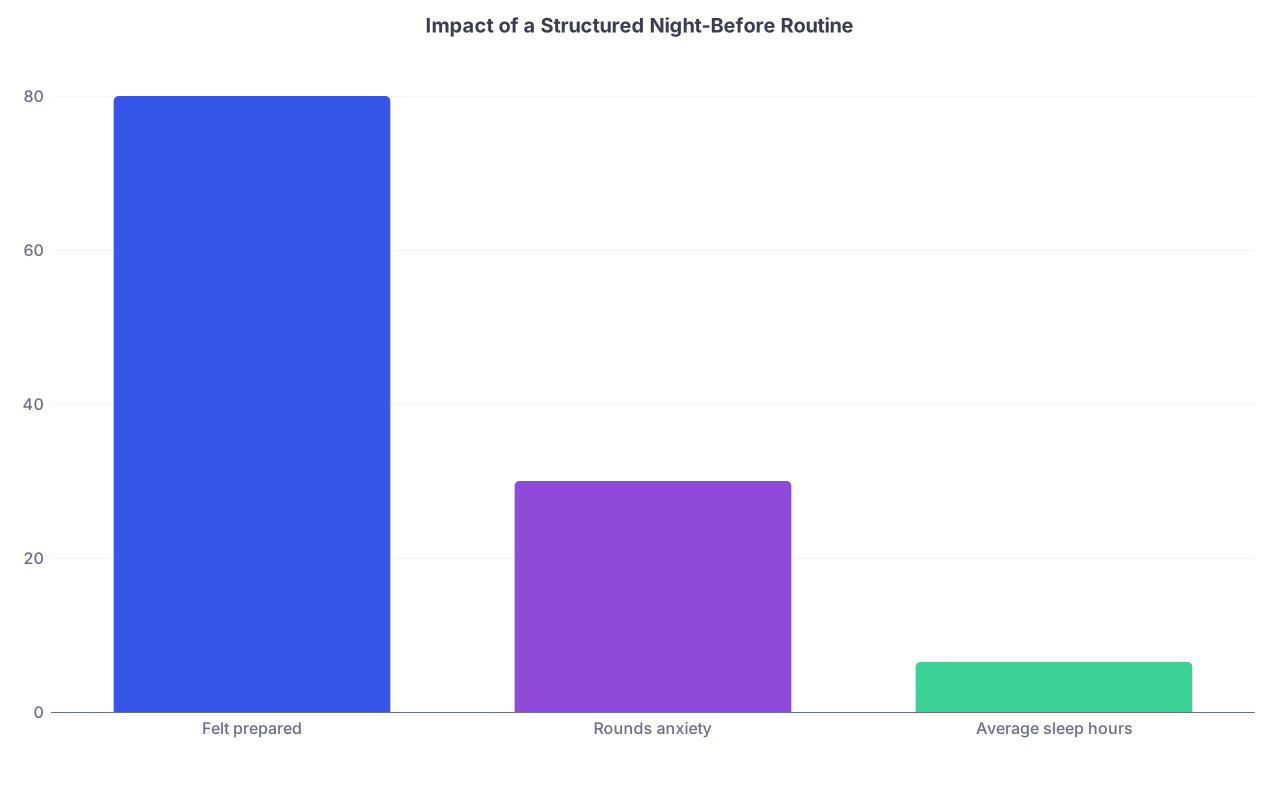
| Category | Value |
|---|---|
| Felt prepared | 80 |
| Rounds anxiety | 30 |
| Average sleep hours | 6.5 |
(Interpreting this how most residents describe it: when they adopt a system like this, perceived preparedness jumps, anxiety drops, and sleep time actually goes up.)
FAQ (5 Questions)
1. How long should night-before rounds prep actually take?
For a typical 10–15 patient list, 30–45 minutes is plenty once you have a system. Early on or with many new/sick patients, you might stretch to 60 minutes, but if you’re routinely pushing past an hour, you’re likely doing extra chart review that isn’t improving your performance on rounds. Aim to trim low-yield activities (like rereading old notes) first.
2. Should I pre-write my entire assessment and plan at night?
Usually no. You can jot bullets or a rough outline for complex patients, but fully writing A/Ps at night is a trap: labs, vitals, and events will change by morning, and you’ll end up rewriting anyway. Use the evening to build structure in your head and on your list; use the morning data to finalize and document.
3. How do I handle days when there are a ton of new admits?
You switch to triage mode. Go deeper on: unstable patients, unclear diagnoses, and anyone headed to a procedure or ICU. For straightforward admits (uncomplicated pneumonia, mild CHF exacerbation improving quickly), focus on a crisp one-liner, a clear plan for the top 2–3 problems, and criteria for discharge. You can refine nuances later in the day.
4. What if my attending likes a different style than what I prepare for?
You adapt the surface to their style, not the core system. If they love detailed labs, add key numbers to your list. If they prefer problem-based over system-based presentations, reframe your script. But the backbone remains the same: you still know the story, the trajectory, and the plan. Your private prep system doesn’t change every month; your presentation does.
5. How do I keep from burning out when every night feels like more work?
You protect sleep with a hard stop time, you stop chasing perfection on every patient, and you lean on templates and routines instead of willpower. The point of a night-before system is to reduce cognitive load, not increase it. Once it’s automatic, you’ll spend less time flailing and more time doing focused, high-yield prep – and you’ll feel it on rounds.
Key takeaways:
Efficient residents prepare for rounds by building a repeatable system, not by staying up later. Your night-before work should focus on: a clean, useful patient list; brief micro-plans for each patient; and prioritizing sick/new patients over stable ones. Then you protect your sleep and use a short morning update to finish the job.