
You walk into the ICU workroom for your first day as a brand-new intern. Whiteboard full. Everyone talking about vents and pressors like it’s a different language. Someone hands you “the list,” your pager goes off before you even sit down, and the night resident says, “You’re covering beds 5–12, sign-out in 10.”
You’re not scared of medicine. You’re scared of losing control. Forgetting someone. Missing a critical lab. Looking like chaos while everyone else seems… fine.
Here’s the game plan: how to stay organized on ICU as a brand-new intern so you do not drown.
Step 1: Your Core Mindset for ICU
You’re not trying to be impressive on day 1.
You’re trying to be:
- Safe
- Predictable
- Findable (people know what you’re doing, where you are, and what you’re waiting on)
The ICU punishes disorganization. Not because you are dumb, but because:
- Every patient has dozens of data points
- Everything changes hourly
- Nurses will rightfully escalate when they sense chaos
So your main goals:
- Build a rigid routine for every patient, every time
- Externalize your brain (lists, checkboxes, timers, EMR flags)
- Communicate your plan repeatedly, even if it feels redundant
If you get those right, the medical knowledge can layer on top.
Step 2: Set Up Your Tools Before You Touch a Patient
Do this before rounds. Before “helping out.” Before you say yes to extra tasks.
A. Your patient list: non-negotiable structure
Most ICUs have a template list. If they do, use it. If not, make one. For each patient, you should have at least:
- Name / MRN / Room
- Primary problem (1 line: “Septic shock 2/2 pneumonia”)
- Code status
- Vent: mode / FiO2 / PEEP (or “RA” if not intubated)
- Pressors: which, dose, titration goal (MAP > 65)
- Lines/tubes: ETT, A-line, central line, Foley, NGT, drains
- Key labs: Na / K / Cr / lactate / Hgb / WBC (or whatever matters today)
- Drips: sedation, insulin, heparin, others
- To-do boxes (for today’s tasks)
Make it compact. You’ll be looking at it constantly.
| Field | Example |
|---|---|
| ID/Room | Smith, John / 8A |
| Problem | Septic shock 2/2 pneumonia |
| Code Status | Full |
| Vent | AC/VC 16/450/5, FiO2 40% |
| Pressors | Norepi 0.08, MAP goal > 65 |
| Lines/Tubes | ETT, A-line, RIJ CVC, Foley |
| Key Labs | Na 138, K 3.6, Cr 1.4, Lac 2.1 |
| Drips | Prop 25, Fent 50, Insulin gtt |
| Today’s Tasks | □ Wean FiO2, □ Repeat lactate |
Print it if your unit allows. If not, keep it open and updated in real time.
B. Timer and alarms
Your phone (if allowed) or your pager watch:
- Set alarms for:
- Critical re-checks (post-bolus BP recheck, post-vent change ABG)
- “Do not forget” tasks (call family by 3 pm, repeat lactate at 16:00)
- Time-sensitive meds (stress-dose steroids, q1h checks)
If you tell a nurse, “I’ll come reassess in 30 minutes,” set an alarm. Every time.
C. Your pre-made ICU note template
Bust this out before you get crushed. Build a skeleton ICU note with fixed sections:
- Overnight events
- Neuro
- CV
- Pulm
- Renal/Fluid
- GI/Nutrition
- Heme
- ID
- Endo
- Lines/Tubes
- Prophylaxis / Code status / Dispo
Copy it into each patient’s note. Edit as you go. Do not reinvent the wheel on every note.
Step 3: Pre-Rounds: How to Prep Each Patient Without Wasting Time
You’ll be tempted to click everything. Don’t. You don’t have time.
Here’s a tight sequence that works.
For each patient, in this order:
Check vitals trend (last 12–24 hours)
Scan: fever curve, MAPs, HR, RR, SpO2, I/Os.
Ask: better, worse, or stable?Check current supports
- Vent settings (pull up vent flowsheet, don’t rely on memory)
- Pressor doses + MAP goal
- Sedation and pain meds
- Any new lines placed overnight
Scan labs and imaging
- Look at:
- BMP, CBC, lactate, ABG if on vent or unstable
- Culture results, new imaging
- Do not read every radiology report word-for-word unless it’s new and relevant.
- Look at:
Read overnight note / sign-out
- What changed? Any boluses? New arrhythmias? Procedures?
Update your list
- Cross off old tasks
- Add 1–3 focused “today” goals per patient:
- “Wean FiO2”
- “Start trickle feeds”
- “Assess for extubation readiness”
Walk into the room
- Glance at:
- The patient (awake? sedated? distressed?)
- Ventilator screen
- Drip pumps
- Foley bag / drains
- Introduce yourself to the nurse if you have not yet: “Hey, I’m [Name], new intern on days. I’m covering [rooms]. Anything worrying you right now about [patient]?”
- Glance at:
That last sentence will save you repeatedly. Nurses will tell you what actually matters.

Step 4: Surviving Rounds Without Losing Your Mind
ICU rounds are firehose-level. Multi-attending, RT, PT, pharmacy, case management, maybe students. You’re trying to:
- Present coherently
- Capture every plan item
- Not get destroyed when the attending rapid-fires questions
Here’s how to structure yourself.
A. Pre-round “micro-presentation” notes
For each patient, write 3–5 bullet lines on your list or paper:
- ID + hospital day + reason they’re here
- What changed overnight (1–2 bullets)
- Supports: vent mode/FiO2/PEEP, pressors, key drips
- Today’s 2–3 main issues
- A very short “plan headline” for each issue
Example:
- “70M, HD 3, septic shock 2/2 pneumonia, intubated”
- “Overnight: norepi up from 0.04 → 0.10; FiO2 40→50%”
- “Vent: AC/VC 16/450/8, FiO2 50%; Norepi 0.10, MAP goal >65”
- “Issues: Shock, Hypoxemic RF, AKI”
- “Plan: Trend lactate, adjust pressors, consider diuresis vs. fluid, pulm toilet, evaluate for SBT tomorrow if oxygenation improves”
You don’t need a speech. You need an organized skeleton to talk from.
B. How to capture orders during rounds
While the team discusses the plan, your job is to write down orders in real time in a very specific, action-oriented way.
Do not write “renal – fluids.”
Write: “AKI – check FeNa; hold lisinopril; strict I/Os; renally dose meds.”
Do not write “wean vent.”
Write: “Vent – wean FiO2 to maintain SpO2 > 92%; try PEEP down to 5 this afternoon if stable; consider SBT tomorrow a.m.”
Pro move: put a □ checkbox in front of every task:
- “□ Order repeat lactate 14:00”
- “□ Call family with update before 17:00”
- “□ Remove Foley if UOP stable and no retention”
You will physically check these as you go. Very satisfying, very effective.
C. When you’re grilled and you do not know
You will get asked about:
- Vent modes
- Pressor choice
- Antibiotic coverage
- Weaning criteria
If you do not know, don’t bluff. Say:
- “I’m not sure, but my understanding is…”
- “I don’t know the best vent mode here; can you walk me through how you’re thinking about it?”
Then write down the explanation. Not because you’ll use it on boards. Because the same question will come up again tomorrow.
Step 5: Mid-Day: Controlling the Chaos
From 10 am to 5 pm, everything hits at once:
- New admission
- Central line needed
- Nurse calling for low MAPs
- Family wanting to talk
- Pages about 3 different patients within 2 minutes
You need a triage and task system.
A. One running “to-do” list for the whole unit
On a separate sheet or EMR note, keep an active daily task list with priorities.
Use 3 levels:
- “NOW” – threats to life / stability
- “SOON” – today but not urgent (orders, ABGs, med changes, consults)
- “LATER” – can be done between 3–6 pm (discharge summary drafts, detailed notes, education)
Reassign tasks as new stuff hits.
B. A simple triage rule for interruptions
When multiple things hit you at once, think:
- Airway/breathing problem? (vent alarms, desaturation)
- Hemodynamics? (MAP < goal, new arrhythmia, bleeding)
- Neuro change? (new confusion, decreased responsiveness)
Those beat:
- “Can we liberalize diet?”
- “Family wants to know MRI timing”
- “Can you sign this PT order?”
If you’re stuck, say to the person paging you:
- “I’m managing an unstable patient right now, but I will come as soon as I stabilize them. Is it safe to wait 20–30 minutes?”
If they say “No,” you re-triage.
C. How to manage new admissions without losing your other patients
New ICU admission is anxiety-inducing. Do not abandon your current list.
Do this:
- Ask your senior: “Do you want me at bedside now or can I finish X first?”
- On your list, put a big star next to any time-critical follow-up (like ABG post vent change). Set an alarm.
- During admission:
- Get the basics: ABCs, vitals, initial labs, empiric antibiotics, fluids/pressors
- Document a focused H&P (it doesn’t have to be novel-length)
- Update your list and to-do sheet as soon as you step out
You can always fill in more chart-review “story” later. Stabilization comes first.
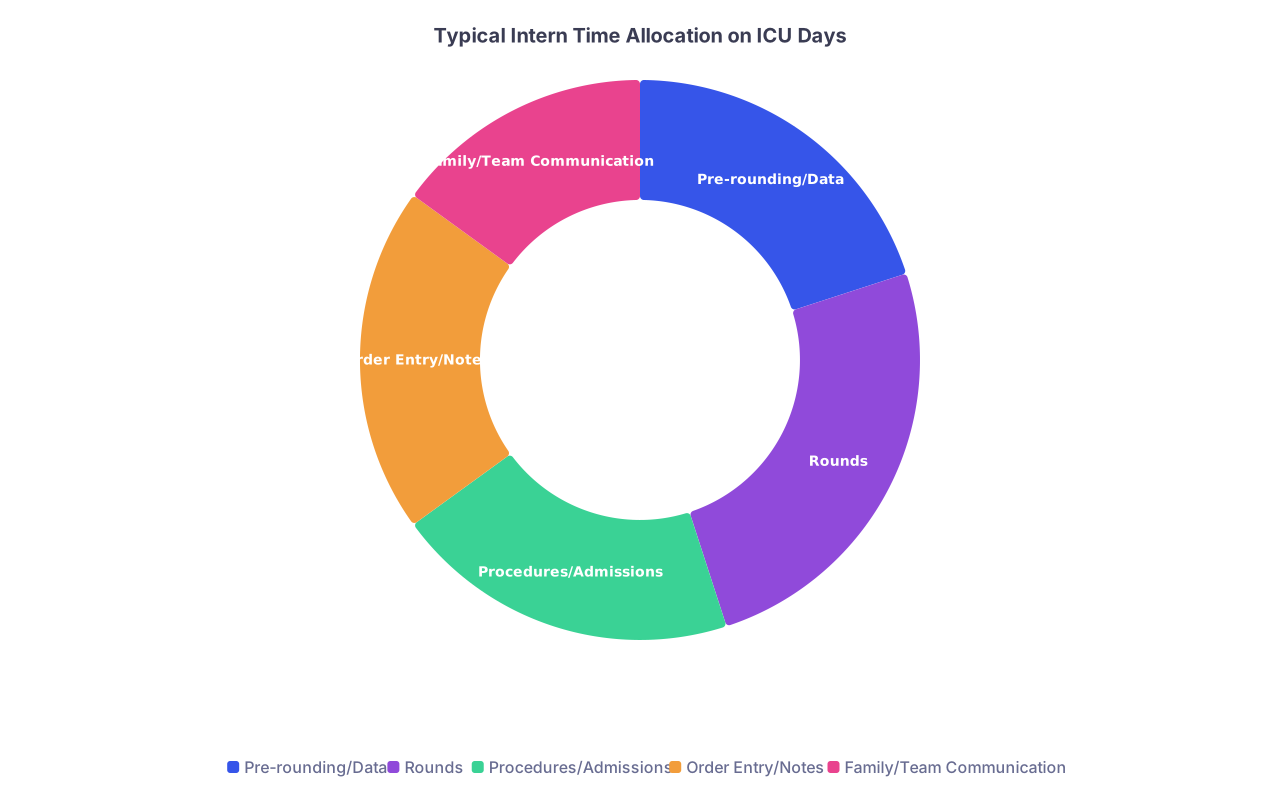
| Category | Value |
|---|---|
| Pre-rounding/Data | 20 |
| Rounds | 25 |
| Procedures/Admissions | 20 |
| Order Entry/Notes | 20 |
| Family/Team Communication | 15 |
Step 6: Keeping Track of Labs, Imaging, and “Did I Follow Up On That Thing”
ICU is basically a constant loop of: order → wait → reassess → adjust.
You will forget stuff if you don’t systematize follow-up.
A. Build a follow-up section for each patient
On your list or in a small margin, create a recurring spot:
- “Pending / follow-up today:”
Examples:
- “Blood cultures – follow at 14:00”
- “Repeat lactate @ 14:00 – check result by 15:00”
- “CT head read – check final report by 16:00”
When you order something, immediately add it under that line and—again—set alarms for truly time-sensitive items.
B. EMR tools: use them like a grown-up
Most EMRs let you:
- Favorite key labs (ABG, lactate, BMP, CBC) in one “summary” screen
- Set up customized flowsheets (vitals + drips + I/O in one view)
- See “recent results” by time
Take 10–15 minutes early in your rotation with a senior or friendly nurse to learn how your ICU likes things displayed. This one-time investment pays off for weeks.
Step 7: Talking to Nurses Like a Functional Team Member
If the nurses think you’re disorganized, you’ll sink. If they trust you, they’ll save you.
A. Start of shift: make a loop
In the first hour, try to:
- Walk by each of “your” patient rooms
- Briefly say to each nurse: “I’m [Name], covering [rooms] today. Anything that worried you overnight or anything specific you need from me early?”
They will tell you:
- “He was really hypotensive when we turned him.”
- “Family’s been calling nonstop.”
- “She wakes up extremely agitated when we lighten sedation.”
That’s gold. It also shows you care.
B. When a nurse calls with a concern
Do not brush it off. Don’t armchair-manage from the computer.
If possible, go see the patient. At the bedside, do a quick, structured check:
- Look at the patient
- Look at monitor and drips
- Listen to nurse’s assessment
- Make a plan and say it out loud:
- “Okay, let’s give a 500 mL bolus and recheck BP in 15 minutes. I’ll put the order in now and I’ll come back to reassess.”
Then document a quick note if it’s a meaningful change.
C. When you disagree
Sometimes what the nurse asks for doesn’t match what your attending wants.
Say:
- “I hear you; that makes sense. Our attending’s plan is [X]. Let me call and clarify if we can adjust.”
Then actually call. Be transparent. Do not hide behind “they won’t let me.”
Step 8: End-of-Day Checklist So You Don’t Screw the Night Team
The fastest way to make enemies is to hand off a disaster at 6:59 pm.
Here’s your late-afternoon structure.
A. For each patient, ask yourself:
- Are vitals reasonably stable for handoff?
- Are there any “scheduled land mines” after sign-out?
- Expiring pressor bags
- Time-sensitive antibiotics
- Scheduled CT/IR procedures
- Have I:
- Followed up all critical labs I ordered?
- Put in overnight PRN parameters that make sense? (e.g., SBP ranges, insulin sliding scale, pain/sedation orders)
B. Clean sign-out
Your sign-out for each patient should include:
- One-line ID + primary problem
- Current support level (vent/pressors)
- “If-then” statements for common overnight issues:
Example:
- “If MAP < 65 despite norepi up to 0.2, call fellow—do not start second pressor without discussing.”
- “If vent dyssynchrony and desaturation, first check for kinked tubing, secretions, biting; then call RT; if still bad, page me/fellow for sedation bolus.”
- “If UOP < 0.3 mL/kg/hr for 4 hours, don’t give blind fluids; please call—concern for evolving AKI vs. cardiogenic shock.”
The night team will love you for this.

| Step | Description |
|---|---|
| Step 1 | Arrive Early |
| Step 2 | Pre-round Chart Review |
| Step 3 | Bedside Check and Nurse Huddle |
| Step 4 | Multidisciplinary Rounds |
| Step 5 | Order Entry and Early Tasks |
| Step 6 | Admissions and Procedures |
| Step 7 | Afternoon Follow Ups and Labs |
| Step 8 | Family Updates and Documentation |
| Step 9 | Stabilize for Night Team |
| Step 10 | Structured Sign Out |
Step 9: Protecting Your Own Brain So You Don’t Burn Out in Week 1
Yes, we’re talking organization, but none of this holds if you’re cognitively cooked.
A few blunt points:
- Hydrate and eat. If you don’t schedule a 5–10 minute break to shove food in, the day will eat that time for you. Pick a time (11:30ish or 14:00ish), tell your senior, “I’m stepping away for 10 minutes unless something is crashing.” Then go.
- Sleep what you can. On nights, do not waste your post-call hours doom-scrolling. Shower, sleep.
- Debrief your worst case each week with someone: senior, co-intern, mentor. ICU will mess with your head if you pretend it doesn’t.
- Keep a small “lessons learned” note on your phone:
- “Don’t forget to recheck lactate after bolus.”
- “Ask RT before making vent adjustments yourself (in this unit).”
- “Always confirm code status changes via proper note + order.”
That little list will turn into your personal ICU manual.

Step 10: Specific “Do This, Not That” ICU Organization Moves
To make this concrete, here are some very direct comparisons.
| Situation | Bad Habit | Better Habit |
|---|---|---|
| New order placed | Assume you will remember to check | Add to follow-up list + set alarm |
| Vent change during rounds | “RT will handle it” | Confirm change happened + plan ABG/check |
| Nurse calls with concern | Give orders from computer | Go to bedside, reassess, then decide |
| Notes | Start from scratch every time | Use structured ICU template and update daily |
| Rounds | Try to memorize overnight events | Micro-outline per patient before rounds |
| End of day | Leave labs hanging | Scan orders for pending results before sign-out |
Final 2–3 Things to Remember
- Organization in the ICU is not optional; it’s a safety intervention. Your list, checkboxes, timers, and routines literally prevent harm.
- Do the same structured thing for every patient, every day: chart → bedside → talk to nurse → update list → execute plan → follow up. Boring is good.
- Over-communicate with nurses, seniors, and night team. If people know what you’re doing and what you’re worried about, you’re already ahead of most brand-new interns.
You’re going to feel behind for the first week or two. That’s normal. Just don’t let disorganization be the reason.