
It’s 2:43 a.m. You’re on night float. You’ve got 18 patients, 4 cross-cover admits, 27 unread labs, and the ED is paging you about “just a quick admit, very stable.”
And in the back of your head is the same looping thought:
What if I miss the one patient who’s actually crashing?
Not the obvious code-blue, chest-clutching, STAT-intubate kind of sick. Those you see coming.
I’m talking about the quiet trainwreck. The “they were fine at sign-out” patient who’s now hypotensive, altered, and septic—and nobody noticed for 4 hours because everyone assumed someone else was watching.
That’s the nightmare, right?
Not just that a patient gets worse.
But that they get worse and you. didn’t. see. it.
You’re not crazy for obsessing over this. That fear is actually accurate. You can absolutely miss a deteriorating patient if you rely on vibes and random chart checks. The system is not designed to protect you from that. You have to build your own safety net.
Let’s talk about how to do that—how to create “red-flag alerts” in your own brain and workflow so the truly sick or about-to-be-sick patients practically scream at you from your list.
Step One: Accept That Your Brain Alone Is Not Enough
The first hard truth: your brain, by itself, is a terrible early warning system at 3 a.m.
You’re tired. You’re juggling too many people. You don’t remember every detail you were told at sign-out. And the EHR is basically a hostile environment that hides the most important data 5 clicks deep.
So yeah, you will forget things if you don’t externalize them.
The residents who look “chill” and “effortless” usually aren’t relying on memory. They have systems. Crude ones sometimes, but systems.
I’m going to walk through specific things you can start doing tomorrow that turn “vague worry” into actual red-flag alerts you can see, touch, or hear.
Step Two: Build a Red-Flag List for Every Shift
You need a working list that makes your sickest or most unstable patients visually impossible to ignore.
On paper. On your sign-out. On your EHR list. I don’t care where—just somewhere you actually stare at.
Here’s the basic idea:
Every shift, you explicitly mark patients who are even remotely worrisome, whether or not anyone else is taking them seriously.
Personal rule I’ve seen work: if a patient has any of these, they get flagged:
- Borderline vitals
- High-risk story (GI bleed, sepsis, NSTEMI, ODs, post-op day 0–1)
- Recent rapid / ICU transfer / stepdown
- Big change in status over last 12–24 hours
- You have a “gut unease” about them but can’t fully articulate it
And you don’t just flag them once. You write down what you’re watching for.
Something like:
| Patient | Risk Reason | Must Recheck By |
|---|---|---|
| Bed 12A | New sepsis on pressors weaning | 02:30 vitals/labs |
| Bed 8C | GI bleed, Hgb drop from 9 to 7.4 | Repeat Hgb at 04:00 |
| Bed 10B | COPD on BiPAP, borderline gas | ABG and mental status 03:00 |
| Bed 6D | Post-op day 0, tachy 110-120 | Pain, UOP, vitals 02:45 |
| Bed 3E | DKA, transitioning off insulin | Gap, K, anion gap at 03:30 |
Is this extra work? Yes.
Does it actually keep you from dropping the ball? Yes.
Because now you’re not vaguely “keeping an eye” on someone. You’ve created promises to your future self. And you either honor them or you know you’re consciously breaking them.
Step Three: Use the EHR Like a Weapon, Not a Maze
I hate EHRs. You hate EHRs. Everyone hates EHRs.
But there’s one thing they’re good at: repetitive, predictable alerts—if you set them up or at least use what’s already there.
Make your list scream at you
Ask upper levels or nurses how they “hack” the EHR to highlight sick patients. Common tricks I’ve seen:
- Sorting patients by unit or acuity so the sickest (ICU/stepdown) are always at the top of your list
- Changing patient list colors/tags for “watch closely,” “new admit,” “rapid earlier”
- Adding custom columns for: lactate, MAP, HR, O2 requirement, code status
You want to be able to glance at your list and immediately see:
Who’s hypotensive? Who’s on more O2 than yesterday? Who has a rising creatinine or lactate? Who has a fresh positive blood culture?
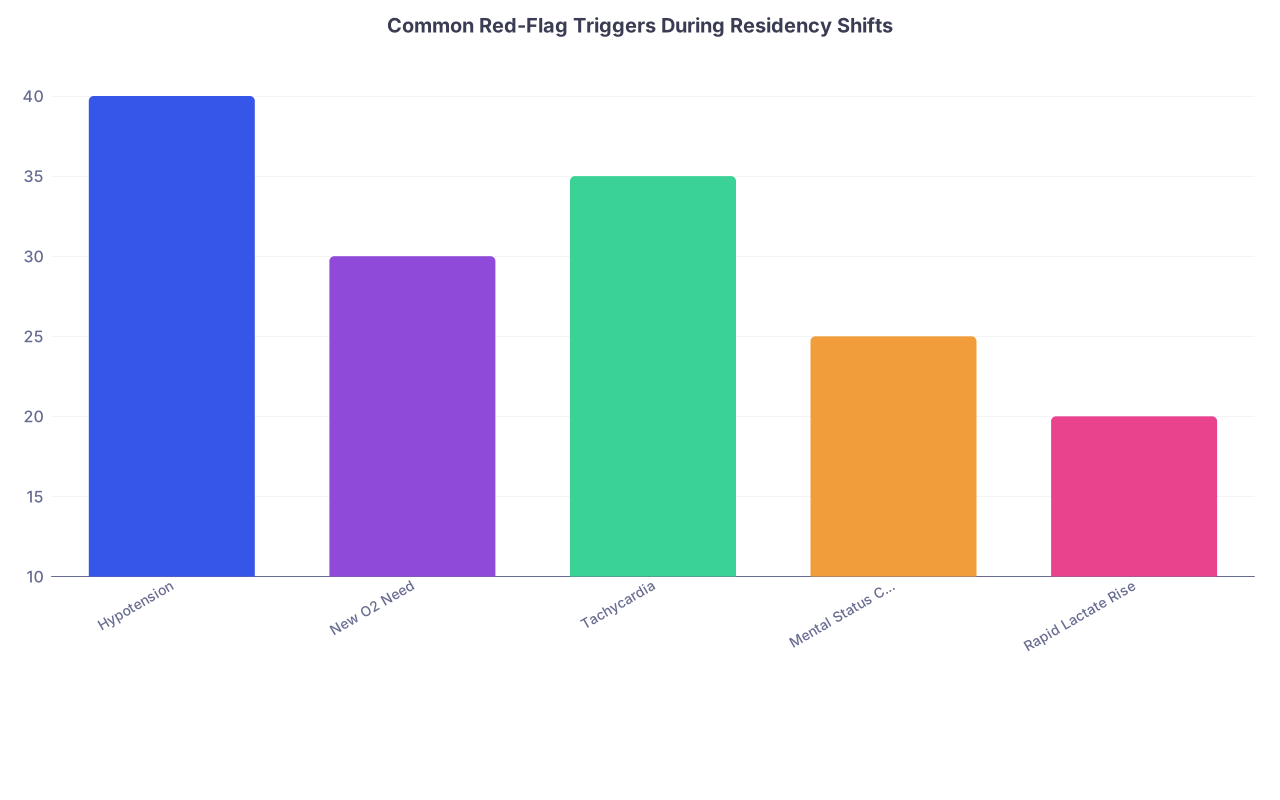
| Category | Value |
|---|---|
| Hypotension | 40 |
| New O2 Need | 30 |
| Tachycardia | 35 |
| Mental Status Change | 25 |
| Rapid Lactate Rise | 20 |
If your EHR allows it, create patient lists that auto-flag:
- MAP < 65
- HR > 110
- RR > 24
- O2 > 4 L NC or new HFNC
- Lactate > 2, or trending up
- New troponin, new positive blood culture
- Creatinine jump > 0.3 in 48h
If it can’t auto-flag, then you manually check these on your “red-flag list” at set times and write them down.
Step Four: Time-Based Check-Ins (So You’re Not Trusting Memory)
The thing that burns residents over and over is this:
“I meant to recheck them, but I got pulled into something else.”
Translation: there was no hard stop forcing you to circle back.
So you need two layers: scheduled red-flag reviews and “must-hear-from” rules.
1. Scheduled red-flag rounds
Every night shift, build in structured mini-rounds on your risky patients.
Example pattern that works on nights:
- Start of shift: identify + list red-flag patients, write why they’re high-risk
- 10–11 p.m.: first full recheck of all flagged patients (chart + eyeballs if needed)
- 1–2 a.m.: vitals + labs + nursing concerns for all flagged patients
- 4–5 a.m.: final “am I comfortable signing these patients out?” review
You don’t always need to physically see every single one every time, but if your gut is even slightly queasy, you go see them. You don’t argue with that feeling. It’s there to save you.
2. “If I don’t hear from you by X, I’m coming back”
When you put in a plan with nursing—especially with “soft” things like fluids, titrating pressors, insulin, pain meds—say something like:
“If their MAP is still <65 in 30 minutes, let me know. If no change by an hour, I’m coming back.”
Or:
“If they’re still working hard to breathe in 15–20 minutes, page me. If I haven’t heard by 30–40 minutes, I’ll swing by again anyway.”
Then you actually write: “Recheck in 30 min” on your list with the time.

| Step | Description |
|---|---|
| Step 1 | Start shift |
| Step 2 | Identify red-flag patients |
| Step 3 | Write specific concerns and recheck times |
| Step 4 | First red-flag rounds 22-23h |
| Step 5 | Update concerns and orders |
| Step 6 | Second check 01-02h |
| Step 7 | Third check 04-05h |
| Step 8 | Prepare safe sign-out |
Is it annoying to be this structured? Yeah.
Is it better than waking up to “the patient was hypotensive for hours and no one did anything”? Absolutely.
Step Five: Use Nurses as an Early Warning System (Because They Are)
If you want to not miss a crashing patient, you need nurses on your side. Full stop.
Nurses see deterioration before anyone else, almost every time. They know whose urine output is dropping, who’s getting more confused, who suddenly “doesn’t look right.”
The problem is: they’re used to being brushed off. So some of them get quieter. Or they call later than they should because the last resident snapped at them.
You want the opposite. You want to be the resident they feel comfortable “bothering.”
Say this out loud at the start of a shift or after a rapid:
“Please call me early if you’re worried. I’d always rather be called too soon than too late, even if it turns out to be nothing.”
And actually mean it. Even when the page feels “unnecessary.” Because what you’re really protecting is the relationship, not just that moment.
Some things I’ve seen good residents say when they’re truly overwhelmed but still want that trust:
“Hey, I’m getting pulled into something acute, but you’re worried, so I’m going to trust that. Here’s what I can do right now, then I’ll come back and reassess once I’m free.”
Or:
“Okay, their vitals look okay right now, but your concern matters. Let’s order X, Y and I’m going to put a note for myself to recheck in 30 minutes.”
That nurse will absolutely call you next time before a disaster.
Step Six: Make Your Sign-Out a Red-Flag Map, Not a Data Dump
Sign-out is where a ton of badness gets baked in. People say “they’re fine” when they are not remotely fine.
Your goal is simple: any cross-cover resident, including your sleep-deprived future self, should know exactly who to watch and what to be terrified of.
Focus on 3 questions for each patient:
- Why are they here? (1-line problem frame, no fluff.)
- What am I specifically worried might happen next?
- What should you do or check if X happens?
Bad sign-out:
“Bed 12, 68-year-old with pneumonia. On 4 L. Pretty stable.”
Better:
“Bed 12, 68-year-old with pneumonia, now on 4 L from 2 L this morning. I’m worried she’s trending toward respiratory failure. Red flag for you: if she needs >6 L or RR >28 or more confused, please call me/ICU early and consider ABG + CXR.”
You should be verbally saying:
“These three patients are red-flags for tonight. I’d check them first and again around 1–2 a.m.”
If you’re receiving sign-out and people say “everyone’s fine,” push back gently:
“Okay, who are you least comfortable with?”
“Who would you not want to hear about overnight because it would mean they’re much worse?”
That’s your red-flag list.
Step Seven: Internal Red Flags – The “I Feel Weird About This” Rule
Little secret: most residents who miss a crashing patient had a moment earlier in the shift where they thought, “Something feels off,” and they ignored it.
They rationalized it:
“It’s probably just anxiety.”
“They look okay right now.”
“I don’t want to overreact and bug the attending.”
I’m telling you directly: you get to overreact as a resident. That is literally the job.
Create a personal rule:
If I find myself thinking, “Am I overreacting?” – I will assume I’m not, and I’ll check again or escalate.
And write that concern in your note or sign-out, even if it feels vague:
“Clinical status feels fragile. Will need close overnight monitoring.”
“Unsure if early sepsis vs. mild SIRS, low threshold to broaden/bolus/call ICU.”
A vague unease written down becomes a red-flag later when someone goes, “Oh, okay, they were already on the radar.”
Step Eight: When Things Still Go Wrong (Because They Will)
Here’s the other fear sitting in your chest:
What if I do all this, and someone still crashes and I still feel like I failed them?
That’s not hypothetical. It will happen. Sometimes the trajectory is too fast. Sometimes you don’t get called. Sometimes the disease wins.
The point of red-flag systems isn’t to give you a 0% miss rate. You’re not a robot, and medicine is not a video game with perfect inputs.
The point is:
- You create a track record of reasonable, documented vigilance.
- When something goes sideways, you can see what failed (system, communication, you) and figure out how to tighten your process.
- You slowly peel away the truly preventable misses.
And maybe the most honest thing:
Even with perfect systems, you’ll still wake up some nights replaying cases in your head.
“Why didn’t I check them one more time?”
“Would it have changed anything if I called ICU 30 minutes earlier?”
That’s part of this job’s ugliness. But building red-flag alerts gives you fewer of those nights. And when they do happen, you’ll be able to say, “I had a plan. I was watching. It wasn’t neglect.”
Quick Reality Check: You’re Not Supposed to Do This Alone
Last thing, because it matters.
If your census is 25 patients, your cross-cover list is ridiculous, and your system has zero built-in safety nets, that’s not a “you’re not vigilant enough” problem. That’s a structural one.
Still, within the mess you’re in, you can:
- Flag 3–6 patients per shift to be extra obsessive about
- Use nursing, RT, and pharmacy as actual teammates, not just people who page you
- Speak up when a patient feels too sick to be on the floor
- Call your senior/attending early and say, “I’m worried. Here’s why.”
Nobody worth respecting will ever roast you for over-calling on a sick patient. They will absolutely question you if you under-call.
So if you’re going to err, err loudly.

FAQs
1. How many “red-flag” patients is realistic to track on a busy night?
On a brutal night with 20+ patients, you’re not going to microscrutinize all of them. That’s fantasy.
Aim for 3–6 truly high-risk patients on your explicit red-flag list. That doesn’t mean you ignore the others; it means these are the ones you’re going to double- or triple-check, write recheck times for, and mentally prioritize. If you’ve got more than 6 that you feel uneasy about, that’s a sign you should talk to your senior about level of care or getting help.
2. What if my senior/attending thinks I’m overreacting about a patient?
Let them think that. Your job is to be the canary in the coal mine, not the cool cucumber who misses sepsis. Phrase it clearly: “I might be overcalling this, but here’s what I’m seeing and why I’m worried.” Then document your concern in the chart. You are allowed to be the one in the room who says, “I’m not comfortable with this on the floor.” That’s not drama. That’s judgment.
3. How do I balance red-flag vigilance with not burning out from constant anxiety?
You can’t run at “code blue” adrenaline all night, every night. The point of systems—lists, time-based checks, EHR flags—is to take some of the anxiety out of your head and put it into structure. Instead of cycling through 15 “what ifs,” you say: “These 4 people are my red flags. I checked them at 10 p.m., 1 a.m., and 4 a.m., and I had a plan.” Structure is how anxious people (hi, us) survive this job.
4. What do I do when a nurse doesn’t seem worried, but I am?
You’re allowed to be more worried than the nurse. Use their assessment, but don’t let it override your own. You can say: “I hear you that they seem okay right now, but something about this trajectory worries me. Let’s do X, Y and I’ll recheck in 30 minutes.” You’re not accusing anyone. You’re just acknowledging that you hold the liability and the medical decision-making.
5. How do I fix things if I already missed a deteriorating patient?
First, don’t pretend it didn’t happen. Look back specifically: Did you have any red flags you ignored (borderline vitals, lactate, nurses’ concern)? Did you have no system at all (no list, no recheck times)? Use that case to rebuild how you practice: add a red-flag list, set hard recheck times, get more aggressive about early calls. And when M&M comes, don’t just let it be theoretical. Ask yourself, “What would I literally write or do differently on my next similar patient?”
6. How do I know if I’m being “too anxious” about patients?
Honestly? Early in training, “too anxious” almost always beats “too chill.” Over time, you’ll notice patterns: which red flags almost always matter (rising O2 needs, soft BPs, confusion, low UOP), and which ones rarely do. You’ll calibrate. But you only get to calibrate if you start by seeing those patients and mentally logging, “Okay, this pattern got worse; this one didn’t.” Until then, lean into the anxiety but channel it into structure: lists, times, specific vitals/labs you’re tracking, not just vague dread.
Years from now, you won’t remember the exact blood pressure or lactate of that one borderline patient on your third night float. You’ll remember whether you ignored your worry—or turned it into a system that kept people alive.