

The idea that “real estate is always the best retirement plan” is wrong.
Owning rental property can absolutely work for retirement planning—but only if the numbers and the hassle both make sense for you. For a lot of people, the returns don’t justify the stress, risk, and complexity. For others, it’s the backbone of a very solid retirement.
Let’s walk through this like an actual decision, not a sales pitch.
The Real Question: What Are You Trading For What?
You’re not just buying a rental. You’re trading:
- Time
- Headspace
- Risk (tenant, property, legal, market)
…for:
- Cash flow
- Tax benefits
- Potential appreciation
- Some inflation protection
If you want a clean framework, you’re really answering three questions:
- Can I get a better risk-adjusted return with less hassle somewhere else (index funds, bonds, annuities)?
- Do I realistically want to deal with tenants, repairs, and decisions in my 60s and 70s?
- Do the actual numbers on a given property support my retirement income target—not just in a “best case” market?
Most people skip straight to “real estate builds wealth” and never do that analysis. That’s how they end up being “accidental landlords” who resent every phone call.
How To Evaluate A Rental For Retirement – In Numbers, Not Vibes
Forget appreciation for a minute. For retirement planning, long-term cash flow is the main point. Here’s the bare minimum math you should be doing on any property you’re considering as part of your retirement plan.
1. Start with realistic income and expense numbers
Monthly rent: be conservative. Don’t use the top Zillow estimate. Use what similar units actually rent for today.
Then subtract this, every month:
- Property taxes (annual / 12)
- Insurance (annual / 12)
- HOA, if any
- Property management (typically 8–10% of collected rent)
- Maintenance reserve (minimum 8–12% of rent)
- Vacancy (5–10% of rent)
- Utilities you pay, if any
- Any other fixed junk (landscaping, pest control, etc.)
That gives you Net Operating Income (NOI) before the mortgage. Then subtract:
- Principal and interest on the mortgage
What’s left is your cash flow. That’s your actual monthly retirement income from this unit.
If you’re trying to replace, say, $4,000 a month in retirement income, and one property will realistically net you $400 a month after everything, that’s 10 similar properties you’d need. Helpful to see it in those terms.
2. Compare to what your money could do elsewhere
Let’s say you’re buying a $300,000 rental. You put down $75,000 (25%). Closing and setup costs bring it closer to $85,000 out of pocket.
After all expenses, including property management, you net $400/month = $4,800/year.
$4,800 ÷ $85,000 ≈ 5.6% cash-on-cash return. Then you might add:
- Principal paydown (equity buildup)
- Long-term appreciation assumption (say 2–3% above inflation—maybe)
- Tax benefits (depreciation, etc.)
Once you factor those in, your total return might be 8–10% in a decent market.
Now compare that to:
- A 60/40 stock-bond portfolio with a long-run expected return of 6–8%
- A pure stock index approach at 8–10% over long periods
- Dividend ETFs at 3–4% yield plus growth
But here’s the key: stocks don’t call you at 11 pm with a plumbing leak. Rentals are not passive in the way index funds are passive, even with a property manager.
Where Rentals Shine Specifically For Retirement
Rentals can be excellent in a few very specific scenarios. If you’re in these categories, real estate might absolutely be worth the hassle.
1. You’re in a high-tax bracket and want depreciation
Real estate allows you to depreciate the building value (not the land) over 27.5 years for residential. That’s a big paper loss that can offset rental income.
For example:
Building value: $275,000
Annual depreciation: ~$10,000
If your rental income is $8,000 net before depreciation, you might show a tax loss on paper while still putting cash in your pocket. For high earners, especially those who qualify as real estate professionals or materially participate, this can be very powerful.
If you’re already retired with modest taxable income, that tax shield still helps, but the impact might be smaller. Though it can help you control how much taxable income you show from year to year.
2. You want inflation-resistant income
Rents generally rise with inflation over time. So does replacement cost and sometimes property value.
If you lock in a fixed-rate mortgage, your biggest cost stays flat while rents increase. Long term, that can widen your margin nicely and act as a built-in inflation hedge.
This is something bonds and fixed annuities struggle with.
3. You like tangible assets and control
Some people sleep better knowing their wealth is in a property they can drive by, repair, improve, refinance, or sell creatively. If you’re that person—and you’re reasonably handy or good at hiring skilled people—real estate fits your psychology.
Psychology matters. The “best” asset on paper that you hate owning is a bad fit for retirement.
Where Rentals Are Absolutely Not Worth It
Let’s be blunt. Here are the situations where I almost always say no: do not build your retirement around rentals.
1. You hate dealing with people and decisions
Even with property management, you still make decisions:
- Approve this tenant or not?
- Renew at this rent level or push higher and risk vacancy?
- Approve the $6,000 HVAC replacement now, or band-aid it and gamble?
- Sell, refinance, or hold during a downturn?
If you truly want a “set it and forget it” retirement, rentals fight that goal.
2. You’re buying negative or razor-thin cash flow properties
The “it’ll cash flow later” fantasy is how people get trapped.
If today, with conservative numbers and proper reserves, the property barely breaks even or loses money—don’t count it as a retirement income source. At that point you’re speculating on appreciation, not planning for predictable retirement income.
3. You’re close to retirement and over-leveraged
If you’re in your late 50s or early 60s and looking at highly leveraged rentals (small down payments, variable rates, thin emergency fund), you’re playing with fire.
You do not want to face:
- A big roof bill
- A multi-month vacancy
- A major local employer leaving
…when you no longer have strong employment income to plug the gaps.
Active vs Passive: How “Hands-On” Do You Want To Be At 70?
This part gets ignored a lot in the spreadsheets.
Your 45-year-old self might be perfectly happy dealing with:
- Turnovers
- Contractors
- Lease enforcement
- Surprise repairs
Your 72-year-old self may not. Or may have cognitive decline. Or may be widowed and not want the hassle alone.
You need a succession plan for your rentals:
- Who manages them if you’re ill?
- Does your spouse actually want to handle them? (Ask, do not assume.)
- Do your kids know what to do with them—or will they fire-sale at a discount?
Sometimes the right move is:
- Grow a rental portfolio in your 40s–50s
- Enjoy the cash flow
- Gradually sell and transfer equity into simpler assets (index funds, maybe a SPIA or deferred annuity) as you age
Think of rentals as a stage of your retirement strategy, not necessarily the final form.
Legal and Risk Stuff You Should Not Ignore
Here’s where a lot of “mom and pop” landlords are delusional. Being a landlord is a business. Businesses have legal and risk exposures.
At a minimum, you should be thinking about:
Liability protection:
Often via LLC ownership plus strong insurance. Not perfect but better than nothing.Umbrella insurance:
Personal umbrella liability coverage (often $1–5M) on top of home and auto. Cheap relative to what it protects.Estate plan:
Who inherits the properties? How are titles held? Do you need a revocable trust? This matters for probate, step-up in basis, and ease of management when you die.Fair housing and landlord-tenant laws:
I’ve watched small landlords get hammered for well-meaning but illegal screening questions or handling of security deposits. “I didn’t know” doesn’t work in court.
Ignoring this because “it’s just a little rental” is how assets get burned down—sometimes literally, sometimes by lawsuits.
Property vs Stocks For Retirement: A Direct Comparison
Here’s a side-by-side snapshot so you can see the tradeoffs clearly.
| Factor | Rental Property | Stock Index Fund |
|---|---|---|
| Effort Level | Medium to high (even with manager) | Very low |
| Cash Flow Predictability | Medium (tenant, repair risk) | Medium (market swings, dividends) |
| Inflation Protection | Strong (rents tend to rise) | Good (company revenues rise with prices) |
| Tax Treatment | Depreciation, 1031 possible | Lower long-term cap gains, dividends |
| Diversification | Weak (few assets, one market) | Strong (hundreds/thousands of companies) |
| Liquidity | Low | High |
Notice this: rentals are NOT automatically superior. They’re a different tool.
A Simple Decision Framework: Is It Worth The Hassle For You?
Use this as a quick filter. If you can’t honestly answer “yes” to most of these, owning rentals as a core retirement strategy is probably not worth it:
- I’m willing to treat this like a business, not a hobby.
- I have—or will pay for—competent legal, tax, and insurance advice.
- The property cash flows positively today with conservative assumptions.
- I can handle periods of vacancy and major repairs without panic.
- I’m okay with some ongoing decision-making in my 60s+—or I have a clear plan to exit or hand off.
- Even if real estate underperforms stocks, I still value the inflation protection and control enough to own it.
If your honest answers lean “no,” you’re not a failure. You’re someone who should probably lean on simpler vehicles: IRAs, 401(k)s, low-cost index funds, maybe a partial annuity later.
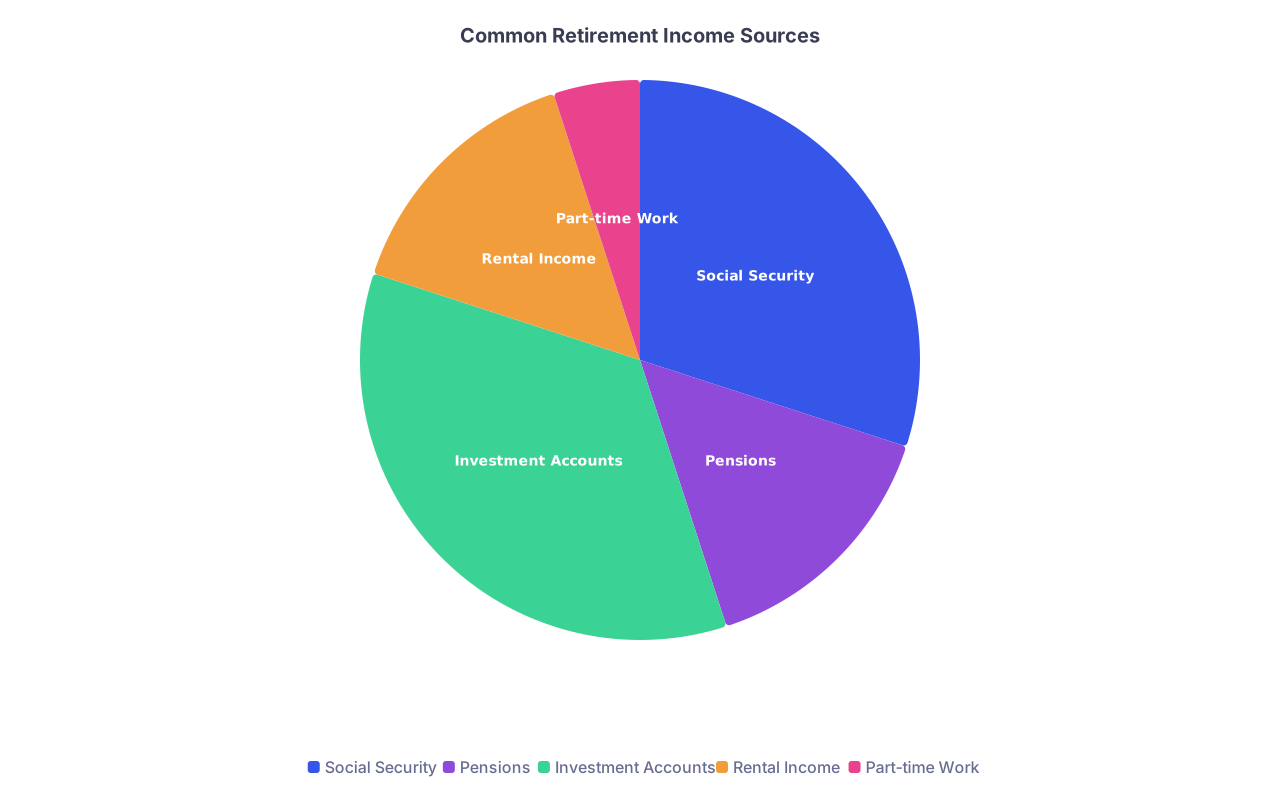
| Category | Value |
|---|---|
| Social Security | 30 |
| Pensions | 15 |
| Investment Accounts | 35 |
| Rental Income | 15 |
| Part-time Work | 5 |

| Step | Description |
|---|---|
| Step 1 | Considering Rentals for Retirement |
| Step 2 | Skip or Sell - Not Worth Hassle |
| Step 3 | Consider REITs or Index Funds |
| Step 4 | Build That Plan First |
| Step 5 | Rentals Can Be Part of Retirement Plan |
| Step 6 | Positive Cash Flow Today |
| Step 7 | Okay With Ongoing Management? |
| Step 8 | Have Risk Cushion and Reserves? |
| Step 9 | Plan to Exit or Delegate With Age? |
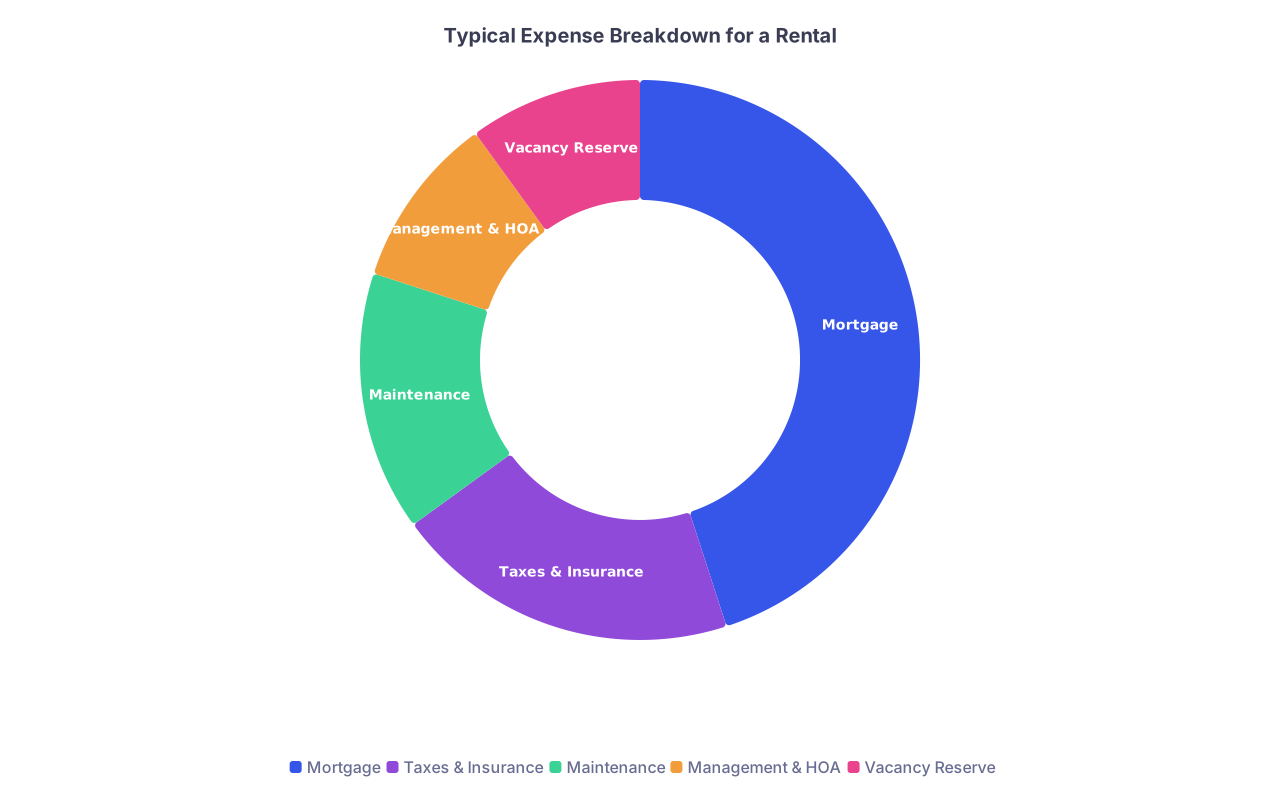
| Category | Value |
|---|---|
| Mortgage | 45 |
| Taxes & Insurance | 20 |
| Maintenance | 15 |
| Management & HOA | 10 |
| Vacancy Reserve | 10 |

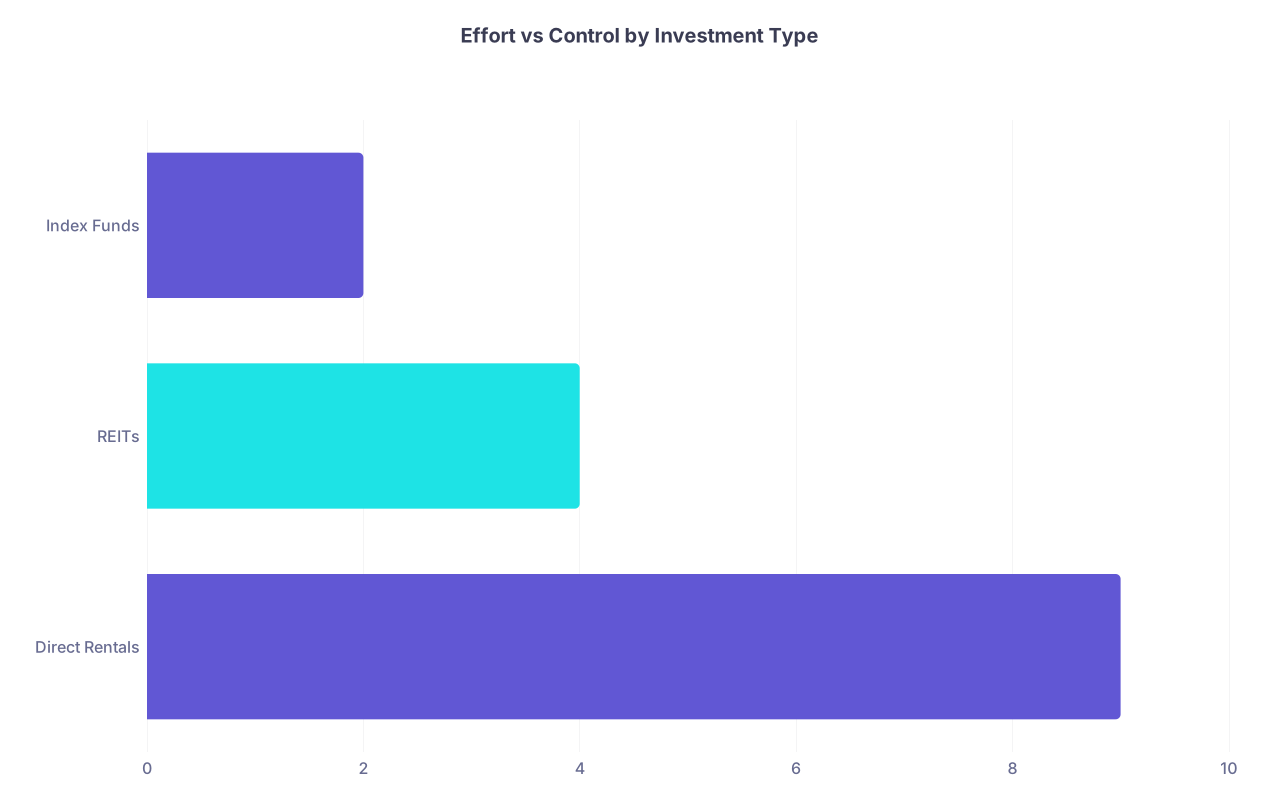
| Category | Value |
|---|---|
| Direct Rentals | 9 |
| REITs | 4 |
| Index Funds | 2 |

So…Is Owning Rental Property Worth The Hassle For Retirement?
Sometimes yes. Often no. The real answer is conditional:
It is worth it if: you buy true cash-flowing properties, you understand and accept the management and legal realities, you have reserves and risk tolerance, and you like the idea of tangible, inflation-resistant income.
It is not worth it if: you’re chasing appreciation, stretching your finances, hate ongoing decisions, or want a set-and-forget retirement.
Rentals are a tool. Not a religion.
If you decide to use them, do it with open eyes, not Instagram fantasies.


