
The fastest way for a high‑earning physician to destroy a decade of savings is a bad “friends and family” investment.
Why Physicians Get Targeted (And Why You Are Not Special)
You are a walking bullseye. Not because you are foolish. Because you:
- Earn more than average
- Have little time
- Are used to people deferring to you
That combination is catnip for:
- Struggling business owners looking for a lifeline
- “Entrepreneurs” who want your money, not your advice
- Well‑meaning relatives who do not understand risk but know you have cash
I have watched attendings lose:
- $250,000 in a cousin’s “can’t miss” restaurant
- $400,000 in a friend’s urgent care expansion that never opened
- $100,000 in a med‑spa “partnership” where they had all the risk and zero control
Same pattern every time:
- Personal relationship
- Vague but exciting pitch
- No real diligence
- Social pressure to “support”
- Years later: money gone, relationship damaged, retirement delayed
Your job is not to become a cynical jerk. Your job is to stop treating “friends and family” as a substitute for due diligence.
The Red Flags You Keep Ignoring
The worst mistakes do not come from obvious scams. They come from situations that feel “safe” because you know the person. That false sense of security is your real enemy.
Here are the big red flags physicians routinely blow past.
1. The “I Just Need…” Setup
Any pitch that starts with:
- “I just need a small bridge loan…”
- “I’m already in talks with big investors, you’d be in early…”
- “Banks are too slow and overregulated, but this is a sure thing…”
Translation:
They either cannot get conventional financing, or they do not want the scrutiny that comes with it. Banks say no for a reason. You are not smarter than an underwriter who does this 40 hours a week.
Do not make this mistake:
- Believing that your medical intelligence carries over to business underwriting
- Accepting “the bank is too conservative” as a valid explanation
2. No Written Plan, Just Vibes
If your friend or relative cannot hand you:
- A written business plan with numbers
- A clear description of what they need your money for
- A realistic path to profitability with assumptions spelled out
…then they are not ready for any investor, especially you.
I have literally sat in kitchens where the “plan” was a few bullet points on a napkin and some verbal promises. The physician wrote a $50k check anyway. They were “supporting family.” They were also lighting their savings on fire.
Minimum standard: if there is no written plan you can show a third‑party advisor, you do not invest. Period.
3. Fuzzy Use of Funds
Watch for any version of:
- “We’ll use it for growth.”
- “It helps with working capital.”
- “It gives us flexibility.”
No. You want:
- Exact dollar amounts
- Specific uses (equipment, lease, build‑out, hiring)
- A timeline
If they cannot tell you precisely what your money does, they cannot track it. If they cannot track it, they will misuse it. Not maliciously, necessarily. Just sloppily. Which is enough to kill your capital.
4. “Everyone Is Going To Want This”
Overconfidence is not a business plan. Common nonsense lines:
- “We’ll be cash‑flow positive in three months.”
- “No one else is doing this in our area.”
- “We have zero competition.”
Zero competition almost always means zero demand or a bad idea. Every serious plan should show:
- Who the competitors are
- Why customers would switch
- Realistic revenue projections with downside scenarios
If the only scenario you hear is “best case,” walk away.
5. Pressure + Guilt = Run
If the tone shifts from opportunity to obligation, you are in danger. Sentences that should make you pause:
- “I thought we were closer than this.”
- “You know how much this means to our family.”
- “You’re the only one I can really count on.”
You are being recruited as emotional collateral, not as a rational investor. Healthy sponsors will say:
- “I want you to think about it.”
- “Here’s the data; talk to your advisor.”
- “If this is not right for you, no hard feelings.”
Anything else is manipulation, even if they do not realize it.
The Specific Investment Structures That Burn Physicians
Some structures sound sophisticated. They are often just cleverly packaged ways to transfer risk to you.

“Silent Partner” In A Small Business
Classic disaster. You put in:
- $100k–$300k
- No operational role
- No real voting rights
- No dividend history
- No clear exit
Then:
- The business underperforms
- The active partner draws a salary regardless
- You are told “we are reinvesting” whenever you ask about returns
- Eventually the business is “sold” or wound down and there is “nothing left”
You should never:
- Be a silent partner without detailed legal documents
- Invest in a business you cannot evaluate
- Be the only one injecting fresh capital while others contribute “sweat equity”
If you are paying, others need to bleed with you. Financially, not just in talk.
Owning The Building “For Tax Benefits”
The pitch:
“You buy the building; my clinic/business rents from you. You get tax benefits and a stable tenant.”
What goes wrong:
- Overpriced property pushed by a friendly broker
- Weak lease terms that favor the operating business
- Vacancy risk if the business fails (which you have now double‑exposed yourself to)
- Illiquidity right when you need cash for retirement or college
This can work when:
- The property is underwritten as a pure investment (cap rate, comparables, independent appraisal)
- The lease is at market rent, with strong guarantees
- You can afford to carry the building empty for 6–12 months
Most physicians never require any of that. They hear “tax benefit” and forget that losing money is never a good tax strategy.
“Equity” In A Friend’s Startup
I have seen:
- “Pre‑seed” investments where there is no product, no customers, and no technical team
- Valuations pulled out of thin air (“We’re raising at a $5M valuation”)
- Convertible notes where the physician does not understand conversion mechanics
Startup equity is fine if:
- You can afford to lose 100 percent
- You treat it like lottery money, not retirement money
- You are not counting on it for your financial plan
The mistake is thinking you are “investing” when you are actually speculating. Very different things.
A Simple Framework: The “Retirement First” Rule
You want a blunt rule? Here it is:
If you are not already on track to fully fund your retirement with boring, diversified investments, you have no business doing friends and family deals.
That means:
- Adequate emergency fund
- No high‑interest debt
- Retirement accounts (401(k), 403(b), 457, IRA, backdoor Roth) funded to a sane level for your age
- A simple, diversified portfolio (index funds, broad ETFs, maybe some conservative real estate)
Friends and family investments belong in the “fun money / speculative” bucket. That bucket, for a physician, is usually:
- 5–10 percent of investable assets
- Money you are truly prepared to never see again
Not:
- Your kids’ 529 money
- Your down payment fund
- Your “I am tired of call and want to retire at 60” money
If you violate this rule, you are gambling with your future self’s exhaustion.
The Due Diligence Checklist You Keep Skipping
You cannot outsource all thinking to an attorney or advisor, but you also cannot wing it alone. Here is the minimum you must demand before a single dollar leaves your account.
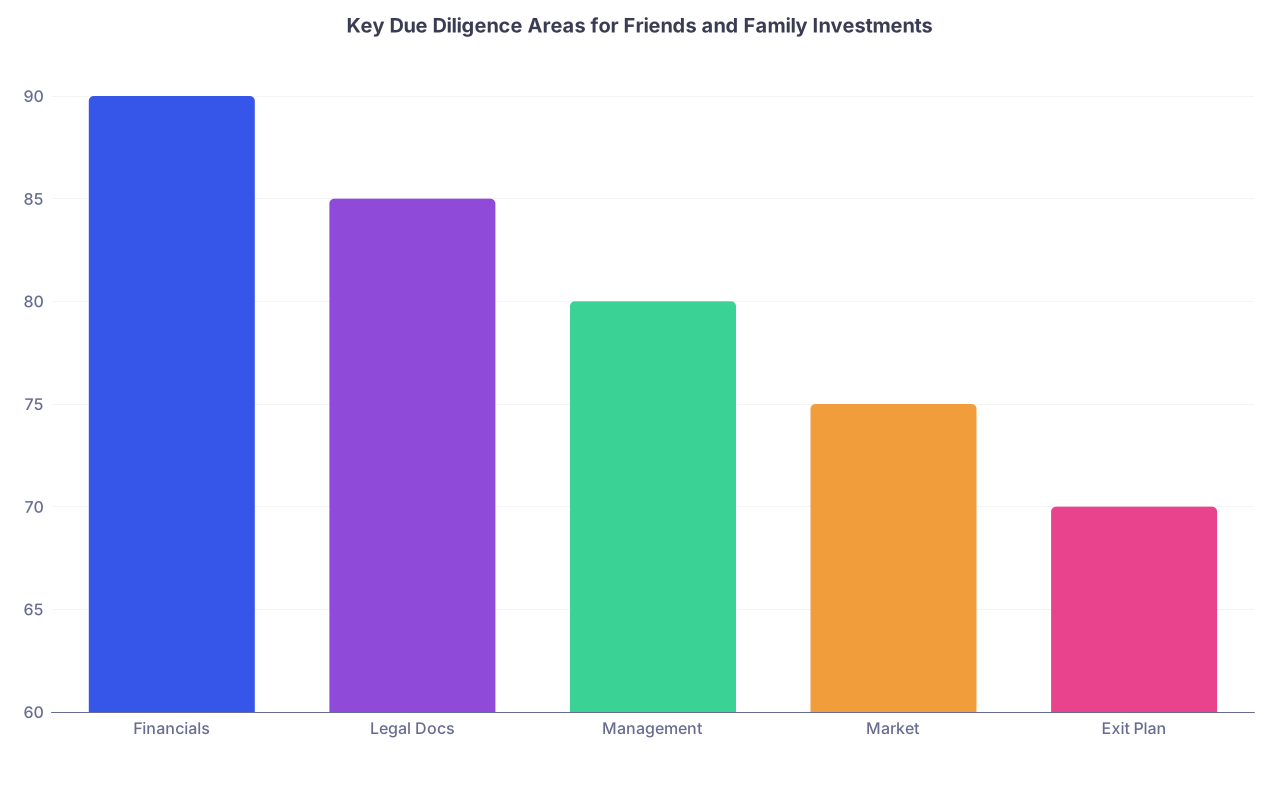
| Category | Value |
|---|---|
| Financials | 90 |
| Legal Docs | 85 |
| Management | 80 |
| Market | 75 |
| Exit Plan | 70 |
1. Business Reality Check
Ask for:
- Last 2–3 years of financials (if existing business)
- Pro forma financials (if new) with assumptions spelled out
- Customer acquisition plan (how they actually get paying customers)
- Clear statement of what makes this business tough to kill
Then do this:
- Run it by a CPA who is not their cousin
- Ask what happens in a recession, not just a boom
- Ask what happens if revenue is 50 percent of projections
If the numbers only work in a perfect world, they do not work.
2. Legal Structure And Your Actual Rights
Do not accept “We will put you on the LLC” as an answer. That is nothing.
You need:
- Operating agreement or shareholder agreement
- Clear description of:
- Your ownership percentage
- Your voting rights
- How and when distributions are made
- Requirements for additional capital calls
- What happens if you refuse to put in more money later
You also need to know:
- Are you personally guaranteeing any debt?
- Are you exposed to lawsuits beyond your investment amount?
If they resist providing documents or suggest “we can just use a template,” that is your cue to stop.
3. Alignment Of Pain
This is non‑negotiable: if the project fails, everyone should hurt, not just you.
Questions to ask:
- How much of your own cash is in this, right now?
- Are you taking a salary? How much and when?
- Under what conditions do you personally stop getting paid?
If the answer is:
- “My contribution is my time,” or
- “Once we raise money, I can finally pay myself”
Then they have upside with limited downside. You have only downside.
Protecting The Relationship (By Protecting Yourself First)
You are not just trying to protect money. You are trying to protect relationships that actually matter.

| Step | Description |
|---|---|
| Step 1 | Friend or family asks for investment |
| Step 2 | Say no clearly |
| Step 3 | Engage advisor and attorney |
| Step 4 | Invest small, no more than 5-10 percent |
| Step 5 | Are you on track for retirement? |
| Step 6 | Can you afford to lose 100 percent? |
| Step 7 | Would you do this if a stranger offered it? |
| Step 8 | Documents and due diligence clean? |
Say “No” The Right Way
You will need this sentence at some point. Use it:
“I care about you, and I have a clear rule that I do not mix my retirement savings with private business deals, even for family. I am sticking to that.”
You can add:
- “I am happy to help you brainstorm.”
- “I can introduce you to a small‑business advisor.”
- “I will be your first customer when you open.”
But do not blur the financial boundary. Once you make one exception, every future ask becomes harder to refuse.
If You Say “Yes,” Do It On Professional Terms
If, after everything, you decide this is worth a small speculative bet:
- Use an attorney who represents you, not “the group”
- Put every term in writing
- Set an amount you will never exceed (no follow‑on checks under pressure)
- Commit that if they ask for more later, the answer will be “only if the returns so far justify it and my advisor agrees”
If that feels “cold,” good. Money needs cold.
Integrating This Into Your Retirement Plan
“Friends and family” deals are not just about that one check. They have real ripple effects on your retirement.
| Scenario | Result at Age 65* |
|---|---|
| Invest $100k at 45, lose it | $0 from that money |
| Invest same $100k in 7% index fund | ~$196,000 |
| Invest $100k in 7% fund at 35 | ~$386,000 |
| Two such bad deals over career | ~$400,000+ lost growth |
*Rough estimates, ignoring taxes and fees
The mistake is thinking: “It is only $50k or $100k. I will make more.” Physicians underestimate compounding and overestimate how long they will want to keep working like this.
You avoid that trap by:
- Treating every speculative dollar as coming directly out of your 65‑year‑old self’s pocket
- Re‑running your retirement projections after any major loss
- Refusing to “double down” on a failing deal just to avoid admitting it was a mistake
A Hard Truth: Charity Is Often Better Than “Investment”
If you truly want to help a struggling relative:
- Consider a small gift with no expectation of return
- Or a clear loan agreement with a realistic repayment plan (and mentally assume it is a gift)
But do not dress charity up as an “investment” to make yourself feel better.
If you want to support them emotionally, do that. If you want to support them financially, do it in a way that, if it goes to zero, does not alter your retirement path.
Your first duty is to your own financial stability. You cannot be the “helpful doctor in the family” if you are working to 75 because of one bad restaurant deal from your 40s.
What To Do Today
Open your current financial picture and do three things now:
- List every informal investment or loan you have made to friends, family, or side businesses.
- Put a realistic “likely recovery” number next to each one (many will be zero).
- Write one rule for yourself: the exact conditions under which you will say “yes” or “no” to the next ask.
Then, save that rule somewhere visible. The pitch will come when you are tired, distracted, or flattered. You will not have time for deep analysis. Your written rule will protect you when your emotions will not.
FAQ (Exactly 5 Questions)
1. Is it ever smart for a physician to do a friends and family investment?
Yes, but only under strict conditions: your retirement path is already solid; you can afford to lose 100 percent without changing your work or retirement plans; the deal looks attractive even if a stranger brought it to you; and you use lawyers and advisors just as you would in an arms‑length transaction. Anything less is not “smart,” it is emotional gambling.
2. How much of my portfolio can I risk on these types of deals?
For most physicians, 5–10 percent of investable assets is the absolute ceiling for all speculative, illiquid, high‑risk investments combined (startups, private businesses, private real estate deals, etc.). Friends and family deals should be a subset of that, not the whole bucket. If you are underfunded for retirement, that ceiling should be closer to zero.
3. Should I loan money or take equity if I decide to help?
Loans sound safer, but they often just delay the pain. If the business fails, equity and unsecured loans both go to zero. A loan with clear terms and collateral can be reasonable if the business is stable and the collateral is real. Equity can make sense only if the business has strong fundamentals and you have professional documents. In both cases, assume you may never see the money again.
4. What if saying no will seriously damage the relationship?
If the relationship is contingent on you risking your financial security, it is already damaged. You can reduce the sting by: explaining your personal investment rules; offering non‑financial help; and, if appropriate, giving a small gift instead of an investment. But do not let fear of conflict push you into a decision that will haunt you for decades.
5. How do I evaluate a “good” private deal versus a bad one?
A good deal has: transparent financials; sponsors with substantial cash at risk; clear legal documents; realistic projections; defined exit options; and terms that make sense to a neutral CPA and attorney. A bad deal relies on hype, guilt, urgency, and your trust in the person. If the business would not pass scrutiny from a bank or professional investor, you should assume it is not good enough for you either.
Open your net worth spreadsheet or retirement plan today and add a new line: “Speculative / Friends & Family Bucket.” Set a hard dollar limit. The next time someone comes to you with an “opportunity,” you will not decide from guilt. You will decide from a plan.