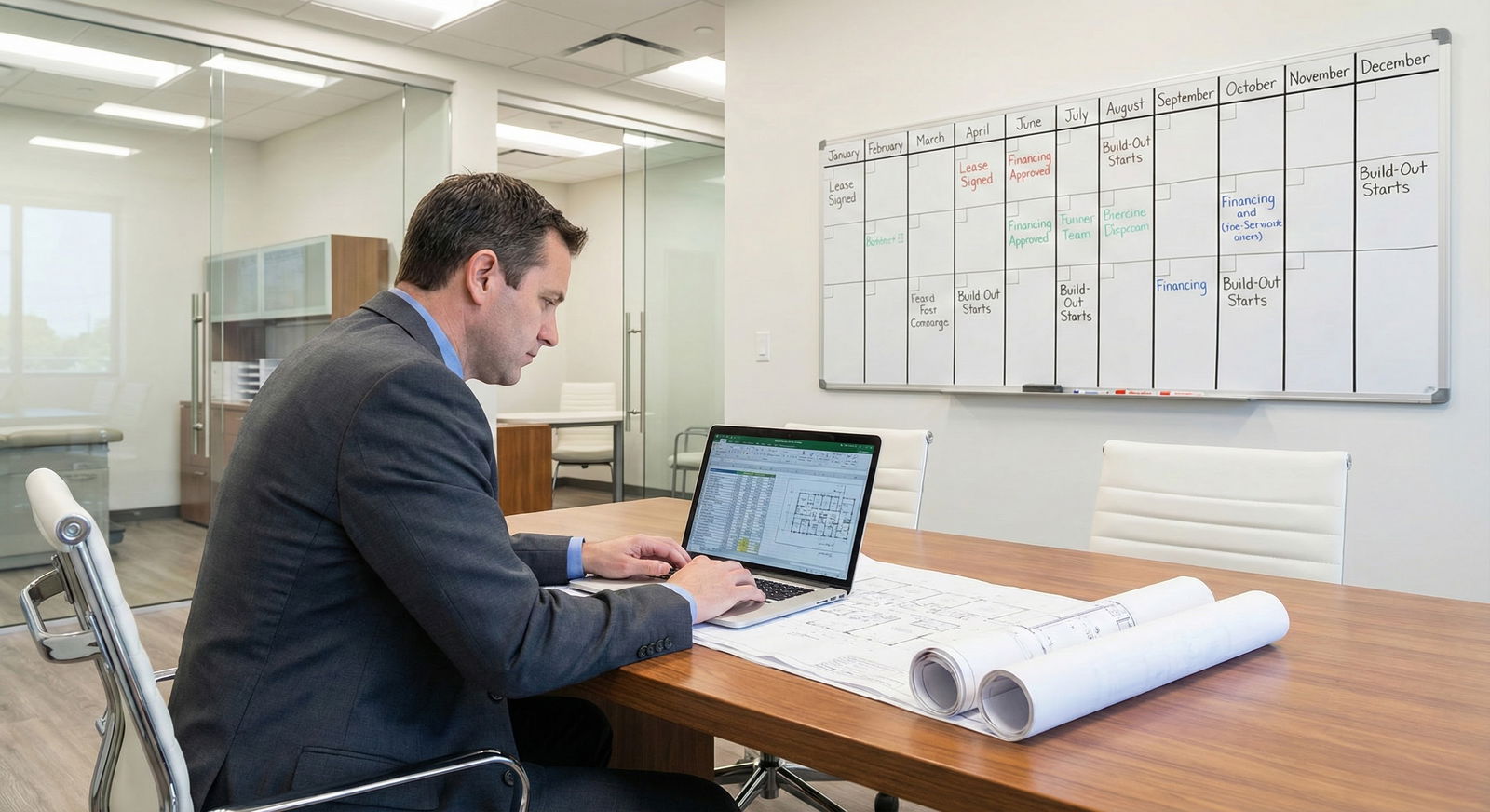
Waiting until you “have more clarity” is how private practices die before they open.
Twelve months before you see your first patient, the clock starts on three brutal, non-negotiable decisions: lease, financing, and build‑out. If you’re not moving on all three in a disciplined timeline, you’re already behind.
I’m going to walk you month‑by‑month from 12 months out up to opening day, and I’m not sugar‑coating the parts that routinely blow up new practices.
12 Months Out: Commit To the Project, Not the Fantasy
At this point you should:
- Decide: “I am opening a practice in X month, in Y city, with Z services.”
- Start assembling your core team.
- Get a hard sense of your budget and borrowing capacity.
Week 1–2: Define your practice and constraints
You cannot negotiate a lease or talk seriously to a bank with “maybe 2–4 exam rooms somewhere in the city.”
Lock in:
- Clinical scope: solo outpatient IM? concierge peds? psychiatry with telehealth?
- Target start date: realistic, not dreamy. Assume:
- 3–6 months for build‑out
- 2–3 months buffer for overruns and inspections
Decide the maximum monthly all‑in facility cost you can tolerate (rent + triple net + utilities).
Week 2–4: Build your “launch team”
At this point you should reach out and schedule meetings with:
- A medical CPA who actually handles private practices
- A healthcare attorney (lease review, entity setup)
- A commercial broker who has done medical space in your city
- At least one local practice owner for reality checks
You are not hiring everyone yet at full tilt. You’re identifying who you’ll lean on as decisions hit.
11 Months Out: Pre‑Financing Prep and Market Reality Check
At this point you should:
- Start collecting documents banks will demand.
- Narrow your location targets to 2–3 sub‑markets.
Financial prep (weeks 1–3)
Banks will not move quickly if you show up with nothing. Get your ducks in a row:
- Updated CV
- Last 2–3 years of tax returns (personal, and any 1099 side work)
- Current debts (student loans, mortgage, credit cards)
- Any moonlighting/locums contracts you’ll keep for income stability
- Basic pro‑forma assumptions:
- First‑year expected visits/month
- Average reimbursement per visit
- Planned staff (front desk, MA, RN)
Do not overcomplicate the pro‑forma yet. A one‑page spreadsheet is enough to start conversations.
Market and location scan (weeks 2–4)
Sit down with your broker:
- Define:
- Minimum square footage (e.g., 1,500–2,500 sq ft for small primary care; less for psych)
- Parking requirements
- Need for ground floor vs upper floor
- Review:
- Medical office buildings vs retail strip vs mixed‑use
- Average rents and TI (tenant improvement) allowances
You should walk at least 3–5 buildings. Get a feel for:
- Hallway width and ADA access
- Plumbing flexibility (for exam rooms)
- Existing medical build‑outs you could reuse
10 Months Out: Start Financing Conversations — Early
The mistake I see all the time: people wait to get a lease, then beg a bank for financing. Backwards.
At this point you should:
- Talk to 2–3 lenders about practice start‑up loans.
- Clarify how much you can borrow and on what terms.
| Lender Type | Typical Max Amount | Term Length | Rate Style |
|---|---|---|---|
| Major national bank | $250k–$500k | 7–10 yrs | Variable/Fixed |
| Physician‑focused bank | $300k–$750k | 7–12 yrs | Often fixed |
| Local community bank | $150k–$300k | 5–7 yrs | Variable |
You’re not signing anything yet. You’re mapping the box you must live in:
- Rough approval amount (subject to a business plan and lease)
- What they want to see:
- Signed lease or LOI
- Build‑out bid
- Equipment quotes
- Personal guarantee (yes, you’re giving one)
This is where you either:
- Confirm your plan is realistic
- Or shrink the plan now instead of mid‑construction when you’re out of cash
9 Months Out: Shortlist Spaces and Lock in an Architect
At this point you should:
- Narrow to 1–2 serious spaces.
- Engage a healthcare architect or designer.
Space shortlist (weeks 1–2)
You and your broker should now be brutally selective:
- Ditch anything that needs structural work (too slow and expensive).
- Prioritize former medical or dental spaces (existing plumbing, exam room layout).
- Pay attention to:
- Zoning for medical use
- Building hours and HVAC (can you see patients early/late?)
- Elevator reliability if not ground floor
Architect and preliminary test fit (weeks 2–4)
You need a rough “test fit” plan:
- Number of exam rooms
- Nursing station
- Waiting area and check‑in/check‑out
- Physician office(s)
- Storage, lab, staff break area
The goal is not final drawings yet. You want:
- Confirmation that your target square footage works
- Early build‑out price range (per square foot)

| Category | Value |
|---|---|
| Build-out | 40 |
| Equipment/Furniture | 25 |
| Working Capital | 25 |
| IT/EMR/Phones | 10 |
8 Months Out: Negotiate the Lease — Don’t Wing This
This is where people get hurt. A bad lease can destroy a profitable practice.
At this point you should:
- Submit offers (LOIs) on 1–2 spaces.
- Loop your attorney into every serious draft.
Weeks 1–2: Letter of Intent (LOI)
LOI sets the big picture:
- Base rent and increases
- Lease term (medical usually 5–10 years)
- TI allowance (how much the landlord contributes to build‑out)
- Free rent period (to cover build‑out and ramp‑up)
- Who owns improvements at the end
Push for:
- Maximum TI and free rent you can get
- Right to assign the lease if you sell the practice
- Clear timeline for landlord build‑out approvals
Weeks 3–4: Full lease negotiation
Do not rush here, even if everyone is “in a hurry.”
Your attorney should flag:
- Personal guarantee terms and burn‑off schedule
- Operating expense pass‑throughs (CAM, taxes, insurance)
- After‑hours HVAC charges
- Exclusivity clauses (e.g., you’re the only pediatrician in the building)
- Use restrictions that might block future services (e.g., adding procedures)
You should aim to have:
- A near‑final lease ready for signature by the end of month 8
- Drafts in hand to send to your lender and architect
7 Months Out: Finalize Lease, Formalize Financing
At this point you should:
- Sign the lease (once you and your attorney are satisfied).
- Submit full financing application with supporting documents.
Week 1–2: Lease signing
Before you sign:
- Double‑check:
- TI allowance dollar amount and payment schedule
- Commencement date vs rent start date
- Who pulls permits (you or landlord’s contractor)
Once signed:
- Send the executed lease to:
- Your lender
- Your architect
- Your contractor (if already identified)
Week 2–4: Loan application and approval
Now the bank takes you seriously. They’ll want:
- Signed lease
- Detailed build‑out estimate
- Equipment quotes (big ticket items: cabinets, exam tables, autoclave, IT hardware)
- Business plan with 3‑year financial projections
This is where delays often happen. Keep pressure on:
- Weekly check‑ins with your loan officer
- Rapid responses to “we just need one more document”
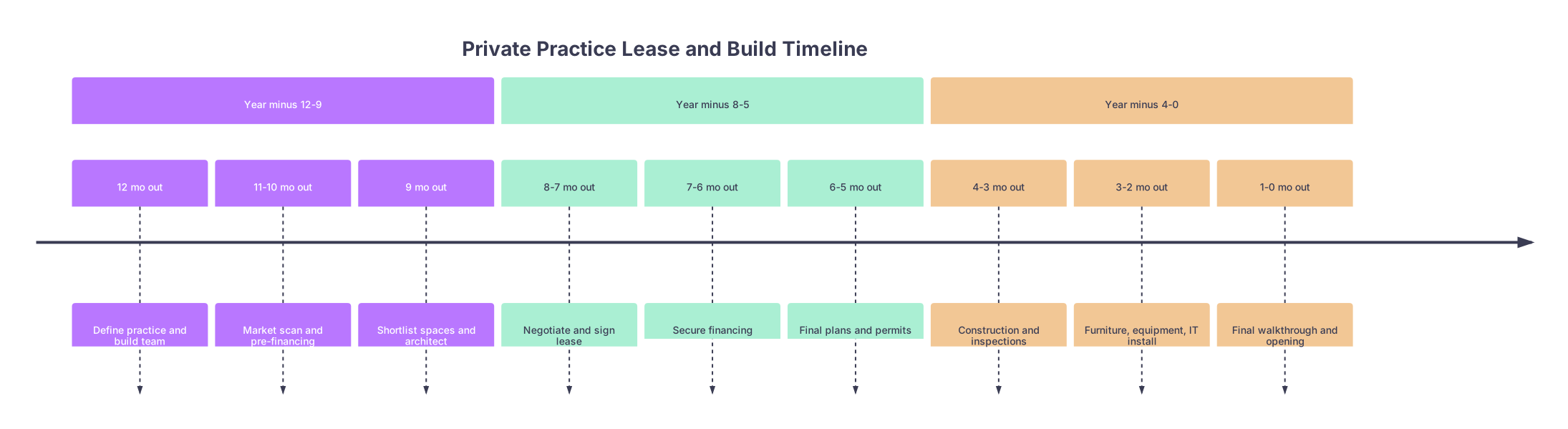
| Period | Event |
|---|---|
| Year minus 12-9 - 12 mo out | Define practice and build team |
| Year minus 12-9 - 11-10 mo out | Market scan and pre-financing |
| Year minus 12-9 - 9 mo out | Shortlist spaces and architect |
| Year minus 8-5 - 8-7 mo out | Negotiate and sign lease |
| Year minus 8-5 - 7-6 mo out | Secure financing |
| Year minus 8-5 - 6-5 mo out | Final plans and permits |
| Year minus 4-0 - 4-3 mo out | Construction and inspections |
| Year minus 4-0 - 3-2 mo out | Furniture, equipment, IT install |
| Year minus 4-0 - 1-0 mo out | Final walkthrough and opening |
6 Months Out: Final Plans and Permits — The Red Tape Phase
At this point you should:
- Have loan approval or at least a clear commitment.
- Finalize construction drawings and submit for permits.
Weeks 1–2: Construction documents
Your architect now produces:
- Detailed floor plans to code
- Electrical and plumbing plans
- Finishes schedule (flooring, counters, lighting)
You review for:
- Flow — can you room and unroom patients efficiently?
- Privacy — sound control between rooms, especially for psych or OB/GYN
- Storage — you’ll always need more than you think
Weeks 2–4: Permitting
Your contractor or architect will:
- Submit plans to the city/county building department
- Coordinate with the landlord’s requirements
Your job:
- Stay on top of timelines
- Be available for quick decisions if plans need minor changes
Permits can take 2–8 weeks. This is why everything upstream had to happen on time.
5 Months Out: Lock in Contractor and Build‑Out Budget
At this point you should:
- Select a contractor with medical experience.
- Lock in a realistic construction schedule.
Bids and selection (weeks 1–2)
You want at least 2–3 bids from:
- Contractors who’ve built medical or dental offices
- Ideally someone your architect or broker already trusts
You compare:
- Cost (obviously)
- Timeline
- References from other physicians
Do not just pick the cheapest. Cheap plus delays is expensive.
Weeks 3–4: Construction contract
Key items to define:
- Start date and substantial completion date
- Change order process (how scope changes are priced and approved)
- Penalties or incentives related to schedule (if you can get them)
- Payment schedule tied to milestones, not just time
4 Months Out: Construction Starts — You’re Now on the Hook
At this point you should:
- Have demo and build‑out underway.
- Start aligning lease milestones with your business launch tasks.
You’re not just a spectator. Every week of construction delay pushes your opening and burns cash.
Weekly you should:
- Walk the space
- Confirm progress matches schedule
- Approve any small changes fast (outlet locations, fixture choices) so they don’t stall
This is when you also:
- Finalize furniture and equipment orders with real delivery dates
- Confirm IT vendor for:
- Network cabling
- Wi‑Fi
- Phones
- EMR hardware (workstations, tablets, scanners)

3 Months Out: Overlap Build‑Out with Operational Setup
At this point you should:
- Be 50–75% through construction.
- Start setting up the non‑clinical backbone of your practice.
Facility‑wise, you must keep an eye on:
- Rough inspections (framing, electrical, plumbing)
- Drywall and finishes schedule
- Millwork installation (cabinets, counters)
If inspections are failing or dragging, you need to push your contractor, not wait passively.
Operationally, this is when lease and build‑out choices start driving other decisions:
- How many exam rooms you ended up with affects:
- Provider schedule templates
- Staffing levels
- Layout dictates:
- Where phones and networking go
- Where printers, scanners, and check‑in kiosks live
By the end of month 3 out, you should:
- Have furniture ordered and scheduled for delivery
- Have initial IT cabling either done or scheduled to slot into the construction timeline
2 Months Out: Punch List, Final Installations, and Inspections
At this point you should:
- Be finishing construction.
- Have major equipment and furniture deliveries scheduled.
Weeks 1–2: Finishing touches
You’re looking for:
- Paint, flooring, lighting completed
- Plumbing fixtures installed and functioning
- Cabinetry in place
This is also the sweet spot for:
- IT rack and network hardware installation
- Workstation and phone install prep (but not necessarily go‑live yet)
Weeks 3–4: Final inspections and certificate of occupancy
Your contractor coordinates:
- Final city building inspection
- Fire marshal inspection
- Any landlord inspection
You must:
- Get a certificate of occupancy (CO) or equivalent
- Confirm with your malpractice and general liability carriers that coverage starts when you need it
Without CO, no patients. Period.
1 Month Out: Lease, Financing, and Build‑Out Tie Together
At this point you should:
- Have a usable, inspected space.
- Be transitioning from “project mode” to “clinic launch mode.”
You walk the space with:
- Contractor: punch list of small fixes
- Architect: confirm design intent is met
- IT vendor: verify everything is live and secure
You also confirm:
- First rent payment date versus when you actually open
- Loan disbursement has covered all contractor invoices
- Remaining funds are earmarked for:
- Working capital (payroll, supplies)
- Initial marketing and referral outreach
If something is unfinished now — cabinets missing, network unstable, ADA issue flagged — this is the last moment to push hard. Three days before opening is too late.
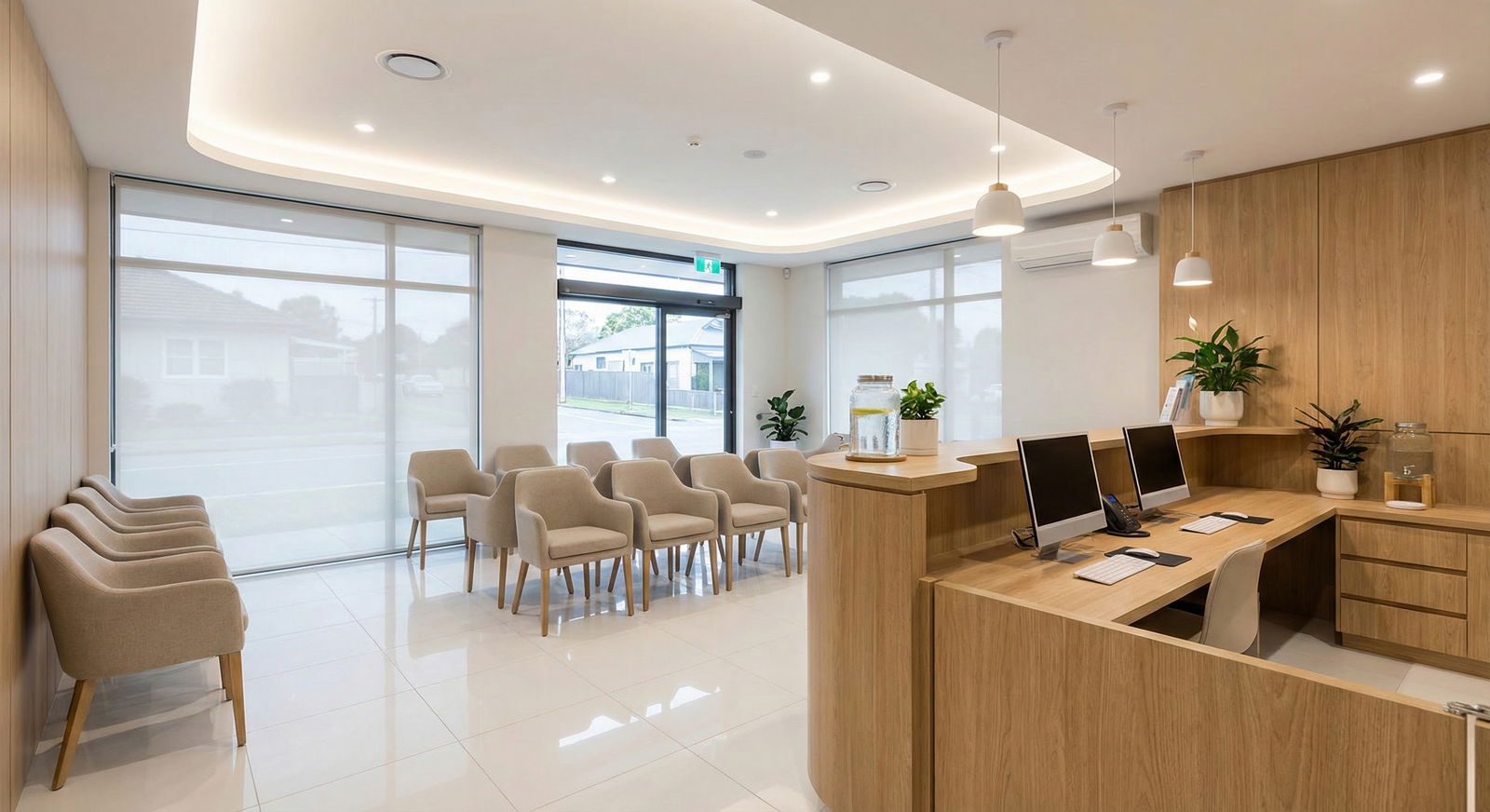
2 Weeks to Opening: Final Walkthrough and Handoff
Strictly speaking this is less about lease and financing now, and more about verifying that the decisions you made 6–12 months ago actually produced a functional clinic.
At this point you should:
- Conduct a final walkthrough with your contractor and sign off on the punch list.
- Verify:
- No outstanding permit issues
- All inspection paperwork is in hand
- Landlord has no unresolved complaints
Then you:
- Flip from “capital spend” to “operating mode” in your mind and your accounting.
- Start monitoring:
- Monthly rent and CAMs against your projections
- Utility and maintenance costs in the real world versus your budget
The launch is not the end of the lease/financing/build‑out story. It’s the audit.
Quick Reality Check: What You Cannot Delay
Let me be blunt. These are the deadlines that are not negotiable without pain:
| Time Before Opening | Decision You Must Have Locked |
|---|---|
| 10–9 months | Target area and space size |
| 8–7 months | Lease terms and signed lease |
| 7–6 months | Loan approval path clarified |
| 6–5 months | Final plans and permits filed |
| 4–3 months | Contractor and build schedule |
| 2–1 months | CO obtained, punch list nearly done |
If you’re at any of these points and that box is still “in progress,” assume your opening date is sliding.
FAQ (Exactly 2 Questions)
1. What if I’m already 8–9 months out and I haven’t started any of this?
You compress, and you cut scope. That probably means:
- Smaller space or shorter term lease to reduce build‑out complexity.
- Aggressive use of second‑generation medical space that needs minimal work.
- Parallel processing:
- Lease negotiation and financing in the same 4–6 week window.
- Architect and contractor engaged earlier, even before final loan approval.
You do not try to cram a full custom build‑out into 3–4 months unless you enjoy opening late and over budget.
2. Should I buy a building instead of leasing if I can afford it?
Not in your first 12 months out of training, in most cases. Owning real estate can be smart long‑term, but it adds:
- More down payment and more complicated financing.
- Longer timelines for due diligence, zoning, and sometimes heavier renovations.
- A distraction from your core job: getting a stable patient base and building a profitable practice.
My usual recommendation: get your practice stable in a good leased space first. Once you know your ideal size, location, and cash flow, then start hunting for a building you can move into or buy and build for your second chapter.
Key points to walk away with:
- Lease, financing, and build‑out are a single system. You cannot delay one without wrecking the others.
- By 8–7 months out, your lease should be basically done and financing well underway, or your opening date is fiction.
- Weekly engagement with your architect and contractor during build‑out is not optional; it’s how you prevent small decisions from turning into 3‑month delays.