
The cash flow crunch in month 3 of a new clinic is not a surprise. It is predictable. Which means you can attack it systematically instead of panicking or taking out the worst possible loan at the worst possible time.
You are not “failing.” You are in a normal lag phase: startup expenses are front‑loaded, payer reimbursements are back‑loaded, and your personal bills do not care about either.
Let’s fix it.
Step 1: Diagnose the Cash Flow Problem Like a Clinical Case
Before you start cutting costs or begging the bank for a bigger line, you need a clean, unemotional view of the problem. Think SOAP note for your business.
A. Build a 90‑Day Cash Flow Snapshot (Today + Next 60 Days)
Open a spreadsheet or your practice management/ accounting software. You need a weekly view, not monthly. Month 3 is where timing kills you, not totals.
Columns: Weeks (Mon–Sun) for the next 8–10 weeks.
Rows:
- Starting cash (each week)
- Expected inflows
- Insurance reimbursements
- Patient payments (co‑pays, deductibles, cash visits)
- Ancillary income (procedures, labs, telehealth fees, etc.)
- Expected outflows
- Rent
- Payroll (including your own draw or salary)
- Malpractice
- EMR / billing software
- Utilities, internet, phone
- Supplies and vaccines
- Equipment leases
- Loan payments
- Marketing
- Misc (cleaning, laundry, shredding, etc.)
You are not budgeting. You are timing cash.
Now mark:
- Non‑negotiable / must pay to stay open
- Deferrable / negotiable
- Discretionary / nice to have
That changes how aggressive you can be.
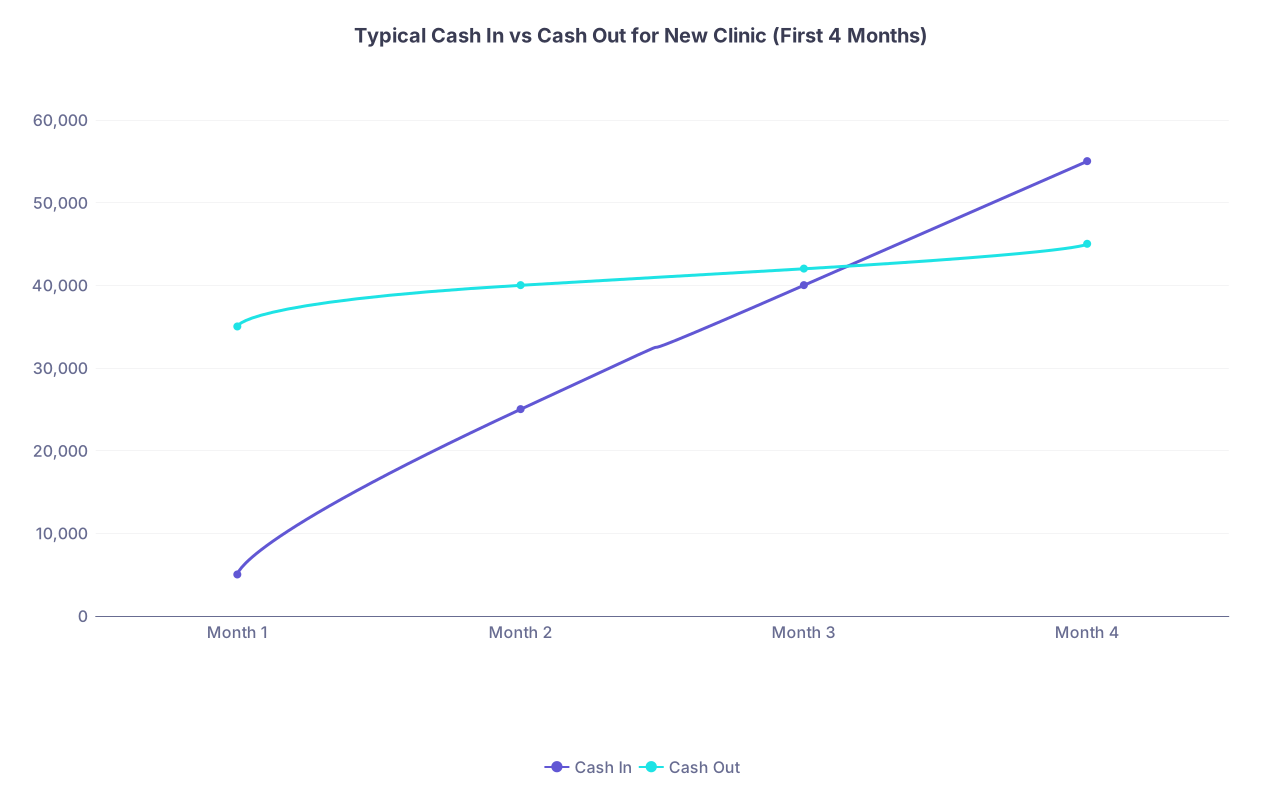
| Category | Cash In | Cash Out |
|---|---|---|
| Month 1 | 5000 | 35000 |
| Month 2 | 25000 | 40000 |
| Month 3 | 40000 | 42000 |
| Month 4 | 55000 | 45000 |
B. Identify the Gap — How Bad Is It?
From that weekly view, mark:
- Lowest projected cash balance
- Week(s) where you go negative
- Size of the maximum shortfall (for example, –$18,000 at Week 4)
That number is your cash gap.
You cannot manage what you refuse to name.
Once you see the exact gap and timing, you can attack three levers:
- Bring cash in sooner
- Push cash out later
- Plug leaks that are draining cash unnecessarily
We will go through each.
Step 2: Pull Forward Cash Inflows — Faster Money, Not Just More Money
In month 3, the single biggest problem is timing of inflows. You have done the work, but the money is stuck in claim purgatory.
Here is how to move cash in faster over the next 30–60 days.
A. Fix the Slowest Leaks: Denials and Rejected Claims
You already have money “earned” but not collected. That is your lowest‑hanging fruit.
Pull an “aging” report (by payer, by days outstanding: 0–30, 31–60, 61–90, 90+).
Sort by:
- Largest balance
- Oldest age
- Most common denial codes
Create a basic Denial Attack List for the next 10 business days:
- Top 3 payers by dollars outstanding
- Top 5 denial reasons (wrong modifier, missing NPI, credentialing not linked, no prior auth, COB issues)
- Specific claims over 60 days old
Decide who owns this:
- If you have a biller: a daily target (for example, “clean up 15 denials/day, prioritize 60+ days”).
- If you are doing it yourself: 60–90 minutes blocked Tues/Thurs at the same time every week. Non‑negotiable.
What you are aiming for: a one‑time, 20–30% bump in receivables landing over the next 4–6 weeks.
B. Reduce Front‑Desk Leakage: Capture Co‑Pays and Deductibles Now
If your front desk staff is saying “We’ll bill you later” because they are uncomfortable asking for money, you are burning cash.
Standardize this immediately:
Policy: Payment due at time of service, including:
- Co‑pays
- Known deductibles
- Self‑pay visits
Script:
“Your co‑pay today is $30. How would you like to take care of that, card or HSA?”
Not “Do you want to pay your co‑pay today?”Add card‑on‑file for all new patients:
- “We securely store a card for your account to handle co‑pays and balances. You will receive a statement before we charge anything.”
Even small changes move the needle quickly. An extra $800–$1,200/week in co‑pays and deductibles is often the difference between overdraft and survival in month 3.
C. Offer Short‑Term Prepay Options (Without Becoming a Discount Mart)
You are not turning into a spa membership program. You are solving a 60–90 day cash gap.
Use small, ethical prepay packages:
Example – Follow‑up Package (Primary Care):
- 3 follow‑up visits over 6 months for chronic disease management
- Slight discount (for example, 5–10%) if paid now
- Works well for self‑pay or high‑deductible patients
Example – Procedure Bundle (Derm, Ortho, Pain, etc.):
- Evaluation + procedure + 1–2 follow‑ups
- One bundled price paid up front for self‑pay patients
Write it down clearly:
- What is included
- Time frame for use
- Refund policy (credit to account, not cash refund, in most cases)
Run this for 60–90 days. Then reassess.
D. Add One or Two High‑Yield, Low‑Setup Services
You are not building a whole new line of business. You are adding 1–2 services that:
- Can be implemented in under 2 weeks
- Require minimal capital outlay
- Pay reasonably quickly
Examples (depends on specialty and payer mix):
- Telehealth follow‑ups you are already allowed to bill
- Simple in‑office tests (rapid strep, flu, COVID, spirometry, etc.) if your patient population supports it
- Nurse visits for chronic care management under your supervision (if billable per your payers)
- Group visits for diabetes, obesity, smoking cessation (if your payers reimburse)
You want an extra $2,000–$5,000/month in relatively easy billables, not a second career.
Step 3: Push Out Cash Outflows — Buy Time Without Burning Bridges
On the expense side, your goal is not to stiff people. Your goal is to sequence payments so your clinic remains functioning and your reputation intact.
A. Rank Expenses by “Clinic Survival Impact”
Harsh but simple ranking system:
Critical to stay open this month
- Rent / mortgage on clinic
- Malpractice insurance
- Payroll for essential staff
- EMR / practice management / billing system
- Internet and phones
Important but negotiable in timing
- Equipment lease payments
- Some vendor accounts (supplies, labs, linen)
- Certain software subscriptions
Nice to have / can pause or cut
- Extra marketing platforms you barely use
- Premium EMR add‑ons
- Snacks for the break room
- Non‑essential consulting / “coaching” fees
Now, you treat category 1 like the equivalent of oxygen on a code. They get paid. Everything else you proactively renegotiate.
B. Call Landlord, Lenders, and Key Vendors Before You Miss a Payment
Silent late payments make you look flaky. Proactive outreach makes you look responsible.
Script for landlord or major vendor:
“I want to be completely transparent. As a new medical clinic, we are in the typical month 3–4 cash lag. Our patient volume is growing well, but reimbursements are delayed. I intend to remain in this location long term and keep our account in good standing.
I am asking for a temporary modification for the next 2–3 months. For example, could we structure 50–70% of the usual rent now and the remainder spread over the next 6 months? I wanted to discuss solutions before any payment becomes late.”
Most reasonable landlords who understand medical tenants will prefer this over chasing a broken lease. Same with small local vendors.
Common short‑term options:
- Interest‑only payments for 2–3 months on small business loans
- Reduced lease payments with catch‑up schedule
- Extending due dates from 15 to 30 or 30 to 45 days
- Partial payments with written plan for bringing current
Document everything. Even in a simple email recap.
Step 4: Stop the Bleeding — Eliminate Waste and Structural Problems
Some of your pain is not just timing. It is structural waste.
You cannot “growth hack” your way out of a broken cost structure.
A. Audit the Top 10 Monthly Recurring Charges
Pull your last two months of bank and credit card statements. List every recurring charge and subscription.
For each, label:
- Essential for operations (core EMR, billing, malpractice, phones)
- Enhances efficiency but not critical (e‑fax platforms, CRM, analytics tools)
- Nice‑to‑have or underused (extra marketing tools, duplicate services, trial software you forgot to cancel)
Cut or pause:
- Anything you have not actively used in 30 days
- Duplicate tools (two e‑fax services, two CRMs, overlapping EMR add‑ons)
I have seen clinics recover $500–$2,000/month this way in under an hour.
B. Revisit Staffing vs Volume — The Sacred Cow
This one stings. But it matters.
Ask three hard questions:
- Is my staff size tied to actual weekly visit volume or to the clinic I wish I had?
- Are there tasks my staff does that could be:
- Automated (online check‑in, e‑reminders, e‑statements)
- Outsourced more cheaply (billing, prior auth services, call center backup)
- If my cash runs out in 8 weeks, what is my exact staffing plan starting next week?
You have options before cutting people:
- Temporarily reducing hours (for example, 0.8 FTE for 8–12 weeks)
- Shifting some roles to part‑time or per‑diem
- Cross‑training so fewer people can cover more functions efficiently
If you must cut a role, do it once, do it clearly, and do it respectfully. Bleeding out slowly with half‑measures is cruel to everyone.
Step 5: Use Smart Credit, Not Desperation Loans
There is a difference between bridge financing and digging a grave with a credit card.
Your cash flow snapshot from Step 1 tells you the size and duration of your gap. If you have, say, a $20,000 predicted low point in week 5 that resolves by week 10, you do not need a $200,000 line of credit.
A. Stack Your Credit Options in Order of Sanity
| Option | Typical Use Case |
|---|---|
| Existing business LOC / bank line | Known gap, predictable inflows |
| Business credit card (short term) | Sub-30-day timing issues |
| Vendor terms / landlord deferral | Expense timing adjustments |
| New SBA/microloan | Larger, structural shortfall |
| Merchant cash advance | Last resort, often predatory |
Use them like this:
Existing business LOC / line of credit
- Ideal for short gaps if you secured it before opening.
- Draw only what your 90‑day model suggests.
- Plan principal payback based on projected receivables, not blind optimism.
Business credit cards
- Fine for 30–45 days if you have high‑confidence revenue coming.
- Never use personal cards for long‑term float. That is how you blow up your personal life along with the practice.
Vendor terms and landlord negotiations (see Step 3)
- Often cheaper than new debt because you are just extending terms, not paying high rates.
New debt (SBA 7a, microloans)
- Use only if your projections show a real, sustainable practice with a one‑time undercapitalization issue.
- If your volumes are stagnant and marketing is weak, new debt is not a bridge. It is an anchor.
Merchant cash advance / “fast funding” online lenders
- APRs are often insane.
- Use only if you are 100% sure inflows will spike and you have no other option.
- Even then, treat it like a temporary chest tube, not a lifestyle.
Step 6: Lock In a Simple Revenue‑Acceleration Protocol
You do not fix a month 3 crunch by “trying harder.” You fix it with repeatable weekly behaviors.
Build a Cash Flow War Plan for the next 8 weeks with 3–5 recurring actions.
A. Weekly “Revenue Operations” Block (90–120 Minutes)
Every week, same time, no clinic visits scheduled. You and, ideally, your office manager or lead biller.
Agenda:
Quick scan of:
- Weekly visits and no‑shows
- Collections vs goal
- Aging report highlights
Tactical actions:
- Call or work top 10–20 highest‑value overdue claims
- Send statements or payment reminders for patient balances
- Identify 5–10 patients eligible for follow‑up visits or chronic care management
You are basically applying the same discipline you used for studying for boards to your business.
B. Tighten No‑Show and Late Cancellation Policies
No‑shows at 15–20% in a new clinic are financial suicide.
Fix it:
Appointment reminders:
- Automated text/email 48 hours and 24 hours before
- Clear instructions for rescheduling
Policy (and scripting):
- “We reserve 30 minutes specifically for you. Missed appointments or late cancellations with less than 24 hours’ notice may be subject to a fee.”
- Then actually charge it, even if small (for example, $25–$50).
This does two things:
- Increases show rate
- Brings in a small buffer of extra cash for unused time slots
Step 7: Prepare for Month 4–6 — So You Never Live Month 3 Panic Again
Putting out the fire is not enough. You need to fix the wiring.
A. Convert Your 90‑Day Snapshot Into a Rolling 6‑Month Cash Flow
Take that weekly model and extend it:
- Visit volume assumptions (conservative, realistic)
- Expected collection per visit (after write‑offs and denials)
- Major one‑time expenses (new equipment, extra staff, marketing pushes)
Update:
- Actuals vs projections every 2 weeks
- Adjust assumptions (average reimbursement time, no‑show rate, average visit revenue)
This is not MBA work. It is a decent spreadsheet and some discipline.
B. Set One or Two Hard Guardrails
Guardrails protect you from emotional decisions when you are tired and scared.
Examples:
- “If clinic cash balance < $X, I stop taking any personal draws.”
- “If new patient volume does not reach Y per week by Month 5, I pause all non‑essential hiring and marketing experiments.”
- “If accounts receivable > Z days on average, I bring in outside billing support for 3 months.”
Write them down. Share them with one person who will hold you to them (spouse, business partner, financially literate friend).
Step 8: Fix the Front End — Patient Volume and Payer Mix
Cash flow is not only about internal mechanics. It is also about enough patients and the right mix of payers.
A. Reality Check: Are You Seeing Enough Patients?
No amount of tweaking will fix a clinic that is only seeing 25 visits a week by month 3 when you need 60.
Plot your weekly volume:
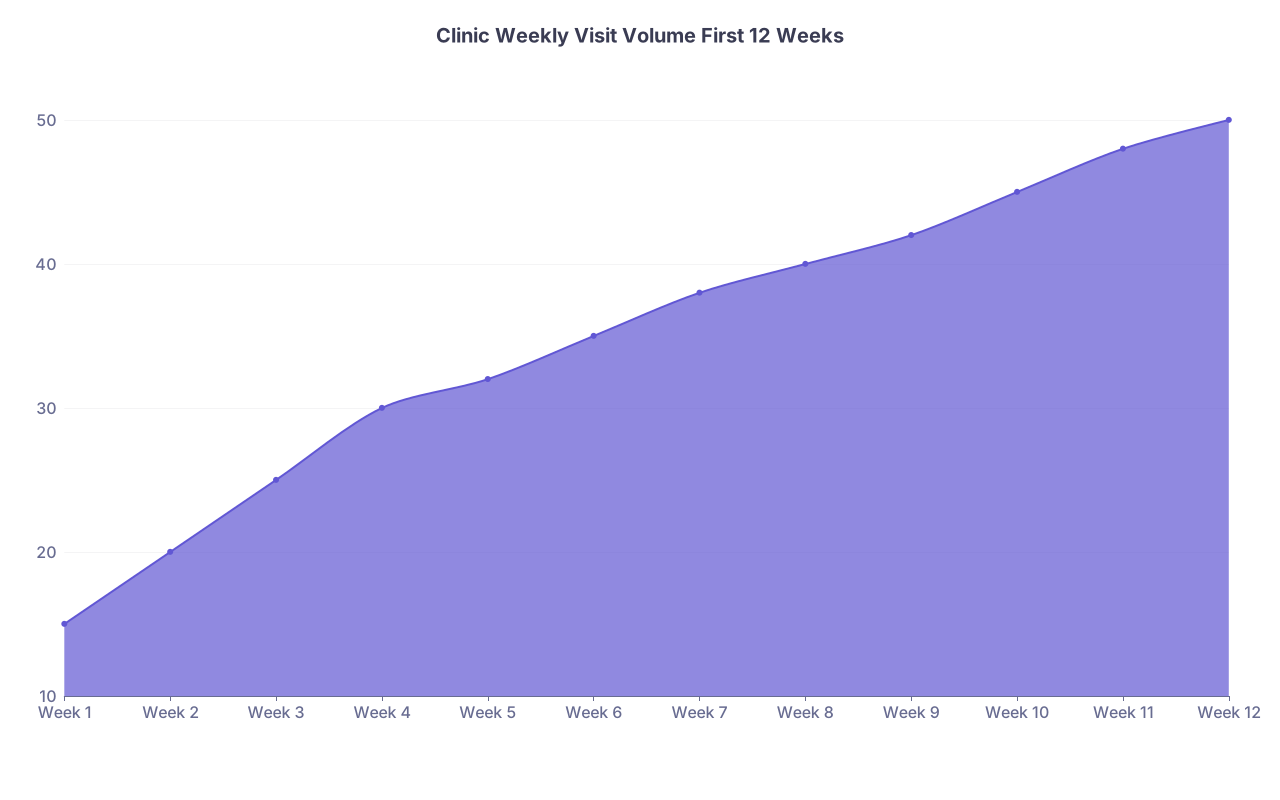
| Category | Value |
|---|---|
| Week 1 | 15 |
| Week 2 | 20 |
| Week 3 | 25 |
| Week 4 | 30 |
| Week 5 | 32 |
| Week 6 | 35 |
| Week 7 | 38 |
| Week 8 | 40 |
| Week 9 | 42 |
| Week 10 | 45 |
| Week 11 | 48 |
| Week 12 | 50 |
If your line is flat or growing painfully slowly, you tackle volume aggressively:
- Make sure you are on insurer directories accurately (name, address, phone, accepting new patients). Call and verify.
- Introduce yourself directly to:
- Local urgent cares
- Hospital discharge planners
- Nearby specialists who need primary care follow‑up or procedural partners
You do not need 10 marketing channels. You need 2–3 that actually send patients.
B. Purge Bad Payers, Lean Into Good Ones (When Possible)
Some payers are slow, high hassle, and low pay. Others are tolerable.
Pull a quick Payer Scorecard:
| Payer | Avg Days to Pay | Avg Reimbursement per Visit | Hassle Level (1-5) |
|---|---|---|---|
| BlueCross | 18 | $110 | 2 |
| Aetna | 25 | $105 | 3 |
| Medicaid | 30 | $70 | 2 |
| Cigna | 45 | $95 | 4 |
| Self-pay | 0 | $80 | 1 |
Over time, you:
- Steer scheduling towards better payers and self‑pay where ethically appropriate
- Decide if any payer is not worth the administrative pain once you have stable volume
You do not drop payers lightly in month 3. But you start collecting data so future you can make better decisions.
Step 9: A Simple “Crisis‑Mode” Operating Rhythm
You are still a clinician. You cannot spend 20 hours a week playing CFO.
So you adopt a stripped‑down operating rhythm for the next 8–12 weeks.

| Step | Description |
|---|---|
| Step 1 | Weekly Cash Review 30 min |
| Step 2 | Trigger Expense Review |
| Step 3 | Maintain Plan |
| Step 4 | Negotiate Terms or Cut Nonessential |
| Step 5 | Increase Collections Work |
| Step 6 | Monitor Visit Volume |
| Step 7 | Adjust Next Week Projections |
| Step 8 | Cash < Target? |
Core cadence:
Weekly (30–60 min):
- Look at cash balance vs last week
- Review visit volume and collections
- Update short‑term projection
Biweekly (60–90 min):
- Aging report review and denial work
- Check on any negotiated payment plans with landlord/vendors
Monthly (60–90 min):
- Evaluate staffing vs volume
- Minor course corrections on marketing and services
You keep running this rhythm until your weekly cash flow is consistently positive and your cushion is at least 1–2 months of expenses.
The Bottom Line
Three key points to carry out of this:
- Month 3 cash pain is predictable, not personal. You treat it as a timing problem with a defined cash gap, not a referendum on your worth as a clinician or owner.
- You have three real levers: pull cash in faster, push cash out later, and plug the structural leaks. Everything practical in this playbook is just a variant on those three moves.
- You need a simple, relentless operating rhythm, not heroics. A weekly cash review, systematic denial work, and disciplined expense management will keep your clinic alive long enough for your growing visit volume to actually show up in your bank account.