
Only 18% of multi‑site medical practices report that their second location was profitable within 12 months.
Everyone loves the idea of “scaling.” Very few actually structure the operations correctly. The rest just replicate chaos in more ZIP codes.
Let me break this down specifically, because the decision you make about centralized vs localized operations will determine whether your second, third, and fourth sites become a machine or a money pit.
Step One: Get Clear On What Actually Needs Structuring
Before arguing about central vs local, you need to be precise about which functions you are talking about. People say “we centralize billing” or “our sites are independent” and mean completely different things.
There are 9 core operational domains in a multi‑site practice:
- Strategic management and governance
- Clinical standards and care protocols
- Scheduling and patient access
- Billing, coding, and revenue cycle
- HR: hiring, training, and performance management
- IT/EMR and data infrastructure
- Purchasing, supplies, and vendor management
- Marketing, referral management, and brand
- Finance, compliance, and legal
Now, for each of those 9, you have a spectrum:
- Fully centralized (one team/department for all sites)
- Hybrid (central rules + local execution)
- Fully localized (each site runs its own version)
The worst setup? Random. “We’ll see as we go” is how you end up with three EHRs, six referral processes, and twelve ways to schedule a follow‑up.
We are going to walk through:
- What works well centralized
- What breaks if you over‑centralize
- Where local control is absolutely necessary
- How this shifts as you grow from 1 → 3 → 7+ locations
Centralized vs Localized: The Reality By Function
Let us go function by function. This is where real practices either get disciplined or die by a thousand exceptions.
1. Strategic Management and Governance
This one should not be controversial: strategy must be centralized.
- One leadership group (even if small): managing partner, admin director, maybe a COO once you are >3 sites.
- Centralized:
- Vision, growth plan, site selection
- Major capital decisions (new tech, new service lines)
- Payor contracting and network participation
- Localized input:
- Each site lead gives data and reality checks
The mistake I see all the time: turning each site into a semi‑independent kingdom. Different “chiefs” deciding what insurance panels to join, what hours to run, and which services to offer. That does not scale; it fragments.
Strategic governance is not where you “empower” each site. This is where you maintain coherence.
2. Clinical Standards and Care Protocols
Medicine is local. But your risk exposure is not.
You centralize:
- Clinical protocols
- Documentation standards
- Order sets
- Safety policies
- Quality metrics and thresholds
You localize:
- How those standards flex for the specific patient population
- Which diagnoses/procedures dominate that market
- Local subspecialty niches
Example: Multi‑site orthopedics group
- Central:
- Standardized post‑op pathways for common procedures
- Same peri‑op antibiotic policy
- Same radiology documentation requirements
- Local:
- Rural site: more trauma and workers comp; more coordination with local ED
- Urban site: more sports medicine, different PT networks, different referral patterns
The rule: Centralize the “what,” allow some local tuning of the “how,” but with guardrails.
3. Scheduling and Patient Access
This is where most groups get the central vs local decision wrong. They either:
- Run everything locally with each front desk “doing their own thing” and destroying any hope of access optimization, or
- Over‑centralize into a rigid call center that does not understand local nuances and infuriates patients and referring providers.
Practically:
Central components:
- Core scheduling rules
- New vs established templates
- Urgent slots
- Telehealth slots
- Cross‑site scheduling permissions
- Technology stack
- Single phone tree architecture
- Online scheduling rules
- Single waitlist / recall system
Local components:
- On‑site staff who can override when clinically indicated
- Local control of last‑minute add‑ons for same‑day/next‑day
- Knowledge of local referring patterns (e.g., “Dr Patel’s office will send 3–5 consults every Thursday afternoon”)
The sweet spot is often:
- Centralized centralized scheduling hub with:
- Trained schedulers handling 80–90% of inbound calls for all locations
- Standardized scripts and scheduling templates
- Local control for:
- Same‑day access
- Direct line use for high‑value referrers
- In‑person rescheduling
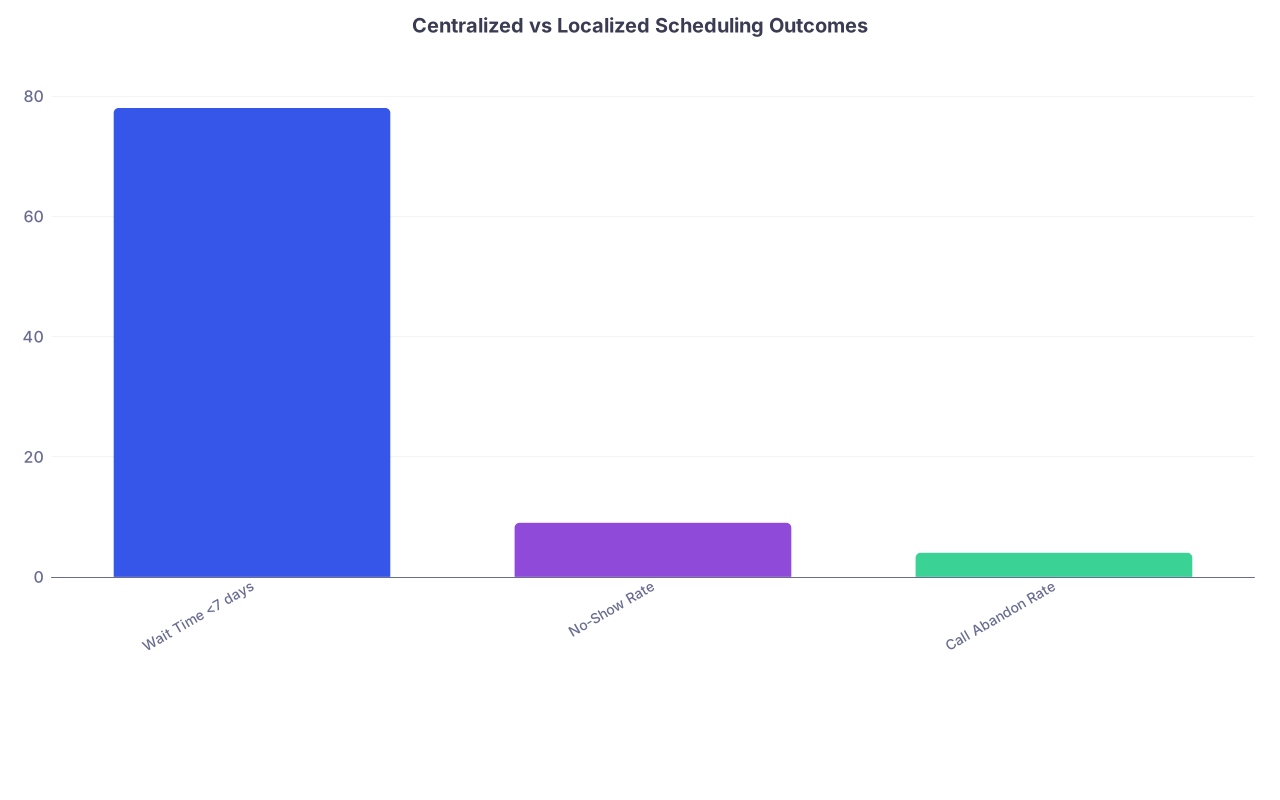
| Category | Value |
|---|---|
| Wait Time <7 days | 78 |
| No-Show Rate | 9 |
| Call Abandon Rate | 4 |
This is based on what I see repeatedly: groups that centralize scheduling with discipline (and real training) tend to get shorter wait times and lower abandon rates than scattered, site‑specific phone systems.
4. Billing, Coding, and Revenue Cycle
Here the answer is blunt: centralize aggressively. Local billing is how revenue leaks quietly for years.
Centralized:
- Charge capture workflows
- Coding standards and audits
- Claims submission
- Denials management
- Payment posting
- AR follow‑up
- Reporting and analytics
Localized role:
- Clinicians documenting correctly and consistently
- Local leadership pushing providers who are slow/erratic with notes
- Identifying local payor quirks (but not reinventing process)
What should absolutely not happen: Site 1 uses a local billing service, Site 2 has an in‑house biller, Site 3 is three months behind submitting claims. I have seen that exact scenario more than once.
With central revenue cycle, you get:
- Unified metrics across sites
- Ability to staff a real, specialized team instead of 1.3 overwhelmed billers per location
- Better leverage in payer disputes (one contract, many locations)
| Model | Typical Net Collection Rate | Denial Follow-Up Quality | Risk of Cash Flow Disruption |
|---|---|---|---|
| Fully Local Billers | 88–92% | Inconsistent | High |
| Outsourced Per-Site | 90–94% | Variable by vendor | Medium |
| Centralized In-House Team | 94–98% | High | Lower |
You can outsource billing initially. But doing it separately per site is a structural error. One billing entity. One set of processes.
5. HR: Hiring, Training, and Performance Management
Multi‑site practices screw this up constantly. Either:
- Everything is “corporate HR” and local leaders have no say, or
- Every site hires whoever shows up, with zero standardization.
You need a hybrid model.
Centralized HR:
- Pay scales and benefits structure
- Job descriptions and role definitions
- Interview standards and background checks
- Onboarding frameworks
- Disciplinary pathways and legal risk management
Localized HR responsibilities:
- First‑pass cultural fit
- Day‑to‑day performance coaching
- Schedule management and micro‑level staffing
- Immediate handling of interpersonal conflict (with HR backing)
What should never be local:
- Writing their own employment contracts
- Ad hoc non‑competes
- “Side deals” on compensation or PTO
- Off‑the‑books arrangements
You want one HR playbook, with local implementation.
As you grow to 3–5 sites, you typically add a regional practice manager or lead at each location. That person owns:
- Morale and culture at that site
- Execution of centrally defined policies
- First‑line issue spotting
But their authority lives inside central HR-defined fences.
6. IT/EMR and Data Infrastructure
This one is non‑negotiable: centralize.
- One EHR
- One PM system
- One data warehouse or reporting system
- Standardized templates and order sets
I have seen groups try to “grandfather” in different systems when they acquire a practice. It always looks like a clever concession at the time and becomes a handcuff later. Integration projects drag on. Reporting is incomplete. Workflows differ. Staff float between sites and are useless for half of them.
You also centralize:
- User provisioning and access control
- Security and compliance (HIPAA, backups, encryption)
- Device management and support
- Telehealth platform and patient portal
Local input is useful for:
- Template refinement
- Specialty‑specific documentation needs
- Workflow quirks that actually improve care
But the infrastructure is central. You do not get scale benefits with five different EMRs.

| Step | Description |
|---|---|
| Step 1 | Central EMR and PM |
| Step 2 | Site 1 |
| Step 3 | Site 2 |
| Step 4 | Site 3 |
| Step 5 | Reporting Dashboard |
| Step 6 | Leadership Team |
| Step 7 | Patient Portal |
| Step 8 | Patients All Sites |
That is what healthy looks like. Not six disconnected boxes with arrows everywhere.
7. Purchasing, Supplies, and Vendor Management
Here, centralization gives you measurable dollar savings quickly.
Centralized:
- Vendor selection and contracts
- Standardization of key supplies, implants, devices
- Bulk ordering of high‑volume items
- Capital purchase approvals
- Inventory policy (minimums, re‑order triggers)
Localized:
- Day‑to‑day stock checks
- Identifying genuine local needs (e.g., different pediatric vs geriatric supplies profiles)
- Submitting requests for new items
The trick is this: do not let “surgeon preference” or “we’ve always used this brand” open the door to vendor chaos. I have watched supply costs differ by 20–30% between sites in the same group solely because of undisciplined purchasing.
You can allow some specialty‑driven variation. But it is centrally negotiated and tracked.
8. Marketing, Referral Management, and Brand
This is where central vs local is more art than science.
Brand must be centralized:
- Same practice name and visual identity across sites
- Unified website with location pages
- Coherent online presence and reviews strategy
But referrals and local reputation are hyper‑local.
Centralized:
- Overall brand positioning
- Website, SEO, digital advertising
- Core messaging and patient education materials
- Review request workflows integrated with EMR
Localized:
- Physician‑to‑physician outreach
- Community events
- Structuring clinic hours that fit that neighborhood
- Micro‑strategies for unique referral sources (e.g., large employers, college teams)
The bigger you get, the more central marketing you need. But the referring PCP on the corner cares far more that your local site lead shows up to their office, answers their cell, and gets their patients in quickly than about your fancy logo.
9. Finance, Compliance, and Legal
This cannot be local. Period.
Central finance:
- Chart of accounts, budgets, and financial reporting
- Cash management and banking relationships
- Tax compliance
- Capital allocation across sites
- Partner distributions and equity structure
Central compliance/legal:
- HIPAA program and risk assessments
- OSHA, CLIA, state-specific regs
- Malpractice coverage structure and carrier relationships
- Payor contract review
- Employment law compliance
Local site leaders are responsible for:
- Following the rules
- Raising red flags early
- Cooperating with audits and corrective plans
But they should not be improvising their own legal structures or compliance strategies.
How the Right Structure Changes As You Grow
The correct answer for a 2‑site practice is not the same as for 10 sites. Let’s be concrete.
| Function | 1–2 Sites | 3–5 Sites | 6–10+ Sites |
|---|---|---|---|
| Strategy | Central | Central | Central |
| Clinical Standards | Light central | Central w/ local nuance | Strong central, monitored |
| Scheduling | Hybrid | Mostly central | Central with local overrides |
| Billing/RCM | Central or outsourced | Central | Central, specialized teams |
| HR | Informal + central | Central + site leads | Central HR dept + regional mgmt |
| IT/EMR | Central | Central | Central with governance body |
| Purchasing | Hybrid | Mostly central | Central with formulary |
| Marketing | Local heavy | Balanced | Central strategy + local exec |
| Finance/Compliance | Central | Central | Central with internal audit |
As you scale up:
- Local autonomy typically decreases on process, but
- Local accountability on performance increases
A common pain point: the “second site” stage. This is when many physicians first notice that what worked at one location falls apart when duplicated. That is your early warning that you need central systems.
Real‑World Structures That Actually Work
Let me lay out a couple of practical models that I have seen succeed.
Model A: “Lean Central Hub” for 2–3 Sites
Good for: You plus a couple of partners, expanding to 2 or 3 locations within the same metro.
Central:
- Practice administrator (non‑clinician) who runs operations for all sites
- Central billing team (could be outsourced but with one relationship)
- Single EMR/PM
- Shared phone system with common scheduling protocols
- Unified HR policies and payroll
Local:
- One lead physician per site, 0.2–0.3 FTE leadership time
- Site supervisor (MA or front‑desk promoted) handling staff schedules and day‑to‑day
- Local referral and community work
Common mistake: treating the new site as a “spin‑off” with its own admin, its own scheduler, and half‑baked brand connection. It looks easier early. It is more expensive and harder to fix later.
Model B: “Central Ops + Local Leadership” for 4–8 Sites
Good for: Regional practice with defined geography, serious about scale.
Central office:
- COO or operations director
- HR manager + recruiter
- Revenue cycle manager + team
- IT lead and support (can be partly outsourced)
- Central scheduling team (call center style but not a script‑reading factory)
- Finance controller / strong bookkeeper
Site level:
- Each site has a practice manager (non‑physician)
- Each site has a designated physician lead with a formal leadership role
- Metrics tracked per site:
- Access (wait times, call answer times)
- Productivity (wRVUs/clinician, visits/day)
- Revenue and collections
- Quality metrics
The rule: central sets targets and processes; local leaders are responsible for hitting targets and feeding back what is not working on the ground.
Model C: “Diffused Service Line Pods” for Multi‑Region Practices
Once you are big (10+ sites, maybe in multiple cities), things get more complex. Then you often structure around:
- Central core (finance, HR, IT, contracting, legal)
- Service line pods (e.g., “Spine,” “Sports,” “Women's Health”) crossing multiple sites
- Regional pods for operations
That is beyond the scope of a post‑residency doc opening their 2nd or 3rd location. But it is the direction you are heading if you get this right.
How To Decide What To Centralize First
Here is a practical way to decide, instead of guessing.
Ask three questions for each function:
- Does inconsistency across sites create legal, financial, or brand risk?
- If yes → Centralize strongly.
- Does local variation actually generate value (revenue, access, relationships)?
- If yes → Maintain some local autonomy.
- Do economies of scale clearly exist (bulk buying, specialized teams)?
- If yes → Push centralization, but keep local feedback.
Run that against the 9 domains:
- High‑risk if inconsistent:
- Clinical standards, billing, HR legal, compliance, EMR, brand
- High value in local variation:
- Scheduling nuances, referral patterns, community engagement
- Strong economies of scale:
- Billing, IT, purchasing, finance, contracting, scheduling
You end up with:
Centralize early and firmly:
- EMR/IT
- Billing/RCM
- HR policies and contracts
- Finance and compliance
- Brand standards and digital footprint
Hybrid from early on:
- Scheduling
- Clinical pathways (shared core, local add‑ons)
- Marketing/outreach
- Purchasing (central framework, few local exceptions)
Governance: Who Actually Gets To Decide?
Structure without governance is just a slide deck. You need clarity on who decides what, or every argument becomes personal.
At minimum, define:
- Owners’ council / board
- Strategic decisions: growth, partnerships, capital, service lines
- Approves practice‑wide policies
- Operations leadership (admin side)
- CEO/COO/practice administrator who owns execution
- Authority over non‑clinical staff across sites
- Medical leadership
- One or two physician leaders responsible for clinical standards
- Chair a quality or clinical governance committee
- Site leadership
- Site physician lead
- Site manager
Then explicitly map:
- Who decides central vs local for each function
- Who breaks ties
- What requires owner vote vs operational decision
Otherwise, the “central vs local” debate becomes endless turf warfare: “Corporate does not understand,” vs “That site always wants to do their own thing.”
Watch For These Red Flags
I will be blunt: if you see these patterns as you add locations, you are setting yourself up for a messy unwinding later.
- Different locations using different forms or intake processes
- Recruiting MA/front‑desk via text and handshake, no standardized hiring pathway
- “We have a biller at each site”
- More than one EHR or PM system
- Site‑specific phone numbers with totally different call flows
- Physicians negotiating their own payor deals or informal side arrangements with hospitals
- Individual locations doing their own website or branding
Each of those is a small local convenience. And a long‑term structural liability.
Implementation: How To Shift Towards The Right Structure
If you already have 2–3 sites running loosely, here is how you fix it without burning everything down.
Step 1: Pick 2–3 functions to centralize in year one
- Usually: billing, IT/EMR standardization, HR policy/handbook
Step 2: Design the central team and authority
- Decide: in‑house vs outsourced billing (but unified)
- Identify who is the actual head of HR and revenue cycle
- Clarify their authority over all sites
Step 3: Standardize your tech stack
- One EHR and PM
- One phone system with call routing rules
- One online scheduling and patient portal
Step 4: Create site lead structure
- Appoint one physician lead per site
- Appoint one non‑physician site manager
- Define their responsibilities vs central ops
Step 5: Build your metrics dashboard
- Same metrics for each site:
- Access, productivity, collections, quality, patient experience
- Review monthly with central and local leaders together
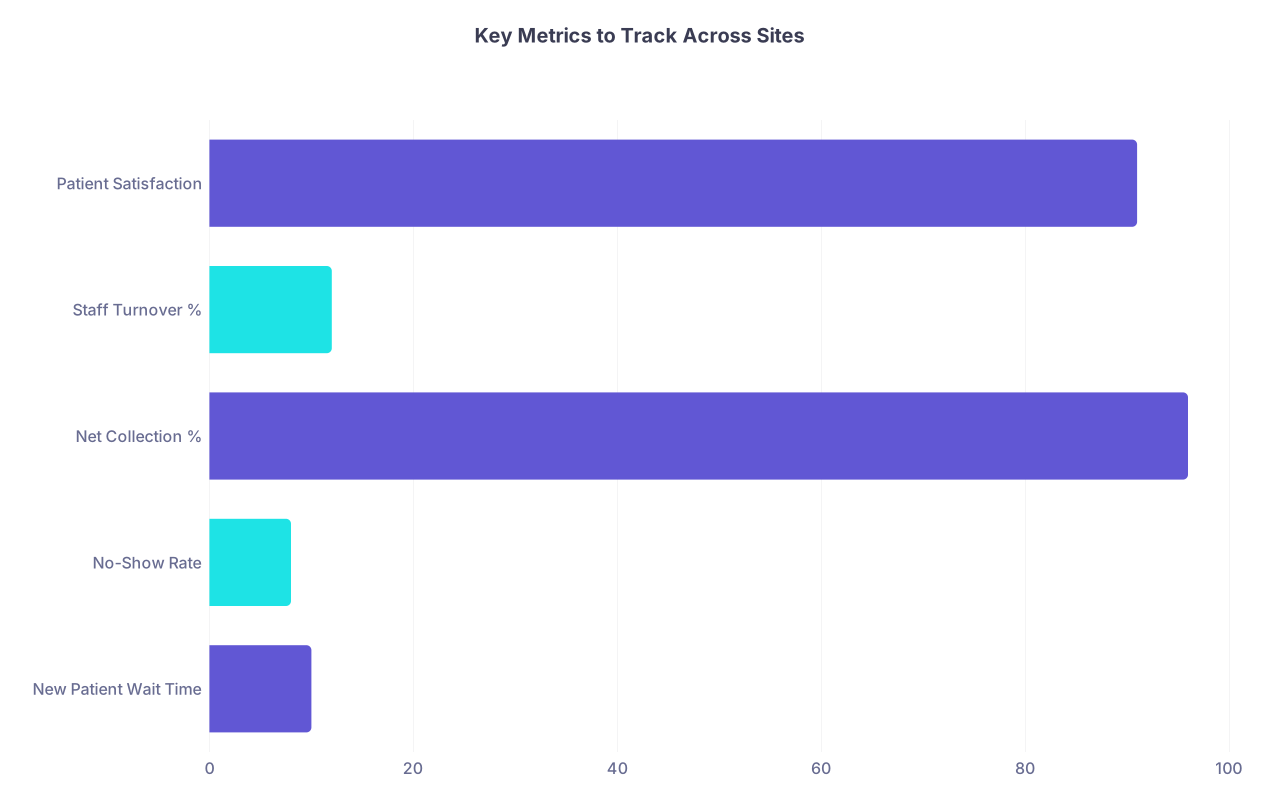
| Category | Value |
|---|---|
| New Patient Wait Time | 10 |
| No-Show Rate | 8 |
| Net Collection % | 96 |
| Staff Turnover % | 12 |
| Patient Satisfaction | 91 |
You cannot manage multi‑site structure effectively without shared data.
What Changes Post‑Residency vs Later In Career
Coming right out of residency or early attending years, you often underestimate two things:
- How quickly operational complexity overwhelms informal systems when you add locations
- How hard it is to retro‑fit centralization after three years of “we’ll figure it out later”
If you are early:
- Design as if you will have 3–4 sites, even if you are just on site 1
- Pick scalable systems and standard operating procedures from day one
- Do not let each new location negotiate its own micro‑deal on anything structural
If you are mid‑career, already with a messy multi‑site structure:
- Start by centralizing the highest‑impact dysfunction: billing and IT
- Then standardize HR and policies
- Then rationalize scheduling and phones
- Finally, rework purchasing and marketing around a central model
You do it in that order because:
- Without centralized billing and IT, you are bleeding money and cannot see it clearly
- Without HR and policy standardization, you risk legal exposure
- Without unified scheduling and phones, you cannot improve access and patient experience coherently
One More Thing No One Tells You
Centralization will make you unpopular with at least some people at first. Site managers, front desk staff, and even some physicians who are used to “doing things my way” will complain.
You will hear:
- “Corporate is taking over.”
- “We know our patients better.”
- “This worked fine before.”
Sometimes they are right on execution details. Often they are wrong on structure.
Your job as an owner is to:
- Centralize where standardization and scale matter
- Preserve local judgment where relationships and nuance matter
- Be explicit about which is which
If you avoid hard decisions to keep everyone comfortable, you will pay for that with lower margins, more chaos, and less time for actual medicine.
Key Takeaways
- Do not treat “central vs local” as one global choice; decide it function by function across 9 domains.
- Centralize early and firmly on billing, IT/EMR, finance/compliance, HR structure, and brand; keep a hybrid model for scheduling, marketing, and some clinical nuances.
- Build a clear governance and leadership structure so central decisions stick and local leaders have defined authority instead of endless turf wars.