
Do PDs Now Ignore Preclinical Years? The Evidence Says Otherwise
The idea that “preclinical no longer matters” in the Step 1 pass/fail era is wrong. Confidently wrong. And if you build your med school strategy around that myth, you’re going to pay for it in MS3 and in residency applications.
Let me be blunt: program directors did not suddenly decide that the first 18–24 months of medical school are irrelevant because the NBME changed a score report. They shifted which signals they read from that period. They did not stop reading it.
You’re hearing the wrong sound bites in the hallway:
“Bro, Step 1 is pass/fail, no one cares about preclinical now.”
“Just vibe MS1–MS2 and turn it on for Step 2.”
I’ve heard these lines from MS1s who are already setting themselves up for shelf and Step 2 pain.
Let’s walk through what’s actually happening, with data, PD surveys, and some common-sense pattern recognition.
What Changed With Step 1 — And What Didn’t
Step 1 going pass/fail removed a numerical filter, not PDs’ need to stratify applicants. Residency programs still have to screen thousands of applications in a few weeks. They still need proxies for:
- Knowledge base
- Work ethic
- Consistency over time
- Risk of failing boards or struggling in internship
Before: Step 1 scores acted as a crude but powerful funnel for all of that.
Now: Programs are leaning more on other indicators, many of which trace straight back to your preclinical performance.
The AAMC and NRMP have both surveyed program directors after the Step 1 change. The pattern’s very clear:
- Step 2 CK moved way up as a filter.
- Clerkship grades and MSPE narrative became even more important.
- Class ranking/quartiles still matter when available.
- And for some specialties, preclinical performance metrics (e.g., “failed a course/remediated,” “academic difficulty,” internal honors) are explicit red flags.
You don’t see a survey category called “preclinical years,” so students run around saying, “Look, they don’t list preclinical as a factor!” That’s shallow reading. Preclinical feeds:
- Whether you pass Step 1 on time
- How strong your foundation is for shelves and CK
- Any academic flags in your MSPE
- Your class ranking at schools that factor in preclinical
PDs absolutely care about these. They just don’t label them “MS1/2 GPA.”
The New Screening Stack: Where Preclinical Still Shows Up
Let’s strip away the marketing phrase “holistic review” and talk about what PDs actually use.
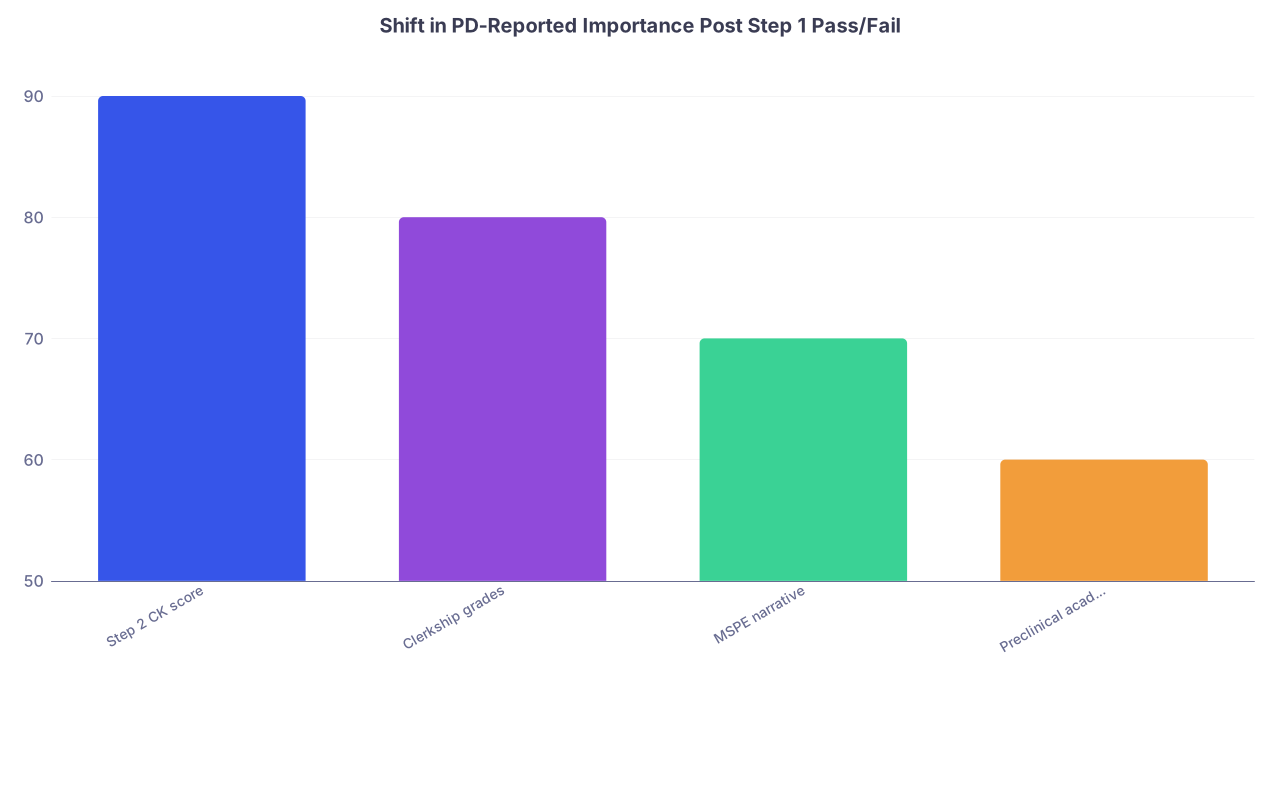
| Category | Value |
|---|---|
| Step 2 CK score | 90 |
| Clerkship grades | 80 |
| MSPE narrative | 70 |
| Preclinical academic issues | 60 |
These numbers aren’t exact from any single survey, but they reflect the relative trend reported consistently across NRMP and AAMC data: Step 2 CK and clerkships dominate, MSPE matters a lot, and academic issues — usually born in preclinical — are not ignored.
Here’s the part students underestimate: your preclinical habits and outcomes are not quarantined to MS1–MS2. They echo forward:
- Weak basic science understanding → worse shelf scores → worse clinical grades → worse Step 2 CK
- Repeated preclinical failures → flagged in MSPE → PD worry about residency remediation
- Chronic “barely passing” early → you struggle with the volume and complexity of wards
PDs talk about this explicitly. I’ve heard variations of:
“If someone has multiple fails preclinically, then barely passes Step 1, then squeaks by CK, we’re not gambling on them in a high-volume, high-acuity residency.”
“Holistic” doesn’t mean “we ignore risk.”
Myth: “Preclinical Doesn’t Matter Because It’s P/F Too”
Many schools layered more pass/fail into preclinical at the same time Step 1 went pass/fail. Students then conclude: “Sweet, this whole phase is low-stakes.” That’s not how it works.
Three problems with that belief.
1. P/F Still Generates a Record
Preclinical P/F does not mean “no documentation.” Schools still track:
- Exam failures and remediation
- Longitudinal professionalism issues
- Patterns needing faculty intervention
These go straight into your MSPE as phrases like:
- “Required remediation in the preclinical curriculum”
- “Demonstrated academic difficulty during foundational courses”
- “Showed improvement after early performance challenges”
PDs are not stupid. They know what that code language means.
2. Many Schools Are Quietly Preserving Rank
Some schools pretend everything’s pass/fail and “non-ranking,” then internally stratify students when writing MSPEs. That vague line “student performed in the upper third of the class” did not come out of nowhere.
Those internal ranks are often weighted by preclinical performance. I’ve sat in meetings where faculty hash this out: “Do we keep the 50/50 preclinical–clinical formula? Shift to 30/70?” No one is arguing for 0/100.
So when you coast MS1–MS2 because “no one cares,” then try to flip a switch M3, you’re dragging around a baked-in disadvantage in your comparative evaluation.
3. Early Habits Become Your Default Under Stress
You do not re-invent yourself in MS3. You compress.
The way you:
- Take notes
- Space repetition or not
- Approach UWorld-style questions
- Manage fatigue and procrastination
…all of that is rehearsed in preclinical. When you hit 80-hour weeks and nightly reading, you fall back on what you’ve practiced. If you’ve only practiced cramming for low-stakes pass/fail block exams, you’re going to bleed on shelves and Step 2 CK.
PDs don’t have to see your Anki stats. They just see the downstream outcomes.
Where PDs Explicitly Care About Preclinical: Red Flags
Let’s talk about the stuff that moves you from “maybe” to “no” on a PD’s screen in under 10 seconds. Preclinical is usually where the landmines are buried.
| Preclinical Issue | Typical PD Interpretation |
|---|---|
| Failed course, required repeat | Risk for struggle, needs bandwidth |
| Step 1 delay due to knowledge | Weak foundation, possible CK risk |
| Multiple exam failures | Consistency and learning strategy gap |
| Professionalism write-ups | Culture and reliability concern |
I’ve heard PDs say things like:
- “One remediated course? Maybe. Multiple? Hard sell.”
- “If they needed extra time just to pass Step 1, not sure they keep up with our service.”
- “We can’t be running a tutoring service for interns.”
Is that fair? Not always. But it’s the current reality in competitive fields and solid academic programs. They have more viable applicants than spots. Any sign of early instability pushes you to the reject pile unless something else in your file is spectacular.
The Step 2 / Shelf / Foundation Triangle
Here’s where the “preclinical doesn’t matter” crowd really hurts themselves: they think Step 2 CK is some totally new test that only depends on MS3 rotations.
Wrong. CK is built on a spine of basic and pathophysiologic concepts laid down in preclinical, then dressed in clinical clothing.
If your preclinical learning basically consisted of memorizing PowerPoint phrases long enough to pass NBME-style school exams, you’ll recognize this during M3:
- You start UWorld for CK and feel like every question is written in a foreign language.
- Shelves turn into a brute-force fight you barely win or outright lose.
- Your study days become “learn from scratch what I should’ve actually learned MS1–MS2.”
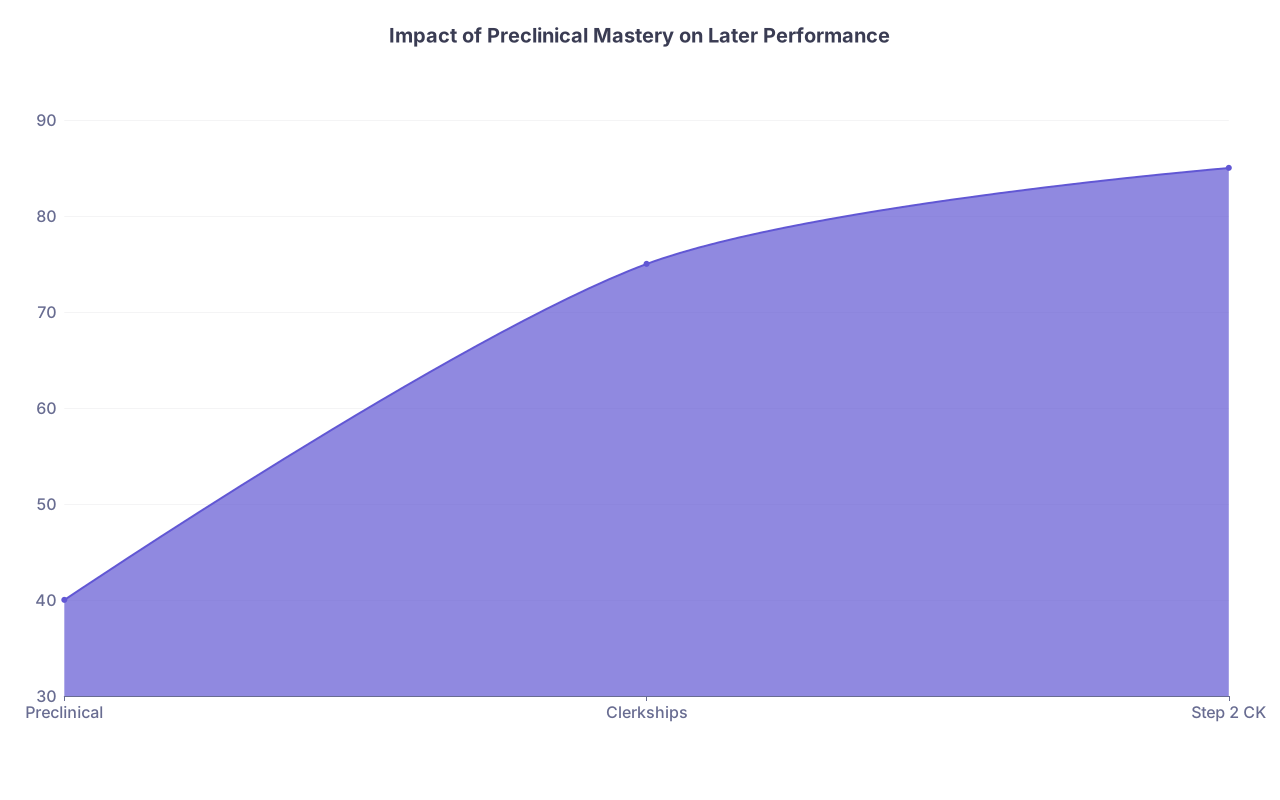
| Category | Value |
|---|---|
| Preclinical | 40 |
| Clerkships | 75 |
| Step 2 CK | 85 |
Again, not literal numbers, but the pattern is real: strong preclinical mastery expands what’s possible later. Weak preclinical compresses your ceiling.
PDs don’t look at your MS1 cardiology exam grade. They look at the manifestations:
High CK + strong IM/surgery shelf + solid narratives → “This person knows their stuff.”
Mediocre CK + weak shelves + MSPE comments about needing more time to master content → “Maybe not.”
But that started back in the “low-stakes” years you were told not to care about.
“But I Know People Who Coasted Preclinical And Matched Fine”
Of course you do. Survivorship bias is powerful.
You didn’t see:
- The MS4 with 2 preclinical failures who quietly went unmatched in a competitive field and SOAPed into something else.
- The student who “partied MS1” and then spent all of MS3 in chronic anxiety triaging shelves, research, and a late Step 2 with mediocre scores.
- The people who changed specialty ideas last-minute because their portfolio wasn’t competitive for what they actually wanted.
Everyone showcases the one classmate who did minimal preclinical work, turned it on for CK, and matched derm or ortho. You’re not hearing the underlying data:
- That person may have had a 3.98 undergrad GPA, absurd test-taking talent, and a well-connected mentor.
- They might have actually done a ton of Anki/UWorld quietly while telling friends “I’m not really studying.”
- Or they matched before the full effects of Step 1 pass/fail and “arms race CK” really hit.
Building your approach on the outliers is how you end up disappointed.
What PDs Say They’re Doing Now
If you strip away the PR language and just listen, PDs are remarkably consistent post-Step 1 change. The message is:
“We still need a way to minimize risk and find residents who can handle the workload, pass boards, and not implode. We lost one numerical signal; we’re compensating with others.”
Those “other” signals all pull from things that preclinical strongly influences:
- Time to Step 1 and whether you passed on schedule
- Whether your MSPE is full of “required remediation” and “improved performance” euphemisms
- How well you handle clerkships and shelves (which lean heavily on preclinical foundations)
- Your ability to crush Step 2 CK when everyone else is gunning for a 250+ equivalent
Is there any data suggesting PDs proactively value preclinical honors or local exam grades as a top-5 factor? Not usually. But there is clear, survey-backed evidence that they care about:
- Academic problems
- Board performance
- Reliability and consistency
Preclinical is where those traits either develop or crumble.
So What Actually Makes Sense To Do In Preclinical Now?
No, I’m not saying you need to treat every preclinical quiz like it’s an existential event. That’s just anxiety cosplay. But swinging to the opposite extreme—“none of this matters anymore”—is flat-out dumb.
Here’s the sane, evidence-aligned approach:
- Aim for real mastery of core systems (cardio, pulm, renal, neuro, heme/onc). These dominate CK and shelves.
- Use question-based learning (NBME style, not just your school’s PowerPoints) to build test-taking skills early.
- Avoid academic issues that trigger MSPE red flags: don’t rack up remediations because you “didn’t think it counted.”
- Treat Step 1 as an on-time, low-drama pass. Not as an afterthought you push 3 months because you’re behind.
- Build study habits in MS1–MS2 that you can scale in MS3–MS4 without killing yourself.
You’re not doing this because “PDs care about preclinical grades.” You’re doing it because PDs care about everything that flows from preclinical: stability, board performance, and the ability to not crumble when the volume spikes.
The Bottom Line
The narrative that “PDs ignore preclinical years now” is comforting. It lets you treat the first two years like an extended orientation. But it’s not how selection actually works.
Three key points:
- Preclinical changed from being scored via Step 1 to being scored via everything that comes after. The scoreboard moved; it didn’t disappear.
- PDs care deeply about red flags and downstream performance, both of which are heavily shaped by your preclinical years, even if they never see a single MS1 grade.
- If you treat preclinical as low-stakes, you will pay for it in CK, shelves, and MSPE language, right when things become genuinely high-stakes.
Ignore the hallway myths. Build a strong foundation early. Not because it “looks good,” but because you will not have time to rebuild it later when residency programs are actually judging you.