
It’s 11:47 p.m. You’re staring at your ERAS dashboard, not even really reading anymore, just… spiraling. You click through program websites and see it over and over: “We typically recruit from X, Y, Z top-tier schools.” You look at your badge sitting on your desk. It’s not Harvard. It’s not Hopkins. It’s your “mid-tier,” “no-name,” “new-ish” med school.
And the question that’s been eating you alive comes back:
Is my school’s name quietly killing my chances?
Let me just say it out loud the way you’re saying it in your head:
“Did I screw myself before I even started by going to this school? Are programs tossing my app in the trash as soon as they see my med school?”
Let’s actually unpack that. No sugarcoating, but no doomsday fantasy either.
How Much School Reputation Actually Matters (And Where)
Here’s the part nobody puts plainly on the official websites:
School prestige does matter.
But not in the cartoon version we imagine, where PDs sit in a room saying, “Top 10 only, shred everything else.”
Programs are looking at a mix of things, and school name is just one filter among several. Think of it like this: it affects how much benefit of the doubt you get.
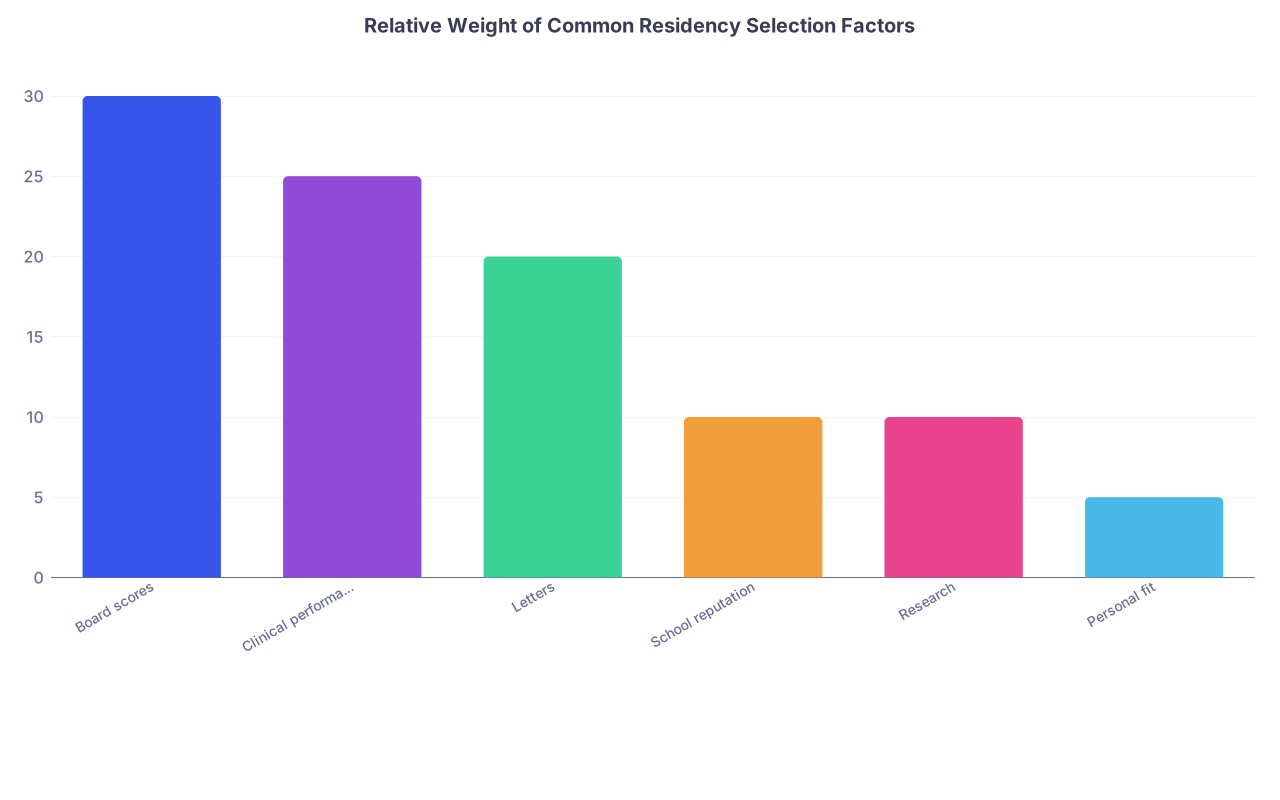
| Category | Value |
|---|---|
| Board scores | 30 |
| Clinical performance | 25 |
| Letters | 20 |
| School reputation | 10 |
| Research | 10 |
| Personal fit | 5 |
Is that exact data from a single study? No. But it matches what I’ve seen over and over talking to residents, PDs, and chiefs: board scores, clinical performance, and letters drive the bus. School reputation rides in the backseat.
Where school name tends to matter more:
- Ultra-competitive specialties (derm, ortho, plastics, ENT, rad onc, neurosurg)
- Hyper-elite academic programs (MGH, Brigham, UCSF, Hopkins, etc.)
- When your metrics are borderline and they’re searching for reasons to risk or not risk you
Where it matters way less than your brain thinks:
- Solid academic programs that aren’t “Top 10 god-tier”
- Community or university-affiliated residencies
- Bread-and-butter specialties (IM, peds, FM, psych, anesthesia, EM) when your stats are in range
Here’s the blunt truth:
If your scores, evaluations, and letters are clearly strong, your school’s reputation becomes background noise. If those things are weak, even a big-name school can’t save you.
What PDs Actually Use Your School’s Name For
They’re not just ranking schools in their heads like US News.
They’re asking a few practical questions:
Do we know what grades here mean?
If you’re from a “known” school, they already understand what Honors/HP/pass means there. With a “new” or “less famous” school, they may not trust the grade inflation/deflation situation. So they lean harder on objective stuff: Step 2, shelf exams, standardized letters.Do we know people there?
This is a huge, underrated thing. Connections. PDs care way more about, “Do I know and trust the person who wrote this letter?” than, “Is this a Top 20 school?”Have we had residents from there before?
If someone from your school came to that program, crushed it, and was beloved, your school gets an invisible bump. If someone came and crashed and burned… yeah, your school gets a quiet penalty.How much risk are we taking?
Unknown school + unknown letter writers + mediocre Step 2 = risk. Known school + trusted letter + strong scores = less risk.
Notice what’s missing?
Nobody’s asking, “Is this school on some arbitrary prestige ranking?” They’re asking, “Can I predict how this person will function at 2 a.m. in my ICU?”
Ways a “No-Name” or Mid-Tier School Quietly Helps You
I know, sounds fake. But I’ve seen this play out.
1. You can stand out more easily
At hyper-elite schools, everyone has big research, everyone has connections, everyone has honors. Being “strong” is the default.
At a mid-tier or lesser-known school, your achievements stand out more sharply. That “top 5% of students I’ve worked with in 10 years” letter suddenly matters a lot, because it’s not competing with 20 other rockstars in the same class.
2. You often get more hands-on clinical experience
This isn’t universal, but it’s common. Many “non-brand-name” schools dump you into real clinical work faster and with less protection. You end up:
- Writing more notes
- Seeing more patients independently
- Being forced to figure things out when the system isn’t perfectly oiled
And that shows. On away rotations. In letters. In interviews when you talk through real patient stories that aren’t straight out of a textbook.
3. People are curious about you
You think your school’s name is a red flag. A lot of attendings just see it as a question mark. I’ve literally watched interviewers say, “Oh, I don’t know much about that school—tell me what training there is like.”
That’s an opening. You can frame your experience: the volume, the patient complexity, the responsibility you had.
The Worst-Case Thoughts You’re Having… And What’s Actually True
Let’s drag your 3 a.m. brain out into the light.
“Programs auto-reject my app when they see my school”
Some do have filters. They’re usually based on:
- Step 1/Step 2 scores (or pass vs fail patterns)
- Visa status
- Years since graduation
- Sometimes: DO vs MD for specific programs (yeah, it’s ugly but real)
Very few have “school name” as a hard filter. It’s too crude. They’d knock out too many great candidates.
What does happen is this: at elite programs drowning in apps, school name nudges you into:
- “Review more carefully” pile vs
- “Glance, then move on” pile
But it’s not an absolute gate for most places.
“If I’m not from a T20 med school, I can’t match at a big-name residency”
False, but with conditions.
I’ve seen:
- Caribbean grads match academic IM at places like UPMC, Mayo AZ, and big-name state flagships.
- DO students match anesthesia and EM at strong university programs.
- Mid-tier U.S. MD students match derm, ortho, and rad onc at “top” places because they had monster scores + research + home/away rotations that went incredibly well.
Is it harder from a less-known school? Yes.
Is it “you’re dead before you start”? No.
It just means you can’t be average. Average plus mid-tier school won’t usually crack the top-tiers in the most competitive fields. But if you’re reading this, you’re not exactly aiming for “average” anyway.
Where Your School’s Reputation Hurts You Most (So You Can Counterattack)
Let’s be realistic and strategic, not defeated.
1. Hyper-competitive specialties
If you’re at a mid/low-prestige school and want derm, ortho, ENT, plastics, neurosurg, rad onc, or urology at a top-10 academic place, here’s the bar:
- Step 2: stellar
- Research: real, ideally in the specialty
- Letters: from people known and respected in the field
- Rotations: strong home and away rotations where you destroy in-person impressions
If your school isn’t known for that specialty, you’ll have to build your reputation through:
- Away rotations
- Research at external places
- Conferences and networking
You can’t just sit at your home institution and hope the school’s name carries you. It won’t.
2. Brand-name-obsessed academic programs
There are programs that overwhelmingly take residents from “elite” schools. You can check their current residents and see the pattern.
Does that mean you shouldn’t apply? Not necessarily. But you shouldn’t build your emotional stability around an interview from them. They’re playing a prestige game. You’re better off targeting strong but slightly less prestige-drunk programs that care more about performance than branding.
What Actually Overpowers School Name
This is where you get some control back.
| Factor | How Strong It Needs To Be |
|---|---|
| Step 2 CK | Clearly above program's average |
| Clinical evals | Consistently top-tier |
| Letters of rec | From respected, connected faculty |
| Away rotation | “We want this person” level performance |
| Research/Scholarship | Aligned with specialty, with output |
Board scores
You know this one already. A high Step 2 CK is one of the cleanest ways to silence the “but your school” question. It’s the great equalizer.
Programs don’t care if you got a 260 from Harvard or a 260 from “Middle of Nowhere School of Medicine.” It’s still a 260.
Real, specific, glowing letters
The “top 5% in my career” type letters that tell real stories about you carry enormous weight. Especially if they’re from people programs know and trust.
A lukewarm letter from a big-name school is less useful than a detailed, passionate letter from a mid-tier school written by someone who clearly watched you work closely.
Crushing your away rotations
This is where you prove, in person, that your school is not your ceiling.
I’ve watched students from small, unknown programs become absolute favorites on away rotations and jump the line over students from “better” schools. Why? Because for a month, the team watches them:
- Show up early, stay late
- Take ownership of patients
- Study at night based on cases they saw
- Be pleasant, teachable, and not weirdly competitive
And then the attending writes, “We want this student. Full stop.” That letter can erase a lot of name-bias.
How to Strategically Apply When You’re Worried About School Rep
You can’t change the name on your diploma. But you can absolutely change your application strategy.
Build a realistic tiered list
Not “spray and pray” 100 applications with no plan. Actual tiers:
- Reach programs: dream places, fine, but don’t emotionally depend on them
- Target programs: where your stats are in range and your school is similar to their usual resident pool
- Safety-ish programs: places that historically take from a wide variety of schools and test ranges
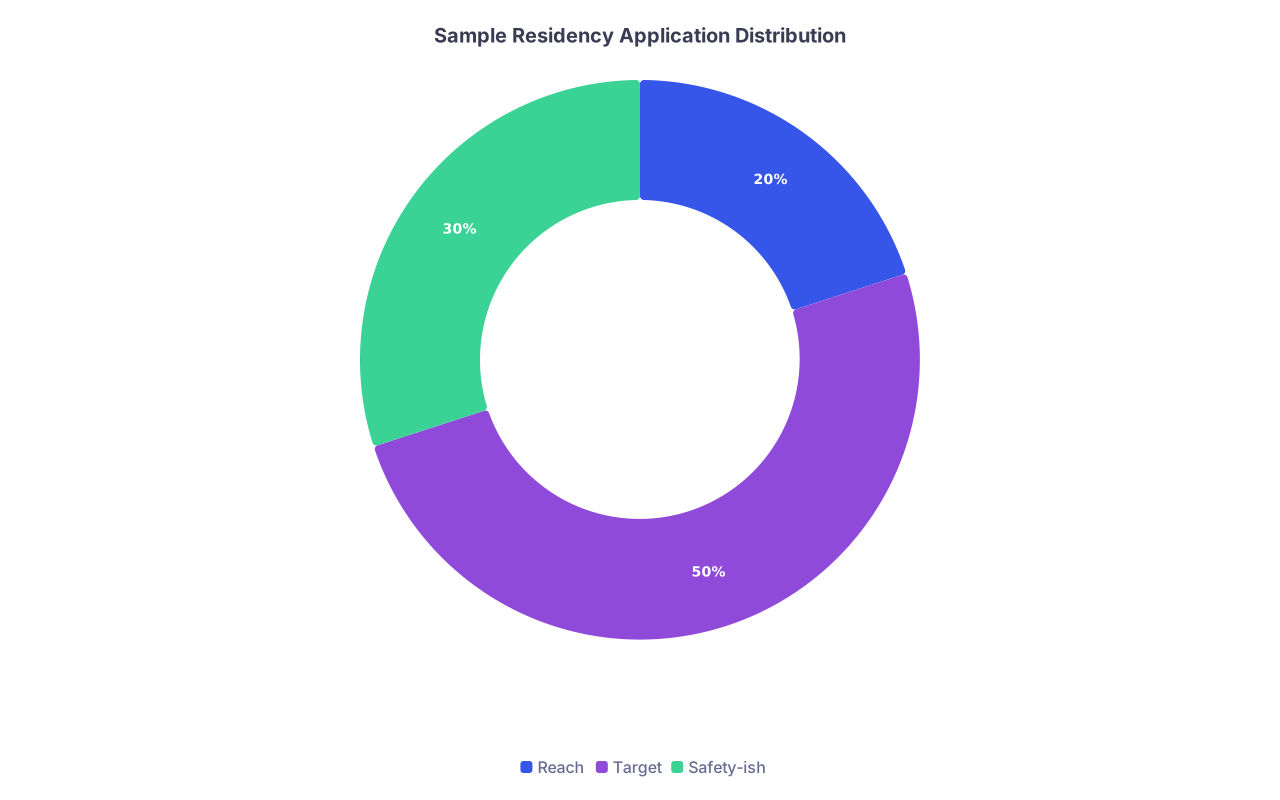
| Category | Value |
|---|---|
| Reach | 20 |
| Target | 50 |
| Safety-ish | 30 |
Use your personal statement and interviews to reframe your school
You don’t have to name-drop your school defensively, but you can subtly highlight:
- High clinical volume
- Diverse patient population
- Responsibility you had on the wards
- Any structural challenges you faced and handled (new curriculum, limited research infrastructure, etc.)
Programs know not all schools are resourced equally. Showing that you still excelled says, “I’ll probably thrive even more when given more tools.”
If You’re Already in the Application Cycle and Panicking
You might be mid-cycle reading this, watching friends from “better” schools rack up interviews at shiny places while your inbox stays quiet.
Here’s what I’d do in that situation:
Stop doom-scrolling Reddit and SDN
Those places are distorted samples. People from big-name schools and high scores are more likely to post their wins. You’re comparing your inside to their highlight reel.Talk to your dean’s office or advisor and ask for brutal honesty
“Given my school and my stats, do my programs make sense?”
If they say you’re under-applied to realistic places, fix that ASAP if the window’s still open.Start thinking about Plan B without assuming you’ve already failed
That could mean SOAP, a research year, reapplying with a strengthened CV. Planning a backup doesn’t curse your primary path; it just protects your mental health.Remember match data is messy
Every year, people from tiny, unknown schools match insanely well. Every year, people from top 5 schools go unmatched in competitive fields. Reputation tilts odds; it doesn’t determine fate.
FAQ – Exactly What Your 3 a.m. Brain Is Asking
1. Can a student from a low-ranked or new med school match into a competitive specialty?
Yes, but not by accident. You’ll need:
- A strong Step 2 CK
- Consistently stellar clinical performance
- Serious specialty-aligned research
- Strategic away rotations at programs that actually take people from a variety of schools
You can’t coast. But it’s not impossible.
2. Do program directors openly discriminate based on school name?
“Discriminate” is a loaded word. They absolutely use school familiarity as a shortcut for risk assessment. But that’s only part of the picture. Many PDs are very deliberate about not overvaluing prestige, especially in less malignant, more teaching-focused programs. The loud, prestige-obsessed outliers are not the whole system.
3. If my school has never sent anyone to X program, should I even apply there?
You can still apply, but don’t bank on it. Programs tend to have pipelines—schools they know and trust. If your school’s never sent anyone and your application isn’t obviously exceptional, odds are lower. Apply anyway if it’s a dream, but make sure you’re investing most of your energy in places where your profile realistically fits.
4. How do I handle it if an interviewer indirectly insults my school?
It happens. You’ll get the “So where is that school?” or the raised eyebrow. Best move: don’t get defensive. Calm, confident framing works: “We’re a newer school, but the clinical volume at our main hospital is intense, and I’ve had a lot of hands-on responsibility. I’ve felt well prepared on my rotations and away electives.” Show pride without overcompensating.
5. Is doing an away rotation mandatory if I’m from a lesser-known school?
For some competitive specialties, it’s close to mandatory if you want a serious shot at stronger academic programs. For less competitive specialties, it’s not always required, but it can still help you break into regions or institutions that don’t usually recruit from your school. Think of it less as “mandatory” and more as “one of your best tools.”
6. Will my school’s reputation still matter after I match?
A lot less. Once you’re in residency, nobody cares day-to-day where you went to med school. They care if you’re safe, teachable, hard-working, and not a jerk. For fellowship and jobs, people look more at: where you trained for residency, what you did there, your letters from attendings, your clinical reputation. Your med school becomes a line on a CV, not your identity.
Years from now, nobody’s going to be whispering about your med school name on rounds. They’re going to remember whether you were the intern who quietly handled chaos at 3 a.m. without falling apart. Right now, in this exact moment, it feels like your school’s reputation is everything. It isn’t. What you do with the opportunities you do have will matter far more than the name printed at the top of your white coat.