
You’re updating your ERAS CV. You’ve got “President, Surgery Interest Group – 1 year” on one line… and “Free clinic volunteer – 3.5 years, same site, every Tuesday night” on another. You can feel it: there’s no way they value these two things the same. But which one actually impresses residency programs more—flashy leadership titles or long-term commitment?
Here’s the blunt answer:
If forced to choose, sustained, meaningful, long-term commitment usually beats shallow leadership titles.
But. The most competitive applicants usually have both—and they use them strategically.
Let me break down how programs actually think about this, and how you should build and present your experiences.
How PDs Actually Read Your Experiences
Programs are not counting titles. They’re reading patterns.
When a program director, APD, or senior resident looks at your ERAS, they’re asking:
- Does this person show up consistently over time?
- Have they actually taken responsibility for something?
- Can they work in a team without being a disaster?
- Do they see things through, or do they hop around?
They look at leadership and longevity as evidence for those questions. Not as scores.
So the game is not “collect as many leadership titles as possible.” The game is “use your roles and commitments to tell a credible story that you are reliable, mature, and trainable.”
Leadership Titles: When They Matter And When They Don’t
Leadership can be very impressive—but only in certain situations.
Strong leadership roles:
- Chief or director-level roles with clear responsibility
(“Clinic Coordinator,” “Chief Scribe,” “Lead QI Student,” “Editor-in-Chief”) - Positions where other people actually depended on you
(scheduling, budgets, organizing events, supervising peers) - Roles that lasted at least a year and changed something concrete
(grew membership, got funding, created a new program, fixed a broken system)
Weak or overplayed leadership:
- “Treasurer” of a dead interest group that meets twice a year
- “Co-chair” of a subcommittee that had one meeting and a shared Google doc
- A new title every 6–12 months with no continuity and no real work
If a PD has seen thousands of apps (many have), they can smell empty titles in three seconds.
The question they’re asking is not “Did you lead?”
It’s “Did you actually own something difficult and make it better?”
That’s what makes a leadership title worth anything.
Long-Term Commitment: Why Programs Love It
Sustained involvement is underrated by students and overrated by no one on the program side.
When they see 3+ years of:
- The same free clinic
- The same research mentor
- The same outreach program
- The same mentorship pipeline program
- The same QI project or hospital committee
what they read is:
- This person doesn’t quit when it’s boring or inconvenient.
- This person probably isn’t a drama magnet.
- This person will likely stick with our program and finish.
They’re thinking about residency reality: month 18 when the job is repetitive, exhausting, and not fun at all. Who keeps showing up and doing solid work then? People with real track records of commitment.
To be clear: long-term commitment doesn’t mean you never change interests. It means for at least a few things, you didn’t vanish after the “shiny new project” phase.
So Which Is More Impressive: Title or Time?
If everything else is equal:
- A 3+ year, consistent, meaningful, non-leadership role
usually looks stronger than
a 6–12 month, superficial leadership title.
Example:
- Applicant A: “Free Clinic Volunteer, 3.5 years, weekly; trained new volunteers; transitioned to intake lead in MS4.”
- Applicant B: “President, Neurology Interest Group, 1 year; organized 2 talks; average attendance 10–15.”
Applicant A looks more reliable, more grounded, and frankly, more like a resident.
But the real win is this combo:
- Year 1–2: consistent volunteer/research/clinic/QI involvement
- Year 3–4: take on a real leadership role within that same ongoing activity
That tells a very powerful story: “I showed up, learned how it works, then I took responsibility to improve it.”
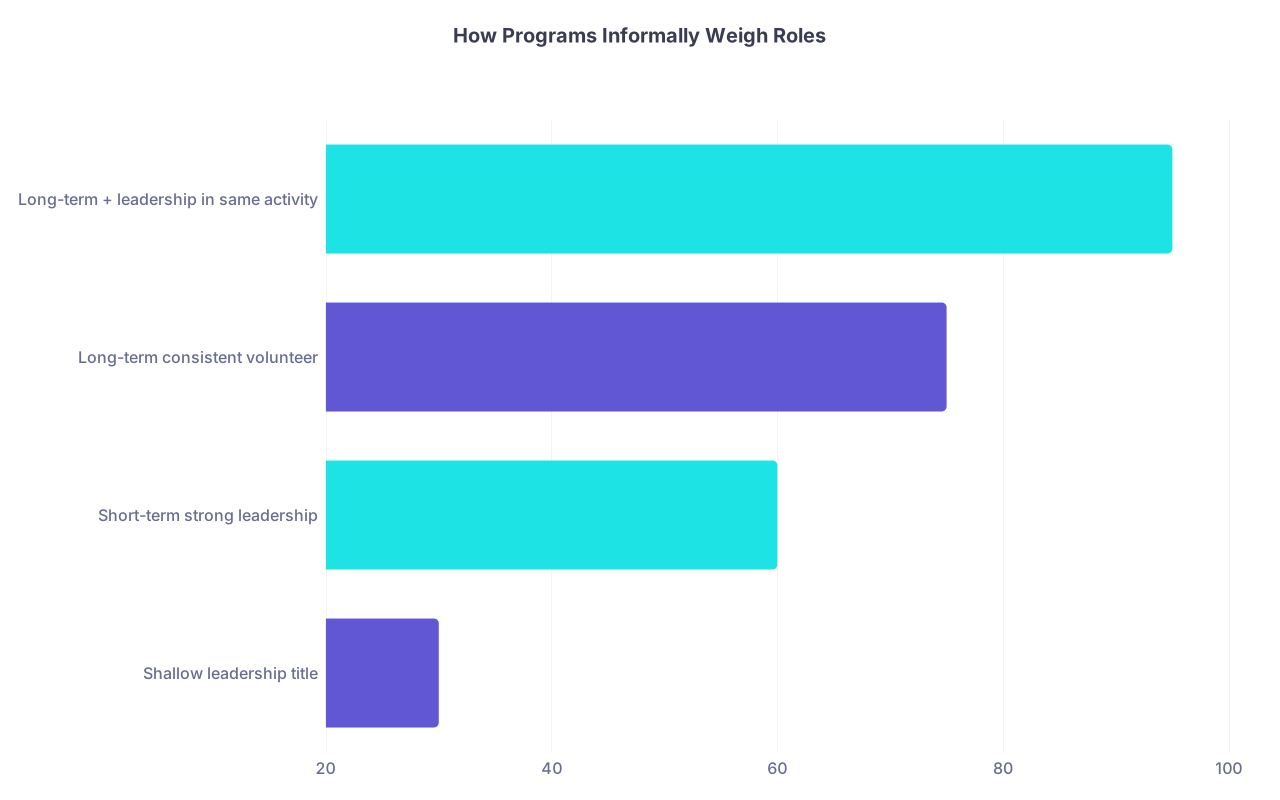
| Category | Value |
|---|---|
| Shallow leadership title | 30 |
| Short-term strong leadership | 60 |
| Long-term consistent volunteer | 75 |
| Long-term + leadership in same activity | 95 |
(Think of these as relative “impressiveness points,” not real scores—but that’s the hierarchy you’re dealing with.)
How Different Specialties View This
Not all specialties care equally about the same mix.
| Specialty | Leadership Weight | Long-Term Commitment Weight |
|---|---|---|
| Internal Med | Medium | High |
| General Surgery | High | High |
| EM | Medium-High | High |
| Pediatrics | Medium | Very High |
| Derm/Plastics | High (substance) | High |
Rough pattern I’ve seen:
Surgical fields and competitive specialties
Like leadership that shows you can handle responsibility, command a team, and push projects forward. But if your CV is all tiny titles and zero depth, they lose interest.Primary care and fields like peds, psych, FM
Absolutely love continuity: long-term clinics, advocacy, mentorship, community programs. Leadership helps, but it’s not mandatory.EM and IM
Like both. They read depth and continuity as “good colleague, good resident,” and leadership as “will be chief material.”
No one is impressed by a long list of titles with no continuity and no impact.
What Programs Care About Underneath Both
Strip away the labels. Programs are screening for traits:
- Reliability
- Professionalism
- Team behavior
- Ability to grow
- Ownership and follow-through
Leadership and long-term commitment are just proxies.
Short, flashy leadership with zero continuity tends to suggest:
- You like recognition more than work.
- You might be chasing lines on a CV.
- You might get bored and leave when it’s no longer exciting.
Long-term commitment with no leadership ever can suggest:
- You’re dependable but possibly passive.
- You may be fine as a worker bee but not someone who will step up.
The strongest applications balance both signals.
How To Build An Application That Uses Both (Starting Now)
If you’re early (MS1–MS2):
Pick 1–3 “anchor” activities you actually care about.
Free clinic, a PI whose work you respect, a pipeline program, a specialty interest group with substance.Commit to them for years, not months.
Keep showing up. Even when nobody is watching. Especially then.Later, seek leadership inside those same anchors.
Don’t become president of five random things. Become the go-to person in one or two spheres that match your story.
If you’re late (MS3–MS4) and already applied or about to:
Don’t panic and grab titles.
A sudden spike of 3–4 new “leadership” roles the year before applying looks fake.Lean into continuity in your personal statement and interviews.
“I’ve been with this clinic since my first year” or “I started with this lab in college and continued through medical school” plays well.Highlight any de facto leadership even without the title.
“Senior volunteer who trained new members, coordinated schedules, and served as the point person for XYZ.”
How To Describe Leadership And Commitment In ERAS
A lot of people bury the good stuff under vague language. Don’t.
Weak description:
- “President, IM Interest Group. Organized meetings. Coordinated events.”
Stronger:
- “Led 10-member board; increased average event attendance from 20 to 60 students; secured $3,000 in funding; launched new resident–student mentorship dinner series.”
For long-term commitment:
Weak:
- “Volunteer, student-run clinic. Helped provide care to underserved.”
Stronger:
- “Weekly volunteer for 3.5 years; transitioned from intake to supervising MS1s; co-created new hypertension outreach workflow adopted by all Tuesday clinics.”
You’re showing:
- Time
- Responsibility
- Concrete outcomes
That’s what programs actually care about.
Red Flags And Overcorrections To Avoid
A few patterns that hurt more than help:
The “leadership collector”
Ten different small titles. Each 6–12 months. No obvious thread. No impact. PDs see this as “CV manager,” not a future colleague.The “eternal follower”
Five ongoing roles, 3+ years each, but never once stepped into any kind of responsibility beyond showing up. That’s fine for matching many places, but it caps how competitive you look for top and leadership-minded programs.The “late scramble”
You realize in MS4 you have no leadership, so you grab a title on a low-committee committee. Programs can see the timeline. It doesn’t kill you, but it doesn’t fix anything either.
If you recognize yourself in those, you’re not doomed. But stop thinking in terms of “title vs time” and start thinking “what story am I telling about the kind of resident I’ll be?”
How To Decide Where To Put Your Energy This Year
If you have limited time (everyone does), here’s how I’d rank priorities:
Protect your clinical performance and letters.
No leadership title makes up for weak evals.Maintain at least 1–2 long-term commitments you already have.
Don’t drop them for something shiny. Depth sells.Add leadership only where:
- You already have trust and context.
- You can point to specific problems you want to fix or goals you want to reach.
- You can hold the role for at least a full academic year.
If you’re choosing between:
- Becoming “co-VP of education” for some weak interest group you joined last month, or
- Continuing as a core volunteer in a clinic you’ve done for 2 years,
I’d tell you: stay with the clinic unless the leadership is genuinely substantive and aligned with your story.
Simple Framework: How Will This Look In One Line?
Before you say yes to anything, ask yourself:
“In one line on my ERAS, one year from now, how will this read?”
If the best you can imagine is:
- “Vice Chair, Wellness Committee – Attended meetings, helped with events.”
That’s rarely worth a big time investment.
If you can imagine:
- “Clinic Coordinator – Managed ~40 volunteers; implemented new follow-up workflow reducing no-show rate by 15%.”
That’s the kind of leadership that actually matters.

| Step | Description |
|---|---|
| Step 1 | New Opportunity |
| Step 2 | Probably skip |
| Step 3 | Consider as long-term volunteer only |
| Step 4 | High-yield leadership or commitment |
| Step 5 | Will I stay >= 1 year? |
| Step 6 | Can I have real responsibility? |
That’s the filter. Use it ruthlessly.
FAQs
1. I have no formal leadership titles. Can I still be a strong applicant?
Yes. Especially for many IM, FM, psych, and peds programs. If you have strong clinical evaluations, solid letters, and some clear long-term commitments, you’re fine. In your application and interviews, emphasize roles where you took responsibility—training others, running parts of a project, managing logistics—even if nobody gave you an official title. Programs care about what you did more than what it was called.
2. Is being “class president” or “student government” actually impressive?
It can be. But only if you actually did work. If your class president role involved negotiating with administration, organizing major events, or advocating for student needs, say that clearly. If it was basically attending a few meetings and signing emails, it’s less meaningful. PDs have seen hundreds of these; they’re not automatically impressed by the title itself.
3. What if my leadership roles are short because of COVID, curriculum changes, or school structure?
Then you explain context. Many PDs are very aware that recent classes had disrupted timelines. Highlight continuity within that environment: did you stay with the same group over several phases? Did you keep working with the same mentor or project across transitions? Use your experiences section and interviews to show that you stuck with things as much as circumstances allowed—and that you took on responsibility when you could.
4. How many leadership roles is “enough” for a competitive applicant?
There’s no magic number. One or two substantial roles beat six superficial ones every time. For most applicants, something like: one anchor leadership role (clinic, interest group, research team, project) plus a couple of smaller positions or committee memberships is perfectly fine. If you’re applying to highly competitive specialties, the emphasis should be on the quality and impact of leadership, not raw count.
5. I’m about to start MS4 and my CV feels light. What’s the best move now?
Do not panic and stack empty titles. Focus on: strengthening relationships with letter writers, clarifying your long-term commitments in your ERAS descriptions, and, if possible, stepping into a modest but real responsibility within something you already do (e.g., becoming the senior volunteer trainer at your clinic, or the point person for a specific project in your lab). Then, in your personal statement and interviews, frame your story around reliability, growth, and follow-through—not a laundry list of positions.
Key points to walk away with:
- Long-term, consistent, meaningful involvement usually beats shallow, short-term leadership titles.
- The real gold standard is continuity plus responsibility—growing into leadership within something you’ve stuck with.
- Programs are reading your experiences for reliability, maturity, and follow-through. Build and describe your roles to show those traits clearly.