
The way most people dual-apply is sloppy—and selection committees notice immediately.
You think you’re “keeping your options open.” They think you’re unfocused, risky, and possibly gaming the system. Those are not the adjectives you want coming up in a rank meeting.
Let me walk you through how dual-applying gets done wrong all the time, and how to avoid turning a reasonable backup strategy into a red flag factory.
The Core Problem With Dual-Applying
Dual-applying itself is not the mistake.
Plenty of smart, realistic applicants dual-apply:
- Radiology + Internal Medicine
- Ortho + General Surgery prelims
- Derm + Internal Medicine
- EM + IM or FM
Programs understand this. What they don’t tolerate is confusion. Mixed messages. Inconsistency.
Selection committees are trying to answer three questions fast:
- Do you actually want my specialty?
- Are you likely to come here if we rank you?
- Are you going to bail, fail, or be miserable halfway through PGY-1?
Bad dual-apps make it impossible to say “yes” to those. That’s when files get pushed to the “easy no” pile—even with decent scores.
Mistake #1: Copy-Paste Personal Statements Across Specialties
This one kills people every year.
The lazy move:
- You write a “generic” personal statement about loving “team-based care,” “procedures,” and “continuity of care.”
- You change exactly three words and submit it to two totally different specialties.
Programs can tell. They read hundreds of statements. A Program Director in IM isn’t stupid; they know when you’ve just scrubbed “surgery” and dropped in “internal medicine.”
Common ways this goes wrong:
- You forget to change a single specialty name.
Yes, this happens constantly. “I’m passionate about a career in Emergency Medicine” in a Family Medicine application. That’s an almost guaranteed death sentence at that program. - You use vague, interchangeable language that fits everything and therefore means nothing.
- You make your “backup” specialty sound like a consolation prize.
What to do instead:
- Write two real statements.
Not “IM with a twist” and “IM-lite for FM.” Actually different:- Different stories
- Different mentors mentioned
- Different clinical moments that pushed you toward each field
- Make both specialties sound like genuine, independent choices.
Never write: “When I didn’t match derm, I realized IM would be acceptable.” That’s insulting. And it reads like a self-own. - Do not reuse your “primary” specialty’s mentor anecdotes in your backup’s statement. PDs talk. Faculty overlap. You’ll look disingenuous very fast.
If you don’t have the time or energy to write two proper statements, you don’t have the time or energy to convincingly dual-apply.
Mistake #2: A CV That Tells Two Completely Different Stories
Here’s where selection committees get uneasy.
Imagine this:
- 3 derm publications
- 2 summers of derm research
- Derm interest group leadership
- One shadowing day in IM and zero scholarly work in it
And then your ERAS says you’re “equally interested” in dermatology and internal medicine.
No, you’re not. Not by any believable metric.
Dual-applying becomes a problem when your trajectory doesn’t match your declared interest. Committees don’t need perfect alignment—but they do need coherence.
Major CV red flags:
- 90% of your experiences scream one ultra-competitive specialty, but you tell another specialty they’re actually your “strong interest.”
- Your backup specialty has:
- No meaningful clinical exposure
- No letters
- No longitudinal involvement at all
- Your backup specialty gets one line: “Shadowed cardiologist (4 hours).”
What to do instead:
- Build bare-minimum credibility in the backup specialty:
- A few solid rotations where you actually worked hard
- At least one project, QI, or case report
- Involvement in the interest group or clinic
- Make your experiences section read like: “I’ve explored both X and Y in real depth; I’d be happy in either, for different reasons.”
If your CV reads like you panic-chose a backup at the last second in September, they will assume exactly that.
Mistake #3: Letters of Recommendation That Contradict Your Story
This is where dual-applying gets truly dangerous.
Programs read your letters much more carefully than you think. And they do not appreciate being obviously second-tier.
Bad patterns:
- Letters that explicitly state: “She is 100% committed to neurosurgery and will be an outstanding neurosurgeon.”
That same letter in your IM app? Instant disconnect. - All of your strongest letters are from one specialty, but you tell another specialty they are your “top choice.”
- A backup specialty receives generic, template-like letters from people who barely know you, while your primary specialty gets glowing, specific narrative letters.
The worst scenario:
- An IM PD reads your letter from a surgery attending:
“John will make an outstanding surgeon; he is not satisfied unless he’s in the OR.”
And you’re “dual-applying” IM telling them you love rounding, continuity, and chronic disease management. They’ll laugh. Then they’ll rank someone else.
What to do instead:
- Get separate letters targeted to each specialty whenever possible.
- Ask your letter writers explicitly:
- “Can you support my application to internal medicine strongly, even though I also explored cardiology and EM?”
- Never submit a letter that blatantly sells you as the “perfect X specialist” to Y specialty.
- If you genuinely must reuse a letter across specialties, choose ones that:
- Emphasize your work ethic, team skills, clinical reasoning
- Avoid strong specialty-specific language
If your letters don’t align with your story, committee confidence plummets.
Mistake #4: Sloppy Program Signaling and List Strategy
Dual-applying in the signaling era has its own specific traps.
Here’s what programs hate:
- You signal their specialty… but only apply to 10 total programs in it. That screams “fake backup” or “I’m not actually serious.”
- You send confusing signals:
- You heavily signal one specialty
- You half-heartedly apply to another 60+ programs
- Your numbers and experiences clearly fit the second one better
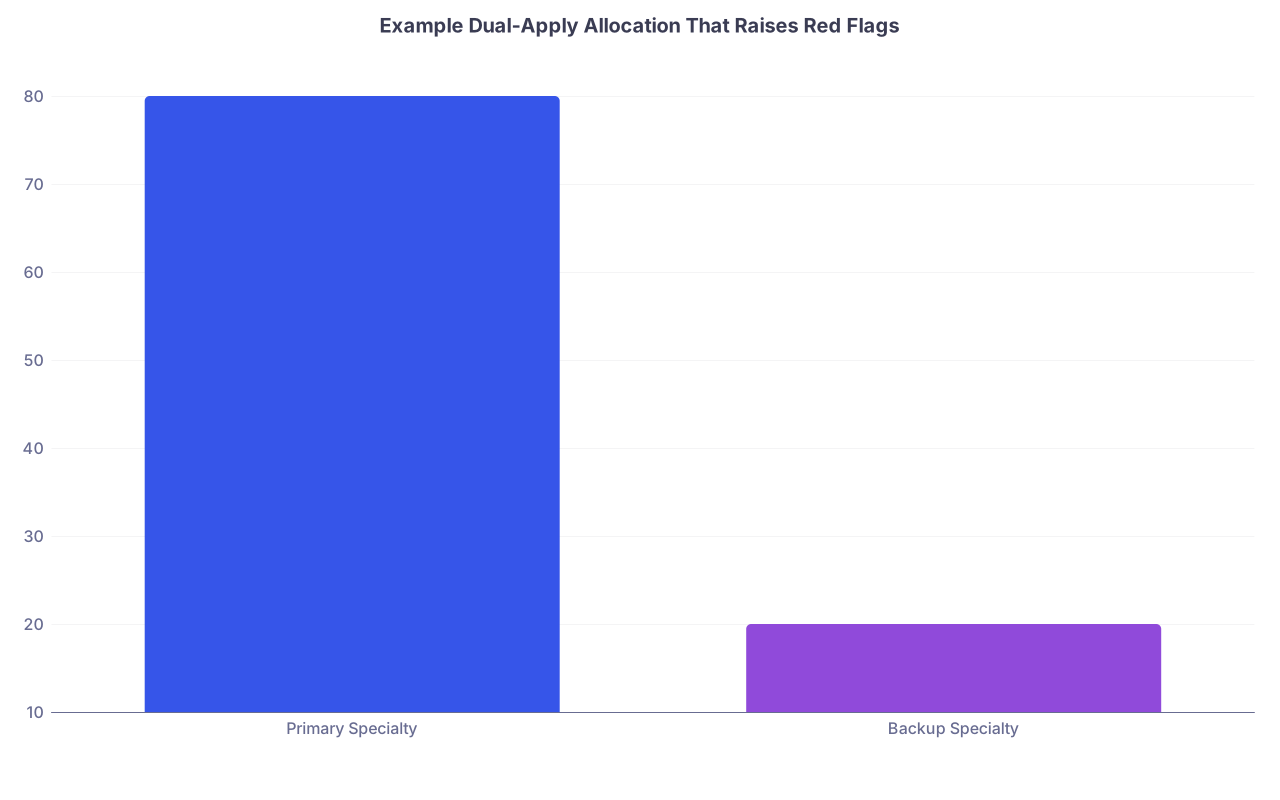
| Category | Value |
|---|---|
| Primary Specialty | 80 |
| Backup Specialty | 20 |
That 80/20 split might look “logical” to you. To committees, it can look like:
- You’re desperate for the primary specialty
- The backup specialty is your “safety net,” not a place you’ll be happy or committed
Common strategic errors:
- Choosing two hyper-competitive specialties and calling one a “backup.” (Like plastics + derm. That’s not a backup; that’s a fantasy.)
- Applying way too thinly to the backup: “I applied to 15 IM programs as my backup.” That’s not a backup; that’s a coin flip.
- Sending signals that contradict your supposed rank list intentions later.
What to do instead:
- If you dual-apply, treat both lists seriously:
- Backup specialty: usually more programs, not fewer.
- Primary specialty: realistic range, not just top 20 prestige places.
- Use program signaling to match your actual intent. If you know you’d happily match in the backup, signal accordingly.
- Don’t pretend your “backup” is as strong numerically if the numbers clearly disagree. Be realistic with volume.
Mistake #5: Interview Behavior That Outs You Immediately
Your interview day will expose any shaky dual-apply strategy in about 10 minutes.
Things that instantly tank you:
- Saying to an IM PD: “Well, my heart is really in cardiology and I’m hoping to do a fellowship, but I’m also applying to EM just in case.”
Translation: “I’m using your program as a holding area.” - Admitting you haven’t actually rotated in the specialty you’re interviewing for. That’s a huge risk flag.
- Getting basic specialty questions wrong:
- “What attracts you to Family Medicine?”
“I really like high-acuity and trauma resuscitations.”
Wrong room.
- “What attracts you to Family Medicine?”
- Talking openly about another specialty as your “true passion.”
None of this makes you look “honest.” It makes you look undecided and likely to burn out or leave.
What to do instead:
- Before each interview, reset:
- Review why you'd be genuinely happy in that specialty
- Specific aspects you like: patient population, disease processes, lifestyle, procedures
- Have a clean, consistent answer to:
“Are you applying to other specialties?”
Example:
- “Yes, I explored both EM and IM in depth. Over time I realized that the longitudinal relationships in IM fit me better. I applied broadly in IM and would be happy building a career in this field.”
- Never insult the specialty you’re interviewing for by calling it a “backup” or “practical choice.”
You can acknowledge exploration without making them feel like the second-choice prom date.
Mistake #6: Rank List Games That Blow Up Your Match
The dual-apply disaster doesn’t end with interviews. It often finishes with a bad rank list.
Dangerous patterns:
- Ranking a primary ultra-competitive specialty way too optimistically, then ranking too few backup programs.
- Making two completely mismatched lists:
- You treat the primary specialty as “all or nothing”
- The backup list is short and filled only with “top” locations you like

| Step | Description |
|---|---|
| Step 1 | Primary List: 8 programs |
| Step 2 | Primary Specialty Match |
| Step 3 | Backup List: 10 programs |
| Step 4 | Backup Match |
| Step 5 | Unmatched |
| Step 6 | Match? |
| Step 7 | Match? |
With numbers like that, you’re begging to SOAP.
Also bad:
- Ranking a program in a specialty you know you’ll hate “just to see what happens.”
You know what happens? You match there. And now what—drop out? Transfer? You look like a bad bet forever.
What to do instead:
- Only rank programs at which you’d actually be willing to train.
- Make the backup specialty list robust:
- If you’d be okay doing that specialty, treat it seriously. 30–60+ programs in many fields is normal, depending on your competitiveness.
- Stop pretending the algorithm will “figure out what’s best for you.” It won’t. It just follows your rank order.
The match algorithm is applicant-favorable, not applicant-psychic.
Mistake #7: Choosing the Wrong Pair of Specialties to Dual-Apply
Some pairs make sense. Some look bizarre or desperate.
Reasonable pairs:
- EM + IM
- IM + Neurology
- Gen Surg + Surg Prelim / Categorical IM
- Radiology + IM
- Anesthesiology + IM
Bizarre, confusing pairs that raise eyebrows:
- Neurosurgery + Psychiatry
- Dermatology + Pathology without any coherent story
- Ortho + Pediatrics with zero explanation or exposure in peds
| Pair | Committee Reaction |
|---|---|
| EM + IM | Plausible, common |
| IM + Neurology | Logical overlap |
| Derm + IM | Competitive + stable |
| Ortho + Gen Surg | High-intensity continuum |
| Neurosurgery + Psych | Confusing, needs story |
If your combo feels like two totally different identities, you need a brutally clear narrative or you’re going to look scattered.
What to do instead:
- Ask yourself: “Could I explain this pair in one clean, honest sentence that’s not ridiculous?”
- Good: “I’m drawn to both high-acuity resuscitation and longitudinal care, so I explored both EM and IM before realizing I’d be happy in either.”
- Bad: “I couldn’t decide between surgery and talking about feelings, so I’m applying to neurosurgery and psych.”
- Prefer combinations with:
- Some overlap in patient population
- Overlap in skill sets or environments
- A believable exploration history during med school
If your advisor looks confused when you say your dual plan, committees will too.
Mistake #8: Trying to Hide That You’re Dual-Applying
Programs are not dumb. They see your:
- Publications
- Presentations
- Clerkship grades
- Sub-I choices
- Dean’s letter language
They hear from faculty. They talk at conferences. Word gets around.
Trying to pretend you’re single-applying when it’s obviously untrue makes you look dishonest, not strategic.
Examples:
- You do 3 sub-Is in ortho, present at ortho conferences, have 4 ortho letters—but insist to an IM PD that IM was “always the plan.”
- Your MSPE says, “She has been strongly committed to a career in surgical subspecialties,” while you’re interviewing for peds.
What to do instead:
- Don’t lie. Ever.
- Use language like:
- “I explored both X and Y heavily as a student. Over the year, I’ve become more convinced that [specialty you’re interviewing for] is the right long-term fit.”
- Own your exploration; emphasize your clarity now, not your confusion before.
Committees can work with transparency. They reject obvious spin.
Mistake #9: Ignoring How Programs Interpret Risk
Here’s the part most applicants don’t understand:
Programs aren’t just evaluating how good you are. They’re evaluating how risky you are.
Dual-applying, done badly, screams “risk” in multiple ways:
- Risk that you’ll be unhappy and leave
- Risk that you’ll constantly complain and compare
- Risk that you’ll be emotionally checked out because your “real dream” was elsewhere
I’ve heard PDs say this directly in rank meetings:
- “He’s clearly a radiology person just parking here in IM.”
- “She wants derm. I don’t want to invest three years on someone who’s mentally somewhere else.”
Your job is to reduce that perceived risk.
How to lower perceived risk:
- Show consistent commitment in each specialty’s application version:
- Coherent story
- Appropriate experiences
- Aligned letters
- Avoid any language that implies: “If I get X, I’m out of here.”
- Demonstrate understanding of the realities of that specialty—hours, call, scope. Idealized or fantasy-level understanding makes you look more likely to regret it.
Programs want people who are likely to finish, grow, and maybe even become faculty. If your file reads like you’ll bolt at the first chance, you’re done.
Visual: A Sane Dual-Applying Workflow
Here’s what a thoughtful, low-mistake version of dual-applying looks like laid out:

| Step | Description |
|---|---|
| Step 1 | Decide to dual-apply |
| Step 2 | Choose logically related pair |
| Step 3 | Build credible exposure in both |
| Step 4 | Secure aligned letters for each |
| Step 5 | Write distinct, honest personal statements |
| Step 6 | Apply broadly, with serious backup volume |
| Step 7 | Prepare specialty-specific interview answers |
| Step 8 | Construct realistic, consistent rank lists |
If your process doesn’t look roughly like this, you’re probably leaving red flags all over ERAS.
FAQ: Dual-Applying Without Torpedoing Your Application
1. Should I tell programs outright that I’m dual-applying?
You don’t need to volunteer it in every conversation, but if asked, don’t lie. A clean version:
- “Yes, I explored both X and Y. Over time I’ve become more drawn to [specialty you’re interviewing for] for [specific reasons]. I’d be very happy training here in this field.”
2. Can I use the same personal statement for both specialties if I keep it vague?
You can—but you shouldn’t. Vague = generic = forgettable. And it still won’t protect you from specialty name slip-ups. Write two focused statements. It’s extra work. That’s the price of dual-applying without looking unserious.
3. How many programs should I apply to in my backup specialty?
If it’s truly a backup you’d accept, don’t be stingy. For many mid-competitive fields, 30–60+ is common, depending on your Step scores, class rank, and red flags. Applying to 10–15 backup programs is not “safe.” It’s magical thinking.
4. Is it better to go “all in” on one specialty instead of dual-applying?
If you’re a strong candidate for that field and you’d truly rather go unmatched than do anything else, maybe. But most people aren’t in that category. What’s dumb is fake “all in” followed by panicked last-minute backup applications thrown together in September. Decide early. Build both narratives properly.
5. What if my school strongly pushed me toward dual-applying—do programs know that?
Advisors push students to dual-apply all the time for competitive specialties. Programs know this. They don’t hold the idea of dual-applying against you. They hold sloppy execution, conflicting stories, and obvious second-choice attitude against you. Your job is to clean up the story so your application still reads as coherent, not conflicted.
Key points to walk away with:
- Dual-applying isn’t the problem; confusing, inconsistent applications are.
- Your documents, letters, and interviews must each tell a coherent, specialty-specific story—twice.
- If you don’t have the time to do that properly, don’t dual-apply. Or accept that you’re choosing to look like a risk.