
What if your ERAS opens on some program director’s screen… and they just think, “Meh. Next.”?
That’s the nightmare, right?
Not being a disaster. Not being amazing. Just invisible.
Let me say the uncomfortable part out loud: most of us are terrified we’re forgettable. Middle Step score, middle of the class, a couple of posters, decent letters… nothing that screams “rank me #1.” And then you start imagining that every other applicant is a triple 260, Gold Humanism, 12 first‑author pubs, chief resident of the universe.
You’re not crazy for thinking this. But your brain is lying to you about how PDs actually see “average.”
Let’s dismantle this properly.
First: “Average” In Your Head vs “Average” To a PD
You’re probably doing this comparison:
- You vs. the loudest people in your class
- You vs. Reddit / SDN flex posts
- You vs. whatever specialty’s “stats” infographic is circulating this year
But PDs are comparing something completely different:
- You vs. the whole pool that applied that year
- You vs. the kind of resident who can actually survive their program without burning out or making them regret their rank list
Here’s the twist: what feels “average” at your med school is often already above average nationally.
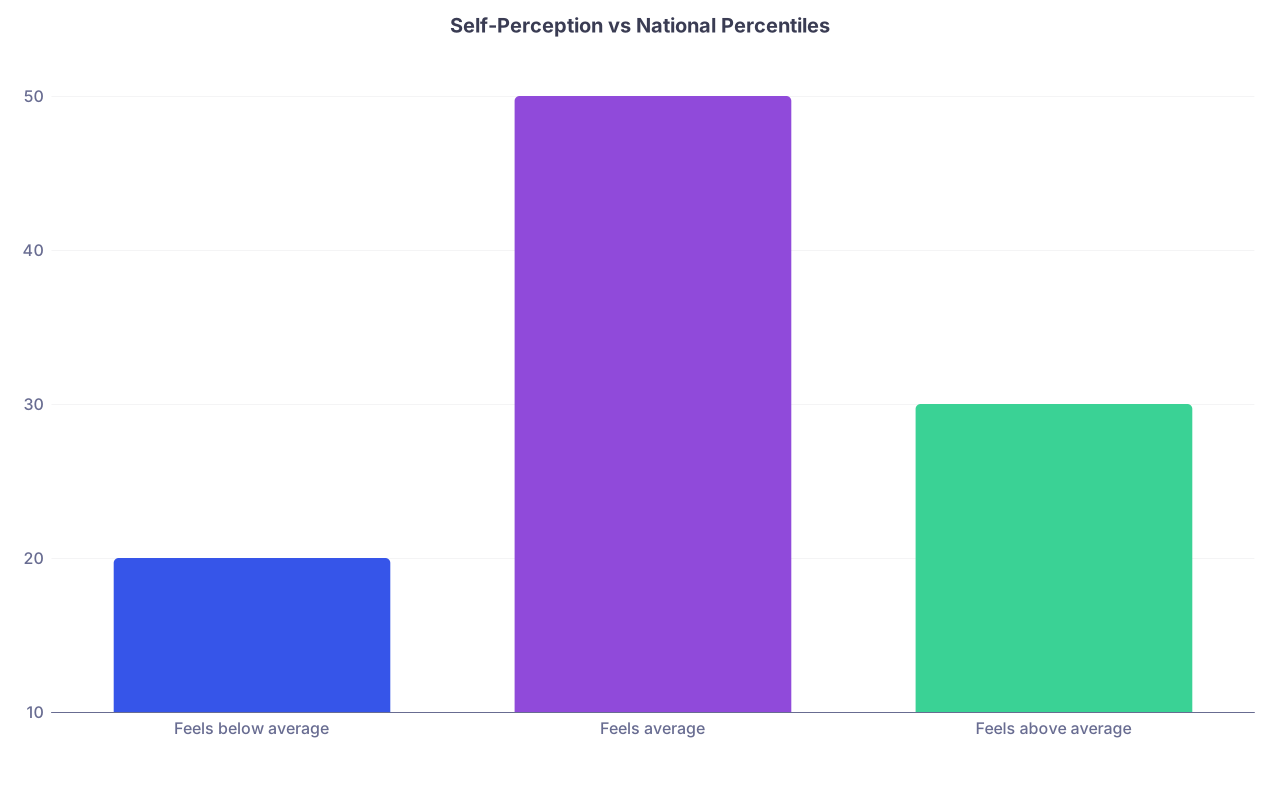
| Category | Value |
|---|---|
| Feels below average | 20 |
| Feels average | 50 |
| Feels above average | 30 |
That “mid-pack” at a strong school? PDs know what that means. They’ve watched patterns for years. A 235–245 from a heavy-hitter school isn’t the same as a 235–245 from nowhere-without-support MD/DO. And both of those are still good enough at the majority of programs.
Your brain collapses nuance into “average = doomed.” PDs don’t.
They’re not drafting for the Olympics. They’re trying to build a call schedule.
What PDs Are Actually Scanning For (It’s Not Just Scores)
You picture a PD zooming in on your Step score like it’s a stock price: green arrow up, red arrow down.
But when they skim you, they’re doing something more like a pattern recognition scan:
“Is this person going to (1) show up, (2) not implode, (3) not be a nightmare?”
They’re not hunting for perfection; they’re trying to avoid landmines.
Here’s the rough mental checklist I’ve seen over and over when faculty scroll through ERAS in a conference room:
| Category | PD’s Real Question |
|---|---|
| Exams | Can you pass boards without drama? |
| Clerkships | Do attendings trust you with patients? |
| Letters | Does anyone vouch for your character/work? |
| Experience | Do you seem genuinely interested in this? |
| Red flags | Are there any big risks or behavior issues? |
Step/COMLEX: Threshold, Not Personality Test
For most non-ultra-competitive programs, once you clear their informal number in their head, the vibe shifts from “are you good enough?” to “do I like you for this place?”
If their mental floor is, say, 220 for IM, there is zero emotional difference to them between a 229 and a 239. That emotional difference only exists in your head.
Programs don’t want bragging rights. They want residents who aren’t crying in the work room at 3 a.m. because they never learned to manage basic tasks.
Clerkship Grades: A Blurry Signal
You see:
“High Pass in Medicine = failure. Honors or bust.”
They see:
“Okay, mostly HP/H, nothing scary. Let’s see the narrative comments.”
Those little phrases matter more than your exact shelf percentile:
- “Hard-working, reliable, and loved by patients”
- “Needed close supervision; struggled with time management”
- “Mature beyond level of training; excellent team player”
A slightly “average” transcript with comments like “calm under pressure” beats someone with straight Honors and a passive-aggressive letter you can feel through the screen.
Letters: This Is Where “Average” Often Dies
Your numbers may be middle. Your personality isn’t.
Letters are where PDs decide if “average application” actually means “solid resident.”
I’ve literally heard, in a review meeting:
- “Stats are fine. But this letter is incredible. Invite.”
- “Scores are great, but this letter is weirdly lukewarm. I’d pass.”
The exact same specs on paper can be carried or sunk by one paragraph from someone who actually worked with you. That’s why the “quiet but reliable” student with a 230 sometimes outruns the “genius but abrasive” 260.
The Myth Of The “Standout Unicorn” Applicant
Let me be blunt: you’re imagining a type of applicant that rarely exists in the numbers you think.
Yes, some people are truly insane on paper. But most people matched in your specialty are not postdoc superstars with a 270 and 14 first-authors.
Most are… fine. Solid. Good. Competent.
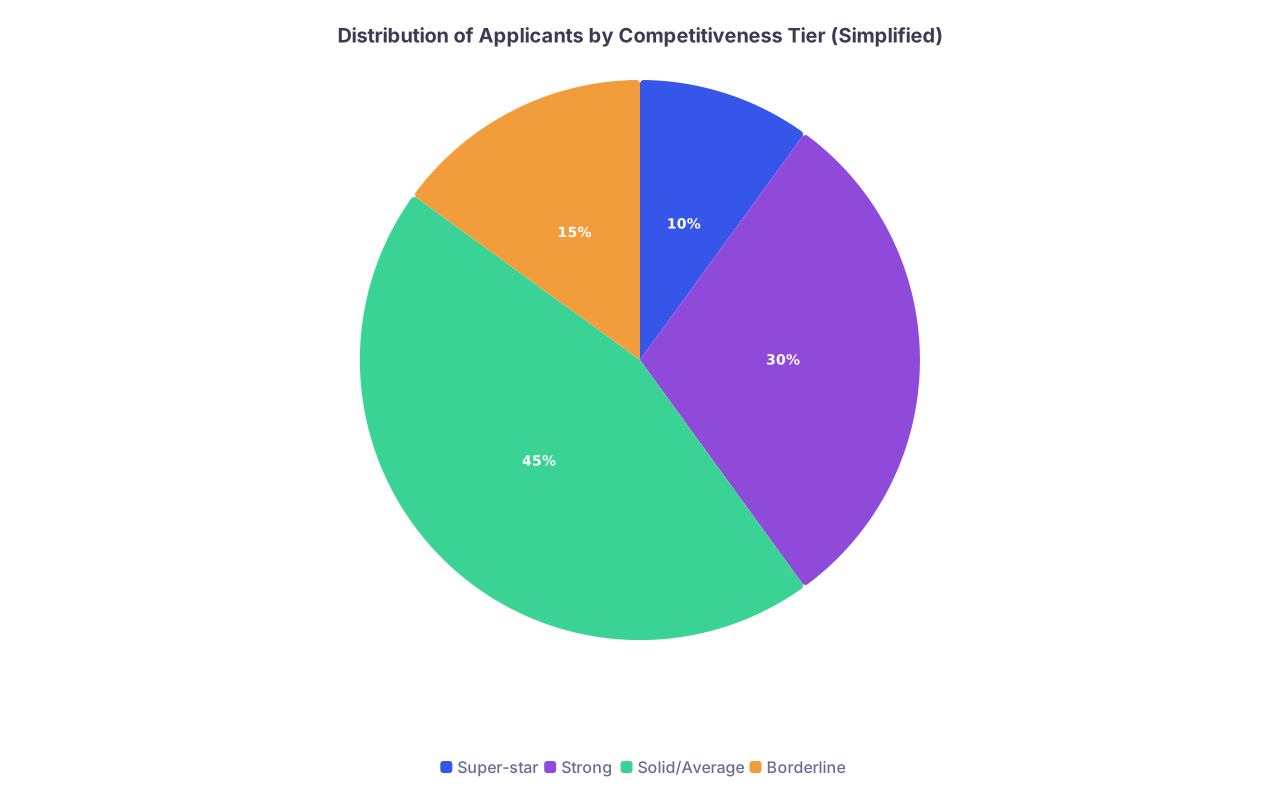
| Category | Value |
|---|---|
| Super-star | 10 |
| Strong | 30 |
| Solid/Average | 45 |
| Borderline | 15 |
That big “solid/average” chunk? PDs must fill most of their spots from that group. There literally aren’t enough superstars to staff all the hospitals.
So what actually separates you inside that large middle?
Not magic. Not a secret score. Usually:
- Consistency (no weird wild swings or chaos)
- A clear, believable story for “why this specialty/why this place”
- Proof you can function on a team without burning the place down
If your application reads like: “Pretty good at most things, seems like a normal person with some interests, letters say they work hard and patients like them” — that’s not “meh” to a PD.
That’s gold.
Because the alternative they’re terrified of is:
“Brilliant on paper, toxic in person, possibly going to quit or cause a grievance.”
What Actually Makes You Risky vs “Just Average”
Your fearful brain groups these together:
- 230 on Step, few research items, not AOA = “maybe red flag?”
PDs don’t see those as red flags. They see them as normal.
Red flags are different:
- Massive professionalism issue documented somewhere
- Multiple unexplained leaves / failures with no narrative or growth
- Truly awful or “coded negative” letter (yes, they know the codes)
- Pattern of lack of follow-through (tons of half-started things, no completion)
You know what’s not a red flag?
- “Only” one poster
- “Only” community volunteering
- “Only” mid-range scores
- “Only” one home rotation in that specialty
- “Only” working as a scribe/MA instead of NIH lab hero
Programs match plenty of people who are “only” this or that.
Most of the residents you’ll meet on the wards? They were “only” people on ERAS too.
How PDs Sort 1,000+ “Average” Applications
You’re probably picturing some harsh, detailed evaluation of every tiny part of your life.
Reality is uglier and way less precise.
This is closer to what actually happens when the stack is huge:

| Step | Description |
|---|---|
| Step 1 | Applications Downloaded |
| Step 2 | Auto-screened out |
| Step 3 | Set aside / Reject later |
| Step 4 | Quick qualitative scan |
| Step 5 | Add to interview shortlist |
| Step 6 | Borderline / Backup pool |
| Step 7 | Meets basic score/citizenship filters? |
| Step 8 | Any obvious red flags? |
| Step 9 | Seems solid fit? |
Here’s the uncomfortable truth and the comfort in it:
- The first pass is fast and crude
- They’re scanning for reasons not to interview you
- If you don’t give them a clear reason to say no, you slide forward
So if your app is: “Clean scores above their floor, okay transcript, decent experiences, letters that sound real and positive” — you clear the first pass. You’re in the “we could totally interview this person” bucket.
Are there people they are more excited about? Sure.
But interviews aren’t infinite. After the obvious “yes!!” and the obvious “no,” there’s a big pile of “yeah, these could all work.”
You just need to be in that pile across enough programs.
Where You Actually Have Control If You’re “Average”
If you’re not going to wow anyone with numbers, you need to stop obsessing over them. They’re baked.
You do still control:
1. How clear your story is
If your app screams “generic med student,” that’s when “average” hurts you.
If your app reads like an actual, specific person, it doesn’t.
Tell a coherent story across your PS, experiences, and letters. Not some cheesy “ever since I was 5” thing. Just:
- What actually pulled you into this specialty
- What kind of work you’ve actually done that relates
- What kinds of patients, settings, or problems energize you
- What you’ve learned from your detours and weaknesses
A PD shouldn’t need to guess why you picked them. Spell it out without groveling.
2. How your letters sound
If you’re average on paper, your letters need to say: “Yes, but trust this one.”
Be intentional:
- Choose people who actually supervised you clinically, not just “famous name who barely remembers you”
- Ask: “Do you feel comfortable writing me a strong, positive letter for [specialty]?” and watch their face
- Work closely with at least one person who really sees you on your AI/sub-I and ask them explicitly to highlight your work ethic, team skills, and teachability
A glowing letter > one more random publication every single time for most programs.
3. Where you apply (and how broadly)
This is the part loaded with anxiety, but it’s where “average” can be completely fine or completely screwed depending on your expectations.
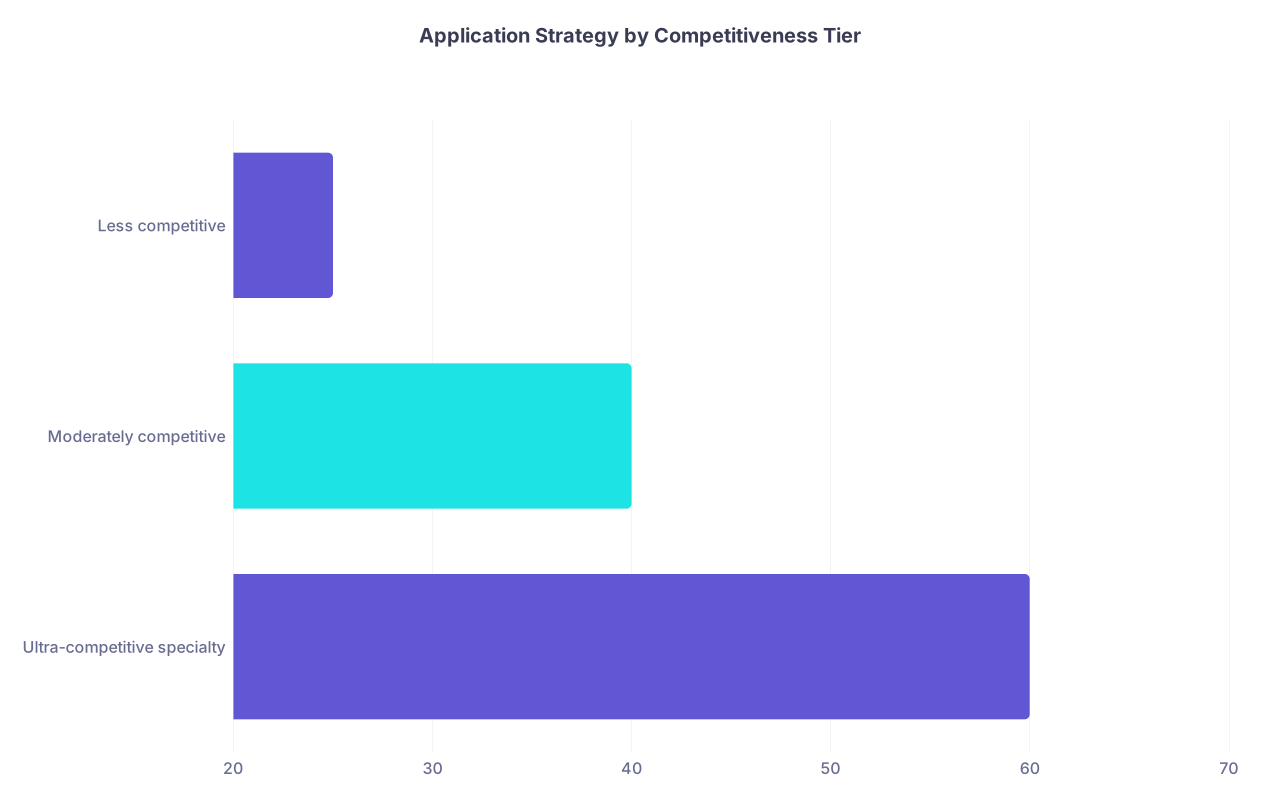
| Category | Value |
|---|---|
| Ultra-competitive specialty | 60 |
| Moderately competitive | 40 |
| Less competitive | 25 |
Those numbers aren’t magic, but the idea is:
- If you’re average for a competitive specialty → you need more programs and a realistic “reach/target/safe” spread
- If you’re average for a less competitive field → you can still be picky if your list isn’t delusional (like all top-10, all coastal, all super academic)
“Average” doesn’t fail. Unrealistic lists do.
The Interview: Where “Average” On Paper Stops Mattering
Once you get the invite, most PDs stop caring in detail about your exact metrics. They saw them, sure. But they’re not re-thinking your 234 vs 241 every second.
Now they care about:
- Are you normal to talk to?
- Can you handle a bad day on wards?
- Do your values fit the program’s culture (or at least not clash with it)?
- Do you have insight into your own weaknesses?
This is where the fear voice is loudest:
“I’m boring.”
“I sound dumb.”
“I blank under pressure.”
You don’t need to be charismatic. You need to be:
- Concrete (real examples, not generic fluff)
- Honest (don’t try to cosplay some fake persona)
- Curious (ask questions that show you’re thinking about your life here, not reciting a list from Google)
Most residents they’ve loved weren’t dazzling interviewers. They were just clearly genuine, stable, and teachable.
The number of times a PD says “Their Step score was average, BUT that interview…” is much higher than you think.
A Quick Reality Check: What “Average” Residents Look Like
If you could fast‑forward 3 years and walk into a random residency’s work room, here’s what you’d see:
- A PGY-2 who barely remembered their Step score until someone asked
- A PGY-3 with a single poster and no publications, running the MICU at 3 a.m. like a boss
- Someone who was “only” in the middle of their class, now teaching interns confidently
- A DO who people trust more than the “hotshot” MD because they’re calm and kind at the bedside
You will not be walking around labeled “average applicant.”
You will be “the resident who always helps,” or “the one who’s great with families,” or “the one you want on call with you.”
No one cares that you didn’t have a Nature paper.
How To Quiet The “I’m Just Average” Voice Right Now
You’re not going to stop worrying completely. That’s not how this works. But you can shift the thought process a bit.
Try this on paper, not just in your head:
Write down the 3 things in your app you’re most embarrassed about.
Be specific: “Step 1 214,” “1 failed OSCE,” “no home research.”Under each one, answer brutally:
- Is this a true red flag or just not a flex?
- Did I explain it anywhere (PS, MSPE, advisor note) if needed?
- Has anyone (advisor/mentor) told me this is fatal? Or is that just my brain?
Now write the 5 things in your app that actually show you’re not a disaster:
- “Worked 20 hrs/week in med school and still passed everything.”
- “Strong letter from my sub-I.”
- “Nurses liked me enough that they emailed my attending after my rotation.”
These are exactly the things PDs pay attention to when they’re building their mental model of “Can this person survive my program?”
Not your ability to flex on Reddit.
The Ugly Truth That’s Weirdly Reassuring
Most PDs don’t remember who was “the star applicant” three years later.
They remember:
- Who quit
- Who caused major problems
- Who surprised them by blooming as a resident
They’re not obsessed with chasing perfection. They’re terrified of matching the wrong personality.
If you’re honest, reliable, willing to work, and your application doesn’t scream chaos, you’re not “average” to them. You’re safe. You’re workable. You’re someone they can invest in.
And that’s what you actually want to be.

Years from now, you won’t be replaying your exact Step score in your head.
You’ll be remembering the patients, the nights on call, the co-residents who got you through.
And the strangest part? Nobody around you will know or care whether your application once felt “average.” They’ll only know the doctor you turned out to be.