
It’s August of MS1. You just paid your first tuition bill, your refund check hit your account, and your loan balance already looks disgusting. You tell yourself, “Future me will figure this out.”
Future you is reading this.
Here’s the deal: the students who keep their med school debt under control don’t magically earn more or get secret scholarships. They make a few boring, smart decisions at specific times. And they don’t wait until PGY‑3 to understand what “capitalized interest” means.
I’m going to walk you from MS1 through Match, year by year, and call out exactly what you should be doing at each point if you want to graduate with less financial damage and more options.
Big Picture: What You’re Aiming For Each Year
| Stage | Main Financial Goal |
|---|---|
| MS1 | Learn system, limit lifestyle |
| MS2 | Optimize borrowing, plan Step |
| MS3 | Control rotation costs |
| MS4 | Prep for repayment & Match |
| PGY1 | Lock in best repayment plan |
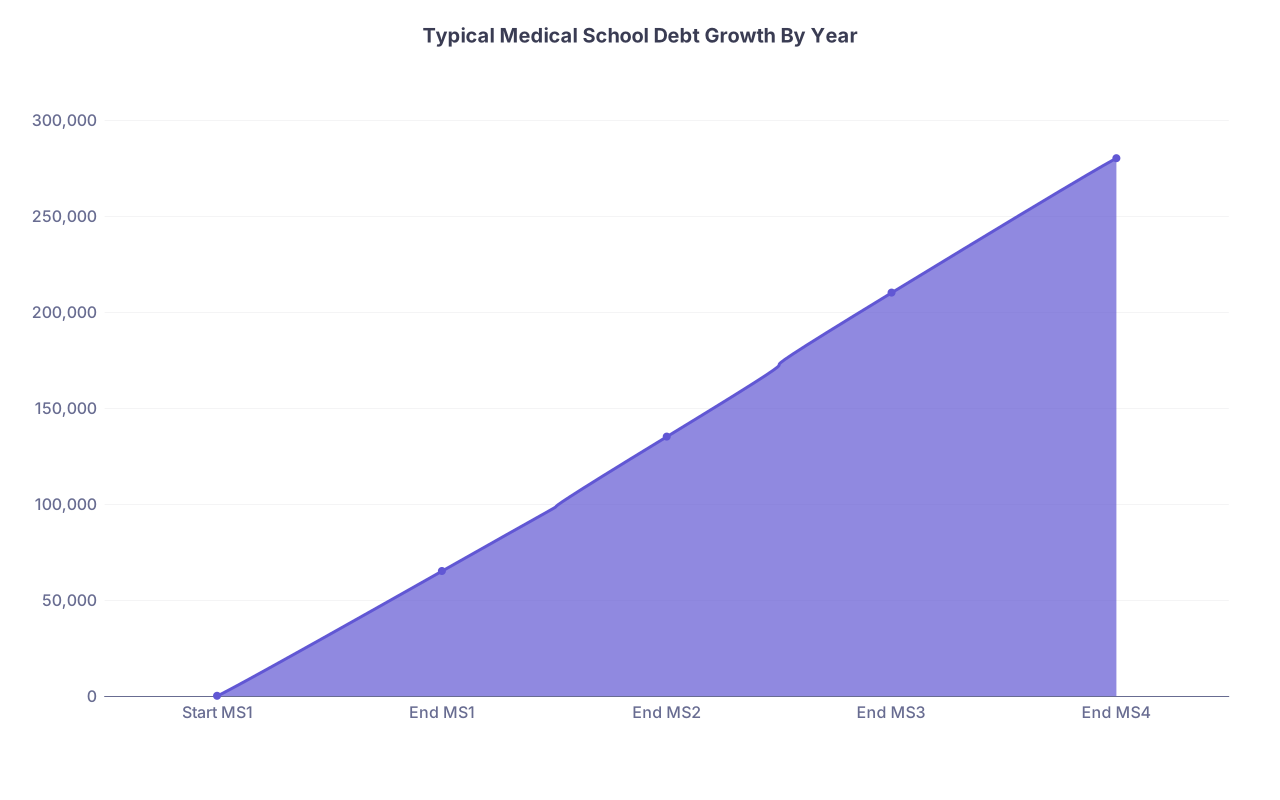
| Category | Value |
|---|---|
| Start MS1 | 0 |
| End MS1 | 65000 |
| End MS2 | 135000 |
| End MS3 | 210000 |
| End MS4 | 280000 |
You’re trying to do three things, continuously:
- Borrow only what you actually need
- Avoid stupid-interest mistakes (capitalization, bad forbearance)
- Set yourself up for the best repayment plan / forgiveness path as a resident
Now let’s get granular.
MS1: Set the Foundation (Do Not Skip This Year)
Before MS1 Starts (Spring–Summer)
At this point you should:
- Pull your full federal aid history: go to studentaid.gov and download your “Aid Summary.”
- Make a simple one-page snapshot:
- Current undergrad loan balance
- Interest rates for each loan group
- Loan types (Direct Subsidized, Direct Unsubsidized, Grad PLUS, any private)
If you have private loans from undergrad, highlight them. They’re the problem children: no federal protections, no PSLF, usually worse hardship options.
You should also:
- Run a bare‑bones budget:
- Tuition & fees (from the school website)
- Required health insurance
- Estimated rent in the neighborhood you’ll actually live in
- Utilities + internet
- Groceries (assume more than you think—$250–300/month minimum)
- Transportation (parking, bus pass, gas, or rideshare)
Whatever’s left after that is your real “lifestyle” money. Not the number the financial aid office throws at you.
First Month of MS1 (August–September)
At this point you should:
Decide your borrowing rule.
Example I like: “I only borrow what covers tuition, fixed bills, and $300/month discretionary. If I want more, I work or cut spending.”Set up separate accounts:
- Checking #1 – “Bills Only” (rent, utilities, insurance, required school costs)
- Checking #2 – “Spending” (food out, coffee, random Amazon)
- Savings – “Emergency/Exam Fund” (target: $500–$1,000 by end of MS1)
Route your refund into Bills + Savings. Then pay yourself a “salary” from Bills into Spending every 2 weeks. This alone stops the “I have $5k sitting here, I’m rich” illusion.
- Avoid this common mistake:
- Do not grab extra Grad PLUS just because it’s approved. Your future interest bill doesn’t care that it felt comforting in MS1.
Mid‑MS1 (October–December)
This is when first‑year exams and anatomy dissection wipe you out and you stop thinking about money. That’s how debt quietly balloons.
At this point you should:
Do a 10‑minute spending review, monthly:
- Open your bank app.
- Look at last month’s non‑fixed spending (coffee, food, subscriptions).
- Identify one category to cut by 20–30% next month. Just one.
Decide on no‑interest behaviors:
- No credit card balances rolling month to month
- No “six-month interest-free” store financing that backloads a penalty
- If you need a card, pick a simple 1.5–2% cash‑back with no annual fee and autopay in full
This sounds basic until you’re post-call, exhausted, and “I’ll just pay it later” turns into 23.99% APR.
Late MS1 (January–May)
At this point you should:
- Learn the vocabulary (once, properly):
- Capitalization
- Unsubsidized vs Grad PLUS
- Forbearance vs deferment
- Income-driven repayment (IDR), PSLF
You do not need to be a guru yet. But if someone says “your interest capitalizes at consolidation,” you should know what that sentence means.
Run a rough 10‑year vs 20‑25‑year comparison.
Use any reputable calculator (AAMC, studentaid.gov, or a major loan servicer, not somebody selling you refinancing). Plug in:- Debt at graduation: try $250k and $350k
- Resident salary: $65k–$75k
- Attending salary ranges for a few specialties (FM vs Ortho, for example)
You’re not choosing a specialty based on this, you’re just getting realistic: a $400k balance with a low-paying specialty and zero PSLF plan is a very different life.
MS2: Get Aggressive About Borrowing & Prep for Step
MS2 is where people overborrow “for Step” and never recover. Don’t be that person.
Summer Before MS2
At this point you should:
- Look at your MS1 total borrowed vs what you actually spent.
- If you ended with >$2k just sitting there at any point, you likely overborrowed.
- Adjust your MS2 borrowing down by whatever cushion you consistently didn’t use.
Start a dedicated “Board Costs” line item:
- QBank / dedicated prep resources
- NBME practice exams
- Registration fees
- Potential travel/housing if you go to a dedicated study environment
Estimate it, then set aside $50–$100/month from your refund starting Day 1 of MS2. That way you’re not panicking in February.
Early MS2 (August–November)
At this point you should:
Reevaluate your housing.
- If you signed the “luxury student apartments with a pool” lease in MS1, start planning to downgrade when the lease is up.
- Dropping $300/month in rent for MS2–MS4 is easily a $10k–$12k interest savings over time.
Clean up any old undergrad loans:
- If you have tiny federal loans (<$2k at 3–4%), ignore them for now.
- If you have high-rate private loans, call the lender, clarify:
- Are you in deferment during med school?
- Is interest compounding?
- If they’re not in deferment and the rate is ugly, consider small autopay ($25–$50/month) just to slow the damage.
Mid–Late MS2 (December–May – Step Heavy)
This is danger season: everyone is stressed, and your brain tells you that buying every resource is somehow “studying.”
At this point you should:
- Commit to a Step budget in writing:
- Decide your QBank(s) and primary resources once.
- Ignore every Reddit thread telling you to add three more books.
- Plan your dedicated study schedule cost:
- Will you move? Then you need temporary housing costs.
- If you’re staying put, good—cheaper.
Do a quick check:
If your “Step spending” is creeping above $1,500–$2,000 all-in (resources + exams + lifestyle bump), you’re probably buying anxiety, not scores.
MS3: Rotations, Travel, and Quiet Debt Creep
This is the year people quietly add $5k–$15k to their total costs via away rotations, commuting, eating out, and “I deserve it” spending.
Summer Before MS3
At this point you should:
- Map your major rotation sites:
- Distance to each
- Parking costs
- Are you required to live near an affiliate hospital?
- Ask actual MS4s:
- “Which rotations absolutely require a car?”
- “Which sites have free or cheap student housing?”
Build a rotation cost map on one page:
- Rotations requiring a car
- Rotations with long commutes
- Rotations with extra housing
Early MS3 (July–October)
At this point you should:
Decide the car strategy if needed:
- If you must have a car, a paid-off used Corolla is financially light-years better than a financed new SUV.
- If you’re tempted by a car loan in MS3: don’t. The combination of med loans + car loan interest is disastrous.
Treat away rotations as small financial projects:
- For each away:
- Housing (short-term rental vs student housing)
- Transportation (flight vs driving, parking, rideshare)
- Food (you’ll be tired; plan for extra takeout, but put a fixed cap)
- For each away:
Start saving during early MS3 for any planned away rotations in late MS3 / early MS4. $150–$200/month makes those rotations much less painful.
Mid–Late MS3 (November–May – Shelf Exams & Specialty Decisions)
At this point you should:
- Keep using two-bank system (Bills vs Spending). It keeps long calls from turning into “Uber Eats every night for 6 weeks.”
- Start being honest about specialty and future earning power:
- You are not locked in, but:
- Peds + $400k debt + no PSLF plan = very tight life.
- Ortho + $250k debt + smart repayment = much more flexible.
- You are not locked in, but:
You’re not chasing salary, but you are connecting the dots: specialty decisions and debt interact. Pretending they don’t leads to ugly, resentful attendings.
MS4: Match, Fees, and Getting Ready for Repayment
This is the fee year. ERAS, NRMP, travel, rank list drama, and everyone magically “needs” nicer apartments now that they’re “almost doctors.” This is how people overshoot their expected debt by five figures without noticing.
Summer Before MS4 (June–August)
At this point you should:
- Estimate your application costs realistically.
| Item | Low Range | High Range |
|---|---|---|
| ERAS application fees | $600 | $1,500 |
| NRMP + transcript fees | $150 | $300 |
| Interview travel (if any) | $300 | $3,000 |
| Away rotation expenses | $500 | $3,000 |
Virtual interviews keep this lower, but people still overspend on “I’ll just fly there too, for fun.” Make a cap. Stick to it.
- Start your “Residency Launch Fund.”
- Target: $2k–$4k minimum by graduation
- Use it for:
- First apartment deposit and first month’s rent
- Moving costs
- Basic furniture
- Board exams (Step 3 soon enough)
$0 in savings at Match as a new PGY‑1 is brutal. I’ve seen people put furniture, moving, and licensure on credit cards at 24% APR. It snowballs fast.
Early MS4 (September–December – ERAS & Interviews)
At this point you should:
Apply deliberately:
- If you’re reasonably competitive, 80+ applications is often wasted money.
- Talk to your specialty advisor; they’ve seen your stats and can give a sane range.
Track interview costs:
- Even virtual: suits, technology, occasional travel adds up.
- If you get more invites than you expected, don’t be scared to decline some you really won’t rank highly. It saves time and cash.
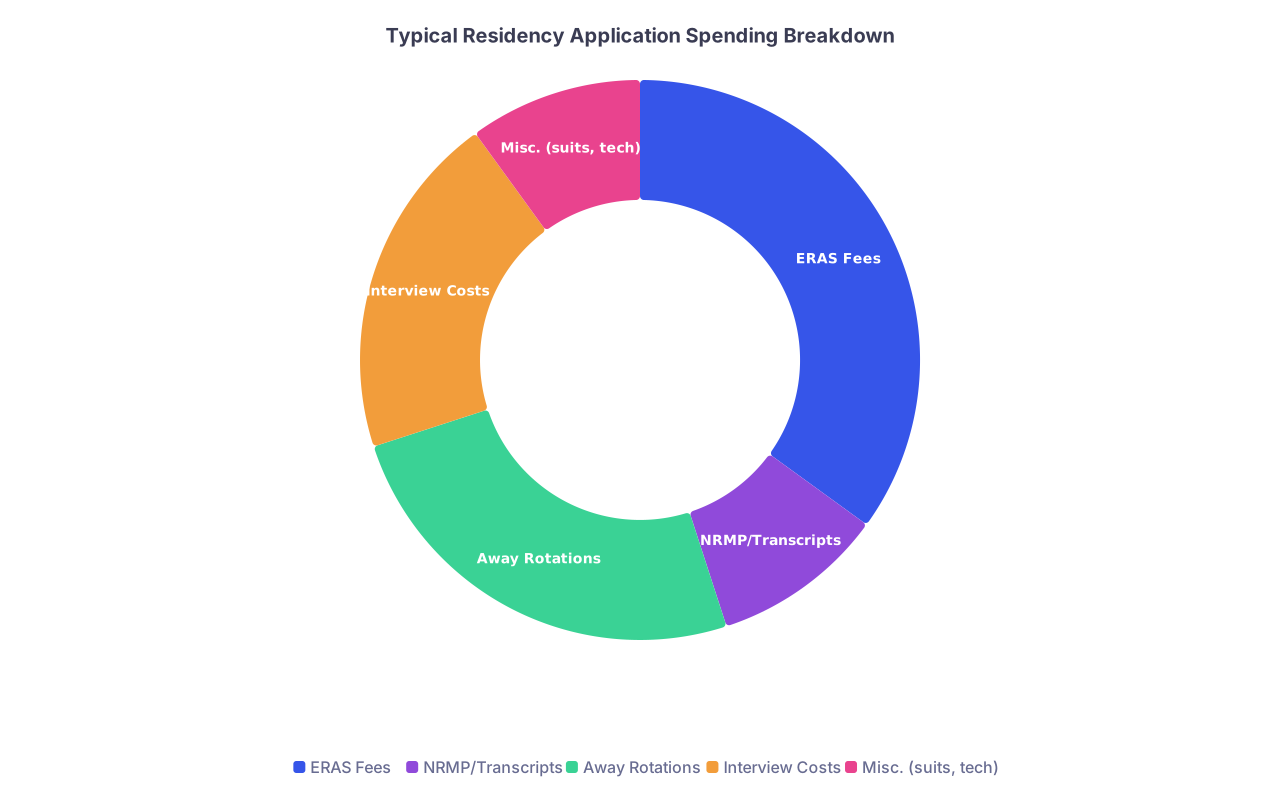
| Category | Value |
|---|---|
| ERAS Fees | 35 |
| NRMP/Transcripts | 10 |
| Away Rotations | 25 |
| Interview Costs | 20 |
| Misc. (suits, tech) | 10 |
Mid–Late MS4 (January–Graduation)
This is when your brain checks out. But it’s exactly when you need to set up repayment correctly.
At this point you should:
Do your federal loan exit counseling properly.
Don’t just click through. Pull out:- Total estimated balance at repayment
- Interest rates (grouped)
- When your grace period ends
Make a basic “resident-year cash flow” plan:
- Projected PGY‑1 salary (use $65k–$75k if you don’t know)
- Estimated taxes (rough guess: 22–28% total including FICA)
- Rent in the city you matched
- Minimum loan payment under several IDR plans
- SAVE (formerly REPAYE)
- PAYE (if still eligible)
- IBR
Decide your likely repayment path:
- If you matched at a large nonprofit academic center and expect to stay in similar settings: PSLF becomes a very real option.
- If you matched into a specialty with high private practice probability: refinancing later might win, but never during residency just to get a slightly lower rate at the cost of federal protections.
Write down your default plan:
- Example: “Residency: SAVE for PSLF qualifying payments. Post-res: evaluate PSLF viability vs refinance.”
PGY‑1: First Year of Repayment (You Don’t Wait Until Orientation)
You’re technically beyond “MS1 to Match,” but the decisions you make right after graduation are linked to the discipline you built in med school. So I’m including a brief PGY‑1 checklist.
Summer Before PGY‑1 (Right After Graduation)
At this point you should:
Consolidate if it helps your IDR options.
- If you have older FFEL loans or Perkins loans, consolidating to a Direct Consolidation can be key to PSLF eligibility.
- But know this: consolidation usually triggers interest capitalization. That means unpaid interest gets added to principal once, increasing the balance principal is calculated from. You do that once, intentionally, not repeatedly.
Choose your repayment plan before grace ends.
- For many new residents, SAVE is the default best:
- Lower payment during low-income years
- Unpaid interest subsidy (government covers some interest so the balance doesn’t balloon as fast)
- Counts toward PSLF if on qualifying employment
- Enroll early so you avoid any “standard repayment” nastiness when your grace period ends.
- For many new residents, SAVE is the default best:
Check your employer’s PSLF-eligibility.
- HR or GME office:
- Are we a 501(c)(3)?
- Are all residents considered full-time for PSLF?
- Submit your first PSLF Employment Certification Form sometime in PGY‑1. Early is better; it catches paperwork issues.
- HR or GME office:
Visual Timeline: Debt Control Milestones
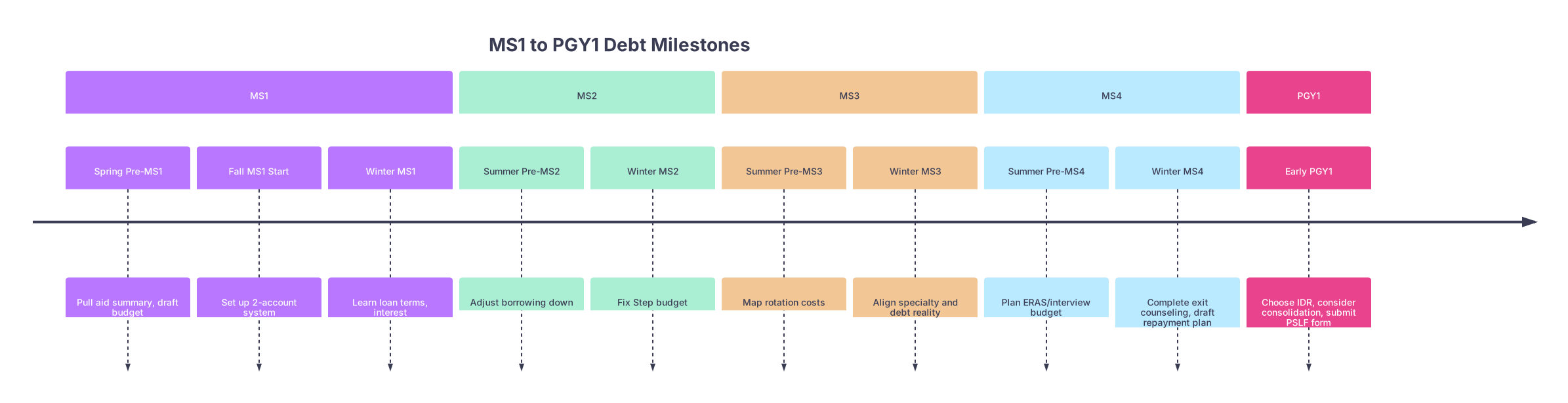
| Period | Event |
|---|---|
| MS1 - Spring Pre-MS1 | Pull aid summary, draft budget |
| MS1 - Fall MS1 Start | Set up 2-account system |
| MS1 - Winter MS1 | Learn loan terms, interest |
| MS2 - Summer Pre-MS2 | Adjust borrowing down |
| MS2 - Winter MS2 | Fix Step budget |
| MS3 - Summer Pre-MS3 | Map rotation costs |
| MS3 - Winter MS3 | Align specialty and debt reality |
| MS4 - Summer Pre-MS4 | Plan ERAS/interview budget |
| MS4 - Winter MS4 | Complete exit counseling, draft repayment plan |
| PGY1 - Early PGY1 | Choose IDR, consider consolidation, submit PSLF form |
Small Habits That Quietly Save You Tens of Thousands
Sprinkled through all four years, there are a few behaviors that make a massive difference over time:
Borrow at least $3k–$5k less each year than “allowed.”
That’s $12k–$20k less principal and years of future interest shaved.Keep lifestyle creep in check:
- Roommate over solo
- Used furniture over new
- “Nice” vacations during med school every year? That’s how a lot of people end up 20–30k deeper than necessary.
Never ignore your loans for 6–12 months.
Log into studentaid.gov twice a year. Glance at the total. It’s painful, but it keeps you honest.

What Actually Matters
You don’t need to be a financial wizard. You do need to be consistent.
If you remember nothing else, remember this:
The big wins are early and boring.
Borrow less than offered. Choose cheaper housing. Avoid dumb consumer debt.Match your repayment plan to your real career path.
PSLF makes sense for many academic-track residents. Refinancing too early, or into the wrong structure, can cost you six figures.Touch your numbers regularly.
Look at your total at least twice a year, adjust borrowing yearly, and make one clear repayment plan by late MS4.
Do those three and you’ll graduate with more control, fewer ugly surprises, and a much quieter loan balance than most of your classmates.