
It is August 1st. You just got your white coat. Your LMS is full of syllabi, your GroupMe is blowing up, and your financial aid refund just hit your bank account.
You also just took on what will likely be six figures of debt.
If you treat the first 30 days of medical school as “orientation chaos time” and ignore the money side, your loans will quietly spread into every corner of your life. Higher rent than you need. Car payment you cannot afford. Subscription creep. Fast food every night. Then M4 hits and you are staring at $350,000 and wondering what happened.
You stop that in Month 1.
I am going to walk you through the first 30 days chronologically—what to do Week 0, Week 1, Week 2, Week 3–4. At each point: “Right now, you should…” so you do not end up with uncontrolled debt sprawl.
Week 0–1: Before / Just as Classes Start — Get Oriented to the Money
Right now you are still in “syllabus shock.” This is the window where people make their worst financial mistakes because they feel too busy to think.
At this point you should do four things:
- Map your actual cost of attendance versus reality
- Decide what refund you are keeping (and what you are sending back)
- Lock in a minimalist M1 budget
- Protect yourself with the right bank / credit setup
Step 1 (Day 1–3): Decode Your Financial Aid Package
Sit down with:
- Your school’s cost of attendance (COA) breakdown
- Your actual lease, utilities estimates, transit plan
- Your financial aid award (grants, scholarships, subsidized/unsubsidized loans)
You are doing one thing: comparing the school’s fantasy budget to your real life numbers.
Look for these:
Housing
- COA says: $1,200/month
- Your lease: $1,650/month in the fancy building by campus
- You just created a $450/month hole = ~$5,400 extra per year = >$20k over 4 years with interest.
If you still can get out of that lease (or swap with an upperclassman), you should seriously consider it this week, not next year.
Food
- COA: $350/month
- Your DoorDash history from the last month: $600+
That is not “treat yourself.” That is debt.
Transportation
- COA assumes bus pass or basic parking.
- You just decided you “need” a new car with $400/month payments.
This is how debt sprawl starts.
At this point: write down two totals for the academic year:
- School’s COA total
- Your projected actual total with your current decisions
If your actual total is more than ~10% above COA, that is a red flag. You are building in lifestyle inflation from Day 1.
Step 2 (Day 3–5): Decide on Your Loan Refund Strategy
The refund is where people blow it. That big number hits your account and suddenly it feels like free money. It is not. It is future attending-hours.
Right now you should:
Calculate how much refund you truly need for this semester
- Divide your semester living costs by months covered (usually 4–5)
- Add a modest buffer (1 month of expenses, max, not 3–6 months)
- Compare to your refund amount
Send unnecessary money back. Immediately.
- Contact financial aid and ask: “What is the process and deadline to return part of my disbursed federal loans this term?”
- Most schools allow you to return disbursed funds within 30–120 days without interest or fees. That window starts now.
Example:
- Refund: $8,000
- Actual living expenses: $1,500/month × 5 months = $7,500
- Reasonable buffer: $500–1,000
- Reality: you do not need the full $8,000. You can send $500–1,000 back and cut interest on that money for the next 10–20 years.
At this point the key habit: if you do not have a specific, near-term use for borrowed money, it goes back. Not “I might want a nicer laptop at some point.”
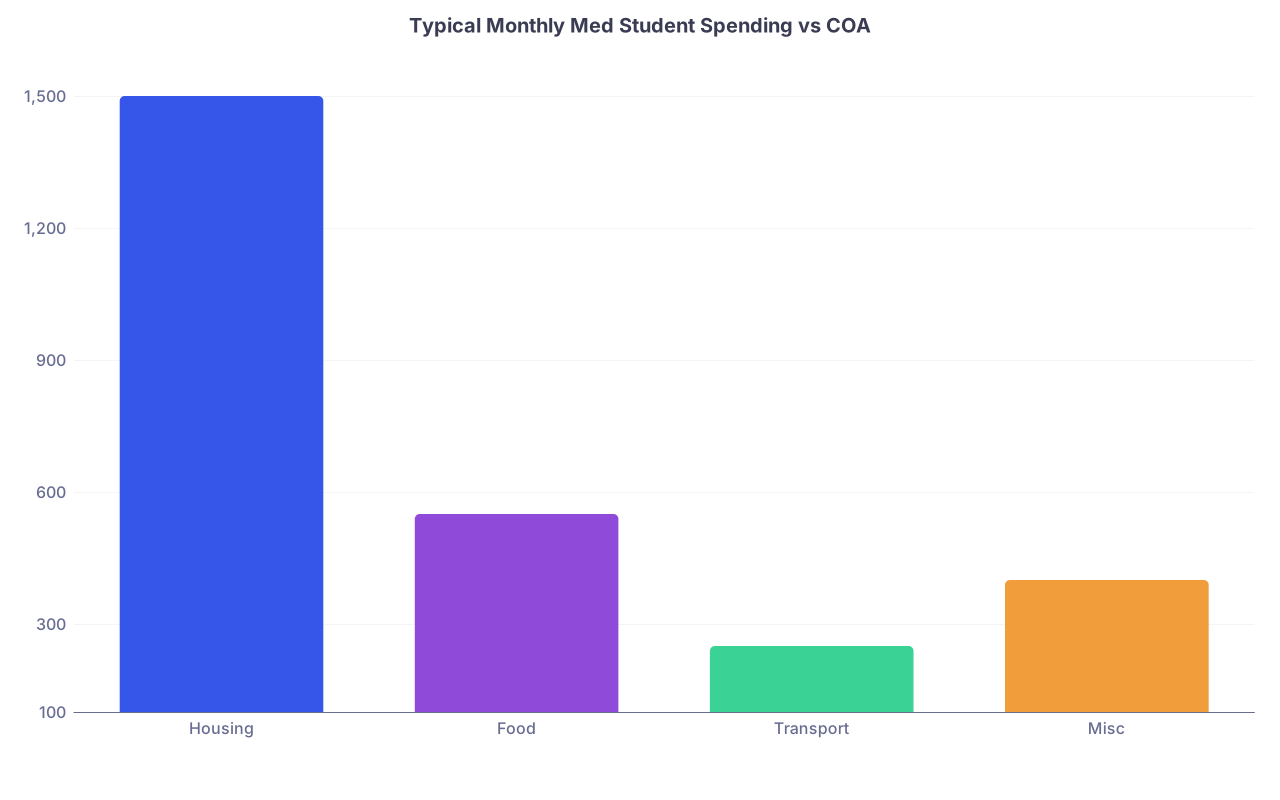
| Category | Value |
|---|---|
| Housing | 1500 |
| Food | 550 |
| Transport | 250 |
| Misc | 400 |
Step 3 (Day 5–7): Build a Bare-Bones M1 Budget (Not Forever. For Now.)
You are not designing your attending lifestyle. You are designing a survival budget to keep debt from getting wild. This is a 10‑minute exercise, not a three-hour spreadsheet marathon.
At this point you should:
Set monthly caps for:
- Housing (fixed by your lease; note it and move on)
- Food (set a number—for example, $350–400, not “eat at home more”)
- Transportation (gas, passes, parking, Uber cap)
- “Fun / social” (yes, you get some; no, it is not $400)
- Books / resources (see Week 2, because this is where people bleed money)
Choose a system:
- One checking account for fixed bills, one for variable spending
- Or use a budget app (YNAB, Monarch, plain old spreadsheet)
The tool does not matter. The visibility does.
Minimalist benchmark for an M1 in a reasonable COL city (rough ranges):
| Category | Target Range (USD) |
|---|---|
| Housing | 800–1,200 |
| Food | 300–450 |
| Transport | 100–250 |
| Utilities/Net | 100–150 |
| Misc/Fun | 100–200 |
| School Stuff | 50–100 |
If your numbers are wildly above these and you are not in SF/NYC/Boston-level COL, that is your signal to reconsider choices while you still can.
Step 4 (By End of Week 1): Clean Up Your Banking / Credit
At this point you should:
Open or confirm a no-fee checking account
- No minimum balance, no overdraft fees if possible
- Separate “school money” from any pre-existing savings so you do not blur lines
Pick one student-friendly credit card (if you do not already have one and can handle it)
- Goal: build credit for future attending life, not to fund lifestyle
- Use it only for fixed, predictable costs (e.g., internet, phone) and pay in full each month
Turn off overdraft
- Overdraft + irregular refunds is a fast way to rack up stupid fees on top of stupid interest.
Week 2: Once Classes Stabilize — Attack Hidden Costs
By Week 2, the welcome events are tapering. Anatomy has punched you in the face at least once. Group chats have turned from “who is going out tonight” to “does anyone have Anki cards for this block?”
This is where the “invisible” money leaks start.
At this point you should tackle:
- Books and resources
- Insurance and legal basics
- Subscription creep and lifestyle noise
Step 5 (Days 8–12): Stop Overpaying for “Required” Resources
Every M1 class has the same pattern: faculty list ten “required” texts and tools, students buy them, and then everyone uses 2–3 consistently.
At this point you should:
Talk to M2/M3s at your school. Specifically.
- Ask: “What did you actually use for [school name] M1? What was a waste of money?”
- You will hear the same few names repeatedly. Trust that.
Delay purchases until you have proof you need them.
- Do not pre-buy full access to 4 question banks.
- Start with what is free through your school (Boards & Beyond, AMBOSS, UWorld, Firecracker, etc. many schools bundle these).
Use the library aggressively.
- Many “required” textbooks are on reserve or have institutional access.
- Test drive a resource for the first block before you pay hundreds.
Example pattern I keep seeing:
- Student buys:
- New laptop + iPad + Apple Pencil + fancy note-taking app subscription + full-price textbooks + 2 extra qbanks “just in case.”
- Cost: an extra $2,000–3,000 M1. With interest, that is more like $4,000–5,000 in eventual repayment.
Instead, at this point:
- Evaluate which of these you actually need for your school’s teaching style
- Ask: “What do 80% of upperclassmen here do for [anatomy / biochem / pharm]?” and copy that
Step 6 (Days 10–14): Lock in Basic Insurance and Legal Protection
Boring, but skipping this can destroy you financially faster than any Starbucks habit.
At this point you should verify:
Health insurance
- Are you on:
- School plan
- Parent’s plan
- Marketplace plan
- Confirm your deductible, out-of-pocket max, and mental health coverage.
Large deductibles matter when you inevitably get sick or need therapy mid-year.
- Are you on:
Renter’s insurance
- If your laptop, iPad, or bike gets stolen, can you replace them without another loan?
- Renter’s insurance is usually $10–20/month. Get it. Today.
Disability coverage (if your school offers a group policy to students)
- Long-term disability is what protects your future earning potential if you get seriously ill or injured.
- If there is a low-cost student policy, consider at least the minimum. Your attending self will be very grateful if something goes wrong.
Legal basics
- Understand your lease: sublet rules, early termination clause, roommate responsibilities.
- If your school has a legal clinic or student resource, this is the week to use it.
Week 3: Mid-Month — Build Systems Before Exams Hit
By now you are starting to feel the exam schedule tighten. The first block exam date is on your calendar, and your brain is shifting from “orientation” to “survival mode.”
This is the danger zone for mindless spending. DoorDash, coffee, “I deserve a treat; this is hard.”
At this point you should:
- Automate your bill-paying and loan awareness
- Create a simple tracking system
- Decide your stance on part-time work (for the whole year, not week by week)
Step 7 (Days 15–18): Automate Everything You Can
Cognitive load is expensive. Every decision you force yourself to make during exam week tends to go the easy, expensive way.
At this point you should:
Set auto-pay for:
- Rent
- Utilities
- Phone
- Internet
- Credit card minimum (or full balance if you reliably keep it small)
Schedule two “money check-in” times per month
- 15 minutes, twice a month. That is it.
- Put them on your calendar:
- “Money Check-In #1: 5th of each month”
- “Money Check-In #2: 20th of each month”
During that time you:
- Look at account balances
- Verify spending vs the caps you set Week 1
- Decide if any adjustments are needed for the next 30 days
- Move extra money into a separate “buffer” savings (not into random spending)
Step 8 (Days 18–21): Start Tracking, Bare-Minimum Version
You do not need a perfect ledger. You do need to know roughly where your money went each month.
At this point you should:
Pick one tracking method:
- A simple spreadsheet with:
- Income (refunds, small job, family help)
- Fixed expenses
- Variable categories with actual spend
- Or a bank app that auto-categorizes, with you checking “Food,” “Entertainment,” and “Shopping” totals
- A simple spreadsheet with:
Define tripwire rules:
- Example:
- If food spending > $450 in a month → next month: no delivery, groceries only
- If “Entertainment / Shopping” > $200 → freeze nonessential purchases for 2 weeks
- Example:
You are not punishing yourself. You are preventing drift. Drift is how your projected $20k/year living cost turns into $30k/year without you noticing until M4.
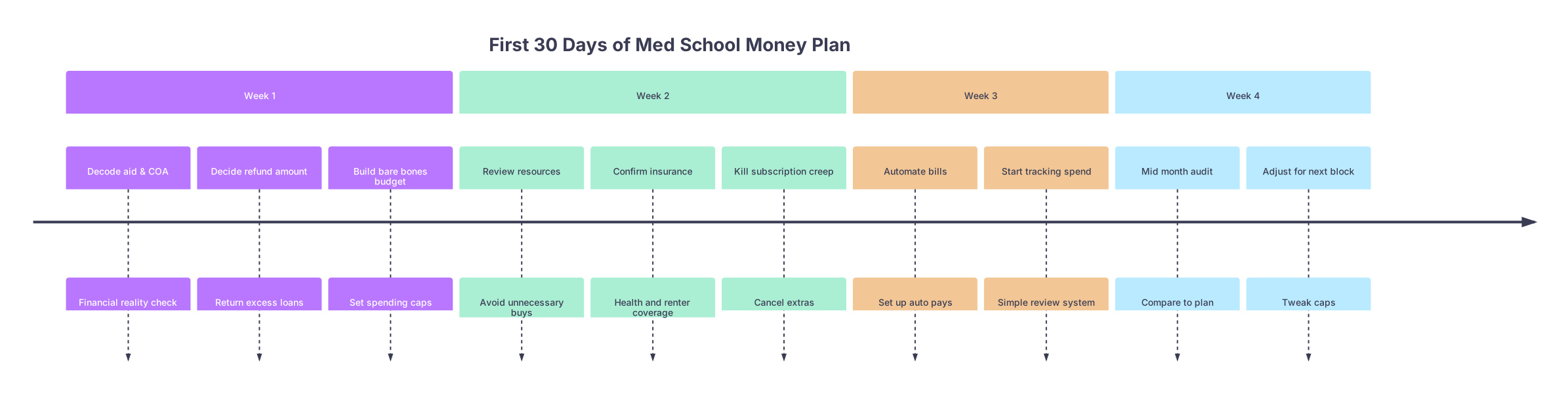
| Period | Event |
|---|---|
| Week 1 - Decode aid & COA | Financial reality check |
| Week 1 - Decide refund amount | Return excess loans |
| Week 1 - Build bare bones budget | Set spending caps |
| Week 2 - Review resources | Avoid unnecessary buys |
| Week 2 - Confirm insurance | Health and renter coverage |
| Week 2 - Kill subscription creep | Cancel extras |
| Week 3 - Automate bills | Set up auto pays |
| Week 3 - Start tracking spend | Simple review system |
| Week 4 - Mid month audit | Compare to plan |
| Week 4 - Adjust for next block | Tweak caps |
Step 9 (By Day 21): Make a Clear Decision About Working During M1
This is controversial. I will be blunt.
For most M1s, especially in demanding programs, regular part-time work is a bad trade: it adds stress, threatens your grades, and does not move your debt number much.
At this point you should:
- Decide: No recurring job during M1 unless:
- You have a very light curriculum
- You have previously proven you can balance intense study with work
- The work is extremely flexible and low-stress (e.g., simple remote gig, occasional tutoring)
Remember the math:
- $300/month earned × 10 months = $3,000/year
- That is not nothing, but if it costs you exam performance, class rank, or leads to a failed course and delayed graduation, it is a terrible trade.
Better short-term moves:
- Occasional high-yield gigs (MCAT tutoring, content creation for medical education if you are already strong at it) rather than fixed shifts
- Summer between M1 and M2 is usually a better time for income experiments
Week 4: End of First Month — Audit and Adjust Before Patterns Harden
By the end of 30 days, your routines are more or less set. Good or bad.
This week is your first “financial case conference” on yourself.
At this point you should:
- Analyze your first month’s spending
- Make one or two structural changes (not twenty)
- Do a mini long-term projection so you understand the stakes
Step 10 (Days 22–26): First 30-Day Spend Review
Pull up:
- Bank statements
- Credit card statement
- Your initial budget plan from Week 1
At this point you should:
- For each category, write:
- Planned amount
- Actual amount
- Difference (+/-)
Ask very specific questions:
Food:
- How many transactions were coffee / delivery / late-night snacks?
- Could you replace 3 of those per week with prepped food without wrecking your sanity?
Housing / utilities:
- Any surprises you did not budget (parking fees, move-in costs)?
- Can any recurring costs be reduced (cheaper internet plan, shared subscriptions)?
“Misc”:
- What exactly is in there? Supplies? Clothes? Random Amazon trash?
- If “I do not even remember what that was” appears too often, that is a problem.
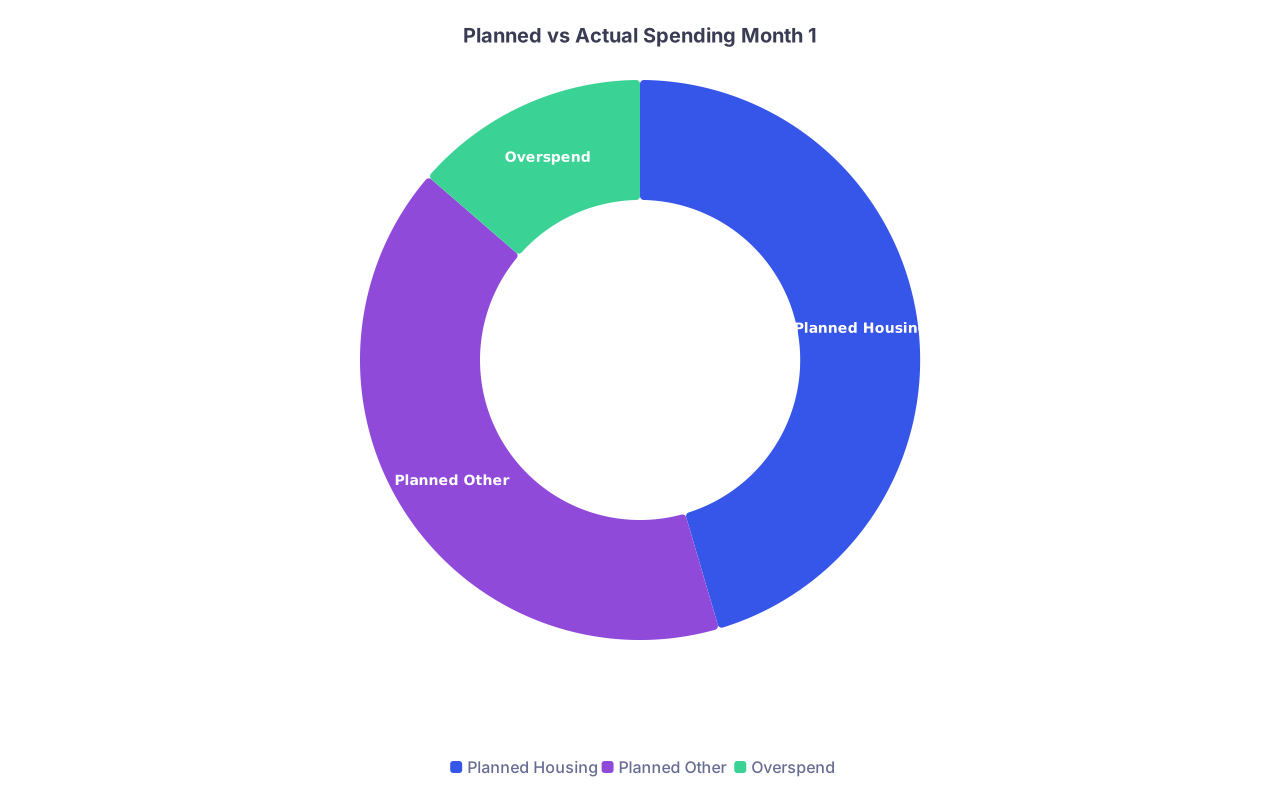
| Category | Value |
|---|---|
| Planned Housing | 1000 |
| Planned Other | 900 |
| Overspend | 300 |
You are not aiming for perfection. You are looking for the 2–3 biggest leaks.
Step 11 (Days 26–28): Make One Big Change, Not Ten Tiny Ones
Common overreaction: first review shows you overspent, so you try to overhaul everything. That never lasts past the next exam block.
At this point you should:
- Pick 1–2 high-impact changes for the next month. Examples:
- Move from individual to shared streaming accounts with roommates/friends
- Commit to cooking 4 dinners/week and freezing leftovers
- Cap ride-share usage by buying a bus pass and using it for all campus trips
- Cancel one expensive study subscription you are not really using, rely on school-provided tools instead
Approximate impact over a year:
| Cut Item | Monthly Saved | Annual Saved |
|---|---|---|
| Delivery → groceries 2x/wk less | $80 | $960 |
| Ditch extra qbank | $30 | $360 |
| Share streaming services | $15 | $180 |
| Lower phone plan | $20 | $240 |
That is easily $1,500–2,000 less borrowing per year. Over 4 years, with interest, that could be $8,000–10,000 less total repayment.
Step 12 (Days 28–30): Zoom Out — Understand Your Trajectory
You do not need a full financial plan for residency right now. You do need a rough sense of what your current path will cost you.
At this point you should:
- Take your monthly living cost from Month 1, adjusted with your new changes
- Multiply by 12 → annual living cost
- Add your annual tuition and fees
- Multiply by 4 for a crude “if nothing changes” total borrowing
Then:
- Use a basic online loan calculator with:
- Total principal (from above)
- Interest rate (6–7% typical for federal Unsubsidized/PLUS)
- Income-driven plan (to estimate eventual forgiveness or payoff)
You are not predicting the future with precision. You are calibrating your brain to realize that “extra $300/month” is not just $300; it is a substantial slice of your future freedom.
Once you see that number, write down:
- “Target maximum total borrowing I will try to stay under: $____”
That number becomes a quiet guardrail for the next 4 years. When you consider taking out extra loans for a fancier apartment next year, you will see the impact clearly, not vaguely.
Three Things to Remember
- The first 30 days are when your habits form. You will not “fix money later” if you let lifestyle creep take over now.
- Loan refunds are not income. If you do not need it in the next few months, send it back before interest starts compounding for the next decade.
- Your goal in Month 1 is not perfection. It is control: a simple budget, a tracking system, and one or two smart cuts that prevent debt from sprawling into every corner of your life.