
The most dangerous moment in student loan management is not when you borrow. It is the few weeks when you leave federal IDR and jump to a private refinance. People destroy forgiveness eligibility, lose protections, and trigger surprise tax and legal problems in that tiny window. You are not going to be one of them.
Below is a chronological, safety‑first timeline to move from a federal income‑driven repayment (IDR) plan to a private refinance without blowing up your long‑term strategy.
6–9 Months Before You Refinance: Decide If You Should Even Leave IDR
At this point you should not be filling out refinance applications. You should be proving to yourself that leaving federal IDR is actually rational.
Step 1: Lock in your “big picture” decision
Over this 6–9 month window, you should:
Confirm your employment path
- Are you working full‑time for a government or 501(c)(3) non‑profit?
- If yes, you are in Public Service Loan Forgiveness (PSLF) territory.
- If you are even plausibly staying there for 10 years, it is usually a mistake to refinance.
- If you are in private practice, corporate work, or planning to leave non‑profit employment soon, PSLF may be off the table. Write that down. This matters later.
- Are you working full‑time for a government or 501(c)(3) non‑profit?
Pull your complete federal loan history
- Log into the Federal Student Aid site (studentaid.gov).
- Download:
- Aid summary with total federal balances, interest rates, and loan types.
- Detailed loan breakdown (Direct vs FFEL vs Perkins; subsidized vs unsubsidized).
- Check your current IDR plan (SAVE, PAYE, IBR, etc.) and qualifying payment count for PSLF or IDR forgiveness.
Estimate forgiveness vs refinance payoff
You are deciding between two futures:
- Federal IDR + possible forgiveness (PSLF at 10 years or taxable IDR forgiveness at 20–25 years).
- Aggressive payoff with private refinance.
You need rough numbers, not vibes:
- Use a PSLF or IDR calculator (there are several: studentaid.gov PSLF Help Tool, or independent calculators).
- Inputs you should have ready:
- Current AGI or projected income trajectory.
- Family size.
- Current and projected monthly payment on SAVE/IDR.
- Years of credit already accumulated toward PSLF or IDR forgiveness.
If:
- You are >5 years into PSLF and working at a qualifying employer, and projected forgiveness value is six figures – you almost certainly stay federal.
- You have low debt or high income, with minimal or no projected forgiveness, and can pay off in ≤5–7 years – refinance is on the table.
- Clarify your financial buffers and risk tolerance
At this stage you should also decide:
- Do you have 3–6 months of emergency savings? If not, build that before you lock yourself into private repayment.
- Are you expecting major life events soon:
- Starting a family
- Leaving training (residency/fellowship)
- Moving, buying a home, starting a business
If your life is about to get chaotic, keeping federal protections a bit longer might be the smarter move.
3–4 Months Before Refinance: Data Gathering and Scenario Modeling
Now you are shifting from “should I?” to “how exactly would this work?”
At this point you should collect and model, but still not refinance yet.
Step 1: Confirm every federal protection you would be giving up
Make a list for yourself. Literally in writing:
If I refinance, I will permanently lose:
- Access to SAVE/IDR plans and payment caps tied to income.
- PSLF eligibility and any existing qualifying payment credit.
- Federal deferment/forbearance safety net (especially unemployment and economic hardship).
- Discharge for death/disability rules that are sometimes more favorable than private contracts.
- Interest subsidies on SAVE (extra interest that does not capitalize when payments are lower than accruing interest).
If any of those feel “non‑negotiable” for your situation, stop. You are not ready to refinance.
Step 2: Organize your documents
In these 3–4 months, you should gather:
- Last 2–3 years of tax returns.
- Recent pay stubs (or employment contracts if in training).
- List of all federal loans, their balances, and interest rates.
- Current credit report (you want to know what lenders will see).
You will need these not just for refinance applications, but also to check for errors in your federal loan records.
Step 3: Model paydown timelines
Create 2–3 concrete scenarios:
- Stay on SAVE/IDR with standard payments.
- Stay federal but pay extra to accelerate payoff.
- Refinance privately at X% rate, Y‑year term, with payment of $Z.
Compare:
- Total interest paid.
- Years until debt‑free.
- Monthly payment vs realistic budget.
Use conservative assumptions:
- Do not bank on continuous 8–10% income growth.
- Assume you might need a year or two of lower payments if you lose a job or cut hours.
2 Months Before Refinance: Pre‑Qualifying and Lender Comparison
Now you start touching the private side. Still safely anchored in federal.
At this point you should shop, not sign.
Step 1: Soft‑pull prequalification with multiple lenders
Over weeks 1–2 in this phase:
- Use soft credit check prequalification tools with 3–5 reputable lenders:
- SoFi, Laurel Road, Earnest, CommonBond (if active), Splash, etc.
- Compare:
- Fixed vs variable rates.
- Term lengths (5, 7, 10, 15, 20 years).
- Resident/fellow or trainee options if you are not yet at attending‑level income.
You will often see a spread like 4.8%–6.5% depending on term and type. Note those ranges.
Step 2: Shortlist 2–3 lenders
Criteria you should prioritize:
- Lowest rate at a term that matches your payoff plan.
For example: If your goal is to be done in 7 years, do not take a 15‑year loan just because the monthly payment is lower. - Flexible payment options, especially:
- Ability to pay extra without penalty.
- Clear policies for temporary hardship forbearance (even private lenders have some, but they are not as generous as federal).
- Borrower protections:
- Co‑signer release terms (if you are using one).
- Clear death/disability discharge clauses.
At this point, still no applications that trigger a hard credit pull unless you are reasonably sure you will proceed.
4–6 Weeks Before Refinance: Lock Strategy and Calendar
Now you are close enough that timing mistakes can cost you real money or protections.
At this point you should set exact dates and coordination steps.
Step 1: Choose your target refinance month
Pick a specific month when:
- Your employment status is stable (contract signed if starting new job).
- You are not mid‑move or mid‑credentialing nightmare.
- You have at least one full paycheck under your new income level if that improves your refinance terms.
Then, inside that month, identify a two‑week window where you can:
- Respond to lender emails quickly.
- Check your federal account several times.
- Adjust autopay without rushing.
Step 2: Align with your federal billing cycle
Look at your current federal loan servicer:
- Identify your monthly due date and autopay schedule.
- Note when your IDR recertification is due (month and year).
You want to avoid three traps:
- Refinancing just before your IDR recertification and then paying a higher final IDR bill unexpectedly.
- Being charged a full federal payment and a first private payment in the same week because you mistimed disbursement.
- Losing a month of qualifying PSLF credit you actually wanted.
A good pattern:
- Aim for your private refinance to fund and pay off federal loans 1–2 weeks after a scheduled federal payment.
That way, you are never late on federal, and you have time to kill autopay before the following cycle.
2–3 Weeks Before Refinance: Application and Hard‑Pull Phase
This is where you commit.
At this point you should submit full applications to 1–2 lenders you have already short‑listed.
Step 1: Submit complete applications
In week 1 of this phase:
- Apply with your best‑fit lender first.
- Have ready:
- Income documentation (pay stubs, offers, contracts).
- Verification for any bonus or side income you want counted.
- Co‑signer info if used.
Expect a hard credit pull at this stage.
If the first lender’s final offer is clearly worse than prequalified or worse than competitors, then and only then consider applying to a second lender. Try to do multiple applications within a short window (e.g., 14–30 days) so credit scoring models group them as “rate shopping.”
Step 2: Analyze actual offers vs theoretical
When you receive a conditional approval with a rate and term:
Check:
- Is the rate meaningfully lower than your weighted average federal rate? (For example, dropping from 7.0% to 4.5% is meaningful; from 7.0% to 6.6% generally is not worth federal protections.)
- Does the term match your payoff target?
- Is there an autopay discount, and what are the conditions?
You should also read the promissory note. Yes, the full thing. Look for:
- Forbearance rules and maximum months allowed.
- Default definitions and timelines.
- Death/disability policies.
- Variable rate margins and caps if you choose variable.
7–10 Days Before Funding: Lock‑In and Federal Exit Prep
Now timing matters a lot. This is the danger zone where people accidentally double‑pay or miss payments.
At this point you should:
Step 1: Accept the offer and get a tentative disbursement date
Once you accept a lender’s offer:
- The lender will give you an estimated disbursement date range when they will send money to your federal servicer and pay off the loans.
- You should immediately:
- Record this window on your calendar.
- Compare it to your next federal due date.
Step 2: Turn off federal autopay at the right moment
You must avoid two mistakes:
- Turning autopay off too early → risking a missed federal payment if funding is delayed.
- Turning autopay off too late → getting charged a federal payment for a loan that will be zeroed out days later.
A conservative pattern that usually works:
- 3–5 business days before your federal due date (once you are confident about the refinance disbursement timeline), log into your servicer and:
- Turn off autopay.
- Leave the ability to make a manual payment if something slips.
If your refinance will clearly fund after your upcoming due date, you should still pay that federal bill. Do not skip a payment hoping the refinance will magically land in time.
Funding Week: The Actual Switch
This is the week your federal loans die and your private life begins.
At this point you should be checking accounts frequently.
Step 1: Verify payoff in your federal account
During the funding week:
- Log into your federal servicer account every 1–2 days.
- Look for:
- Loan balances showing paid in full or $0.
- Status lines changing to “paid” or “closed.”
Once all balances show $0 with a completed payoff:
- Download and save:
- A final statement from your federal servicer showing $0 balance.
- Any confirmation letters or payoff notices.
These documents matter if there is ever a dispute about whether loans were paid in full.
Step 2: Confirm new private loan details
Log into your new private lender account:
- Confirm:
- Total refinanced balance matches what you expect from federal.
- Interest rate is what you were promised (including autopay discount if applicable).
- First payment due date.
- Minimum monthly payment amount.
Set up:
- Autopay from a checking account you control.
- Due date alignment with your paychecks (some lenders let you adjust).
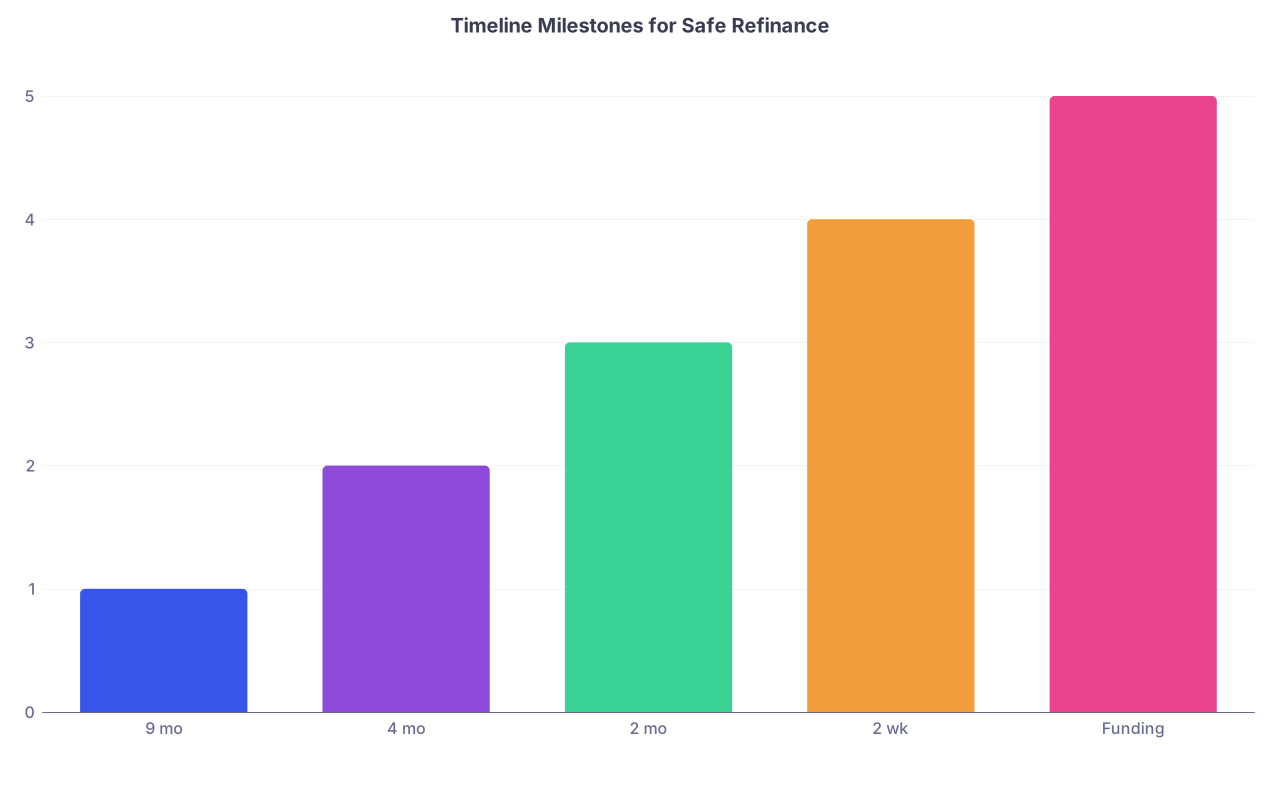
| Category | Value |
|---|---|
| 9 mo | 1 |
| 4 mo | 2 |
| 2 mo | 3 |
| 2 wk | 4 |
| Funding | 5 |
2–4 Weeks After Funding: Clean‑Up and Risk Containment
People forget this phase. Then get bitten later by PSLF errors or credit report issues.
At this point you should be verifying, documenting, and sealing the exit.
Step 1: Confirm federal forgiveness/PSLF records are frozen
If you were ever in PSLF or on an IDR plan:
- Log into studentaid.gov and view:
- PSLF qualifying payment count (if applicable).
- IDR qualifying payment counts (for long‑haul forgiveness).
- Take screenshots or PDFs of:
- Any record showing your final qualifying payment counts.
- Any PSLF employer certifications.
Why? Because if Congress or rules change later and you become eligible for retroactive relief or some new program, you will want proof of your historical payment record, even if your loans are already private.
Step 2: Monitor autopay and first private payment
- Verify that no new federal payments are being drawn from your bank account.
- Confirm your first private payment posts correctly and on time.
If something looks off:
- Call the private lender immediately.
- If any stray federal autopay went through after payoff, call the servicer and request a refund (this happens; I have seen it more than once).
Step 3: Check your credit reports
Within a month or two:
- Pull your credit reports from the three bureaus.
- Verify:
- Federal loans show as paid in full, not “defaulted” or “settled.”
- New private loan is reporting correctly.
If you see incorrect negative marks, dispute them in writing with documentation of the refinance payoff.

When You Should Not Refinance Yet: Red Flag Timing
A quick, time‑anchored checklist of moments when you should pause the process.
If any of these apply right now, delay refinancing:
- You are <3 years into PSLF with a stable non‑profit/government job.
- You are about to:
- Start residency/fellowship (before your program’s specific refinance offers are clear).
- Change employers from non‑profit to private and are not certain the switch will stick.
- Your emergency fund is basically zero and you are one layoff away from disaster.
- You expect:
- Significant loan relief or policy change that directly affects your loans (for example, targeted forgiveness proposals you actually qualify for).
- A major income cut in the next 12–18 months.
In those moments, staying in federal IDR a bit longer is not cowardice. It is discipline.
Putting It All Together: A Simple Timeline Overview
Here is the full process in compact timeline form.
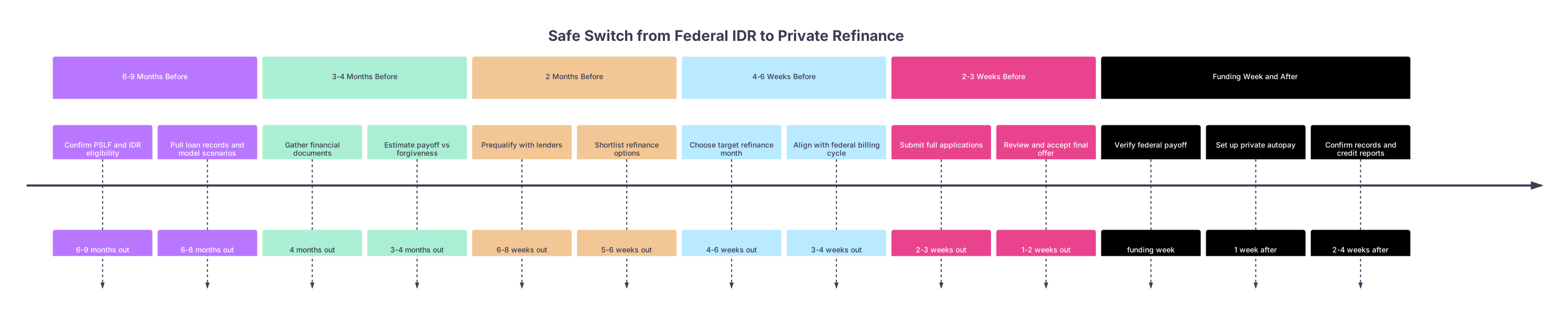
| Period | Event |
|---|---|
| 6-9 Months Before - Confirm PSLF and IDR eligibility | 6-9 months out |
| 6-9 Months Before - Pull loan records and model scenarios | 6-8 months out |
| 3-4 Months Before - Gather financial documents | 4 months out |
| 3-4 Months Before - Estimate payoff vs forgiveness | 3-4 months out |
| 2 Months Before - Prequalify with lenders | 6-8 weeks out |
| 2 Months Before - Shortlist refinance options | 5-6 weeks out |
| 4-6 Weeks Before - Choose target refinance month | 4-6 weeks out |
| 4-6 Weeks Before - Align with federal billing cycle | 3-4 weeks out |
| 2-3 Weeks Before - Submit full applications | 2-3 weeks out |
| 2-3 Weeks Before - Review and accept final offer | 1-2 weeks out |
| Funding Week and After - Verify federal payoff | funding week |
| Funding Week and After - Set up private autopay | 1 week after |
| Funding Week and After - Confirm records and credit reports | 2-4 weeks after |
| Factor | Stay on IDR (Federal) | Private Refinance |
|---|---|---|
| PSLF Eligibility | Preserved | Lost permanently |
| Long-Term Forgiveness | Possible (20–25 yrs) | None |
| Income-Based Payments | Yes (SAVE/IDR) | No |
| Interest Rate | Often higher | Often lower |
| Flexibility in Hardship | Strong (IDR, forbearance) | Limited, lender-specific |
Three Things To Remember
- The decision to leave federal IDR should be made months before you touch a refinance application. By the time you apply, you should already know PSLF and forgiveness are not your best path.
- The danger window is the 2–3 weeks around funding. That is when you must coordinate autopay, verify payoff, and document everything, or you risk missed payments and lost protections.
- A refinance is not just a lower rate; it is a permanent legal trade: flexibility and potential forgiveness for speed and lower interest. Treat the timing with the same seriousness you would any major contract.