
Six Months Before Graduation: Preparing Your Loans for Attending Income
It is about six months before graduation. You just finished another brutal ICU week, you are half‑listening on rounds, and in the back of your mind a number is sitting there: your total student loan balance.
You know attending income is coming. You also know interest has been quietly compounding for four years. Someone in the workroom just said, “Bro, I’m gonna refinance everything as soon as I’m an attending and be done in five years.” Another co‑resident mumbled, “I am PSLF or bust.”
You? You are not even sure who your loan servicer is.
This is the point where small, boring decisions make a six‑figure difference. The mistake people make is waiting until after graduation or after their first attending paycheck to “deal with loans.” By then, you are already locked into bad plans, missed consolidation windows, and preventable tax bombs.
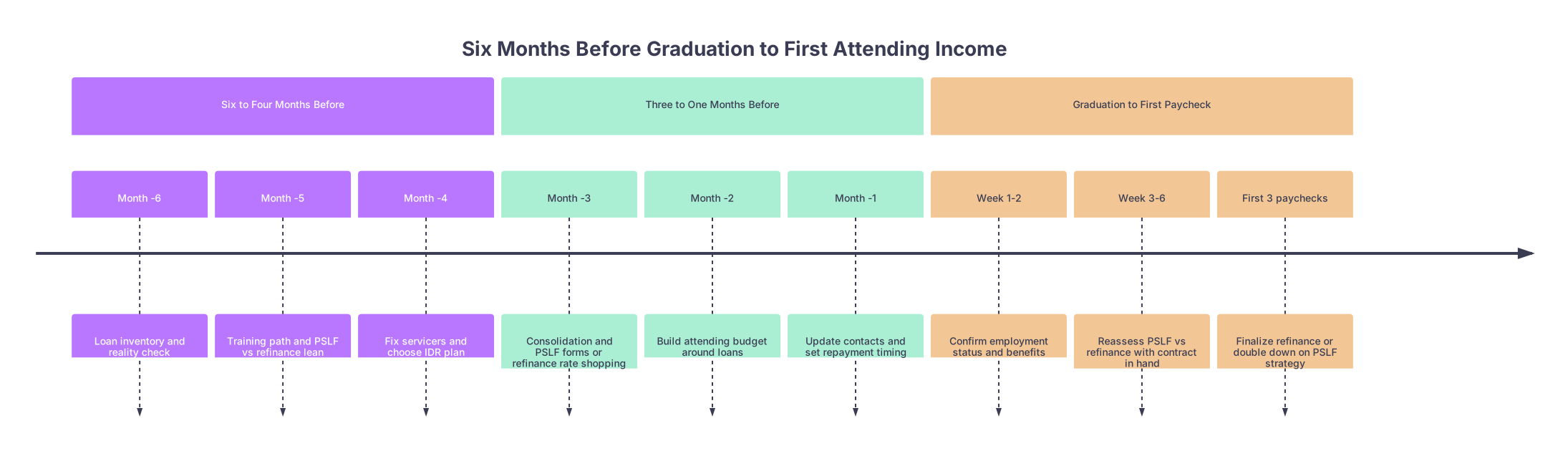
Here is the month‑by‑month, then week‑by‑week path from six months pre‑graduation to your first real attending checks, focused on one thing: getting your loans perfectly positioned before your income jumps.
Six Months Before Graduation: Inventory and Reality Check
At this point you should stop guessing about your debt.
Week 1: Pull the full loan inventory
Block 60–90 minutes. No interruptions. Laptop only.
-
- Go to “My Aid” and export your aid data.
- Confirm:
- Total federal balance
- Loan types (Direct Subsidized, Direct Unsubsidized, Grad PLUS, old FFEL, Perkins)
- Interest rates per loan
- Disbursement dates
- If you see FFEL or Perkins and you care about PSLF: mental note, you will likely need consolidation later.
-
- Separate spreadsheet tab.
- For each:
- Lender
- Balance
- Fixed vs variable rate
- Cosigner?
- In‑school vs repayment status
-
- Columns:
- Lender/servicer
- Loan type
- Interest rate
- Balance
- Eligible for IDR? (Y/N)
- Eligible for PSLF? (Y/N if you were to work at a qualifying employer)
- Notes (FFEL, Perkins, “already refinanced,” etc.)
- Columns:
If this takes you less than 30 minutes, you missed something. Real inventories are a little painful.
Week 2–3: Clarify your likely path (PSLF vs refinance vs hybrid)
You do not need a final decision yet. You need to narrow your likely direction.
Ask yourself, honestly:
- Do I strongly expect to work 10 years total (residency + attending) at:
- Academic medical centers
- VA
- County/public hospitals
- FQHCs or true non‑profit systems?
If “probably yes,” you must assume PSLF is on the table until proven otherwise. That means:
- Do not refinance federal loans yet.
- Plan for an IDR (income‑driven repayment) strategy.
If “almost certainly no,” and you are headed to:
- Private practice group
- For‑profit hospital system
- High‑paying specialty with short training
…then aggressive refinance/rapid payoff is likely your path. But still: do not refinance quite yet. You need your attending contract first.
At this point you should:
- Write down: “Leaning PSLF” or “Leaning refinance / pay off.” Commit to a direction for now. You can pivot, but pretending both are equally likely just procrastinates decisions.
Four to Five Months Before Graduation: Align Training, Job Plans, and Loan Strategy
Now we connect the financial plan to your actual career trajectory.
Month −5: Training length and specialty reality
Pull out your training plan:
- Residency length
- Fellowship plans (probable vs possible)
- Location patterns (academic vs community)
At this point you should:
Timeline your “qualifying employment exposure”
- Year 1–3: Residency at [Hospital X] – non‑profit? (Check their 501(c)(3) status or PSLF employment certification list.)
- Year 4–6: Fellowship? At where?
- Post‑training: What type of job are you realistically targeting based on your specialty?
Check how your cohort actually ends up working
- Ask a PGY‑5 or recent grad:
- “Where did the last 5 people in our specialty go?”
- “Are people mostly academic or private?”
- This is better data than your current fantasy version of your career.
- Ask a PGY‑5 or recent grad:
Match specialty to typical loan strategy
| Profile | Common Loan Strategy |
|---|---|
| Primary care, academic | PSLF via IDR |
| Pediatrics subspecialty, academic | PSLF almost always |
| EM, mixed practice | Hybrid (PSLF or refinance) |
| Orthopedics, private | Aggressive refinance/payoff |
| Derm, private | Immediate refinance/payoff |
Not perfect, but directionally accurate. If you see “PSLF almost always” and you are in that bucket, assume PSLF unless you have a very strong private practice plan.
Month −4: Clean up your federal loans and servicer issues
Now that you have a direction, fix the admin mess.
At this point you should:
Confirm your federal loan servicer(s)
- Mojo lender roulette is common—Nelnet, MOHELA, Aidvantage, etc.
- Record:
- Which servicer has which loans
- Current repayment status (in‑school, forbearance, IDR, etc.)
Fix any accidental forbearance
- If you see multiple years of forbearance during residency:
- That time usually does not count toward PSLF.
- Call the servicer and ask:
- “Was this mandatory medical residency forbearance or voluntary?”
- “Could any of this period qualify for IDR/PSLF credit under current adjustment rules?”
- Sometimes people discover wasted years. Better to know now.
- If you see multiple years of forbearance during residency:
Learn your IDR options For federal loans, your realistic choices as of now:
- SAVE (replacing REPAYE) – usually best for most residents aiming PSLF or minimizing payments.
- PAYE / IBR – may matter if you have old loans or specific family income quirks, but for current grads, SAVE is winning almost every time.
If you are not already on SAVE and PSLF is in the picture, that is probably a mistake.
| Category | Value |
|---|---|
| Standard 10-yr | 100 |
| IBR | 45 |
| SAVE | 25 |
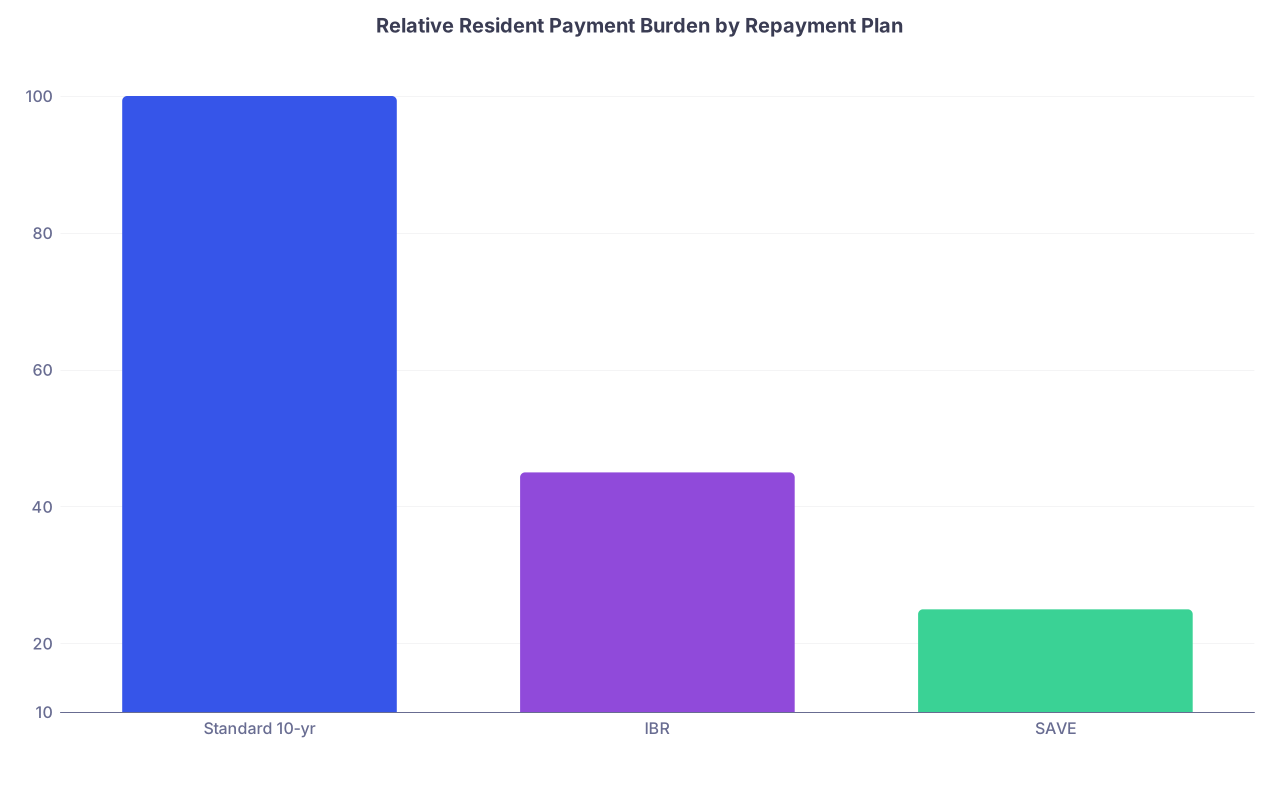
(Assuming the 10‑year standard payment as “100%,” I routinely see SAVE cutting residency cash‑flow burden to a quarter of that.)
Three Months Before Graduation: Position for PSLF or Future Refinance
Now the timeline tightens. This is the window where you set up the structure that will govern the next 10+ years.
Month −3: If PSLF is even possibly your future
At this point you should do three things if PSLF is on the table:
Consolidate strategically (if needed)
- You should consider consolidation if:
- You have FFEL or Perkins loans you want PSLF‑eligible.
- You have multiple loan groups with different payment counts, and consolidation under the current adjustment could maximize your count.
- But: consolidating can reset your PSLF count under older rules. Current “one‑time account adjustment” rules are complex. If you started repayment pre‑residency or had multiple statuses, this is where a specialist consult is worth the money.
- You should consider consolidation if:
Switch to SAVE (if not already on it)
- Apply through studentaid.gov.
- Use your actual residency income, not a random projected attending income.
- If married (or will be soon), think through:
- Tax filing status: married filing jointly vs separately affects IDR payments.
- This is not academic—this can shift your monthly payment by four figures once you are an attending.
Start PSLF employment certification
- Download the PSLF form from studentaid.gov.
- Get HR/credentialing at your residency hospital to sign and certify:
- Start date of employment
- Full‑time status
- Submit now. Build the paper trail early.
- Going forward: plan to do this annually, and any time you switch employers.
Month −3: If you are leaning toward refinance and rapid payoff
Still federal loans right now. Still do not refinance yet.
At this point you should:
Estimate your post‑training income
- Use actual job offers of recent grads:
- EM: $280–380k, depending on region.
- Ortho: $450–700k+ with RVU/partnership.
- Anesthesia: $350–550k.
- Reality, not recruiter fantasy. Ask a senior: “What is your guaranteed base in year one?”
- Use actual job offers of recent grads:
Run a rough payoff projection
- Simple rule:
- If your total loans are less than 1x your expected starting gross income, aggressive payoff within 3–5 years is usually very doable.
- If > 2x your expected income, PSLF/IDR deserves a serious look, even in higher‑paying specialties.
- Simple rule:
Start shopping refinance offers (soft credit check)
- Use 2–3 of the major players (SoFi, Laurel Road, Earnest, etc.).
- Do soft rate checks only—you want data, not a commitment.
- Collect:
- Fixed vs variable options
- 5/7/10/15‑year term quotes
- You are doing this now so you are not scrambling later. You still wait to sign until:
- You have a signed attending contract.
- You are sure PSLF/non‑profit work is off the table.
One to Two Months Before Graduation: Lock in Systems, Not Just Concepts
Now we are close to graduation. Your time is about to evaporate between moving, onboarding, and orientation. You set up automation before that hits.
Month −2: Build your attending budget around loan strategy
Most people do this backward. They sign a lease, buy a car, then let loans fight over the scraps. That is how people end up “unable” to pay more than $2k/month on a $400k balance.
At this point you should:
Sketch a realistic attending budget with loan line‑items first
- Decide your target loan payment:
- PSLF path: IDR payment + separate “tax bomb” savings if you expect forgiveness under non‑PSLF IDR.
- Refinance/payoff path: be honest—$5–8k/month is not crazy on a $350k income for 3–5 years.
- Then fit:
- Housing (cap this; do not let it balloon because “I’m an attending now”)
- Transportation
- Insurance
- Retirement baseline (at least enough to get any employer match)
- Decide your target loan payment:
Decide your “forgiveness tax bomb” strategy (for non‑PSLF IDR)
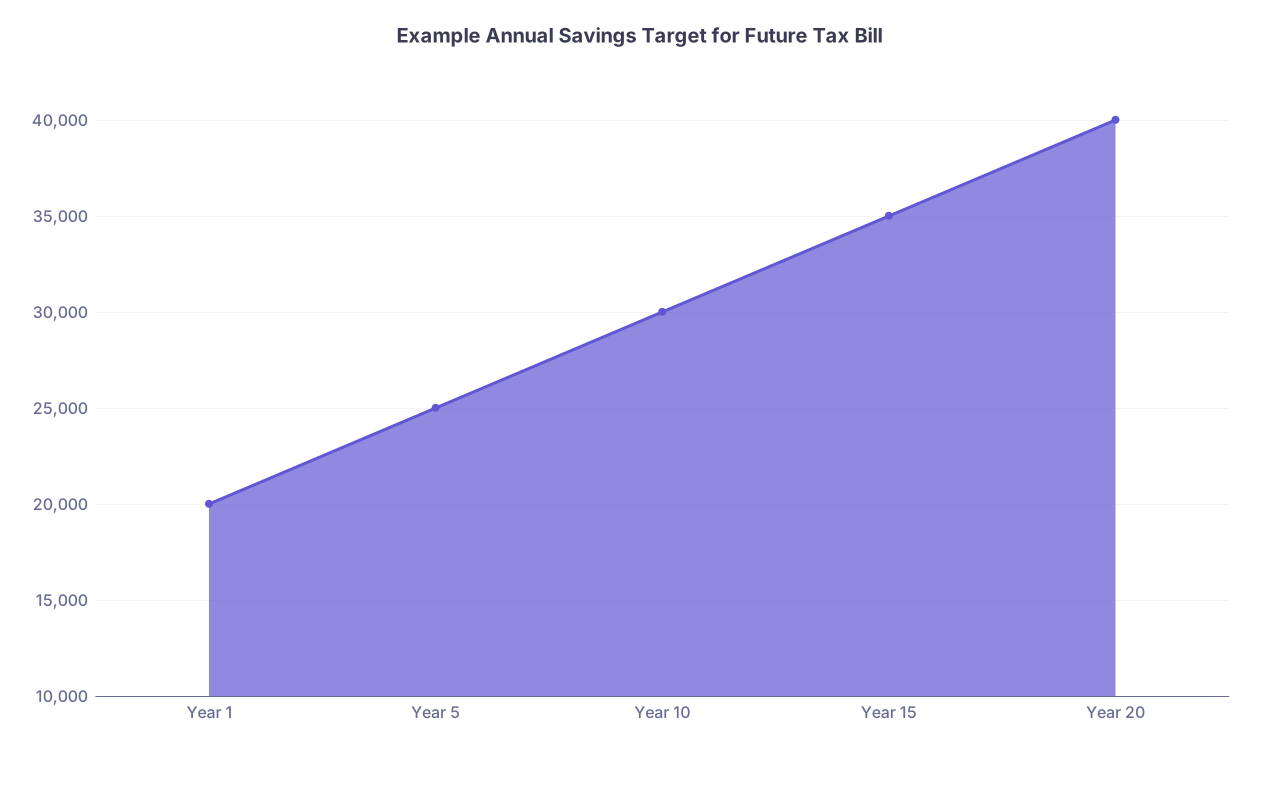
If you are planning long‑term IDR/forgiveness without PSLF (e.g., you are in private practice on SAVE for 20–25 years):- Start a separate tax‑bomb savings account.
- Rough, conservative rule:
- Annually save 5–10% of your loan balance in a taxable brokerage earmarked for the future tax bill.
- It is not perfect math. But it is infinitely better than zero.
| Category | Value |
|---|---|
| Year 1 | 20000 |
| Year 5 | 25000 |
| Year 10 | 30000 |
| Year 15 | 35000 |
| Year 20 | 40000 |
Month −1: Administrative cleanup and final pre‑attending moves
At this point you should:
Verify your contact info with all servicers
- Update email, phone, mailing address.
- Turn on e‑bill and autopay (for the small rate reduction where offered).
Set your repayment plan start date
- For federal loans, you will get a grace period post‑graduation.
- Decide:
- Do you want to enter IDR immediately and count those payments toward PSLF?
- Then file the IDR application before grace ends.
- Or do you want to use grace, keep cash, and start later?
- Less PSLF credit, more short‑term flexibility. Decide intentionally.
- Do you want to enter IDR immediately and count those payments toward PSLF?
For PSLF‑leaning people: lock in employer status
- Confirm with HR:
- Employer is a non‑profit or government entity.
- Your FTE meets “full‑time” definition for PSLF.
- If you have multiple attending job offers:
- Recognize that a lower‑paying academic offer can be financially superior when you factor PSLF.
- Confirm with HR:
Graduation to First Attending Paycheck: Week‑by‑Week Execution
You graduated. Now the timeline shifts to weeks.
| Period | Event |
|---|---|
| Six to Four Months Before - Month -6 | Loan inventory and reality check |
| Six to Four Months Before - Month -5 | Training path and PSLF vs refinance lean |
| Six to Four Months Before - Month -4 | Fix servicers and choose IDR plan |
| Three to One Months Before - Month -3 | Consolidation and PSLF forms or refinance rate shopping |
| Three to One Months Before - Month -2 | Build attending budget around loans |
| Three to One Months Before - Month -1 | Update contacts and set repayment timing |
| Graduation to First Paycheck - Week 1-2 | Confirm employment status and benefits |
| Graduation to First Paycheck - Week 3-6 | Reassess PSLF vs refinance with contract in hand |
| Graduation to First Paycheck - First 3 paychecks | Finalize refinance or double down on PSLF strategy |
Weeks 1–2 After Graduation: Confirm reality, not plans
At this point you should:
Confirm actual job details
- You have:
- Signed contract(s)
- Start date(s)
- Known employer type (non‑profit vs for‑profit)
- If you ended up at a non‑profit when you expected private, or vice versa, your loan plan might flip.
- You have:
Recheck your loan status
- Verify:
- Consolidation processed (if applicable).
- IDR plan active and correctly using your income.
- PSLF employment certification received / processed by MOHELA if you submitted earlier.
- Verify:
Enroll in employer retirement and benefits
- Especially if your employer offers:
- 403(b)/401(k) with match (this lowers your AGI, and thus your SAVE payment).
- Contributing pre‑tax money:
- Reduces your IDR payment.
- Builds retirement.
- Double win for PSLF folks.
- Especially if your employer offers:
Weeks 3–6 After Graduation: Lock in PSLF or refinance
Now your first attending paycheck is within sight. This is the inflection point.
If you are committed to PSLF
At this point you should:
Double‑check you are on SAVE with correct family size and income
- Update family size when:
- You marry.
- You have kids.
- File taxes in a way that aligns with your strategy:
- Married filing separately can cut IDR payments but increases tax; you need a real tax projection to decide if it is worth it.
- Update family size when:
Keep all federal loans federal
- Do not refinance federal loans with private lenders.
- You can, however, refinance private loans aggressively without touching your PSLF‑eligible federal loans.
Aggressively invest the “difference”
- If your SAVE payment is, say, $900/month on a $6k+ “standard” payment:
- That $5k+ gap is not for lifestyle inflation.
- Direct it to:
- Retirement accounts
- Tax‑bomb fund (if using non‑PSLF forgiveness)
- Short‑term goals (down payment fund, etc.)
- If your SAVE payment is, say, $900/month on a $6k+ “standard” payment:
Calendar PSLF admin
- Once a year:
- Submit PSLF employment certification.
- Whenever you change employers:
- Submit again.
- Once a year:
If you are committed to refinance and rapid payoff
At this point you should:
Gather final documentation
- Signed contract
- Recent pay stub (once you get it)
- Proof of graduation/completion
Compare refinance offers again (now with real income)
- Lock terms only after you:
- Confirm job is truly non‑PSLF (for‑profit, private).
- Are confident there is no reasonable PSLF path in your first decade.
- Lock terms only after you:
Choose structure: term and flexibility
- My preference for attendings who want to stay aggressive:
- Shortest term where you can still handle the minimum in a bad year.
- Often 5–7 years, sometimes 10 with heavy overpayments.
- Fixed rate over variable unless you are highly risk‑tolerant and planning payoff in ≤3 years.
- My preference for attendings who want to stay aggressive:
Set your payment automation
- First 3 paychecks:
- Confirm take‑home pay and actual budget.
- Then:
- Set automatic loan payment for your target amount, not just the minimum.
- First 3 paychecks:

The First Three Attending Paychecks: Prevent Lifestyle Creep from Stealing Your Plan
People blow their loan plan right here. Months of careful thinking, destroyed by the first big direct deposit.
At this point you should:
Run a “three‑paycheck test”
- For each of your first three paychecks:
- Track:
- Actual spending by category
- Actual loan payments
- Actual savings/investment contributions
- Track:
- Compare to the budget you built at Month −2.
- Adjust quickly if:
- Housing/transportation is eating your plan.
- You are drifting into “attending lifestyle” costs—daily delivery, new furniture, random subscriptions.
- For each of your first three paychecks:
Commit to a payoff or PSLF horizon
- Write down:
- “I will be debt‑free by [month/year].”
or - “I will hit 120 PSLF payments by [month/year].”
- “I will be debt‑free by [month/year].”
- Put it where you see it: whiteboard, phone note, whatever.
- Write down:
Review yearly, not monthly
- Monthly tweaks make you neurotic.
- Once a year, do a full:
- Loan balance check
- PSLF payment count check (if applicable)
- Refinance rate check (only if still unrefinanced or rates move dramatically)
- Use the other eleven months to just execute the plan.

Today: One Concrete Step
You are somewhere in that six‑month window. Maybe precisely at Month −6, maybe already in the gray zone between Match and graduation.
Do one thing today:
Log into studentaid.gov, download your full loan data, and put every single loan—type, balance, rate—into a simple spreadsheet.
No strategy discussion before that. No PSLF vs refinance debates. No podcasts, no blogs.
Open the spreadsheet. Fill in every cell. When you can answer, without guessing, “How much do I owe, to whom, and at what rate?”—then you are finally ready to make real decisions about how your new attending income will kill this debt instead of feeding it.