
The biggest mistake PGY2s and PGY3s make with student loans is assuming “I put it on autopay during intern year, so I am fine.” You are not fine. Loans are not static. Your income, interest, repayment plan eligibility, and PSLF clock all shift during these years. If you do not run an annual (and brief quarterly) loan checkup, you will quietly bleed thousands.
I am going to walk you through exactly what to do, and when, from the start of PGY2 to the end of PGY3. Treat this like a recurring clinical protocol. Because it is.
Big Picture: Your PGY2–PGY3 Loan Timeline
You should not be “thinking about loans” constantly. You should be hitting specific checkpoints.
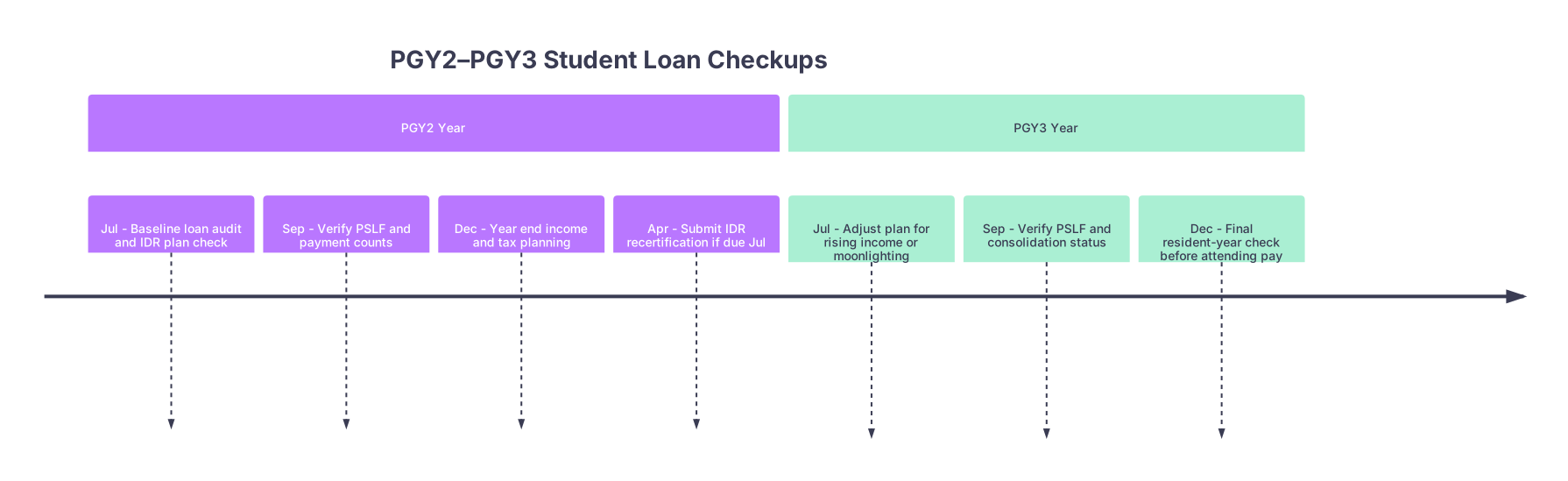
Core expectations:
- Once per year: Deep loan “annual exam” (60–90 minutes).
- Every 3–4 months: Quick “vitals check” (10–15 minutes).
- Before any major change (new job, moonlighting, marriage, big income jump): Mini-adjustment.
You are in PGY2–PGY3. So:
- Your income is still “low” relative to your debt → IDR is usually powerful.
- Your PSLF clock (if going nonprofit) is in the middle innings.
- You are close enough to attending life that the long-term strategy must be locked in.
Step 1: Early PGY2 – Run Your “Baseline Audit”
At the very start of PGY2 (July–August), you should sit down once and get fully oriented. No guessing. No “I think it is on SAVE.”
Week 1–2 of PGY2: Collect Everything
At this point you should:
Log into studentaid.gov
- Pull your full Aid Summary.
- Download the .txt file of your loan details (buried but worth the click).
- Note:
- Total balance (by loan type).
- Interest rates.
- Servicer(s).
- Whether loans are Direct vs FFEL vs Perkins.
Log into your loan servicer (MOHELA is common for PSLF now):
- Confirm:
- Current repayment plan (IBR, PAYE, SAVE, REPAYE, Standard, etc.).
- Monthly payment.
- Autopay active and correct bank.
- Due date and payment history.
- Confirm:
If aiming for PSLF:
- Check your current qualifying payment count.
- Confirm employer info is correct in their system.
If collecting this info takes longer than 20–30 minutes, it usually means your system is chaotic. Fix that now. Create a single “Loans” folder (physical or digital) and park everything there.
Week 3–4 of PGY2: Diagnose Your Current Setup
At this point you should answer five questions clearly:
Am I on the optimal IDR plan for residency?
For most residents right now, that means:- SAVE plan → best default if you are:
- Pursuing PSLF, or
- Planning to maintain IDR for 20–25 years.
- PAYE/IBR may still be relevant if you have:
- Older loans.
- Specific forgiveness timeline strategies.
- SAVE plan → best default if you are:
Are all my eligible loans actually on an IDR plan?
If some Direct loans are sitting in:- Forbearance or deferment (other than in-school), or
- Standard/Graduated when you want PSLF or SAVE
→ fix that. You are likely wasting months of PSLF credit and/or overpaying.
Do I have any loans that need consolidation?
- FFEL or Perkins loans do not count toward PSLF unless consolidated into a Direct Consolidation Loan.
- If you still have these:
- Decide now if you will consolidate.
- Remember: consolidation restarts PSLF count for those loans. For some people that is acceptable; for others, it is expensive.
Is my payment correctly based on resident-level income?
- If your payment seems way too high (e.g., >$400–500/mo on a typical PGY2 salary), your servicer might be using:
- Old pre-med job income.
- Prior attending or spouse income.
- You can submit updated income documents (pay stubs) to recalculate.
- If your payment seems way too high (e.g., >$400–500/mo on a typical PGY2 salary), your servicer might be using:
Is PSLF actually realistic for me?
Quick reality check:- Hospital is 501(c)(3) or government? Good.
- You intend to work full-time for nonprofit/government after residency and fellowship? Good candidate.
- You plan private practice/locums/PP-heavy specialty with weak PSLF opportunities? PSLF may not be the main strategy; avoid over-engineering IDR if you will refinance soon after training.
Here is how this often shakes out:
| Situation | Problem | Recommended Action |
|---|---|---|
| Direct loans, on SAVE, nonprofit hospital | Usually optimal | Confirm PSLF, keep SAVE |
| FFEL loans, in forbearance | No PSLF credit | Consider Direct consolidation, enroll in IDR |
| Standard plan, nonprofit employer | Overpaying & wasting PSLF | Switch to SAVE/PAYE, certify PSLF |
| Private loans only | No federal benefits | Focus on minimums now, plan refinance near PGY3/attending |
Step 2: Quarterly “Vitals Checks” During PGY2
Once your baseline is done, you do not need another 90-minute session for a while. But you do need quick quarterly checks. These are simple.
Every 3 Months in PGY2 – 10 Minute Checklist
At this point you should:
Log into your servicer:
- Confirm:
- Autopay ran correctly.
- No random forbearance or “administrative hold.”
- Scan for:
- Payment plan still marked as SAVE/PAYE/IBR as intended.
- No unexplained payment jumps.
- Confirm:
If PSLF:
- Glance at qualifying payment count trend (if available).
- Confirm your employer is still listed and correct.
If your income changed (moonlighting, new side gig):
- Decide whether to update income now or wait for the annual recert.
- For PSLF-focused residents, you usually do NOT volunteer higher income early. Let the recert schedule work for you.
Set a repeating calendar reminder for this. Treat it like a mandatory conference.
Step 3: Late PGY2 – Prep for IDR Recertification and Taxes
Your IDR payment is tied to AGI (Adjusted Gross Income). That means by late PGY2, you should already be steering your tax picture for the next year’s payments.
3–4 Months Before Your IDR Recertification Date
Most residents have an IDR anniversary around summer, because they started during or right after intern year. Look at your servicer: they list a “recertification by” date.
About 3–4 months before that date, you should:
Confirm your recertification month:
- If it is July, start thinking in March–April.
- If it is January, start thinking in September–October of PGY2.
Estimate your upcoming AGI:
- Look at your current year pay stubs.
- Include:
- Base PGY salary.
- Estimated moonlighting.
- Any side consulting.
Plan legal moves that lower AGI if that helps your loan strategy:
- Max out pre-tax retirement options available (401(k)/403(b), 457(b) if offered).
- Consider traditional vs Roth contributions based on:
- Your expected long-term tax bracket.
- How much you care about lowering next year’s IDR payment.
For residents going for PSLF, reducing AGI (via pre-tax contributions) often saves more in forgiven interest than it costs in lower Roth space. Sacrilege to some financial gurus, but mathematically correct for many PSLF-bound physicians.
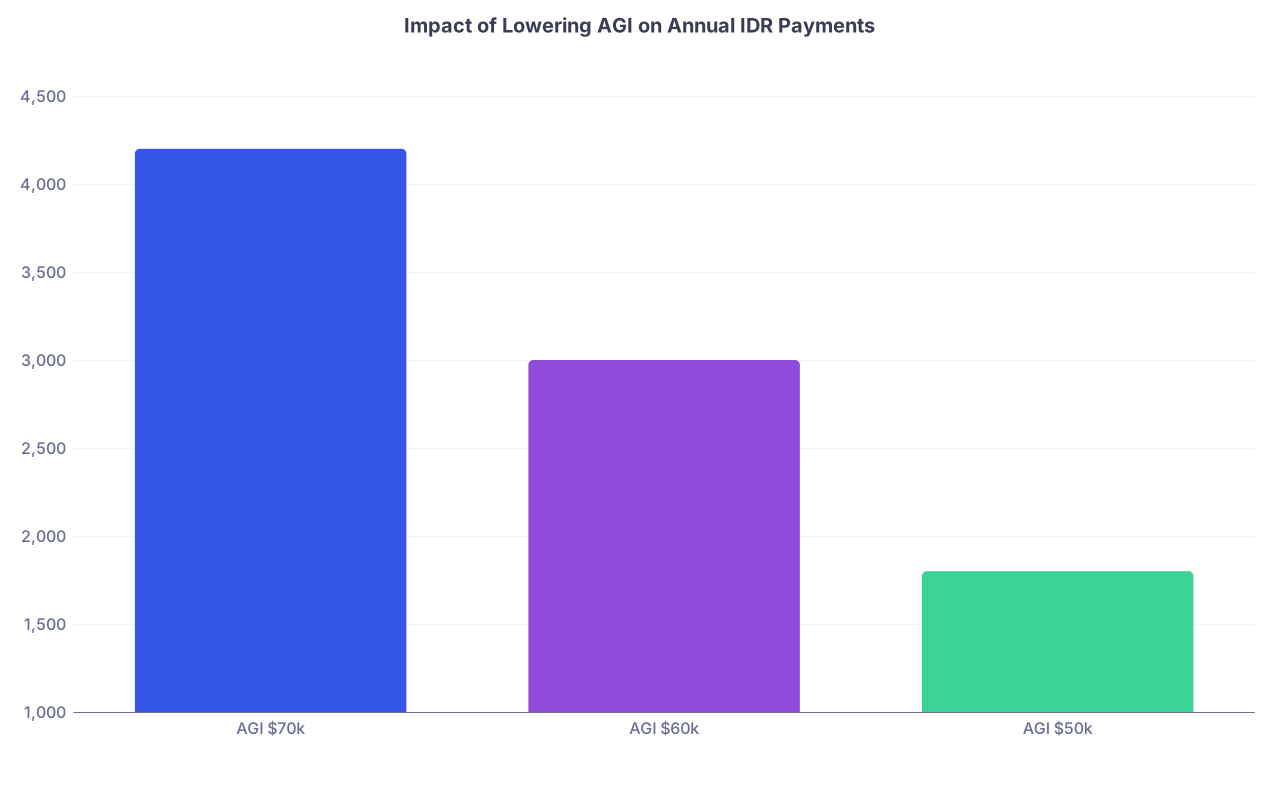
| Category | Value |
|---|---|
| AGI $70k | 4200 |
| AGI $60k | 3000 |
| AGI $50k | 1800 |
(Example PAYE/SAVE-style payments with 10% of discretionary income, single filer, using rough poverty line estimates.)
Step 4: Early PGY3 – Strategy Shift and Income Changes
PGY3 is not PGY2. You are closer to attending income, you may be chief, you might be moonlighting aggressively, and you are starting to see your post-residency path clearly.
Month 1–2 of PGY3: Reassess Your Long-Term Path
At this point you should have a realistic answer to:
- Am I aiming for PSLF with a nonprofit attending job?
- Am I planning to refinance and crush the loans as a high-earning attending?
- Am I somewhere in-between (maybe PSLF, maybe not, still deciding)?
Your answer drives what you do this year.
If PSLF is your path:
- Priority → maximize qualifying payments while keeping them as low as possible.
- So in PGY3:
- Stay on SAVE/PAYE/IBR.
- Keep your AGI reasonable via pre-tax contributions.
- Do not switch to Standard or extended plans.
- Ensure every 12 months you are submitting the PSLF Employment Certification Form.
If refinance-and-payoff is your path:
- Priority → preserve flexibility until you have an attending contract in hand.
- So in PGY3:
- Usually still stay on SAVE/IBR/PAYE through the end of training.
- Avoid private refinancing during residency unless:
- You are absolutely sure you will not use PSLF, and
- The rate drop is massive, and
- You have a stable emergency fund.
- Start shopping refinance lenders in the last 6–9 months of PGY3 / fellowship.
Month 3–4 of PGY3: Adjust for Moonlighting and Spouse Income
This is where many residents get surprised.
IDR payments are based on household AGI if you:
- File Married Filing Jointly, or
- Are on a plan (like SAVE) that looks at household unless you certify separation.
At this point you should:
If married or engaged:
- Forecast whether next year’s tax return will be:
- Single.
- Married Filing Jointly.
- Married Filing Separately.
- Run simple calculators (there are many online) for:
- Tax difference MFJ vs MFS.
- IDR payment difference MFJ vs MFS.
- Forecast whether next year’s tax return will be:
If moonlighting significantly:
- Decide whether extra pre-tax contributions are justified to offset the higher AGI.
- Remember: a $10,000 pre-tax contribution that lowers your IDR payment by $1,000 next year is only clearly “worth it” if you are in a forgiveness/PSLF mindset.
You are not trying to play every angle. You are trying to align your tax decisions with your loan strategy.
Step 5: Annual Checkup Structure – PGY2 and PGY3
Once per year, ideally the same month each year, run a full “loan annual exam.” Here is the structure I recommend.
Part 1 – Snapshot (15–20 minutes)
At this point you should:
- Update a one-page summary (Google Doc or spreadsheet) with:
- Total federal loan balance.
- Total private loan balance.
- Average interest rate(s).
- Current repayment plan.
- Current IDR payment and recert date.
- PSLF payment count (if applicable).
- Compare to last year’s snapshot:
- Balance change (up, down, flat).
- Payment change.
Seeing the trajectory in one place is often the wake-up call that intern-year autopilot will not cut it.
Part 2 – Plan Eligibility Check (15–20 minutes)
For PGY2 and PGY3, you should verify:
- Still eligible for your chosen IDR plan?
PAYE and certain legacy plans have eligibility rules. If your income or filing status changed, eligibility may shift. - Would switching plans help?
- PAYE → SAVE for lower payments and interest subsidy.
- IBR → SAVE in many cases.
- Any loans still outside the system?
- Old FFEL loans not consolidated.
- Perkins left unmanaged.
If PSLF is in your future at all, all federal loans that can be Direct should be in Direct form and on an IDR plan. Unmanaged outliers are expensive.
Part 3 – PSLF and Employment Check (10–15 minutes)
If PSLF is relevant:
- Confirm:
- Your current program/hospital still counts (nonprofit or government).
- Your FTE status is ≥ 0.75–1.0 depending on contract.
- Submit or update your PSLF form:
- At least once per year, ideally each time you change employers.
- Verify:
- Servicer recognizes your employer.
- PSLF qualifying payment count looks logical (no big gaps).
If you discover a 6-month stretch where your employer was not recognized or your plan was wrong, fix it now while you still remember details. Not five years from now.
Step 6: Final Year of Training – PGY3 Endgame Adjustments
The last 6–9 months of PGY3 are where you align loans with your attending contract.
6–9 Months Before Graduation
At this point you should:
Clarify your post-residency job:
- Nonprofit academic or hospital system?
- Private practice group?
- Mixed or uncertain?
Split into two paths.
Path A – PSLF Continues as an Attending
- Confirm:
- Future employer is PSLF-eligible.
- Your role is full-time.
- Your move:
- Stay on SAVE/PAYE/IBR.
- Time your IDR recertification strategically:
- If you can recertify using resident income right before attendingship, you can often lock in 12 months of lower payments while earning attending money. That is a big PSLF win.
- Avoid private refinancing.
Path B – No PSLF, Planning to Refinance
- Start lender research:
- Compare 3–5 reputable refinance companies.
- Look at:
- Fixed vs variable rates.
- Resident/attending refinance policies.
- Forbearance options in case of job disruption.
- Do not refinance before you:
- Have a signed attending contract, and
- Have 3–6 months of expenses saved.
- Plan your timing:
- Many residents refinance within the first 3–6 months of attending income.
- Until then, remain on SAVE/IBR/PAYE.

Step 7: What You Should Schedule – Concrete Calendar Items
Let us convert all this theory into actual recurring tasks, PGY2–PG3.
At the Start of PGY2 (Once)
- 60–90 minutes — Baseline Audit
- Gather all loans and servicer info.
- Confirm repayment plan.
- Check PSLF status and payment count.
- Decide on consolidation if needed.
- Document everything in a one-page summary.
Every 3 Months (PGY2–PGY3)
- 10–15 minutes — Quarterly Vitals Check
- Log into servicer.
- Confirm autopay and plan.
- Skim for anomalies in payments/forbearances.
- For PSLF: confirm employer + payment count logic.
Set these for, say, July 15, October 15, January 15, April 15. Same days every year.
3–4 Months Before IDR Recertification (Annually)
- 30–45 minutes — IDR + Tax Strategy Check
- Confirm recert date.
- Estimate AGI and any moonlighting.
- Adjust retirement contributions if helpful.
- Decide on MFJ vs MFS (if applicable) for next year.
Once Per Year (Any Consistent Month)
- 45–60 minutes — Annual Loan Exam
- Update your one-page summary.
- Compare year-over-year progress.
- Reassess long-term plan (PSLF vs refinance).
- Submit PSLF form if using PSLF.
6–9 Months Before the End of PGY3
- 60 minutes — Attending Transition Session
- Review signed job contract.
- Decide PSLF vs refinance path concretely.
- If PSLF:
- Plan IDR recertification to lock in resident income if possible.
- If refinance:
- Shortlist lenders and prep documents (pay stubs, proof of employment, etc.).
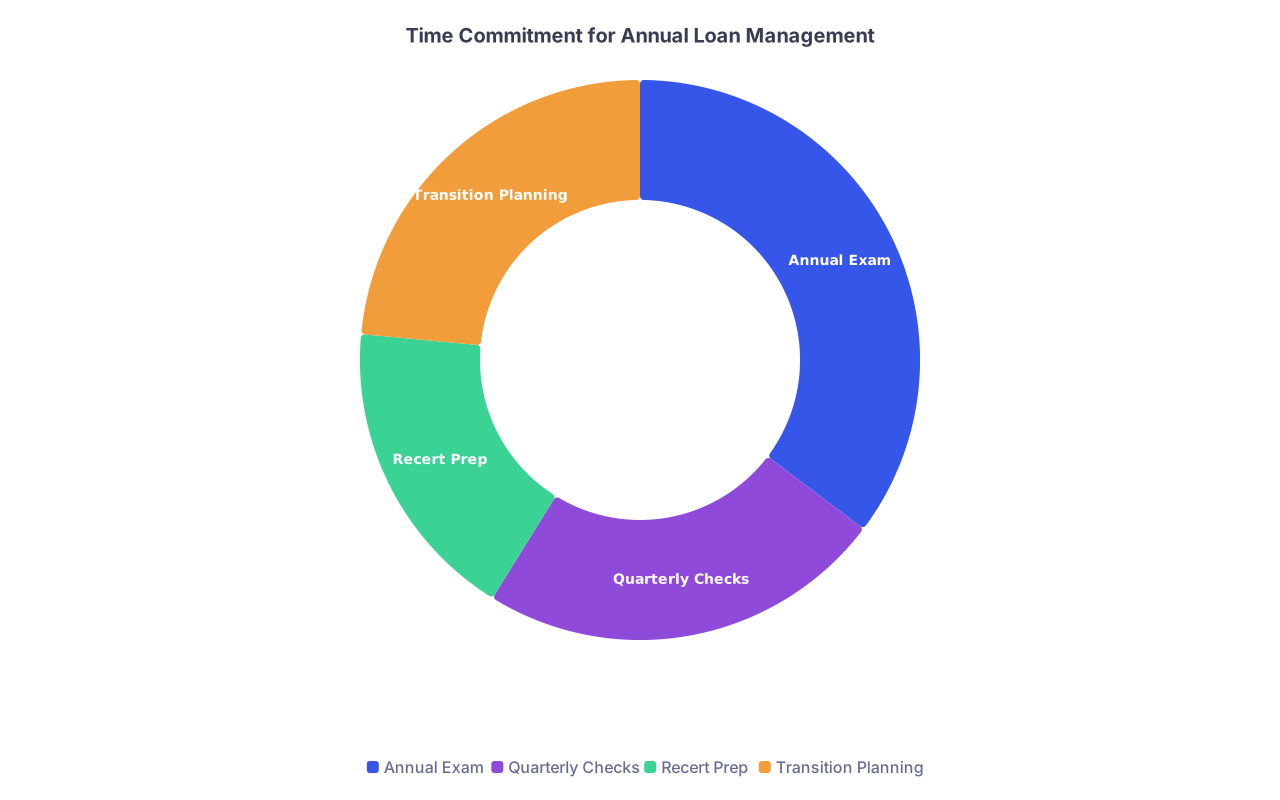
| Category | Value |
|---|---|
| Annual Exam | 90 |
| Quarterly Checks | 60 |
| Recert Prep | 45 |
| Transition Planning | 60 |
(Approximate minutes per year. This is not that much time. The impact is huge.)
Final Thoughts: What Actually Matters PGY2–PGY3
By the end of PGY3, three things should be true:
- Your repayment plan and PSLF/refinance path are explicit, not vague intentions. You know which you are doing and why.
- Your IDR payments are based on accurate, optimized income, not random old W-2s or ignored moonlighting surprises.
- Your annual and quarterly checkups are on your calendar, and your loans are something you manage briefly and intentionally, not something that ambushes you in your first attending year.
Do not treat loans like background noise. Treat them like a complex chronic condition with scheduled follow-ups. PGY2–PGY3 is exactly when you either cement a smart path—or lock in years of avoidable cost.