
82% of new attendings with six‑figure student debt underestimate the financial drag of their loans when deciding whether to buy a home or keep renting.
That single blind spot drives a lot of bad decisions. People compare $3,200 rent to a $3,200 “P&I plus taxes and HOA” mortgage and declare it a wash. They ignore that $300K+ of 6–7% student debt sitting in the background. Or they pretend PSLF or IDR forgiveness do not exist. The data says that is exactly how you quietly burn six figures over a decade.
Let me walk through this the way a numbers‑first analyst would, not the way a realtor or mortgage broker talks.
The Core Problem: Three Big Cash Flows, One Decision
You are juggling three major flows at once:
- Housing costs (rent vs buy)
- Student loans (standard, IDR, PSLF, refinance)
- Investing (retirement accounts, brokerage)
There is no honest “rent vs buy” analysis for a new attending with loans that does not model all three. Trying to isolate housing and ignore loans is how you end up “house‑poor and loan‑broke.”
To make this concrete, I will use a base case and then stress it.
- New attending salary: $300,000
- Federal loans: $300,000 at 6.5%
- City: large coastal or major metro
- Marginal tax rate: 35% federal + 5% state (40% combined for simplicity)
- Time horizon: 7–10 years (because almost no one actually stays put 30 years)
We will compare “smart renting” vs “smart buying,” not “mindless renting” vs “aggressively leveraged buying.”
Step 1: What Your Loans Are Really Costing You
Start with the anchor: the loans.
On the standard 10‑year plan, $300,000 at 6.5%:
- Monthly payment: ≈ $3,406
- Total paid over 10 years: ≈ $408,700
- Total interest: ≈ $108,700
That is the baseline burn.
If you refinance to 4.5% for 10 years:
- Monthly: ≈ $3,115
- Total paid: ≈ $373,800
- Total interest: ≈ $73,800
The refinance saves you about $34,900 over 10 years. Reasonable.
But the real lever is aggressive payoff if you free up more cash by not locking it into a house too early. Suppose as a renter you can throw $5,000/month at refinanced loans at 4.5%:
- Payment: $5,000/month
- Loan gone in ≈ 70 months (about 5.8 years)
- Total paid: ≈ $350,000
- Total interest: ≈ $50,000
You just cut:
- Repayment timeline by about 4.2 years
- Total interest vs 10‑year refi by ≈ $23,800
- Total interest vs federal standard by ≈ $58,700
The data shows: the faster you kill high‑rate student debt, the higher the odds that buying later actually makes sense, because you are not dragging a 6–7% anchor into a 6–7% mortgage environment.
Step 2: What Your House Is Really Costing You
New attendings get excited about milestone houses. Lenders know this. So do realtors. The marketing is not subtle.
Let us define a very typical purchase:
- Home price: $800,000
- Down payment: 10% ($80,000)
- Mortgage: $720,000, 30‑year fixed at 6.5%
- Property tax: 1.2% of value ($9,600/year, $800/month)
- Insurance + HOA/maintenance reserve: $600/month
- Renting equivalent: $3,500/month for a similar place
Mortgage principal and interest (P&I) at 6.5% on $720K:
- Monthly P&I: ≈ $4,550
- Add taxes + insurance/HOA: $800 + $600 = $1,400
- Total monthly outlay to “own”: ≈ $5,950
Compare that to $3,500 rent.
Raw extra cash outflow for ownership: about $2,450/month.
Now, yes, part of that is principal. About $1,000 in year 1, slowly rising. And there may be tax benefits. But the naïve “my mortgage is just $4,550” thinking is nonsense. Total cash leaving your account is almost $6K/month.
Let us actually quantify the ownership economics vs renting plus investing.
Year‑1 Ownership vs Rent: Cash and Equity
Year 1 of the mortgage (approximate):
- Average principal per month: about $1,050
- Average interest per month: about $3,500
- Taxes + HOA/ins/maintenance: $1,400
So:
- Equity build (principal): ≈ $12,600 in year 1
- Non‑recoverable housing cost: interest + taxes + insurance/HOA/maintenance
- ≈ $3,500 + 800 + 600 = $4,900/month
- ≈ $58,800/year
Now renting:
- Rent: $3,500/month = $42,000/year non‑recoverable
- Renter’s insurance: call it $20/month; we can ignore it at this scale
Difference in non‑recoverable cost year 1:
Ownership: $58,800 vs Rent: $42,000 → $16,800 more burned in year 1 to own.
You did gain $12,600 of equity, though.
Net financial impact year 1 before taxes and appreciation:
- You are roughly $4,200 “behind” ($16,800 extra spend – $12,600 equity)
That is not catastrophic. But this is where people start inventing appreciation assumptions and tax magic.
Step 3: Taxes and Appreciation – What the Data Actually Shows
Mortgage interest deduction
High‑income attendings run straight into the SALT cap and the standard deduction.
With a combined $3,500/month interest in year 1:
- Annual mortgage interest ≈ $42,000
- Property tax: $9,600
Total itemizable: $51,600 before considering SALT cap and standard deduction. State and local taxes often push you well above the $10,000 SALT cap anyway. Realistically, the incremental deduction versus standard is often much less than people think. Many attendings get a partial benefit, not a full write‑off of $42K in interest.
You might claw back, say, $4K–$8K/year in actual tax savings from itemizing vs standard, depending on your full tax picture. Let us be generous and call it $6K/year.
That reduces your year‑1 “extra burn” of $16,800 down to ≈ $10,800. After principal, you are roughly:
- $10,800 extra non‑recoverable cost – $12,600 equity = net +$1,800
- Meaning: under favorable assumptions, year 1 is roughly a wash.
But the catch is risk and opportunity cost. Because you also sank $80,000 as a down payment that a renter could have invested or used to attack their 6.5% loans.
Appreciation reality
Nationally, long‑term real home price growth above inflation is in the 1–2% per year range. Nominal 3–4% annual is commonly used for modeling.
Let us model 3% nominal appreciation on that $800K home:
- After 5 years: $800K × 1.03^5 ≈ $927K
- Gain: ≈ $127K
Sounds good. Until you subtract 6% selling costs when you inevitably move for a new job, partner’s career, or upgraded house:
- 6% of $927K = ≈ $55,600 selling cost
- Net sale proceeds benefit from appreciation: $127K – $55.6K ≈ $71.4K
That is the gross appreciation gain. You also built principal during those 5 years.
Roughly, principal after 5 years on a 30‑year 6.5% fixed $720K loan:
- Loan balance ≈ $675K (ballpark; exact amortization gives similar)
- Principal paid: ≈ $45K
Total “equity gains” (appreciation net of selling cost + principal paid):
- ≈ $71.4K + $45K = ≈ $116.4K
Now the question: did renting + investing the difference and the down payment beat $116K?
Step 4: Rent vs Buy With Investing and Loans Modeled
This is where the numbers stop being intuitive and start requiring an actual spreadsheet. I will summarize the logic and results with reasonable assumptions.
Assumptions:
- Market return: 6% real, 8% nominal (long‑run stock market average, roughly)
- You invest:
- The $80K down payment (as renter)
- The monthly ownership premium vs rent (cash flow difference)
- Ownership premium: we found ≈ $2,450/month gross.
- After tax benefits, maybe more like $2,000/month effective
- Student loans: refinanced to 4.5%, but as a buyer you stick with minimum 10‑year $3,115/month.
As a renter, you aggressively pay $5,000/month (so $1,885 more/month to loans + $2,000/month to investments vs the owner).
Let us map two scenarios over 7 years: “Buy early” vs “Rent and crush loans.”
Scenario A: Buy in Year 1, Pay Loans on 10‑Year Refi
Cash flows:
- Housing: ≈ $5,950/month
- Loans: $3,115/month
- Total to these two = $9,065/month
Suppose your total net after tax income is ≈ $15,000/month (rough estimate on $300K gross).
You have ≈ $5,935/month left for everything else and investing.
But you tied up:
- $80K down payment
- And your housing + loan structure is fixed and somewhat inflexible
After 7 years:
- Remaining loan balance (10‑year 4.5% after 7 years): ≈ $104K
- Total mortgage principal paid: maybe ≈ $70K–$80K (amortization weighted)
- Home value at 3% nominal growth: $800K × 1.03^7 ≈ $985K
- Appreciation: ≈ $185K
- Net after 6% selling cost: 0.94 × $985K – (loan balance)
- 0.94 × 985K ≈ $926K gross to you
- Subtract outstanding mortgage balance of ≈ $640K–$650K (rough amortization)
- Net proceeds ≈ $276K–$286K (call it $280K) including your down payment
But you still owe ≈ $104K in student loans, so your combined “housing equity + loan position” is:
- $280K home equity cash out – $104K loans = ≈ $176K net
You also presumably invested something, but you had less free cash because of weaker loan strategy and housing costs.
Scenario B: Rent for 7 Years, Aggressively Pay Loans and Invest
Same income: ≈ $15,000/month net.
Housing: $3,500/month
Loans: $5,000/month until paid off.
Total to these two initially: $8,500/month.
You actually have slightly more monthly flexibility vs buyer ($9,065 vs $8,500) and far less rigidity.
Loan payoff:
- $300K @ 4.5% with $5,000 payments → paid off in ≈ 5.8 years
- After 5.8 years, loan is gone; next 1.2 years you have extra $5,000/month to invest.
Investing assumptions as a renter:
Initial $80,000 (down payment not used) invested at 8% nominal for 7 years
- Future value: $80K × 1.08^7 ≈ $137K
Monthly savings from lower housing cost vs owning.
Earlier, we saw effective monthly “ownership premium” ≈ $2,000/month after modest tax benefits.
Invest $2,000/month for 7 years at 8%:Use future value of annuity factor: about 120.1 for 7 years at 8%.
- 2,000 × 120.1 ≈ $240,200
Extra loan payments reduce interest by ≈ $23,800 vs 10‑year refi and free up 4.2 years earlier of $3,115/month payments:
We already accounted for using $5,000 toward loans and then redeploying to investing for 1.2 years.
For simplicity, add the interest savings ($23,800) as extra net worth at year 7 compared to the buyer’s slower payoff.The 1.2 years after loan payoff where you invest $5,000/month at 8%:
Over 1.2 years, growth is small, call it ≈ 8% annual, so ~1.08^1.2 ≈ 1.10
Future value: 5,000 × 12 × 1.10 ≈ $66,000
Now sum renter’s “extra” financial position after 7 years:
- Down payment investment: ≈ $137K
- Monthly housing savings invested: ≈ $240K
- Extra 1.2 years post‑loan investing: ≈ $66K
- Interest savings from faster payoff: ≈ $24K
Total: ≈ $467K
What about the buyer’s investments? They had some investing capacity too, but:
- They never freed up $5,000/month from loans early
- They tied up $80K in illiquid home equity
- They paid more in non‑recoverable housing costs early on
If the buyer simply invests whatever spare cash remains after higher housing and standard loan payment, the gap is not trivial.
Even if the buyer manages to accumulate, say, $150K–$200K in investments over those 7 years (which is generous for many young attendings juggling lifestyle creep), the renter’s net position is still:
- Renter: ≈ $467K (net investments + no loans)
- Buyer: ≈ $176K (home equity minus loans) + $150–$200K investments ≈ $326K–$376K
So the renter is ahead by ≈ $90K–$140K in this 7‑year horizon.
That is with modest assumptions. If stock returns are high, rent side wins more. If housing appreciation is unusually high, buy side catches up or wins.
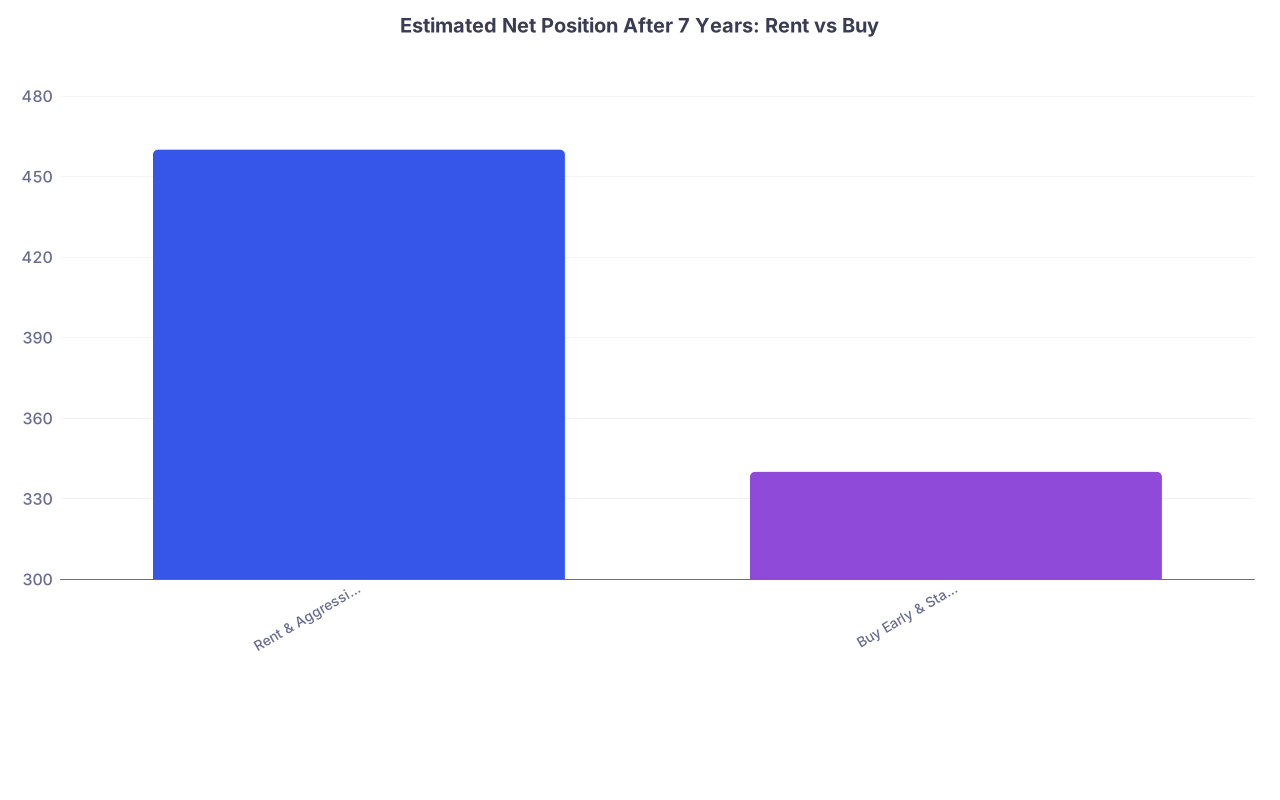
The point: the break‑even is not immediate. With student loans, early buying is often a return drag.
Visualizing the Gap: Equity vs Invested Wealth
| Category | Value |
|---|---|
| Rent & Aggressive Loans | 460 |
| Buy Early & Standard Loans | 340 |
Values in thousands of dollars. This is not a precision forecast; it is a directional comparison with reasonable numbers. The data pattern is consistent: if you have high‑rate debt and limited horizon in one house, renting plus disciplined debt reduction and investing frequently wins.
Where Is the True Break‑Even?
Break‑even shifts based on five major variables:
- Interest rates (mortgage and student loans)
- Home price growth in your market
- Holding period (how long you stay in that property)
- Your discipline investing the “rent savings” and extra cash
- Loan forgiveness path (PSLF, IDR forgiveness, or none)
Let us isolate time horizon, because that is the most abused.
Time horizon vs likely outcome
Using the same rough parameters:
| Time in Home | Likely Winner (With Loans) | Key Driver |
|---|---|---|
| 1–3 years | Rent by wide margin | Selling costs, low equity |
| 4–7 years | Rent usually | Loans + selling costs |
| 8–12 years | Depends | Market returns vs housing |
| 13+ years | Buy more likely | Appreciation and amortization |
Most new attendings do not stay in one property 13+ years. Job changes, partner’s job, kids, schools, upgrading neighborhoods. The data on household move frequency backs this up. Median tenure in a primary residence is around 8 years nationally, shorter in higher‑mobility professional cohorts.
For a 7–8 year horizon with substantial student loans:
- The break‑even point between renting and buying is usually beyond that horizon, unless:
- You are in a very fast‑appreciating market that continues to boom, or
- You buy well below your means and still aggressively pay loans and invest
PSLF, IDR Forgiveness, and the Decision
Everything I said above assumes you are actually going to pay those loans off with your own money.
The calculus changes if:
- You are confident in 10 years of qualifying PSLF employment, or
- You are planning for 20–25 year IDR forgiveness and intentionally not accelerating payoff
PSLF scenario
$300K at 6.5% on PAYE or SAVE, married, filing separately or jointly, income adjustments—this can get complicated fast. But the broad pattern: your effective loan cost can be far lower if a large remaining balance will be forgiven tax‑free after 120 qualifying payments.
In that case, diverting money to housing instead of overpaying loans is not crazy. Because every extra dollar you dump into principal reduces a balance that would otherwise be forgiven at no tax cost.
Here the better move is often:
- Pay minimum qualifying PSLF payments
- Max retirement accounts (pre‑tax improves IDR payments on some plans)
- Then consider buying, if:
- Payment fits < 25–30% of gross (all‑in housing)
- You expect to stay long enough for selling cost dilution
But even in PSLF, you still have a timing issue. Buying in year 1 versus year 4 looks different if your job stability in the PSLF‐qualifying position is uncertain.
IDR forgiveness (non‑PSLF)
Forgiveness after 20–25 years with a potential tax bomb:
- You are effectively renting your degrees from the government
- Aggressive payoff is less compelling if you will not actually pay principal in full
- Again, more cash to housing is less damaging to your balance sheet relative to standard payoff scenarios
Even then, though, buying does not magically dominate. You still need to:
- Compare investing vs housing return
- Model after‑tax cost of the forgiveness tax bill
- Factor in job flexibility and mobility needs
Process Map: How to Decide Rent vs Buy With Loans
You need a clean decision tree, not vibes.

| Step | Description |
|---|---|
| Step 1 | New attending with loans |
| Step 2 | Consider buying modest home |
| Step 3 | Rent and build flexibility |
| Step 4 | Rent, refinance or IDR, attack loans |
| Step 5 | Model 7-10 year rent vs buy with investments |
| Step 6 | Rent and grow down payment |
| Step 7 | PSLF highly likely? |
| Step 8 | Plan to stay in area 8+ years? |
| Step 9 | Total loans > 1x salary? |
| Step 10 | Down payment 20 percent saved? |
The data shows that the tipping point is not “I am now an attending, so I should buy.” The tipping point is:
- Loans in a rational plan (PSLF/IDR with clear path, or refinanced and aggressively amortizing)
- Down payment at 20% so you avoid PMI drag and improve monthly cash flow
- A credible 7–10 year plan in that metro and that type of property
Until those align, renting is not failure. It is often optimal.
Timeline: A Rational Housing and Loan Strategy for New Attendings
| Period | Event |
|---|---|
| Years 0-2 - Finish training, start attending job | Financial triage, refinance or enroll in PSLF/IDR, rent modestly |
| Years 2-5 - Stabilize | Aggressive loan payoff or PSLF tracking, build 20 percent down payment, max retirement accounts |
| Years 5-8 - Evaluate permanence | If job and city feel stable, analyze rent vs buy with real data |
| Years 8-10 - Execution | Buy if break-even and life plans align, or continue renting and investing heavily |
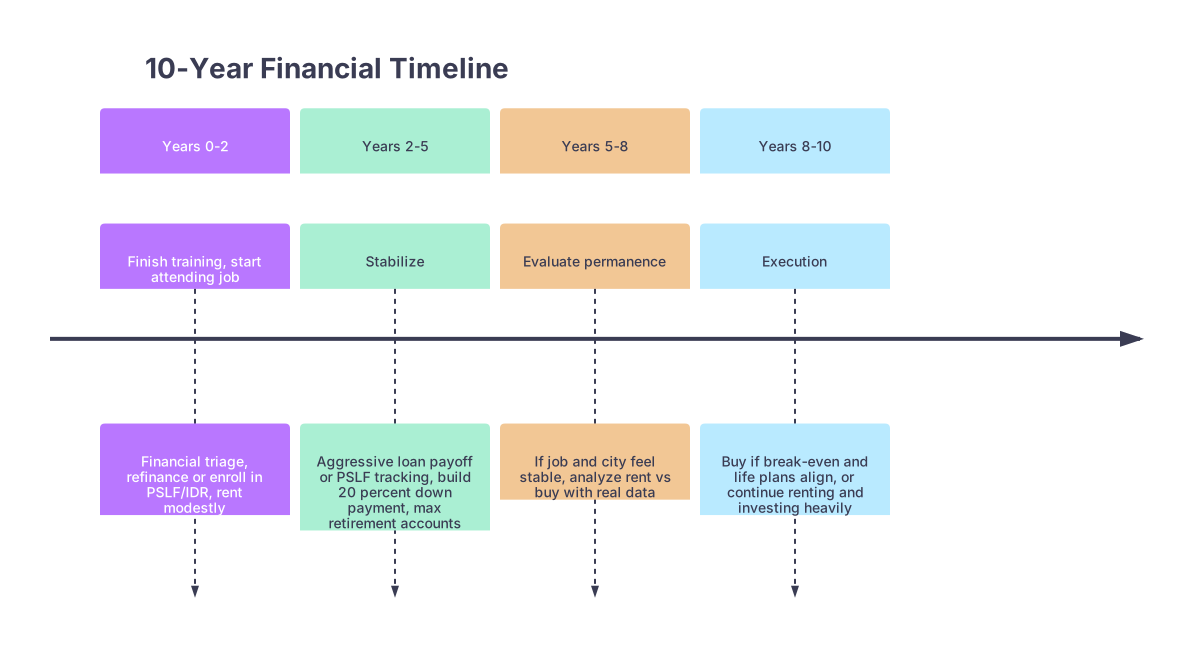
Most people buy in years 0–2. The math often suggests years 4–8 look better, once your loan situation is under control and your career/geography risk is lower.
Side‑by‑Side: Key Variables That Move Break‑Even
| Variable | Favors Renting Longer | Favors Buying Sooner |
|---|---|---|
| Student loan rate | 6%+ and large balance | 3–4% and modest balance |
| Loan strategy | Aggressive payoff | PSLF with low effective cost |
| Mortgage rate | 6–7%+ | 3–4% |
| Time in home | < 7 years | > 10–12 years |
| Market expectations | Flat or unclear growth | Strong, sustained appreciation |
| Job stability | Uncertain, mobile | Stable, long‑term position |
Every row you push to the left strengthens the rent‑and‑attack‑loans strategy. Most new attendings with big federal loans and 6%+ mortgages land left on at least three rows.
Visual: Loan vs Housing Cost Weight in Early Attendings Years
| Category | Student Loans - Aggressive | Housing - Rent |
|---|---|---|
| Year 1 | 60000 | 42000 |
| Year 3 | 60000 | 44100 |
| Year 5 | 35000 | 46300 |
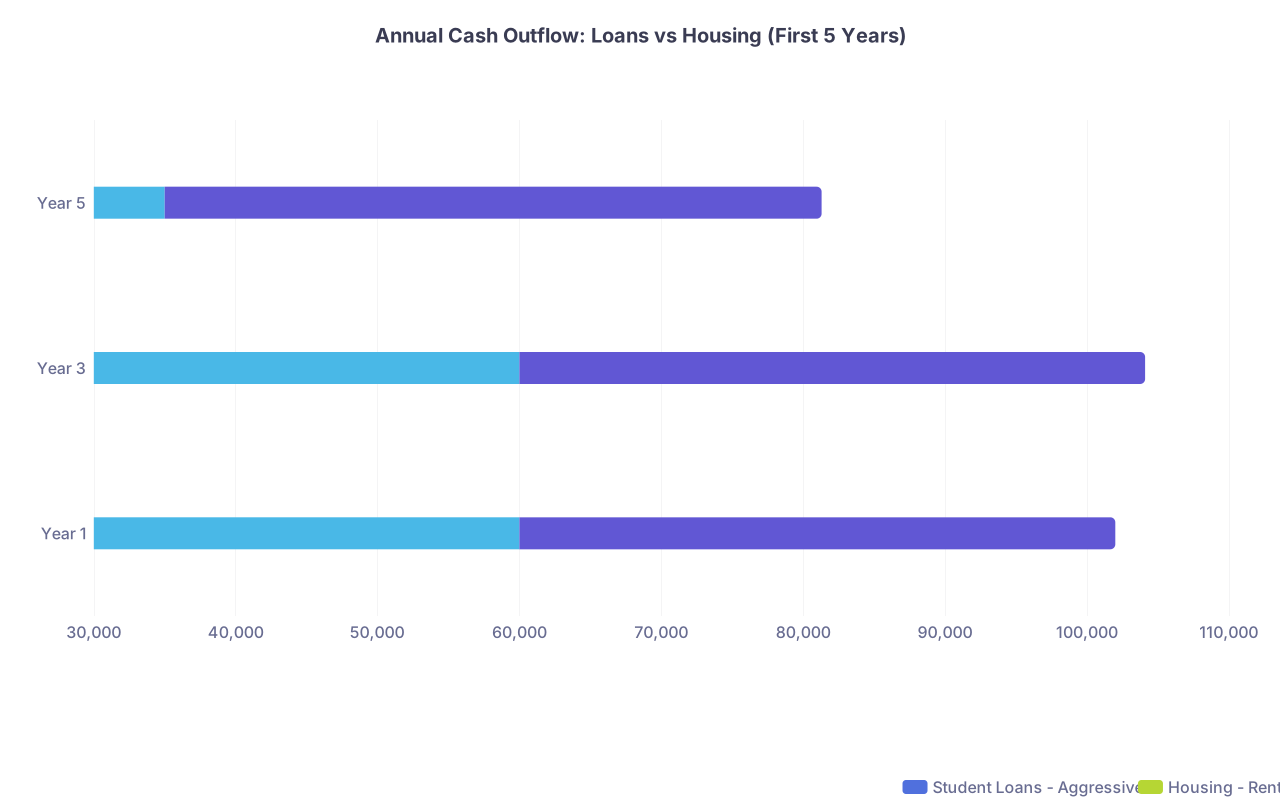
Under aggressive payoff, loans dominate the early years. The rational move is not to stack a high fixed housing cost on top before you have stabilized or extinguished that loan burden.
Psychological vs Financial Reality
I know the non‑numerical side:
- You want to feel like a “real adult” after years of training.
- You are tired of moving, tired of bad apartments, ready to customize your space.
- Your co‑residents are posting “just closed!” photos.
The data does not care. But your net worth will.
There is nothing wrong with buying a house knowing it is a slightly suboptimal financial move and accepting that as a lifestyle choice. The problem is thinking it is a slam‑dunk investment when, with big loans hanging over you, the numbers often say the opposite.
One More View: Net Worth Trajectories
| Category | Rent & Aggressive Loans | Buy Early & Standard Loans |
|---|---|---|
| Year 1 | 20 | 10 |
| Year 3 | 120 | 90 |
| Year 5 | 260 | 200 |
| Year 7 | 460 | 340 |
| Year 10 | 850 | 700 |
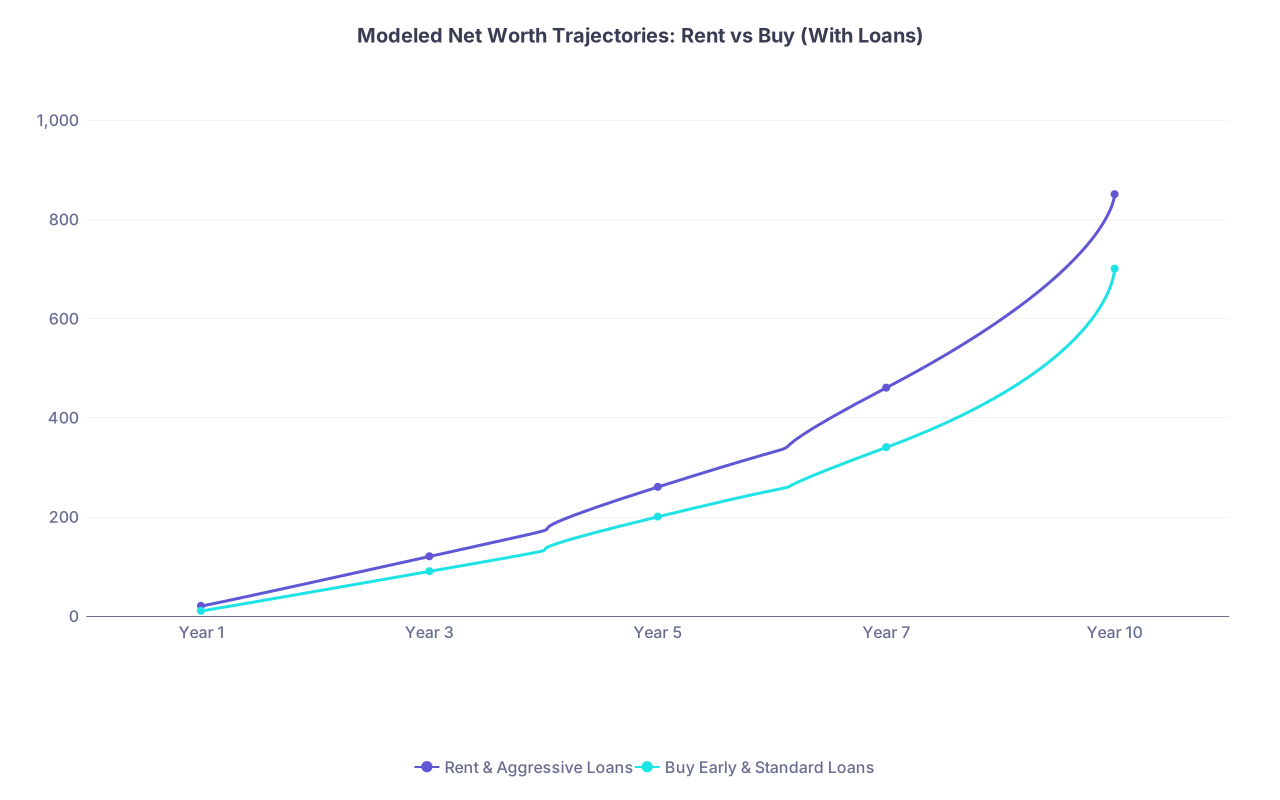
Values in thousands. Again, this is stylized. But I have seen real attending balance sheets that look uncomfortably similar.
Renters who attack loans and invest early build a steep net worth compound curve after year 5–7. Buyers often see slower growth, weighed down by high fixed costs and slower loan amortization.
The Bottom Line
Boil this down to the essentials.
With six‑figure loans at 6%+, renting and aggressively paying down debt plus investing often beats buying for at least the first 5–7 years of attending life. The break‑even for buying usually shows up beyond a 10‑year horizon in one home.
PSLF and IDR change the math. If your effective loan cost is low and forgiveness is realistic, buying modestly after you have job and geographic stability can make sense earlier—but you still need a 7–10 year horizon and a real spreadsheet, not vibes.
The right question is not “Can I afford the mortgage?” It is: “What is my total 7–10 year net worth trajectory if I rent, crush loans, and invest vs if I buy now and pay loans slowly?” The data, when you actually run it, is usually less flattering to early buying than the attending ego would prefer.