
The default advice to “just pick up more call to pay down loans” is lazy and usually wrong.
If you are a med student, resident, or early attending trying to crush loans, you need a hard, quantitative framework to decide:
Is one more hour of extra call better than one more hour on a side gig?
Not vibes. Not guilt. Not what your co-resident is doing. Math.
This is that framework.
The Core Problem: You Only Have 3 Currencies
You do not just have dollars. You have:
- Money
- Time
- Energy / Sanity
Hospitals will happily rent all three from you for cheap. Side gigs can, if chosen intelligently, pay you more per unit of all three.
The key question you must answer for every option:
“How many after-tax, after-expense, realistic dollars does this give me per hour of my life that I actually lose?”
If you do not calculate that, you are flying blind.
Step 1: Know Your Real Loan Target (Not the Sticker Number)
Before you compare side gig vs extra call, you need a clear payoff goal. “I want to pay them off faster” is useless.
You need:
- Loan balance
- Interest rate
- Time horizon
- Repayment plan constraints (IDR, PSLF, private refinance)
A. Get your numbers in one place
- Total federal loans: Direct, Grad PLUS, etc.
- Any private loans: balances + interest rates.
- Current payment plan:
- PSLF?
- SAVE/REPAYE?
- Standard 10-year?
- Refinance?
If you are in PSLF, your goal is not maximizing payoff. It is maximizing forgiveness while not drowning. In that case, side gig vs call math focuses on life improvement and savings, not extra payoff.
For everyone else, you are effectively answering:
“How much extra per month gets these loans gone in X years?”
Use a simple amortization calculator later. For now, grasp the principle:
- Every extra $100 applied early to a 6–7% loan shaves a surprising amount of interest.
- But only if those dollars are actually extra, not pretend (ignored taxes, missed expenses, etc.).
Step 2: Calculate Your Real Hourly Rate For Extra Call
Most residents and attendings wildly overestimate this number.
You are not paid “$150/hour for moonlighting” if:
- You sit for 3 hours unpaid before work starts.
- You drive 45 minutes each way.
- You are taxed at 30–40%.
- You get destroyed overnight and lose all productivity the next day.
We are measuring effective hourly rate, not the fantasy rate.
A. The formula
For any extra call / moonlighting shift:
Effective Hourly Rate (EHR)
= (Gross shift pay – Taxes – Direct costs – Realistic fatigue cost) ÷ Total hours lost
Where:
- Gross shift pay = what is on the contract.
- Taxes = marginal tax rate * moonlighting income.
- Direct costs = gas, parking, childcare, meals, licensing fees if unique to that job.
- Total hours lost = clinical hours + commute + charting + recovery penalty.
- Fatigue cost = value of lost next-day hours if you are non-functional.
Let me walk it concretely.
B. Example: Resident extra call
You are a PGY-3 internal medicine resident.
- Extra 24-hour call: paid $500.
- You go in at 7 am, leave at 7:30 am next day.
- Commute each way: 30 minutes.
- You are useless the whole post-call day until 5 pm.
Compute it:
- Gross pay: $500
- Marginal tax rate (fed + state + FICA): assume 25%
- Taxes: $500 × 0.25 = $125
- Direct costs:
- Gas/parking/food: say $25
- Hours lost:
- In house: 24 hours
- Commute: 1 hour
- Post-call “dead zone”: 10 hours (7:30 am–5:30 pm where you cannot study, side gig, or be a functional human)
- Total hours = 24 + 1 + 10 = 35 hours
- Net dollars:
- $500 – $125 – $25 = $350
- Effective hourly rate:
- $350 ÷ 35 = $10/hour
Yes, you read that correctly. Ten dollars an hour for that extra call. I have seen worse.
Even if you say the post-call day is “free time,” ask yourself honestly:
Are you doing anything high-value with it? Or just surviving?
C. Attending moonlighting example
Now a hospitalist attending:
- Extra 12-hour shift: $1,800 flat.
- Commute total: 1 hour.
- You are moderately wrecked the next day but still function at 60%.
Run it:
- Gross: $1,800
- Tax: assume 35% marginal
- Taxes: $1,800 × 0.35 = $630
- Direct costs: meals/parking: say $40
- Hours lost:
- 12 hours in hospital
- 1 hour commute
- 4 “impaired” hours at home next day (too tired to do meaningful extra work)
- Total: 17 hours
- Net: $1,800 – $630 – $40 = $1,130
- EHR: $1,130 ÷ 17 ≈ $66/hour
Now we are talking about real money. But again: not $150/hour. More like $66/hour of your life.
Step 3: Calculate Your Real Hourly Rate For Side Gigs
Side gigs are not magic. Many are trash once you do the math.
Use the same formula:
Side Gig Effective Hourly Rate
= (Gross income – Taxes – Direct costs – Platform fees) ÷ (Real hours spent, including learning and admin)
The trap: early on, learning costs are huge. As you gain skill, your rate often climbs dramatically.
A. Common physician/trainee-compatible side gigs
Here is a quick snapshot before we go deeper.
| Option | Typical EHR Range | Startup Time | Scales Over Time? |
|---|---|---|---|
| Extra call / moonlighting | $10–$80/hr | None | Limited |
| Telehealth shifts | $40–$120/hr | Low | Limited |
| Expert witness chart review | $80–$250/hr | Medium | Limited |
| Clinical writing / reviewing | $25–$80/hr | Medium | Moderate |
| Tutoring / test prep | $30–$120/hr | Medium | Moderate |
| Niche consulting (med-legal, pharma) | $100–$300+/hr | High | High |
Now let us actually run a couple.
B. Example: USMLE/MCAT tutoring
You tutor for a test prep company.
- Listed rate: $50/hour.
- You prep 20 minutes before each session.
- You spend 10 minutes after session writing a summary.
- You spend an extra 30 minutes per week unpaid calling anxious parents/students.
Assume you tutor 5 hours per week.
- Gross: 5 hrs × $50 = $250/week
- Total time:
- Sessions: 5 hours
- Prep: 5 × 0.33 hr ≈ 1.7 hours
- Admin/parent calls: 0.5 hours
- Total ≈ 7.2 hours
- Pre-tax hourly: $250 ÷ 7.2 ≈ $34.7/hour
- Taxes: At 25%: net/week = $187.5
- Net EHR: $187.5 ÷ 7.2 ≈ $26/hour
Still better than that $10/hour extra call, and you are not getting crushed overnight.
But if you go independent later (direct clients, $100/hour, lower unpaid admin), that can jump:
- 5 hrs × $100 = $500
- Time: maybe 6 hours total
- After 25% tax: $375
- EHR ≈ $62/hour
C. Example: Telehealth shifts
You pick up video visits for a telehealth company.
- $90/hour logged in.
- 4-hour evening shift.
- 10 minutes unpaid per shift on chart clean-up, messages.
- No commute. You sit at home.
- Gross: 4 × $90 = $360
- Time: 4.2 hours
- Pre-tax hourly: $360 ÷ 4.2 ≈ $85.7/hour
- Taxes: Assume 35%: net = $234
- Net EHR: $234 ÷ 4.2 ≈ $55.7/hour
Note that your fatigue cost is much lower than an overnight call.
D. Compare visually
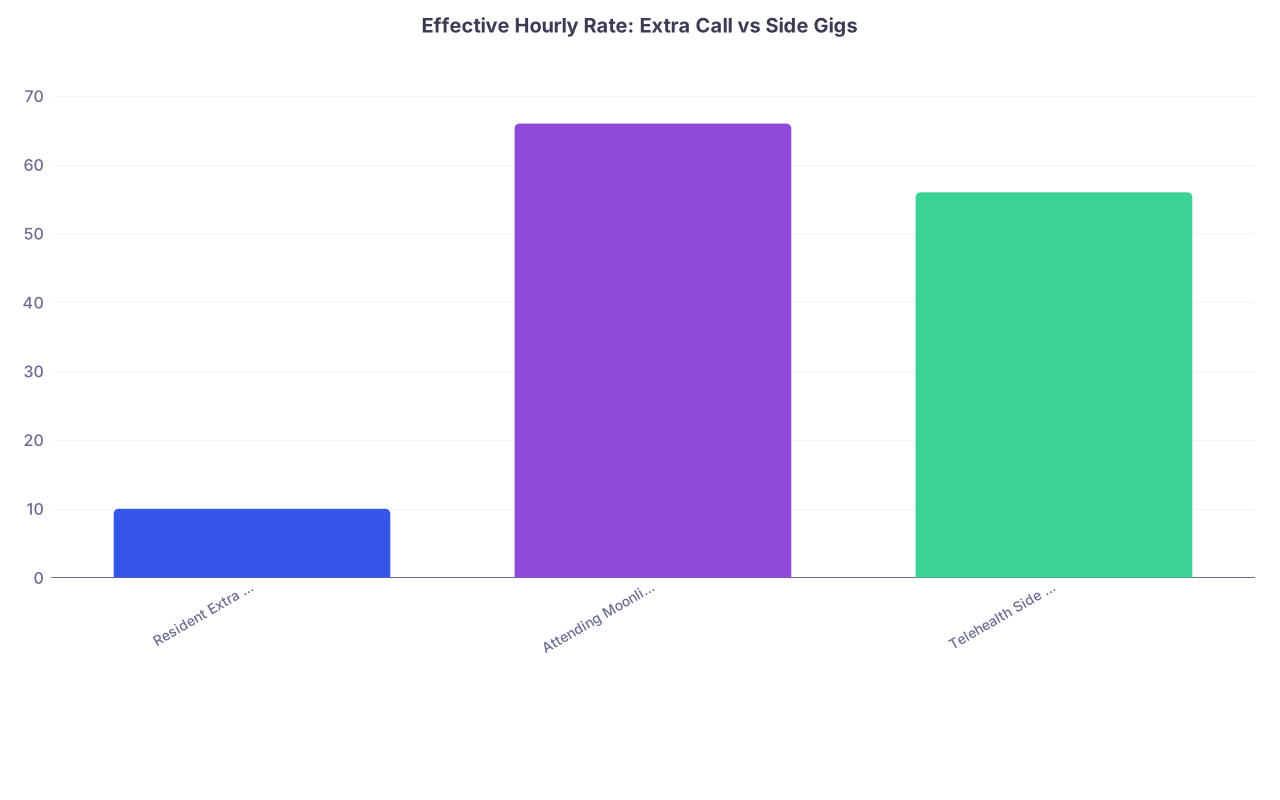
Let us compare three options: bad extra call, decent moonlighting, solid telehealth.
| Category | Value |
|---|---|
| Resident Extra Call | 10 |
| Attending Moonlighting | 66 |
| Telehealth Side Gig | 56 |
You see the problem: blindly taking extra call as a trainee is often the worst possible trade.
Step 4: Convert Hourly Rate Into Loan Impact
Now you care about loan payoff per hour, not just income per hour.
The pipeline is:
- Dollars per hour (net).
- Portion you actually send to loans (not to lifestyle creep).
- Interest rate of loans.
Let us keep it simple.
A. Define your “loan allocation rate”
Example:
- You commit: “Every extra dollar from side income or call goes 100% to loans.”
- Or more realistic: 70% to loans, 30% to savings / breathing room.
Let:
- EHR = effective hourly rate (after tax, full costs).
- L% = percent of that you will send to loans consistently.
Then:
Loan payoff dollars per hour = EHR × L%
Then estimate interest saved over full life of loan. Quick and dirty:
If your loan interest is 6%:
- Every $1,000 extra paid this year instead of at the end of a 10-year term saves you roughly $300–350 in interest. Earlier is better.
You do not need precision down to cents. Direction matters.
B. Example comparison (resident)
Resident choosing between:
- Extra call EHR: $10/hour
- Tutoring EHR: $26/hour
- Both: 100% of extra money goes to loans.
You have 20 hours/month of “extra work” capacity.
- All call:
- 20 hours × $10 = $200 to loans/month
- Over 12 months = $2,400 extra principal
- All tutoring:
- 20 hours × $26 = $520 to loans/month
- Over 12 months = $6,240 extra principal
Difference: $3,840 in year one.
Extend that over 3–4 years of residency and compounding, and you easily get five figures of extra interest saved.
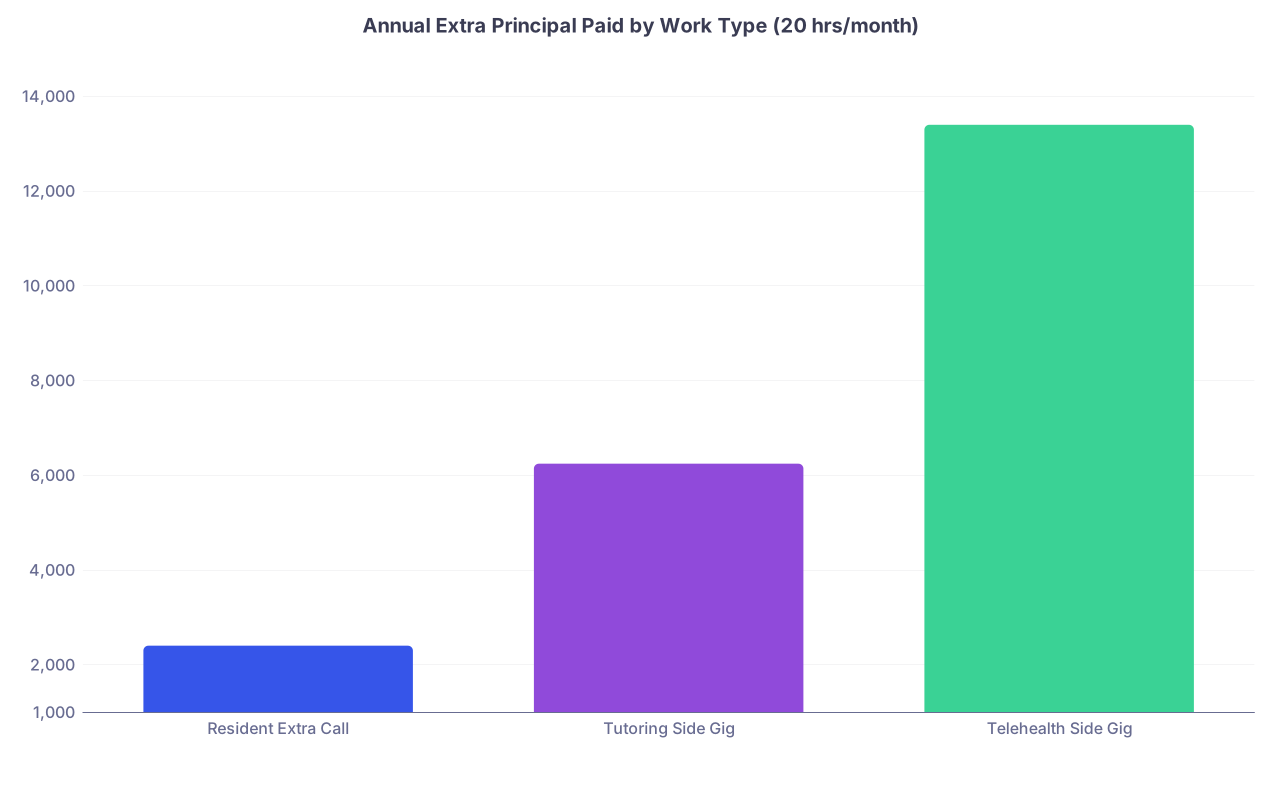
C. Visualizing payoff potential
| Category | Value |
|---|---|
| Resident Extra Call | 2400 |
| Tutoring Side Gig | 6240 |
| Telehealth Side Gig | 13392 |
Assumptions:
- Call EHR = $10/hr
- Tutoring EHR = $26/hr
- Telehealth EHR = $56/hr
- 20 hrs/month × 12 months × EHR
You do not need an MBA to see which strategy destroys loans faster.
Step 5: Build Your Personal Decision Framework
Here’s the operating system you should run every new opportunity through.
1. Define your constraints first
- Max extra hours per month you can safely work without real burnout.
- Any hard schedule blocks (rotations, exams, family logistics).
- Your loan plan:
- PSLF → side gig = lifestyle/savings, not payoff.
- Private high-interest loans → side gig = payoff accelerator.
- Mixed → prioritize highest interest first.
2. Score each option in 4 dimensions
For each potential side gig or extra call opportunity, rate 1–5 (5 is best):
- Money (EHR) – from the math above.
- Schedule control – can you cancel or move it?
- Fatigue / burnout hit – how wrecked are you after?
- Skill-building value – does it improve your CV or future income?
Then weight them. Here is a simple priority table.
| Factor | Weight | Example Good | Example Bad |
|---|---|---|---|
| Money (EHR) | 0.4 | Telehealth | Low-pay extra call |
| Schedule control | 0.2 | Async writing | In-house 24h call |
| Fatigue impact | 0.2 | Light telemed | Overnight ICU |
| Skill-building | 0.2 | Tutoring, research | Generic PRN nurse coverage |
You can literally create a quick spreadsheet, plug in numbers, and pick the highest weighted score.
3. Use a simple go/no-go rule
My rule when coaching residents:
“If a new opportunity’s effective hourly rate is below your current best option, and does not build a valuable future skill, skip it.”
You do not need ten side gigs. You need one or two very efficient ones.
Step 6: Legal, Tax, and Contract Traps (Do Not Skip This)
This is the “I have seen people get burned” section.
A. Contractual restrictions
Check:
- Your residency / employment contract for:
- “No outside clinical work” clauses.
- Moonlighting approval requirements.
- Malpractice limits (who covers you?).
- For telehealth / moonlighting:
- Are you covered by their malpractice or are you using your own?
- Tail coverage if the gig ends?
If you ignore this, you are gambling your license for an extra $30/hour. That is insane.
B. Licensing and credentialing costs
Side gigs that require:
- Additional state licenses
- DEA registrations
- Credentialing with multiple telehealth companies
Those costs must be baked into your EHR:
- If you spend $1,000 on a new state license for a telehealth gig that pays ~$2,000 total before you burn out, your real rate just tanked.
C. Self-employment taxes and retirement advantages
Side gig income = 1099 in many cases. That means:
- You pay self-employment tax (Social Security + Medicare), roughly 15.3% on top of income tax, with some offsets.
- However, you gain access to:
- Solo 401(k) or SEP-IRA
- Business deductions: home office, part of internet, work-related education, etc.
Done right, side gig income can be very tax-efficient and raise your net EHR. Done sloppy, it can be worse than W-2 call if you do not plan.
D. PSLF interaction
If you are on PSLF:
- Extra income from side gigs increases your IDR payment if it is large and stable.
- Extra call as W-2 might also raise AGI.
But:
- If that extra income goes into pre-tax retirement accounts or HSA, you can blunt the AGI increase.
- For some PSLF folks, it is smarter to:
- Max retirement.
- Keep loans on PSLF track.
- Use side gig money to build an emergency fund / down payment.
Bottom line: talk to a tax pro who understands PSLF before you go all-in on a massive side gig strategy as a PSLF candidate.
Step 7: Implementation Blueprint – Next 90 Days
Here is how you turn this from theory into an actual system.
Week 1–2: Get your baseline and pick a target
- List all loans, rates, and repayment plans.
- Decide:
- “I want loans gone in X years” or
- “I am PSLF; my goal is savings + sanity.”
- Choose a monthly extra debt target:
- Example: “I will send $500/month minimum from side income to loans.”
Week 3–4: Audit current extra work
- For the last 2 months, estimate:
- Extra call shifts.
- Moonlighting.
- Side gigs.
- Calculate real EHR for each using the formulas above.
- Identify your top-paying realistic option (and anything that is embarrassingly low).
Month 2: Optimize mix of call vs side gig
- Drop or reduce any low-EHR / high-burnout shifts where possible.
- Expand one high-EHR side gig that:
- Fits your schedule.
- Does not kill you.
- Is legally clean.
- Create a simple tracking sheet:
- Columns: Date, Type of work, Hours, Gross, Net, EHR, Amount sent to loans.

| Step | Description |
|---|---|
| Step 1 | List Loans and Goals |
| Step 2 | Calculate EHR for Call |
| Step 3 | Identify or Test Side Gig |
| Step 4 | Calculate EHR for Side Gig |
| Step 5 | Shift Hours to Side Gig |
| Step 6 | Keep Call and Reassess Options |
| Step 7 | Automate Extra Payments to Loans |
| Step 8 | Review and Adjust Monthly |
| Step 9 | Side Gig EHR > Call EHR? |
Month 3: Automate payoff and protect your time
- Set up automatic transfers:
- Side gig payouts → separate “Debt Attack” savings account.
- Once a month, lump payment to highest-interest loan.
- Install time boundaries:
- Hard cap: “No more than X hours/week of extra work.”
- Pre-scheduled no-work blocks (one full day off per week if at all possible).
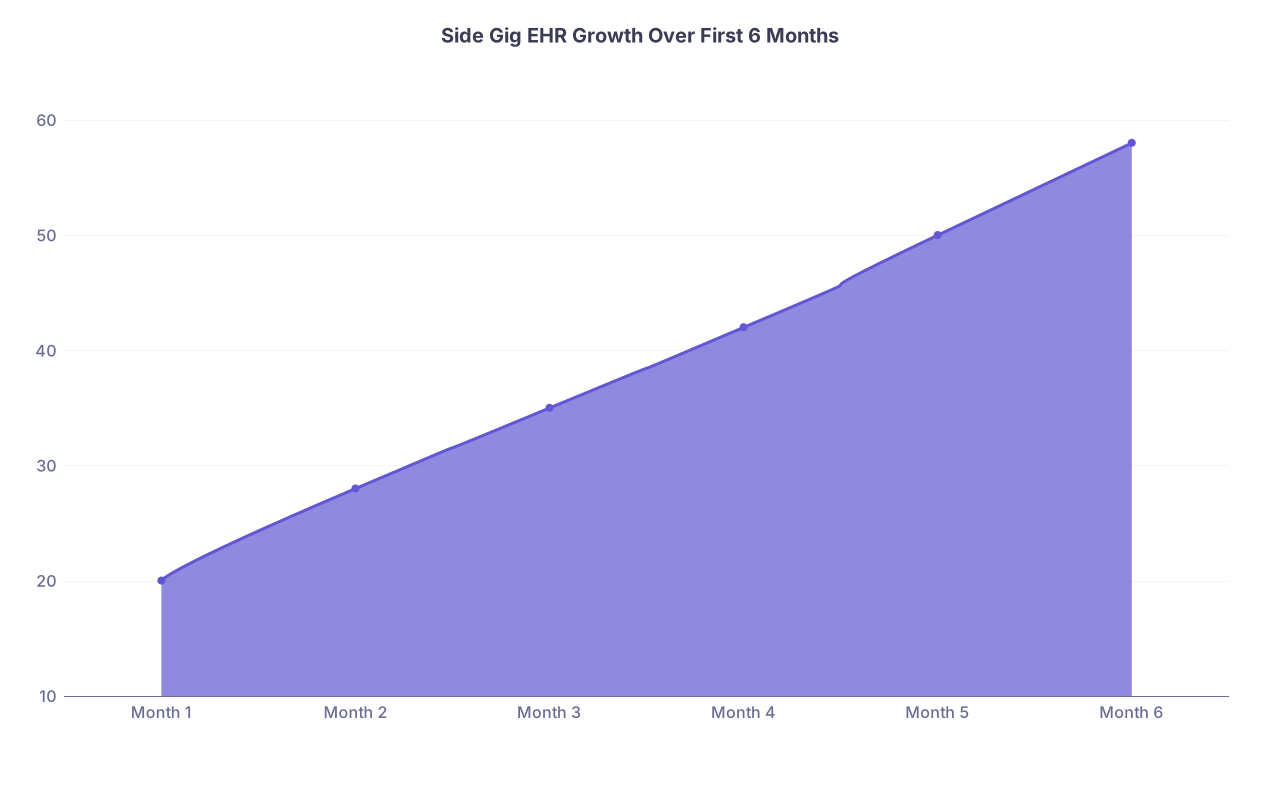
- Recalculate EHR as:
- Your skills improve.
- Your rates change.
- Your fatigue tolerances shift.
| Category | Value |
|---|---|
| Month 1 | 20 |
| Month 2 | 28 |
| Month 3 | 35 |
| Month 4 | 42 |
| Month 5 | 50 |
| Month 6 | 58 |
A decent side gig often ramps like this as you stop fumbling and start operating smoothly.
Step 8: Common Mistakes That Kill Your Payoff Per Hour
I have seen these repeat like a bad template note.
Ignoring fatigue
Treating a 24-hour call like 24 hours instead of the 30–36 life-hours it actually consumes.Chasing “prestige” over payoff
Some academic-ish side roles pay pennies but look nice on a CV. They are fine if that is the actual goal, but do not pretend they are your loan weapon.Not raising rates for side gigs
Staying at the same tutoring/consulting rate for years. If you are booked solid and people keep coming, your rate is too low.Letting extra income leak into lifestyle
You “work more to pay off loans,” but your DoorDash and Uber budgets explode. That is not a loan strategy. That is just self-deception.Forgetting taxes
Looking at gross side gig pay and thinking you are rich. Then April shows up.
What You Should Do Today
Open a blank page or spreadsheet and write three lines:
- “My highest-interest loan balance is: ___ at ___%.”
- “My best current extra work option is: ___ with an EHR of about $___/hr.”
- “For the next 3 months, I will commit X hours/week to that option and send 100% of that net to loans.”
Then, before you sign up for a single extra call or side gig shift, run the EHR math once.
If the number embarrasses you, do not rationalize it. Change the plan.