
Last month I talked to a former PGY‑1 who’d just resigned from residency. No new job lined up, no backup plan, just burnout and dread—and $280,000 in federal student loans quietly accruing interest in the background. She looked at me and said, “Did I just ruin my life? Like actually, financially ruin it?”
If you’re here, you’re probably spiraling through the same mental movie: you don’t finish residency, you never practice independently, and then your loans crush you until you die. Let’s walk through that fear without sugarcoating it—but without catastrophizing it into something it’s not.
First: Does Not Finishing Residency = Financial Death?
Short answer: no. Painful? Potentially. Impossible? No.
Here’s the uncomfortable truth nobody says out loud when they’re hyping you up for Match: the federal loan system was built expecting a chunk of people to not follow the standard high-earning-physician path. People leave medicine. People don’t match. People get disabled. People change careers. The system is clunky and sometimes unfair, but it doesn’t operate on “finish residency or die” logic.
You don’t lose your MD if you don’t complete residency. And you don’t lose your right to all the repayment tools just because you’re not a practicing attending. In some ways, you actually have more flexibility because you’re not trapped in a specific training schedule.
The nightmare scenario in your head is usually something like this:
- You quit residency
- Grace period ends, payments start
- You can’t afford them
- You default
- Your credit is destroyed, your wages are garnished, your life is over
That’s the cartoon version. Real life is messier and has a lot more “options” buttons you can push before you ever hit default—if you’re even remotely proactive.
What Actually Happens to Your Loans If You Leave Residency
Let’s be specific, because vague fear is always worse than reality.
1. Your loans don’t “know” you didn’t finish residency
Loan servicers don’t care about your professional status. You’re either:
- In school
- In grace
- In a deferment/forbearance
- In repayment
- Or in default
That’s it. Whether you’re PGY‑3, unemployed, working as a barista, or doing a non-clinical job, you’re just a borrower in their system.
Federal med school loans (Direct Unsubsidized, Grad PLUS) usually go:
- 6‑month grace period after you cease half‑time enrollment (so basically after graduation, not after residency)
- Then repayment status
Residency does not automatically keep you in a grace period. Some people used residency forbearance or special programs, but that’s not a built‑in protection that magically disappears when you quit. Your status just depends on what you and the servicer set up.
If you’ve finished med school long ago and you quit residency, odds are you’re already in repayment or on some plan. Leaving residency doesn’t suddenly trigger a bomb. Your income might change. That matters. Your “in residency” label doesn’t.
2. Your payment is based on income, not on being a doctor
This is the part people misunderstand all the time.
Under income-driven repayment (IDR) plans like SAVE, PAYE, IBR, etc., your monthly payment is a percentage of your discretionary income, not of your loan balance and not of your job title. If your income plummets because you left residency? Your payment can plummet too.
If you’re making very little—or literally nothing—your calculated monthly payment on an IDR plan can be close to zero. For SAVE, if your income’s low enough relative to family size, it can literally be $0, and that still counts as “on time” payment toward forgiveness.
Is interest ugly? Yes. But is it unstoppable, nuclear, game over? No.
Let me make it more concrete.
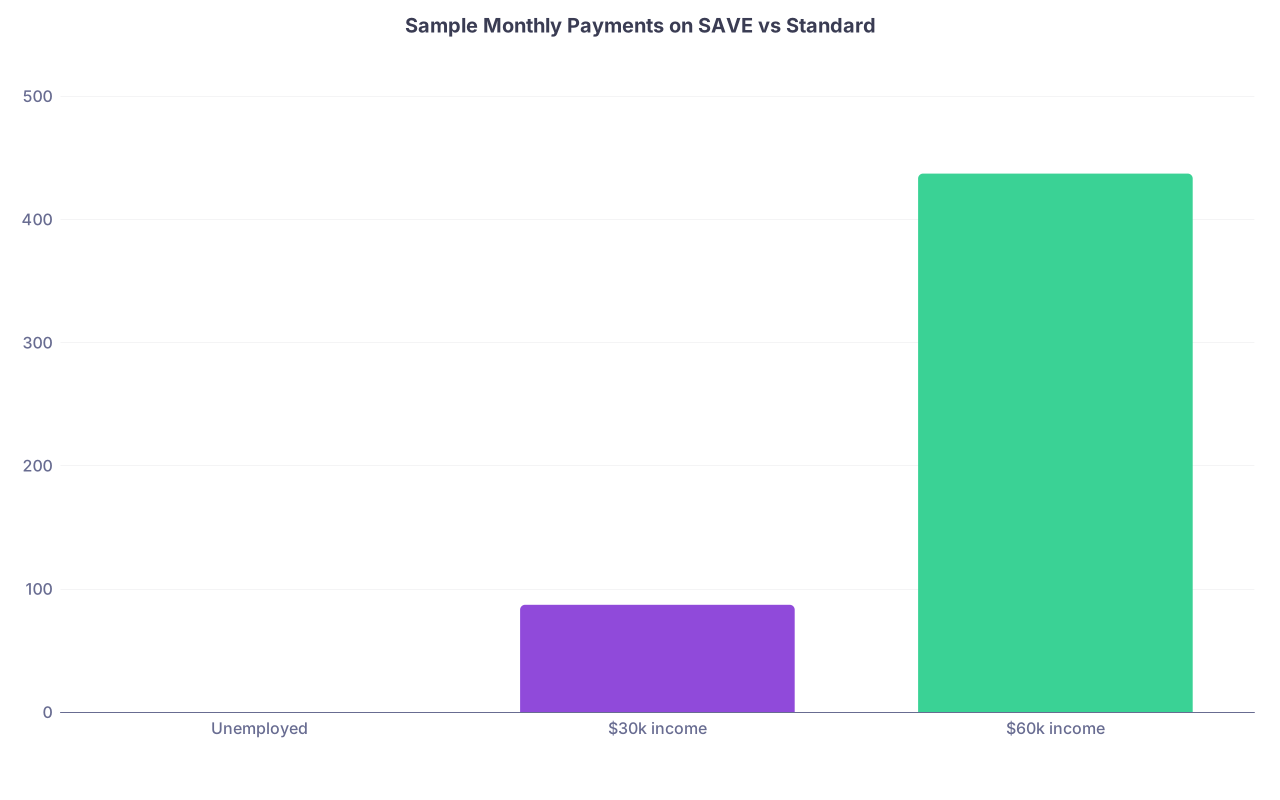
| Category | Value |
|---|---|
| Unemployed | 0 |
| $30k income | 87 |
| $60k income | 437 |
Those are approximate SAVE numbers for someone with $250k loans, single, in the continental U.S. The “Standard” 10‑year payment on $250k at 7% is over $2,900/month. Without IDR, you would be destroyed. With IDR, you’re not. You might be annoyed, stuck, limited—but not annihilated.
3. Loans don’t become immediately due in full unless you default
No one shows up at your door demanding $280,000 in 30 days because you left residency. That’s just not how federal loans work.
What can happen if you bury your head in the sand:
- You ignore your servicer
- You miss payments for 270 days
- You go into default
- Then the government can garnish wages, take tax refunds, and your credit gets trashed
But that’s not automatic. It takes months of nothing—no calls, no forbearance, no IDR application. If you’re even mildly responsive and fill out IDR forms, you stay far away from that cliff.
The Worst-Case Scenarios You’re Afraid Of (And How Bad They Actually Are)
Let’s walk through the actual worst‑case financial situations. Not the fantasy ones your 3 a.m. brain invents.
Scenario 1: You quit residency, can’t find a job, and have no income
This is the one that keeps people up at night.
What really happens:
- You call your servicer or go online
- You apply for an IDR plan (SAVE is usually the best right now)
- You report $0 income
- They set your payment to $0/month
You’re not “safe” in the sense that interest may accrue and psychological stress is still awful. But you’re not in default. And those $0 payments can still count toward forgiveness on qualifying plans.
Is it ideal? Absolutely not. Is it survivable? Yes.
Scenario 2: You leave residency and take a non-doctor job at, say, $55k–$75k
This is actually pretty common. People go into:
- Pharma/medical communications
- Clinical research coordinator
- Consulting-ish jobs
- Tech/healthcare startups
- Totally unrelated fields that just need a smart person who can work hard
You’re terrified that making “normal person money” with “doctor loans” is impossible.
Let’s plug rough numbers.
Say:
- $300k federal loans at 7%
- Income: $60k
- Single, no kids
- On SAVE, your payment is roughly a few hundred dollars a month, not $3k+
It’s not fun. You’ll feel behind your non‑med friends. But it’s not “I can’t eat” level desperation.
Over time, if you stick with an IDR plan, there’s 20–25 year forgiveness at the end (with probable tax consequences, yes, but that’s future‑you’s problem and the laws keep changing).
Scenario 3: You have private loans
This is where things actually get scarier, and where I’m not going to sugarcoat it.
- Don’t have federal IDR plans
- Don’t offer federal forgiveness
- Have whatever rules are in your promissory note and whatever mercy the lender decides to show
If you’ve got a chunk of private med school loans and you leave residency, then yeah, the pressure is real. You’re playing on Hard Mode.
You can sometimes get:
- Temporary forbearances
- Modified payments
- Extended repayment terms
But it’s case-by-case, lender-by-lender, and they’re not obligated to be kind.
This is where people sometimes look into:
- Aggressively refinancing to lower interest once they have stable income (even non‑physician income)
- Taking higher-paying non‑clinical work just to not drown
- Getting a co-signer off the hook eventually via refinance
No magical fix here. Just strategy and blunt math. But again—this is still not “destroyed forever” territory. It’s just… really tight.
What Tools You Actually Have If You Don’t Finish Residency
Let’s put all the repayment acronyms and options in one place, because the jargon alone is anxiety‑inducing.
| Option | Good For | Main Benefit |
|---|---|---|
| SAVE (IDR) | Low-moderate income | Lower payments, interest help |
| PAYE/IBR | Older borrowers / not SAVE-eligible | Income-based, forgiveness |
| Deferment | Unemployment/economic hardship | Pause payments (interest may grow) |
| Forbearance | Short-term crises | Temporary pause, flexible |
| Disability Discharge | Serious permanent disability | Loan wiped out if approved |
Now, in human language.
Income-Driven Repayment (IDR) is your oxygen mask
If you only remember one thing, make it this: get on an IDR plan. SAVE is the current star child.
Why it matters:
- Payment based on your income, not your balance
- If your income is low? Payment is low
- SAVE has an interest subsidy—if your calculated payment doesn’t cover all the interest, a portion of the leftover interest doesn’t get added to your balance
On a terrible month where you’re making almost nothing, you could have a $0 payment and still be considered “on time.” That means no default, no collection, no wage garnishment.
Deferment and forbearance are emergency brakes, not a lifestyle
When you’re panicking, it’s tempting to slam everything into forbearance and never think again. That’s how balances quietly balloon.
Deferment (for specific situations like unemployment or economic hardship) and forbearance are okay as short-term tools. But they:
- Pause payments
- Often let interest accrue and capitalize later
- Don’t count toward forgiveness in the same way IDR often does
If your brain is screaming, “I need time,” fine—use them for a few months while you sort your life out. Just don’t treat them as your 10‑year plan unless you absolutely have no better option.
If things get really bad: disability, bankruptcy, and the “truly worst case”
You’re probably also wondering: what if my health collapses, or I can never work again, or it all goes completely off the rails?
There are paths, but they’re not easy.
- Total and Permanent Disability (TPD) discharge: For federal loans, if you have a qualifying long-term disability (documented by SSA or a physician), your loans can be discharged. I’ve seen residents with severe psychiatric illness go this route. It’s a long, paperwork-heavy process, but it exists.
- Bankruptcy: Historically almost impossible for student loans, but there have been some changes and occasional success stories with federal guidance making discharge slightly more realistic. Still hard, still not something to rely on—but not utterly mythological anymore.
Those are true worst‑case safety nets. The point is: even at the bottom of the bottom, there’s still something.
Facing the Psychological Part: The Shame and “Failed Doctor” Narrative
Let’s be honest: the money is only half the panic. The other half is shame.
“I have an MD and I’m not a doctor.”
“I spent all this money and can’t even finish training.”
“I owe more than I’ll ever earn.”
I’ve heard all of those. Sometimes in stairwells. Sometimes in parked cars outside hospitals.
Here’s the thing: the loan system doesn’t care about shame. It cares about paperwork and numbers. And you can work with numbers, even when your brain is screaming that everything’s ruined.
What actually helps:
- Getting brutally clear on your loan types and balances. Not vibes. Actual numbers. Login, screenshot, write it down.
- Running sample payment scenarios on IDR with realistic non-physician incomes so you see it’s not all-or-nothing.
- Talking to someone who knows this world—an actual student loan advisor or at least your school’s financial aid office—not just panicking on Reddit at 2 a.m.
You’re not the first person to walk away from residency with loans. You won’t be the last. This is a known pattern. There are known ways through it.
So… Can Your Loans “Destroy” You?
Only if you disappear.
If you ignore everything, never enroll in IDR, never ask for help, let everything default, and assume “it’s hopeless so why bother”—then yeah, the consequences stack up. Wage garnishment on a modest salary hurts. Tax refund offset hurts. Bad credit limiting housing and jobs hurts. That’s the real damage.
But the existence of large loans, by itself, doesn’t destroy you. It constrains you. It forces choices. It takes options off the table. But you still have space to build a life that doesn’t look like a burning crater.
You may not end up an attending physician. You might end up a researcher, a medical writer, a health policy analyst, a tech PM, or something that has nothing to do with medicine at all. Plenty of those paths still pay enough that, mixed with IDR, your loans become… annoying background noise. Not a death sentence.
Years from now, you’ll remember this as the moment you realized the story in your head (“if I don’t finish residency, I’m ruined”) wasn’t the only version of the story available.

FAQs
1. If I don’t finish residency, do my loans become due immediately?
No. Your repayment status is based on your enrollment (med school) and whatever plan you’re in, not whether you complete residency. If you’ve already left med school, you’re either in grace, in repayment, or already on a plan. Leaving residency doesn’t trigger a “pay everything now” clause. What changes is usually your income, and you adjust your payment via an IDR application.
2. Can I still use income-driven repayment if I’m not working as a doctor?
Yes. IDR plans don’t care about your specialty, your residency status, or whether you’re clinical. They only care about your income and family size. If you’re making $40k in a non‑clinical job, your payment is based on $40k. If you’re making $0, it’s based on $0. You absolutely can (and should) use IDR if you leave medicine or never complete training.
3. What if I literally have no job and no income after quitting?
You apply for IDR and report $0 income. Your calculated payment can be $0/month, and that still counts as being in good standing. If you need a short breather before sorting that out, you can request a short-term forbearance, but don’t stay in forbearance longer than you must. The key thing: communicate with your servicer and don’t just let months of missed payments stack up.
4. Are private med school loans different if I don’t finish residency?
Yes, and they’re harsher. Private loans don’t have federal IDR, SAVE, or federal forgiveness. You’re stuck with whatever repayment and hardship options your contract allows, which may include interest‑only payments, extended terms, or short deferments. If you have heavy private loans and leave residency, you may need to prioritize higher-paying work (even outside medicine) or refinancing once you can qualify. Still not hopeless—but much tighter and less forgiving.
5. Is it ever rational to leave residency given huge loans?
Sometimes, yes. If residency is destroying your mental or physical health, or you know deep down you cannot do this work safely or sustainably, forcing yourself through “just for the money” can backfire catastrophically—burnout, malpractice risk, long‑term disability. Financially, leaving means you’ll probably earn less than a typical attending, but with IDR and a non‑physician career that pays decently, your loans may be heavy but manageable. The rational move is not “stay no matter what,” it’s “make a decision with clear eyes and a real loan strategy instead of fear.”
Years from now, you won’t remember the exact loan balance on the day you left residency. You’ll remember whether you treated yourself like someone whose future was still worth planning for.