
It’s 11:47 p.m. You’re in call room scrubs, half‑eaten sandwich next to your laptop, staring at your ACGME case log screen. The number is just… there. Not terrible. Not amazing. Just uncomfortably average. And your brain is running the same loop:
“How the hell am I supposed to match a competitive fellowship with this log? Everyone else seems to be doing twice as much. Did I just quietly screw my entire future during residency?”
Let me say the thing you’re actually afraid of:
You’re not worried about your case numbers. You’re worried this is proof you’re not good enough. That programs will see “modest volume” and toss your application in the “safe to ignore” pile.
Let’s walk through this like adults who are mildly panicking but still functional.
First: Does a Modest Case Volume Automatically Kill You?
No. Flat out, no. But it can hurt you if:
- You’re below minimum competence thresholds for your specialty
- And there’s nothing else in your application that screams, “This person is worth betting on”
The ugly truth: some fellowships barely look at case logs. Some glance. Some obsess over them, especially in procedurally intense, competitive fields (surg onc, HPB, transplant, CT, plastics, complex MIS, advanced endoscopy, etc.).
But the myth that everyone who matches competitive fellowships has monster volume? Not true. I’ve seen:
- A general surgery resident from a medium-volume community program match HPB at a big-name place
- A plastics applicant whose microsurgery numbers were downright sad match a top microsurgery spot
- An ortho resident from a no‑name program with mediocre trauma exposure land a strong trauma fellowship
Were they lucky? A bit. But mostly they had one thing in common: they didn’t let low–ish numbers be the only story.
How Programs Actually Look at Case Volume (Not the Horror Version in Your Head)
You’re imagining a PD pulling up your case log, seeing “lower than average,” rolling their eyes, and moving on. That’s not usually how it goes.
Here’s the rough hierarchy of how a lot of fellowship PDs think about case volume, especially in competitive surgical subspecialties:
Baseline competence
“Can this person safely do bread‑and‑butter stuff?”
They’re looking for:- You hit graduation/ACGME minimums
- You’re not wildly below your peers from similar‑type programs
Trajectory
They care if you’re trending up.- PGY2 was weak but PGY4–5 picked up? That’s survivable.
- Consistently low with no explanation? That’s harder to spin.
Alignment with chosen fellowship
For example, in general surgery applying MIS:- They’ll skim basic lap cases, bariatrics, foregut, hernia work, etc.
They don’t need you to be a fully baked attending. They need to see you’ve touched the field enough to know what you’re getting into.
- They’ll skim basic lap cases, bariatrics, foregut, hernia work, etc.
Context
They know:- Some programs are case machines
- Some are more academic, more clinic, more research
- COVID, service restructuring, staffing disasters, attendings leaving — they see this every year
So no, it’s not “high volume or dead.” It’s:
“Are your numbers reasonable for where you trained, and does the rest of your file make me excited to train you?”
The Part That Really Messes with Your Head: Comparisons
You hear your co‑resident bragging: “I just logged my 1,000th case.”
You’re sitting there with 730 and a pit in your stomach.
Let me give you the quiet part no one says out loud: logs are messy.
- Some people log religiously. Some forget half their minor stuff.
- Some attendings double‑count or mis‑categorize.
- Some people are “primary surgeon” on paper but barely touched the case.
- Others under‑log because they’re too busy, burnt out, or compulsively honest.
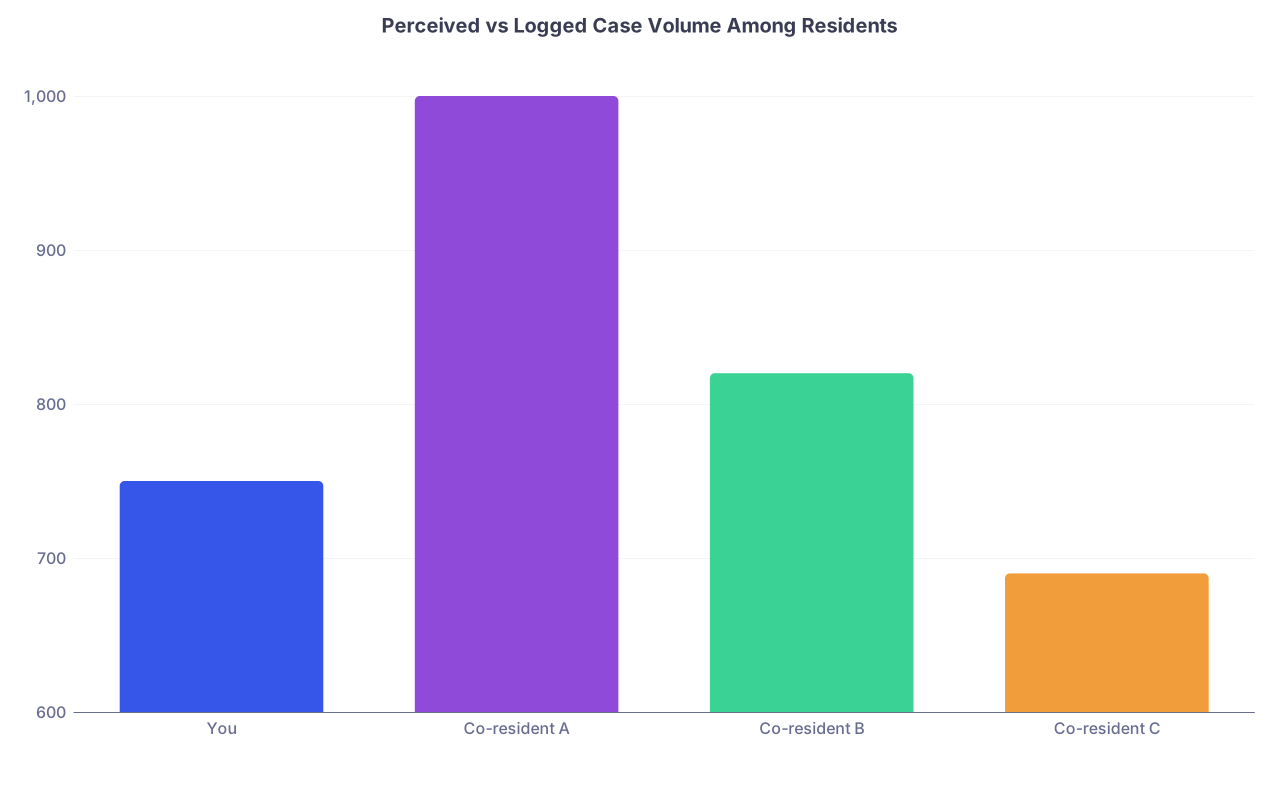
| Category | Value |
|---|---|
| You | 750 |
| Co-resident A | 1000 |
| Co-resident B | 820 |
| Co-resident C | 690 |
The point: your numbers feel like a moral judgment. They’re not. They’re a very rough proxy for exposure. And they only become deadly in applications when:
- You’re low and
- You don’t address it and
- The rest of your application is forgettable
You can’t change the past. But you absolutely can control how you explain it and what you build around it.
When Modest Volume Actually Becomes a Red Flag
Let’s be honest: there are some situations where case volume really does hurt.
Red flags usually look like:
- Consistently well below average for your program
- Poor operative performance reports on top of low numbers
- You needed remediation or extra training for technical skills
- Faculty lukewarm about your operative independence: “Shows interest, but limited hands-on performance”
In other words, it isn’t just “modest volume.” It’s low volume plus doubts about ability.
If that’s you, then yes, competitive fellowships become harder. Not impossible, but harder. You’ll have to be strategic:
- Maybe aim at strong but slightly less competitive programs first
- Build a track record of improvement and mentorship
- Be willing to do a less shiny fellowship, then prove yourself and pivot later
The other subtle red flag: you claim to be obsessed with, say, complex HPB, but your HPB cases are nearly nonexistent and you’ve never done research or gotten involved in that world. It makes fellowship directors doubt your sincerity, not just your skill.
What Fellowship Directors Actually Want More than Sheer Volume
Volume matters. But it’s not king. Directors care a lot about:
- Trainability – Will you respond to feedback, or will you fight every suggestion?
- Work ethic – Will I have to push you to show up prepared?
- Judgment – Do you know when not to operate, or when to ask for help?
- Collegiality – Are you the person other fellows and staff want around?
- Evidence you give a damn about the field – Presentations, research, elective choices, letters from subspecialty faculty.
I’ve watched people with lower case numbers beat out higher‑volume residents because:
- They had killer letters that said “top 5% of trainees I’ve worked with in 20 years”
- They had clear, coherent stories about why they wanted that specific subspecialty
- They’d shown initiative: built a QI project, led an M&M, created a protocol, ran a teaching session for juniors
In other words, they didn’t show up as “person with slightly disappointing numbers.” They showed up as “person this program would be stupid not to train.”
Context: COVID, Service Changes, and All the Stuff You’re Blaming Yourself For
You’re probably minimizing your context in your head. Stop doing that.
I’ve seen residents whose numbers tanked because:
- ORs were shut down for months due to COVID
- A key attending who fed the service left mid‑year
- Hospital pivoted to more APP‑driven models or shifted cases to private practice groups
- They were pulled for months to cover ICU, medicine, or other services
You know who else saw that? Fellowship directors. They lived it too.
If your numbers are modest because the system failed you more than you failed yourself, you address it:
Not with a whiny paragraph. With one calm, factual line in your personal statement or a PD letter:
“Due to COVID-related OR restrictions and staffing changes during my PGY3–4 years, our service experienced a significant drop in case volume, particularly in complex elective cases. I sought additional exposure through electives, simulation, and focused reading to compensate.”
That shows insight and maturity, not excuse-making.
How to Make a Modest Case Log Less Damaging – Practically
This is the part where your brain wants a fix. You won’t like it, because none of it’s instant.
Here’s how you make your case volume less of a central character in your story.
1. Squeeze every case you can out of the time you have left
If you’re not a final-year resident yet, you still have room to move the needle.
- Be that person who texts chiefs: “Any openings on the case list tomorrow? I can scrub in.”
- Trade call to land days with better operative exposure
- Ask attendings directly: “I’m aiming for a fellowship in X. Is there any way I can get more hands-on in Y cases?”
Do you risk being annoying? Maybe. You know what’s worse? Quietly accepting a weak log, then panicking in PGY5.
2. Get your PD and mentors on your side
You do not want your PD surprised when a fellowship director calls and asks, “What happened with their case numbers?”
Ask for a meeting. Be explicit:
“I’m worried my case volume isn’t where I want it to be for [fellowship X]. I’d really appreciate your honest assessment and any ideas to strengthen my operative experience or overall application.”
Most PDs would much rather help a motivated, anxious resident now than write vague, apologetic letters later.
3. Build non‑case strengths that are hard to ignore
If your volume is modest, other parts of your file need to be loud.
Think:
- One or two solid publications or abstracts in your target field
- Presenting at your specialty’s national meeting
- A QI project or guideline you led that your PD can brag about
- A reputation (backed by letters) for being reliable, thoughtful, safe
| Area | Example That Actually Helps |
|---|---|
| Research | 1–3 focused projects in your subspecialty with clear role |
| Leadership | Chief resident, committee work with real outcomes |
| Teaching | Curriculum, bootcamp, or recurring teaching session |
| Reputation | Letters describing you as top-tier, mature, safe |
You’re not trying to distract from your log. You’re trying to show directors: “Yes, my numbers are modest, but you’d be getting a high-ceiling, low-drama trainee who cares about this field.”
How to Talk About Modest Volume Without Sounding Defensive
You will get asked, “How was your case experience?” on interviews. Or, “Looks like your [X] exposure was a bit limited—tell me about that.”
Here’s what not to do:
- Blame your program for everything
- Spiral into a monologue about how screwed you feel
- Overcompensate and lie: “Oh, numbers don’t really reflect what I did.”
You want calm, factual, and forward-looking:
“I’d describe my volume as solid but not extreme. Our program went through [brief context], which limited some elective and complex cases during my middle years. I compensated by [extra electives, simulation, reading, seeking out specific cases], and by my senior year I felt very comfortable managing [specific types of cases]. One of my goals in fellowship is to deepen my exposure to [field‑specific procedures].”
If you can say that with a straight face and some confidence, most directors will move on.
The Dark Fear: “What If My Numbers Prove I Shouldn’t Be in a Competitive Field?”
There’s this intrusive thought you’re probably not saying out loud:
“Maybe I don’t have the numbers because I’m not talented enough. Maybe the universe is trying to tell me to stay in general practice and stop pretending I’m fellowship material.”
I’ve watched this thought eat people alive. Here’s the uncomfortable reality:
- Some residents truly discover they hate the OR or high-acuity stuff. They pivot. That’s healthy.
- But most of the time, modest case volume reflects systems, timing, and missed opportunities more than some cosmic verdict on your talent.
If you still light up talking about your field. If faculty in that area say, “You’d be great in this. Keep going.” That’s data. Real data. Stronger than one depressing number on a website.
You’re allowed to want a competitive fellowship even if your case log isn’t Instagram‑worthy.
If You’re Very Late in Training or Already Graduated
If you’re PGY5 or already an attending with a modest log, your playbook shifts:
- Consider a less competitive first fellowship in a related area, then do a micro‑fellowship, observership, or focused training later
- Look at mid‑tier programs where they value grit and reliability over pedigree and volume
- Use your early attending work to build a portfolio: outcomes, case mix, letters from current partners

| Step | Description |
|---|---|
| Step 1 | Modest case volume at graduation |
| Step 2 | Apply broadly including mid tier competitive fellowships |
| Step 3 | Target less competitive or related fellowships |
| Step 4 | Use research and letters to stand out |
| Step 5 | Build skills then consider second fellowship or focused training |
| Step 6 | Strong non case strengths? |
Is it harder? Yes. Dead end? No. I’ve seen surgeons do a “non‑fancy” first fellowship, then become absolute beasts in their niche because they stayed intentional and kept seeking training.
Reality Check: Will Some Doors Close? Probably.
I’m not going to sugarcoat this: if you have modest volume and nothing else that screams excellence, some of the shinier fellowships may be out of reach. The ones that get flooded with 200+ applications from people with research, monster logs, and brand‑name mentors.
But your career is not one binary: “top 5 fellowship or failure.”
You can:
- Match a solid, non‑famous fellowship
- Get robust training
- Build a focused practice
- Turn into the surgeon people actually trust—not just the one with the most impressive logo on their CV
And from that place? You’d be shocked how little your residency case log matters.
What You Can Do Today
Don’t just close this and stew in it.
Do this tonight or this week:
- Pull up your case log. Identify where you’re truly weak relative to your field (not compared to the loudest bragger in your program).
- Email or message one mentor or your PD:
“Could we set up 20 minutes sometime this month? I want your honest advice about my operative experience so far and next steps for [fellowship X].” - Write one sentence you could use in a personal statement or interview that calmly explains your situation without self‑destructing.
Then build from there. One concrete action beats ten nights of doom‑scrolling your own ACGME page.