
Last month, a chief resident showed me his case log graph on his phone, hand actually shaking. “Look at this dip,” he said, pointing to three nearly empty months in PGY‑3. “They’re going to think I faked my numbers. Or that I can’t operate.”
I wish I could say that was the first time I’d heard that exact fear. It wasn’t. Not even close.
Let me say the scary part out loud
You’re not imagining it: credentialing committees do look at your case log. Program directors and hospital medical staff offices care about numbers, patterns, and whether you meet minimums.
But here’s the thing everyone whispers in the hallway and almost no one says clearly to anxious residents:
Almost nobody has a perfectly smooth, beautiful, always-rising case curve. “Patchy” is normal. What matters is what kind of patchy you are, and whether the story your log tells matches reality and your references.
Your brain is probably doing what mine would: worst‑case scenario spirals.
- “They’ll see that month with 2 cases and think I disappeared.”
- “I barely have any of X procedure. They’re going to block my privileges.”
- “My co-resident did 300 laparoscopic choles and I barely hit 120. I’m done.”
Let’s pull this apart in a way that calms your brain enough to function, but doesn’t sugarcoat reality.
What “patchy” actually looks like to a committee
Picture the people on a credentialing committee. They’re not scrolling your log like an Instagram feed looking for aesthetic perfection. They’re glancing for patterns that scream one of three things:
- Danger to patients
- Dishonesty
- Inadequate training for requested privileges
That’s it. That’s the triage in their heads.
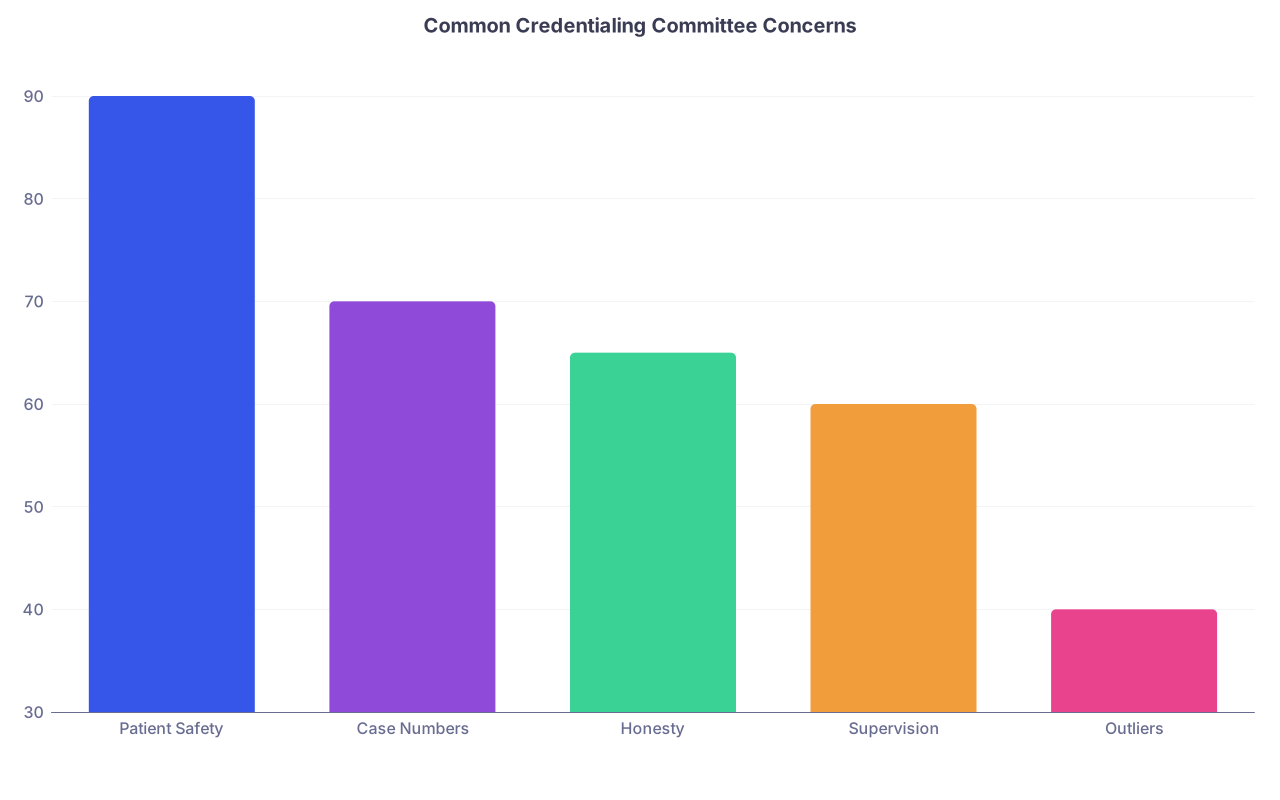
| Category | Value |
|---|---|
| Patient Safety | 90 |
| Case Numbers | 70 |
| Honesty | 65 |
| Supervision | 60 |
| Outliers | 40 |
When they see a “patchy” log, they subconsciously try to categorize it:
- Normal variation: heavy rotation here, clinic block there, research time, maternity/paternity leave, injury, program restructuring.
- Mild concern: chronically low numbers in a core area, but some exposure exists.
- Red flag: wild inconsistencies, obvious back‑entered cases, absurd volumes in a short time, or inexplicable gaps that don’t match your CV.
They’re not thinking, “This PGY‑3 March column looks thin; reject.”
They’re thinking, “Can this person safely do what they’re asking to do? And does this log look real?”
If your case log is “patchy” because:
- you did 3 months of research,
- your service was slow for a quarter,
- your program lost a key attending,
- you were on ICU / consults / off‑service rotations,
- you had medical leave or life blow up for a bit,
that’s not automatic poison. It just means you need a coherent story and supporting letters.
The types of “patchy” that freak us out (and what they mean)
You’re probably staring at your log and seeing one or more of these patterns.
1. The “desert months”
Several weeks or a couple of months with almost nothing logged. Looks like:
- PGY‑2 spring: nearly zero cases
- Or an entire block that looks like you weren’t in the OR at all
Credentialing eyes see this and think:
“Were they on a non‑operative rotation? Were they out? Or did they just not log?”
If those desert months match:
- ICU / trauma / consults
- Research rotation
- Maternity/paternity leave
- Injury or illness
- Away rotation in a system that didn’t integrate logs well
you’re probably fine if it’s:
- Clearly reflected in your CV or training verification
- Backed up by your program director’s letter or the official graduation form
What’s not fine is when:
- Your graduation summary says “full training, no interruptions”
- Your CV has nothing about non‑operative time
- But your log shows 2–3 months of near-zero operative activity
That mismatch is what freaks committees out much more than the low numbers themselves.
2. The “front-loaded” or “back-loaded” log
You did tons of cases early (or late) and look almost inactive at the other end of training.
For example:
- PGY‑2 and PGY‑3: crazy high volume on heavy service
- PGY‑5: more chief clinic, admin, consults, complex but fewer cases
Or the reverse:
- PGY‑1–3: lean years at a small or struggling program
- PGY‑4–5: massive push at a busier affiliate or new rotation site
Credentialing people know programs aren’t clones. New affiliations open. Attendings leave. Services fluctuate. If your overall total is fine and your PD signs off on competence, committees rarely punish you for a lopsided trajectory.
Where this becomes a problem:
You’re asking for independent privileges in something you barely touched until 6 months before graduation. Especially if your numbers are still low for that thing.
Example: asking for independent advanced laparoscopy privileges when your log shows:
- 5 random basic laparoscopy cases across PGY‑1–4
- Then 30 advanced cases in the last 4 months only
That can make people uncomfortable. Not an automatic no, but expect questions, proctoring, or limited initial privileges.
How credentialing actually looks at your case log (not the fantasy in our heads)
Let’s kill the myth that every single case is read and judged. No one has that kind of time.
The real workflow at many hospitals (varies, but this is the vibe):
Medical staff office staff:
- Checks that your training verification form and case log are present
- Verifies that you meet basic board eligibility / training requirements
- Flags anything odd for committee review
Department chair / section chief:
- Reviews your requested privileges
- Compares your requested scope to:
- Your case numbers in those areas
- Their knowledge of your training program
- The letter from your PD
- Recommends full, limited, supervised, or denied privileges
Credentials committee:
- Reviews the chair’s recommendation
- Glances at logs and letters
- Focuses on inconsistencies and safety issues
You know what carries more weight than your “patchy” graph?
- The line in your PD letter: “I recommend Dr. X for full privileges in general surgery without reservation.”
- The department chair’s signature saying “Approved.”
Your log is supporting evidence, not the sole judge.
When “patchy” actually bites you
I’m not going to lie: there are scenarios where your log can hold you back initially.
Here are the honest problem cases I’ve seen:
You’re far below typical minima for core procedures
Think:- A general surgery grad with barely any lap choles, appendectomies, hernias
- An OB/GYN grad with very low C-section numbers
- An ortho grad with almost no independent fracture fixations
You’re asking for high‑risk privileges with flimsy numbers
For example:- Requesting independent advanced bariatric surgery with 10–15 logged as assistant, almost none as primary
- Requesting complex endoscopy privileges when your log shows scattered basic scopes only
Your log looks clearly “cleaned up” right before graduation
This looks like:- Hundreds of cases entered in bulk in the final months
- Strange date clusters, lots of identical copy‑paste fields
- Numbers that don’t make sense for your rotations
Your log and your training verification contradict each other
That mismatch always sets off alarms.
When that happens, committees don’t usually say “never.”
They say:
- “We’ll grant limited privileges in X.”
- “We’ll require proctoring for Y procedures.”
- “We’ll re‑evaluate after 6–12 months and new case summaries.”
Annoying? Yes. Career‑ending? Almost never.
What you can do now if your log makes you queasy
You’re probably reading this with your log open in another tab. Good. Let’s make that productive.
1. Identify your true weaknesses, not just what feels bad
Look for:
- Months with almost no cases
- Procedure categories where your totals are clearly thin
- Areas that don’t match what you want to do in practice
Then ask yourself:
- Are these due to rotation structure?
- Leave / illness / pregnancy?
- Logging laziness?
- Actual lack of exposure?
Be brutally honest with yourself. You can’t fix a lie you tell yourself.
2. Match your log to your story and documents
Pull up:
- Your CV
- Any draft of your personal statement for jobs/fellowships
- Your PD’s expected graduation summary (if you’ve seen a version)
Do they align with:
- When you did research?
- When you were out for medical/family reasons?
- When your program changed sites or faculty?
If something’s missing, you need a plan to explain it. That might be as simple as:
- Asking your PD: “Can we explicitly mention my 3‑month research block in your graduation letter so the desert on my log makes sense?”

| Step | Description |
|---|---|
| Step 1 | Review Case Log |
| Step 2 | Relax and Save PDF |
| Step 3 | Match With Rotations and Leave |
| Step 4 | Ask PD to Note in Letter |
| Step 5 | Plan Targeted Cases or Supervision |
| Step 6 | Discuss With Mentor or PD |
| Step 7 | Prepare Clear Explanation |
| Step 8 | Gaps or Low Areas? |
| Step 9 | Explained by Schedule or Leave? |
3. Talk to your program director or trusted faculty
I know. This is the conversation that makes your stomach drop.
But they’ve seen hundreds of resident logs. They already know how your numbers compare to peers. You’re not revealing a secret.
You can literally say:
“I’m worried my case log looks patchy and will hurt me at credentialing. Can we go through it together and talk about how this will be perceived?”
That does a few things:
- Puts the issue on their radar
- Gives them a chance to adjust your rotations or opportunities before graduation (if you’re still in training)
- Lets them craft a letter that explains the weird parts in your favor
4. Be realistic about your first‑job privileges
You might not walk into your first job with every advanced privilege you want. That’s not failure. It’s actually normal.
Plenty of new surgeons:
- Start with basic privileges
- Get advanced ones added after 6–12 months of proctored or supervised cases
- Use early years to solidify skills and numbers in key areas
Credentialing isn’t a permanent verdict. It’s an evolving file.
How AI and the “future of medicine” change this (and how they don’t)
There’s this fantasy that with AI and modern data systems, case logs will be “perfect” and everything will be super objective.
Reality check:
- Yes, more systems will auto-pull from the EMR into your log.
- Yes, AI might be used to scan for anomalies, fraud, or outliers in case patterns.
- Yes, national benchmarks for case volumes by specialty and procedure will keep getting more refined and more accessible.
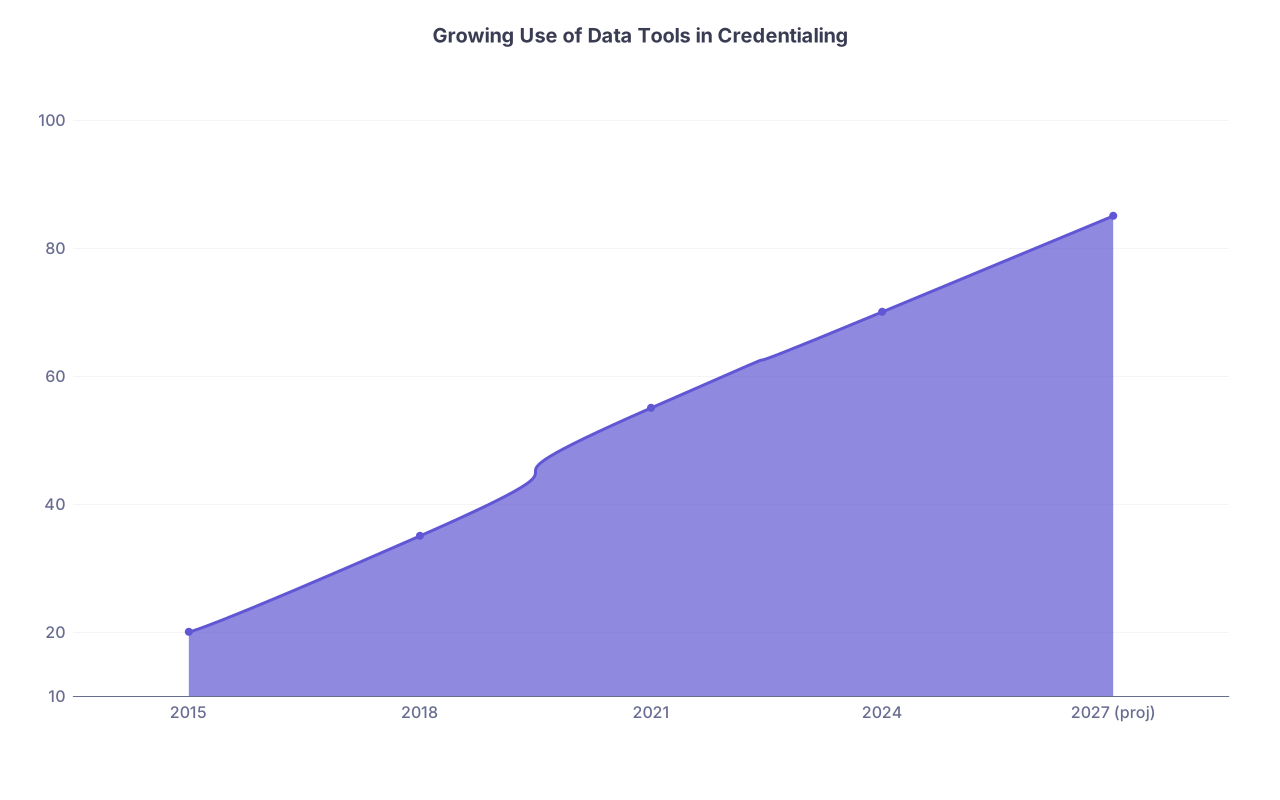
| Category | Value |
|---|---|
| 2015 | 20 |
| 2018 | 35 |
| 2021 | 55 |
| 2024 | 70 |
| 2027 (proj) | 85 |
But human committees still decide. And they will still ask old‑fashioned questions:
- Does this person look safe?
- Does this log match their training story?
- Do I trust their PD’s judgment?
If anything, the AI / data layer will make obvious manipulation riskier. Bulk‑entered fake cases, absurd patterns, copy‑paste behaviors—these will be easier to catch.
What won’t change: people having uneven training because life is messy and healthcare systems are chaotic.
Your job isn’t to become a perfect data object. It’s to:
- Make sure your numbers are honest
- Fill gaps where you can
- Own your story where you can’t
Quick reality check: how many people “fail” credentialing because of patchy logs?
Actual total rejections for an otherwise qualified, board‑eligible graduating resident, solely because their log is cosmetically patchy?
Very rare.
More common outcomes:
- Granted full core privileges, but held back on advanced procedures until more proctored cases
- Asked for clarification from PD or department chair
- Granted everything, because the committee trusted the PD and department and glanced at your total numbers and moved on
Your brain is picturing an email that says:
“Your case log is irregular. You are denied employment and will never practice.”
That’s not how this works.
A few non‑sugarcoated truths you probably need to hear
- If your log is weak in an area you don’t actually want to practice in, you don’t need to fix that to have a good career. Stop torturing yourself over numbers you won’t use.
- If your program chronically under‑exposes residents to a core procedure, that’s on the program more than on you. Credentialing people know which programs are like this.
- If you slacked on logging early and tried to backfill everything, that was a mistake—but the solution is to be squeaky‑clean now and accept that you may need supervised privileges initially.
- Feeling behind compared to your co‑resident with insane numbers is common. Super high volume is not always better; sometimes it’s just different case mix or a more aggressive attending.
FAQ (exactly 5 questions)
1. My case log has a 2–3 month gap with almost no cases. Is that automatically a red flag?
Not automatically. Committees will first ask: does this match your rotations or leave? If you were on ICU, research, consults, maternity/paternity leave, or had a documented medical issue, they’ll usually accept that once it’s clearly explained in your PD’s graduation verification or letter. The real red flag is an unexplained gap that conflicts with your “uninterrupted training” story. Solve that by making sure your PD explicitly documents the reason for those low-volume months.
2. I’m way below my co-residents in certain procedures. Will that block my privileges?
It depends on which procedures and what you’re asking for. If you’re low on a procedure that isn’t central to your planned practice, it usually doesn’t matter. If you’re low on a core procedure (like lap choles in general surgery or C-sections in OB/GYN) and asking for full independent privileges, you might be granted limited or supervised privileges initially. That’s annoying, but it’s usually fixable over your first year with proctored cases and re-review.
3. I back-entered a bunch of cases late. Will AI or credentialing software catch that and flag me?
Bulk late entry is increasingly visible in modern systems—timestamp patterns, large imports, and weird clusters stand out. That doesn’t always equal “fraud,” but it does make some people suspicious, especially if the pattern is extreme. At this point, your best move is honesty going forward, consistent and timely logging, and letting your PD’s letter and direct evaluations carry more weight. Don’t double down by inventing cases; that’s where careers really do blow up.
4. Can I ask my PD to tailor their letter to explain my patchy log, or is that overstepping?
You can absolutely bring it up, and you should—respectfully. Something like: “My case log has a noticeable dip during my research/ICU/leave block. I’m worried credentialing committees will misinterpret that. Would you be willing to mention that period and confirm my overall competence?” Most PDs would rather preempt confusion than deal with annoying calls from hospitals later.
5. I’m still in training and my numbers are low in an area I actually care about. Is it too late?
Not necessarily. If you still have time, talk to your PD or a supportive attending now. Ask for: targeted rotations, extra call on heavy services, or elective blocks that build volume in that area. Even if you can’t catch up to some ideal benchmark, you can at least show an upward trend and recent focused exposure. That, combined with a strong PD endorsement and maybe some initial supervision requirements, is usually enough to get you in the door.
Today, do one concrete thing: open your case log, identify the single weakest area that actually matters for your future practice, and send one email—to your PD or a trusted attending—asking to sit down and review it. Don’t wait for credentialing to be the first time anyone else sees the gaps you’re losing sleep over.