
What if you match into a “low-volume” program and realize… this might be your only shot? And now you’re stuck wondering if you’ll ever feel safe operating on your own.
Yeah. That’s the fear.
The Dirty Secret: “Volume” Is a Terrible One-Word Answer
Everyone online talks about volume like it’s a religion. “High-volume center.” “I did 1200 cases.” “You need 1000+ to be competent.”
But almost nobody says what those numbers actually mean.
I’ve seen people brag about 1100 cases where half of them were “skin lesion, attending did everything, I held retractors.” I’ve also seen residents at so-called low-volume programs graduate doing clean, efficient lap choles and colectomies by themselves, with their attendings scrubbed but basically silent unless something weird happened.
So here’s the uncomfortable truth you already suspect:
You can absolutely become a safe surgeon from a lower-volume program.
You can also be dangerously underprepared coming out of a high-volume one.
It’s not just “how many.” It’s:
- What kind of cases?
- What level are you actually operating at?
- How much teaching vs. assembly-line grinding?
- How much do you think and prepare vs. just show up and cut?
But I get why you’re spiraling. Numbers feel concrete. And low numbers feel like a death sentence.
Let’s break the fear apart instead of just saying “you’ll be fine.”
What “Low Volume” Really Means (And What It Doesn’t)
| Program Type | Total Cases | Resident Autonomy | Mix of Complexity |
|---|---|---|---|
| Big Tertiary Center | 1000–1400 | Variable | Many complex |
| Community-Heavy | 800–1100 | Often higher | More bread-and-butter |
| Small/Low-Volume | 600–900 | Highly variable | Depends on catchment |
| Fellowship-Heavy Site | 800–1300 | Residents sidelined sometimes | Fellows get rare cases |
“Low volume” could mean a bunch of different things:
- Fewer total cases because there are fewer ORs or smaller catchment area.
- Same number of cases overall, but split between many residents and fellows.
- A schedule where attendings keep complex or profitable stuff and give scraps to trainees.
Or it might mean: fewer total cases, but heavy autonomy, tons of bread-and-butter, and real responsibility.
Let’s say you graduate with 750–850 logged cases. That number sounds terrifying when everyone on Reddit is yelling “four digits or bust.” But what if:
- You were primary surgeon for 70% of those.
- You did most of the critical parts yourself: hilar dissection, anastomosis, vascular control.
- You learned to manage post-op complications at 2 a.m. instead of calling the attending for every fever.
Compare that to someone with 1200 cases who:
- Can’t dock the robot without help.
- Never closed an anastomosis without the attending stepping in.
- Has never actually led the room when something went wrong.
Who’s safer on day one of independent practice? It’s not automatically the 1200-case person.
The Real Question: What Makes a “Safe” Surgeon?
You’re not actually asking, “Will I log enough cases?”
You’re asking, “Will I hurt someone because I didn’t see enough?”
Safety is less about the total number of cases and more about four things:
- Technical competence in common operations.
- Judgment about what not to do.
- Ability to recognize trouble early.
- Willingness to ask for help instead of powering through ego-first.
And yeah, repetition helps with all of those. But there’s a point of diminishing returns. After a certain number of lap choles, doing 300 more at exactly the same level doesn’t transform you. It just pads your ACGME log.
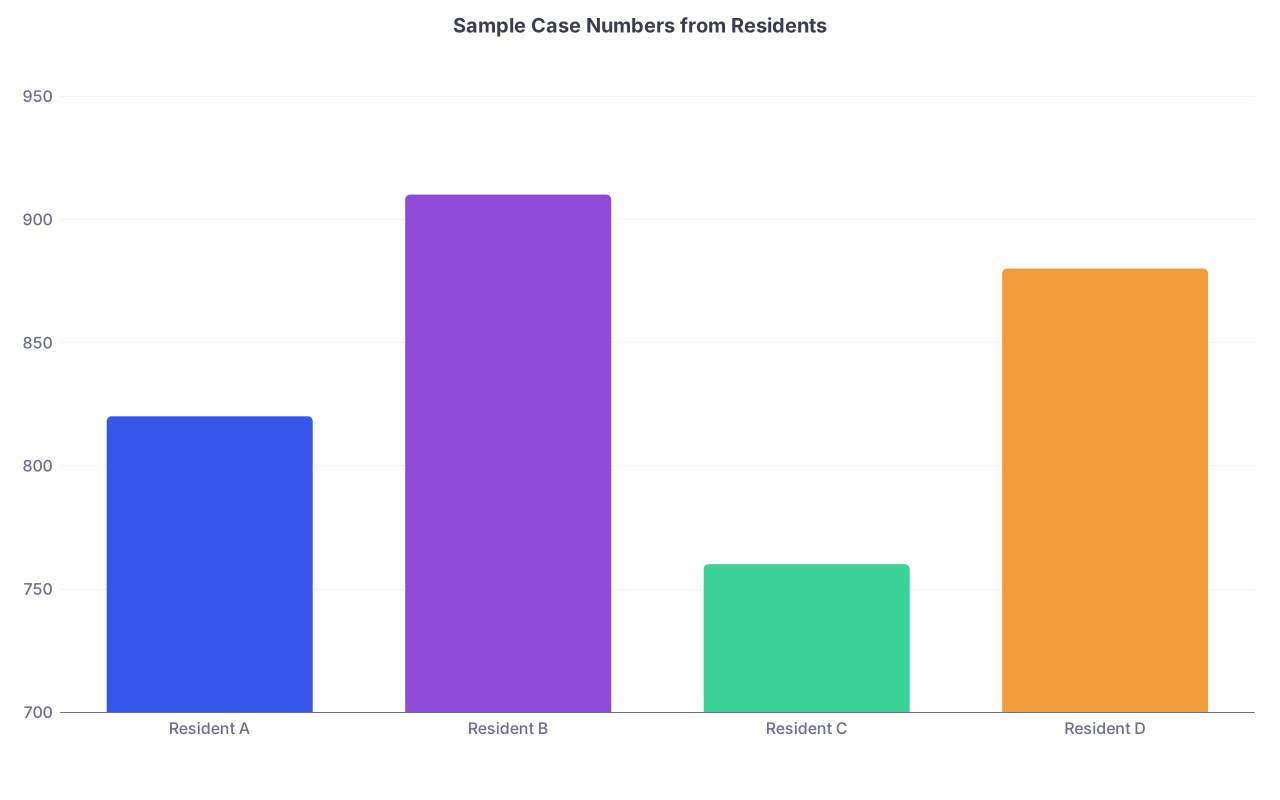
| Category | Value |
|---|---|
| Resident A | 820 |
| Resident B | 910 |
| Resident C | 760 |
| Resident D | 880 |
Above some threshold, the curve flattens. The first 50–100 of a procedure matter a ton. The next 100 add refinement. After that, what matters more is:
- How many times you did it from skin to skin.
- How many times you handled a difficult variant, a complication, or an almost-disaster.
- Whether someone actually corrected your bad habits or just tolerated them.
You can get that at a so-called low-volume program. You can miss it at a high-volume one.
OK, But What If My Numbers Really Are Low?
Let’s not sugarcoat. There is such a thing as too low. If you’re graduating with like 400 total cases, minimal autonomy, and you’ve never independently done bread-and-butter procedures? That’s a problem.
But here’s the part everyone forgets: you’re not a passive object being transmitted through a pipeline. You can move the needle. Not from 400 to 1400, maybe, but from “concerning” to “safe and solid.”
I’ve seen residents at smaller programs do this:
They volunteer for the “boring” things no one else wants: the 5 p.m. add-on lap appy, the hernia that bumps dinner to 9 p.m., the weekend call where everyone else disappears. They say yes to stuff others blow off. Over years, that quietly stacks volume, especially in core cases.
They obsessively prepare. They don’t just show up and let the attending drive. They read the night before, watch videos, mentally rehearse steps. They walk in ready to say, “I’d like to do X, Y, Z today,” instead of, “So what do we do first?” Attendings notice that. And they hand over more.
They get uncomfortable early instead of hiding. They ask for the critical parts when it feels awkward.
“Can I do the anastomosis today?”
“Would you be okay if I tried to take this gallbladder off the hilum?”
That’s how they avoid becoming PGY-5s who’ve “assisted” on 300 cases and actually done 40.

| Step | Description |
|---|---|
| Step 1 | Realize volume is limited |
| Step 2 | Say yes to add on cases |
| Step 3 | Prepare obsessively for each case |
| Step 4 | Ask for critical portions |
| Step 5 | Gain attending trust |
| Step 6 | Increase autonomy per case |
| Step 7 | Graduate with true competence |
So if you’re in a low-volume environment, your reflex has to be: “Fine. I’ll squeeze everything out of every single case I do get.”
Is it fair that you have to fight for it? No. Does fairness matter to the patient on your table five years from now? Also no.
Where Low-Volume Programs Actually Have An Edge
Here’s something no one tells you because it doesn’t sound sexy on a program brochure:
Low- or moderate-volume places often give you more actual room to operate.
Fewer fellows means fewer people between you and the attending. In some big-name programs, every complex or interesting case is swallowed by a fellow, and you become the “retractor specialist.” You log the case; you don’t really own it.
In contrast, in some smaller programs, you may be the only resident in the room. That means:
- You’re the one who consented the patient.
- You’re the one doing most of the operation.
- You’re the one managing the complication that shows up at 3 a.m. on postop day 2.
That’s how judgment gets built. Not by standing in a high-volume OR barn where 15 rooms are running but you’re the least important person in each one.
It’s also easier to get known by your attendings. If there are 12 residents and 20 attendings, they actually learn your style. They see your improvement. They start you with camera and closing as an intern, and by chief year they’re sitting at the desk while you run the show. That continuity is gold.
How to Make a Low-Volume Program Work for You
If you’re already at or headed to a place you’re worried is “low volume,” this is where the panic turns into a plan.
First, get brutally honest data. Don’t trust vague vibes.
Ask your chiefs and recent grads (not the program director) things like:
- “About how many total cases did you graduate with?”
- “How many lap choles, hernia repairs, appys, colectomies did you actually do yourself?”
- “Did you feel comfortable taking call alone by the end of residency?”
- “What did you feel weak in, honestly, and why?”
| Category | Value |
|---|---|
| Resident A | 820 |
| Resident B | 910 |
| Resident C | 760 |
| Resident D | 880 |
Then you figure out if this is a low-volume-but-salvageable situation, or a “run if you can” one.
If you’re already there and can’t leave, focus on what you can actually control:
- Be visible. Volunteer for cases. When the board runner says, “We need a resident for the add-on,” your name should come up first.
- Own your call. Don’t hide. When consults come in, see them, think through plans, ask to scrub when they go to the OR.
- Protect your autonomy. When you do get a case, don’t let it slip by as pure observation. Speak up early: “If you’re comfortable, I’d like to do X part today.”
- Fix your weak spots deliberately. If you’re light on endoscopy, find electives, outside rotations, or even plans for a focused fellowship.
And one more thing: low volume in residency doesn’t mean you’re doomed forever. You have levers after graduation too.

Fellowship can absolutely be your “volume booster.”
So can working your first job in a practice where you’re not the only surgeon, and you can carefully ramp up your scope.
The Worst-Case Thought: “What If I Hurt Someone Because I Didn’t See Enough?”
Let’s be blunt. You will see complications. You will have outcomes that haunt you, no matter where you trained. High-volume, low-volume, doesn’t matter—surgery is surgery.
The question is whether your training gives you:
- Enough reps to recognize when things are off early.
- Enough humility to ask for help before disaster, not after.
- Enough internal red flags to say, “This is too much for me alone,” and refer or bring in backup.
A low-volume resident who knows their limits is safer than a high-volume hotshot who thinks case logs equal invincibility.
I’ve watched junior attendings from name-brand, high-volume programs push into cases they shouldn’t have done solo. Because on paper, they’d “done 40 of these.” In reality, they’d assisted, sutured a bit, and never actually owned the operation. That’s dangerous.
The scary thing isn’t low numbers.
The scary thing is believing your numbers alone make you safe.
What You Should Actually Be Afraid Of (And What You Shouldn’t)
Be afraid of:
- Graduating unable to confidently do bread-and-butter general surgery: lap chole, appy, hernias, simple bowel resections, basic endoscopy.
- Never having managed serious post-op complications (anastomotic leak, post-op bleeding, sepsis) as the primary decision-maker.
- A culture where attendings never let go, and you’re a passenger until the day you graduate.
Do not obsess over:
- Whether your log sheet says 850 vs. 1050.
- Whether another program’s website says “level 1 trauma” and yours doesn’t.
- Whether someone on Reddit called your program “malignant low-volume trash” based on N=1 gossip.
If you’re reading this already anxious, you’re probably not the problem. The people who scare me are the ones who never ask these questions and just fixate on prestige or step scores.
You being worried about safety is—ironically—a very good sign for your eventual patients.

How Medicine’s Future Might Actually Help You
There’s another layer here: surgery itself is changing.
More simulations.
More structured skills labs.
Better intraoperative video review.
AI-guided feedback, smart instruments, robotic consoles that track your movements.
None of that replaces real patients. But it does mean that a resident with fewer raw cases might get better targeted practice than someone in the old-school grind.
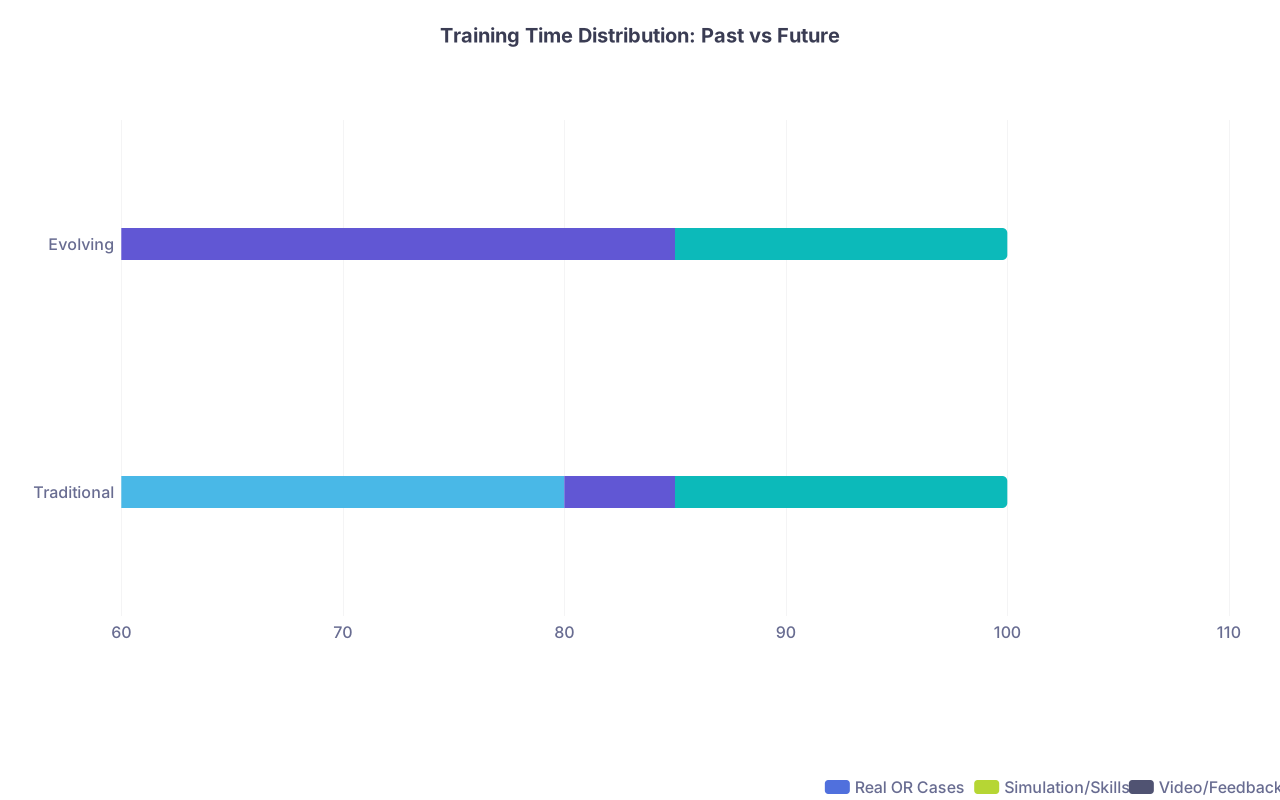
| Category | Real OR Cases | Simulation/Skills | Video/Feedback |
|---|---|---|---|
| Traditional | 80 | 5 | 15 |
| Evolving | 60 | 25 | 15 |
You might:
- Practice rare scenarios on high-fidelity sims.
- Break down your technique on video with an attending.
- Use structured curricula that make sure you don’t just hope you “pick it up.”
So yes, 800 cases in 2026 with serious simulation, structured teaching, and high autonomy may produce a safer surgeon than 1200 cases in 1995 where no one ever gave feedback besides “don’t suck.”
Not popular to say, but true.
FAQ (Exactly 4 Questions)
1. Is there a minimum number of cases I need to be safe?
There’s no magic number, but if you’re graduating general surgery with fewer than ~700–750 total cases and very little autonomy, that’s concerning. On the other hand, 800–1000 cases with strong primary-surgeon experience in core procedures is usually enough to be safe, especially if your judgment and complication management are solid. Numbers matter, but what you did in those cases matters more.
2. How can I tell if my low-volume program will still train me well?
Look at graduates, not brochures. Ask recent alumni: “What do you feel comfortable doing alone now?” and “What felt weak in your training?” If they’re working independently, not all doing extra fellowships to fill gaping holes, and they’re not talking about feeling unsafe, that’s reassuring. Also pay attention to culture: do attendings intentionally hand over the case, or do they treat residents as permanent assistants?
3. If I realize late that my operative volume is low, is it too late to fix?
Not necessarily. You can still aggressively seek add-on cases, electives at higher-volume sites, trauma or community rotations, and focused experiences in your weak areas. You can also be strategic with fellowship choice—picking a program known for heavy operative volume and autonomy can compensate for some deficits. It’s not perfect, but it’s absolutely better than just shrugging and hoping.
4. Bottom line: Can I still be a safe surgeon from a low-volume program?
Yes—if you squeeze every drop out of the cases you do get, push for autonomy, obsess over bread-and-butter competence, own your complications, and are brutally honest about your limits. Low volume doesn’t doom you. Complacency does.
Key points:
Case quality and autonomy matter more than flashy total numbers.
You can actively shape your training, even in a low-volume environment.
Being this worried about safety already puts you ahead of a lot of people.