
What If My Surgical Case Volume Is Below ACGME Minimums as a Senior?
It’s February of your chief year. You open ACGME Case Log, click “Reports,” and your stomach just drops. That one number you’ve been avoiding all year is finally staring back at you:
You’re below minimums.
You start scrolling. Appies, choles, hernias, scopes, index cases. Every line feels like an accusation. You close the browser, open it again, hoping the numbers magically changed. They didn’t.
And then the spiral:
“Am I not going to graduate?”
“Is the program going to hold me back a year?”
“Will I never be board eligible?”
“Is this going to ruin my fellowship chances?”
“Is everyone else fine and I’m the only one who’s short?”
I’m going to walk through this exactly the way your anxious brain is running it: worst case first, then pull it back to reality. Because yeah, this matters. But it’s almost never the career-ending catastrophe your 2 a.m. brain is telling you it is.
First: How Bad Is “Below Minimums,” Really?
There’s “uh oh, we’re a bit short” and there’s “this is a formal problem.” Those are not the same.
| Situation | Realistic Level of Concern |
|---|---|
| 5–10 cases below one category | Low |
| 10–20 below one category | Moderate |
| Below in multiple core categories | High |
| Far below (e.g., half the minimum) | Critical |
| Big gap but time left in year | Fixable |
You being 8 cholecystectomies short in February is not the same as being 40 major cases short in June. Programs look at:
- How far under you are
- In which categories
- How much time is left
- Whether this is just you or a pattern in your class
- Whether there were obvious disruptions (COVID-era, losing a key rotation, maternity/paternity leave, medical leave, etc.)
Everyone’s terrified the second they see “below minimums.” But I’ve watched a lot of people pull this out in the final months with targeted planning. The hidden truth: a lot of chiefs are quietly short on something at some point. They just don’t all talk about it.
Will I Still Graduate If I’m Below ACGME Minimums?
Here’s the part nobody explains clearly to you:
- ACGME case minimums are program requirements and board eligibility requirements.
- Your program director has to attest to your readiness and that you met requirements.
- The board cares that you hit minimums, and your PD cares that you’re safe and competent.
If you’re below minimums at the end of residency, a few things can happen:
You extend training
The big scary one. This could be a few additional months or, rarely, an entire extra year. It’s not common, but it happens. Especially if you’re significantly short or if there are real concerns about your autonomy/operative skills.You do targeted remediation rotations
Extra rotation(s) specifically focused on the missing category: more endoscopy, more vascular, more trauma, more bread-and-butter general. This is actually pretty common. You still graduate—just a bit later than planned.You graduate on time with a plan
Sometimes you’re technically below in one narrow category, but your overall case experience is robust, your PD trusts your skills, and the deficit is small and fixable with careful scheduling in the final months. Programs will move heaven and earth for chiefs they believe in.Program takes responsibility
If the issue is systemic (e.g., a site lost a service, COVID, case volume shifts), the program will often go to bat hard for you and your class. You’re not getting “punished” for institutional problems.
Do people get held back? Yes. I’ve seen it. But it’s almost never a surprise to the resident by that point. There are usually months of warnings, evals, meetings, emails, and “we’re concerned about your case log and autonomy” conversations.
If you’re reading this now and you’re anxious enough to be looking this up, that alone puts you in a better position than the people who ignore it until June.
The Ugly Fear: Does This Mean I’m a Bad Surgeon?
This is the part that hurts most.
You’re not just scared of numbers. You’re scared this means something fundamental about you:
“Everyone else got their choles. Why didn’t I?”
“Attending X never let me operate… was that because I’m incompetent?”
“My co-resident did 20 more scopes than me. Am I behind forever?”
Let me be blunt: case log numbers are a very rough proxy for operative competence. They’re not perfect. They’re not clean. They’re influenced by:
- Which attendings you rotated with
- Whether you got unlucky with clinic-heavy months
- How many juniors were on service with you
- Whether another resident always jumped in and took the case
- Call schedule chaos
- OR cancellations, staffing shortages, or losing key service lines
I’ve seen residents with sky-high numbers who still struggled technically. I’ve seen residents slightly below in a few categories who were absolutely solid in the OR.
Programs know this. PDs know who can operate and who just logged a lot of cases while retracting. So if your PD hasn’t said, “We’re worried about your actual operative skill,” it’s more likely a logistical and planning problem than a competence crisis.
Still, the anxiety is real. You don’t want to be the surgeon who graduated with a weak log and always wonders if you’re missing something. The way out of that is not denial. It’s very clear, very targeted action right now.
What You Should Actually Do This Month
Here’s the part you really care about: what do you do when you see that red “below minimum” number?
1. Stop catastrophizing alone. Tell someone with power.
Not your co-resident. Not your group chat. Your program director or associate program director. Early.
Say it directly:
“I ran my ACGME case log report and I’m below minimums in [X]. I’m worried and I want a concrete plan to fix this before graduation.”
That sentence does three things:
- Shows you’re self-aware
- Signals you’re motivated to fix it
- Forces the program to engage and help you plan
The worst thing you can do is silently hope it improves “somehow” by June.
2. Print the report and dissect it
Open your ACGME Case Log, generate a full category report, and actually print it. Pen in hand. Old school.
Go line by line:
- Which categories are low?
- By how much?
- How much time is left in the year?
- When are your remaining rotations that realistically generate those cases?
Then circle the problem areas. Example:
- 15 below for colon
- 8 below for hernia
- 12 below for upper endoscopy
It’s a lot easier to make a plan when it’s not just this vague cloud of “I’m short.”
3. Turn it into a numbers game, not an emotional one
Say you’re 10 upper scopes short and you have 4 months left. That’s basically 2–3 extra scopes a month. Suddenly it’s not this giant, impossible thing. It’s concrete.
You can do the same math for other categories. It moves the problem from “I’m doomed” into “Okay, I need X per month.”
4. Sit down with leadership and demand a specific plan
You’re not being annoying. This is literally their job.
Go to your PD/APD with your printed report and say:
- “These are the categories I’m short in.”
- “Here are my remaining rotations.”
- “What specific changes can we make to get these numbers up?”
Specific is key. Things that actually help:
- Being preferentially assigned to cases in your deficit categories
- Adjusting call/clinic to get you into the OR more
- Swapping a rotation that’s low-yield operatively for a heavier general surgery block
- Adding an elective block at a high-volume site
- Having attendings specifically loop you into cases (“We need to get them more choles/EGDs/etc.”)
Your program does not want a graduate who fails to meet minimums. That’s a problem for their ACGME reviews and their reputation with the boards, not just for you. They have every incentive to help.
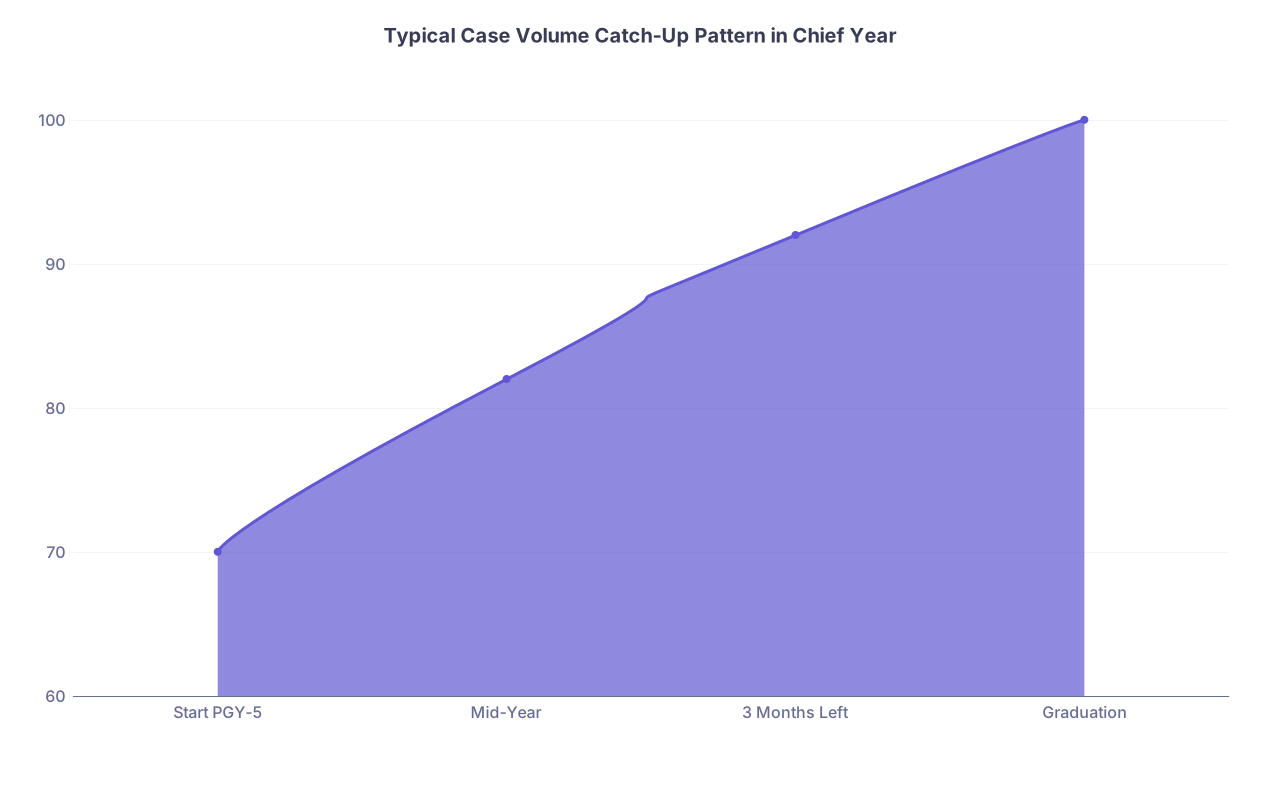
| Category | Value |
|---|---|
| Start PGY-5 | 70 |
| Mid-Year | 82 |
| 3 Months Left | 92 |
| Graduation | 100 |
What About Fellowship and Future Jobs?
This is the next round of panic: “If they see I barely hit minimums, will they think I’m weak?”
Fellowship directors and employers rarely see your raw ACGME case log. They see:
- PD’s letter
- Chair’s letter
- Comments about your operative performance
- Whether you’re trusted to run cases independently as a chief
- Sometimes a summary of exposure (“solid operative volume,” “excellent case mix,” etc.)
If you patch this up before graduation and your PD can honestly say you met requirements and are safe and competent, this doesn’t need to be some giant black mark.
Where it does hurt:
- If you end up extending training and have to explain that in interviews
- If your PD writes a lukewarm letter around autonomy/operative independence
- If you truly never get comfortable with bread-and-butter operations
But being currently below minimums while you still have time to fix it? That’s not a career obituary. It’s a warning light on the dashboard telling you to pull over and adjust course.
Worst-Case Scenario: What If I Really Don’t Make It?
Let’s go all the way there, because your brain is going there anyway.
Imagine it’s June. You’re still significantly below in one or more core categories, and your PD doesn’t feel comfortable signing off.
What actually happens?
- You’re usually offered extended training – extra months or a defined period
- You probably have to rearrange your plans (fellowship start, moving, etc.)
- Your co-residents graduate ahead of you, and that stings
- But: you still become a board-eligible surgeon when you’re done
It’s humiliating in the moment. It feels like everyone’s staring and whispering. But a year later? Most people barely remember. In five years? No one cares. You’re just a surgeon.
The alternative—graduating shaky and underprepared—haunts you for much, much longer.
So yes, the worst case is painful. It is not the end of your career. It is not “you’re never going to be a surgeon.” It’s a delay. A problem to be fixed, not a death sentence.

| Step | Description |
|---|---|
| Step 1 | See low case numbers |
| Step 2 | Meet with PD |
| Step 3 | Targeted scheduling |
| Step 4 | Add extra rotations |
| Step 5 | Graduate on time |
| Step 6 | Extend training |
| Step 7 | Later graduation and board eligibility |
| Step 8 | Time left in year |
| Step 9 | Hit minimums |
How To Keep This From Destroying Your Confidence
Being short on cases can mess with your head. You walk into the OR feeling like everyone secretly knows your numbers. You second-guess yourself. You feel guilty asking to operate more because you don’t want to look needy or incompetent.
Here’s the reframe: advocating for your operative experience is part of being a safe, responsible senior.
Tell attendings straight up:
- “I’m short on [X] category and trying to build my volume. Can I take the lead on this case?”
- “Can we structure this so I do as much of the critical portion as you’re comfortable with?”
- “I’d like to drive as much as possible; I’m specifically working on my [laparoscopy, vascular exposures, stapling, etc.].”
That doesn’t sound weak. That sounds like someone growing into an attending who knows their numbers, their limits, and their needs.
And ignore the imaginary audience in your head. Most attendings don’t know your case log. They know whether they trust you in their OR. Your job now is to show up prepared, speak up, and ask for structured, meaningful involvement.

A Quick Reality Check on Systemic Issues
One more thing your anxious brain conveniently forgets: this is not all your fault.
We’ve had:
- COVID years with wiped-out elective cases
- Hospitals losing key services (vascular, bariatrics, etc.)
- OR staffing crises
- Competing learners (fellows, NPs, PAs) in the OR
- Shifts in inpatient vs outpatient settings
If half your class is under in the same categories, that’s not a “you” problem. That’s a program/systems problem. And it changes how harshly anyone should be judging you.
Will PDs and ACGME still expect solutions? Yes. But nobody sane is looking at a COVID-era chief with slightly low elective numbers and saying, “Wow, failure of a surgeon.”
Be honest about where you could’ve advocated sooner or asked for more responsibility. But don’t carry the weight of a broken healthcare system as personal moral failure.
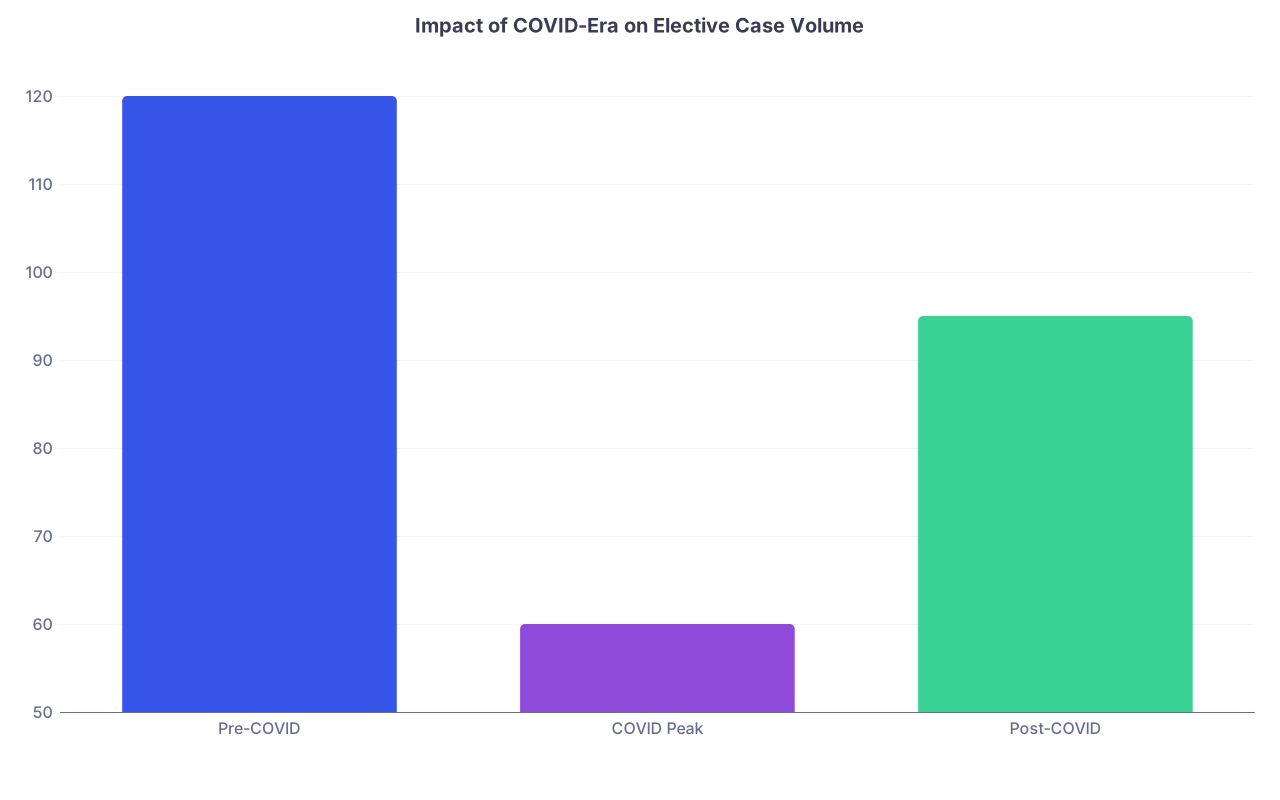
| Category | Value |
|---|---|
| Pre-COVID | 120 |
| COVID Peak | 60 |
| Post-COVID | 95 |
FAQ – Exactly What Your Brain Is Probably Asking
1. “If I tell my PD I’m below minimums, will they think less of me?”
If your PD is even halfway decent, they’ll think more of you for catching it early and wanting a plan. What they hate is the resident who pretends everything is fine until the last evaluation meeting of the year and then bursts into tears.
2. “Should I start secretly over-logging or stretching what counts?”
No. Absolutely not. Case log fraud is a real thing. People have gotten into serious trouble for it. ACGME and boards take that way more seriously than being slightly under numbers. You’d be risking your entire career to hide a problem that’s usually fixable.
3. “Will fellowship programs find out if I had to extend residency?”
Yes, usually. Your PD’s letter and application will show your training dates. If you extend, you explain it. The key is owning it: “I had lower volume in X, we extended my training to hit requirements, now I’m stronger in that area.” It’s not ideal, but it’s survivable.
4. “What if my co-residents all have way higher numbers than me?”
Then you ask why. Did they get different rotations? More elective blocks? Were they more aggressive about getting into cases? Sometimes it’s just bad luck. Sometimes it’s fixable behavior. Use that comparison as data, not as a whip to beat yourself with.
5. “Should I change my career plans if my operative volume is low?”
Not automatically. Low numbers in residency don’t mean you can’t become a highly competent surgeon. But if your numbers are low and you feel shaky and you hate being in the OR? Then, yeah, that’s a different conversation about fit. Separate the numbers from the deeper question: do you actually want this work?
6. “Is it already too late in PGY-5 to fix this?”
It depends how far under you are and how much time is left. I’ve seen people make up surprisingly big gaps in the last 3–4 months with aggressive, focused scheduling and PD support. The only time it’s truly “too late” is when you keep quiet until the final sign-off meeting.
Here’s what you can do today, before you lose another night of sleep over this:
Log in to your ACGME Case Log, generate a detailed report, print it, and highlight every category where you’re below minimums. Then email your PD (or APD) asking for a 20–30 minute meeting this week specifically to review your case volume and make a plan to meet requirements before graduation.