
What actually happens if you finish residency and… you can’t safely operate on your own?
That’s the nightmare, right? Not just “I’m a little rusty,” but the darker version: you’re an attending, the scrub tech is looking at you, the room is quiet, and you realize you have no idea what to do next. Everyone’s about to find out you somehow faked your way through residency.
You’re not crazy for worrying about this. I’ve heard almost every version of this fear:
- “What if I match at a small program and don’t get enough cases?”
- “What if AI/robots take over and I never learn to do the real surgery?”
- “What if my senior hogs the cases and I’m the PGY-5 who can’t do an appy alone?”
Let’s walk through this like someone who’s actually afraid, not like some glossy brochure telling you “All ACGME programs are excellent and you’ll be fine.”
Because no—people do graduate feeling under-prepared. But what happens next isn’t the horror movie you’re picturing.
First: Does This Actually Happen?
Short answer: yes. Not to everyone, but to enough people that attendings openly talk about it.
I’ve heard:
- A new general surgeon saying, “My first year out was basically finishing the residency I wish I’d had.”
- A newly-minted OB/GYN quietly admitting they didn’t feel okay with forceps deliveries solo.
- An ortho attending saying, “I needed my first job to be in a low-acuity community setting because I knew I wasn’t ready for big joints yet.”
You’re not making up a fake fear. It’s real. But the reality is more… fixable than it sounds.
There are three main “under-prepared” flavors:
- Not enough volume (didn’t do enough cases).
- Not enough autonomy (you did the case but never really ran it).
- Not enough breadth (your program is strong in some areas, weak in others).
Each of those has different consequences and different fixes.
The System Is Imperfect… And Weirdly Redundant
Here’s the part nobody advertises: residency alone is rarely what makes you fully “ready.” It’s residency + your first job + sometimes fellowship + ongoing CME + mentorship.
Especially in surgery.
Most people don’t finish residency as fully independent masters of their entire field. They finish as:
- Safe for common stuff.
- Slow on harder stuff.
- Needing backup for complex or rare situations.
That’s normal. Even the talented ones.
The question in your head, though, is more extreme: What if I’m not “normal-new-attending-uncomfortable,” but “actually unsafe”?
Let’s pull the drama down with some structure.
| Stage | What You *Hope* You Feel | What People Actually Feel |
|---|---|---|
| Mid-residency (PGY-2/3) | Clumsy but improving | Overwhelmed, clumsy |
| Senior (PGY-4/5) | Running the room | Half-running, half-asking |
| Graduation | Mostly ready | Ready for some, not others |
| First job/Fellowship | Minor learning curve | Huge growth phase |
Most surgeons will tell you they really became surgeons in:
- Fellowship, or
- The first 2–3 years in practice.
So if you’re imagining that at graduation you’re either 100% ready or a total fraud, that’s already the wrong framework. The reality is a gradient.
Still, that doesn’t help if you’re at a program where your logbook is frankly thin, or you’re the “scut magnet” who got sidelined from the OR.
Let’s talk worst-case.
Worst-Case Scenario: You Graduate and You’re Not Ready
Picture this honestly:
You finish residency. Your case log technically meets the minimum, but barely. You feel shaky closing basic cases, let alone handling intra-op disasters. You get a job anyway.
What happens?
1. The first job you take matters a lot
This is where people quietly compensate for what they didn’t get in residency.
If you know you’re under-prepared operatively, you do NOT go straight to:
- High-volume trauma center as solo surgeon
- Rural hospital with no backup
- Super-sub-specialized niche with no mentorship
You look for:
- Group practice with experienced partners who actually scrub with you early on
- Lower-acuity community hospitals
- Slower ramp-up on complexity and call
And yes, people do this intentionally. I’ve seen attendings say, “I chose a very supported first job because I knew I wasn’t ready to be a cowboy.”
Is this what you want your future to look like? Probably not. But is it a disaster? No. It’s a detour.
2. You lean on fellowship like a second residency
Fellowship is often where people “fix” gaps. And not just the gunners. A lot of people do fellowships because:
- They want more reps
- Their residency didn’t have strong volume in a key area
- They want structured supervision while they get more autonomous
General surgery → MIS, colorectal, breast, trauma/critical care, surgical oncology, etc.
OB/GYN → MFM, REI, urogyne, MIGS.
Ortho → literally everything.
Plenty of those fellows will tell you: “I came here because I didn’t feel operatively strong enough coming out of residency.”
It’s a thing. You’re not the first.
3. There are safety nets
Hospitals don’t just throw fresh attendings into the deepest end with zero oversight and no process. There are:
- Proctoring periods
- Required case reviews
- Gradual granting of privileges
- Morbidity & mortality conferences
- Peer review
If you’re really not ready, one of these things will catch the issue. At worst, it’s painful for your ego. At best, it literally protects patients.
And if early on you say, “I don’t feel comfortable doing X independently yet,” people don’t usually crucify you. They’re more likely to respect you for knowing your limits.
But What If It’s Not Just Me… What If Medicine Is Changing Too Fast?
This is the other layer of fear: not just “What if I am under-prepared?” but “What if everyone is under-prepared because the field is moving too fast?”
Robots. AI. Image guidance. Endovascular techniques. Augmented reality tools. Smaller incisions. Outpatient everything.
You can graduate fully competent in open surgery and then realize the entire field is trending minimally invasive + image-guided + tech-heavy.
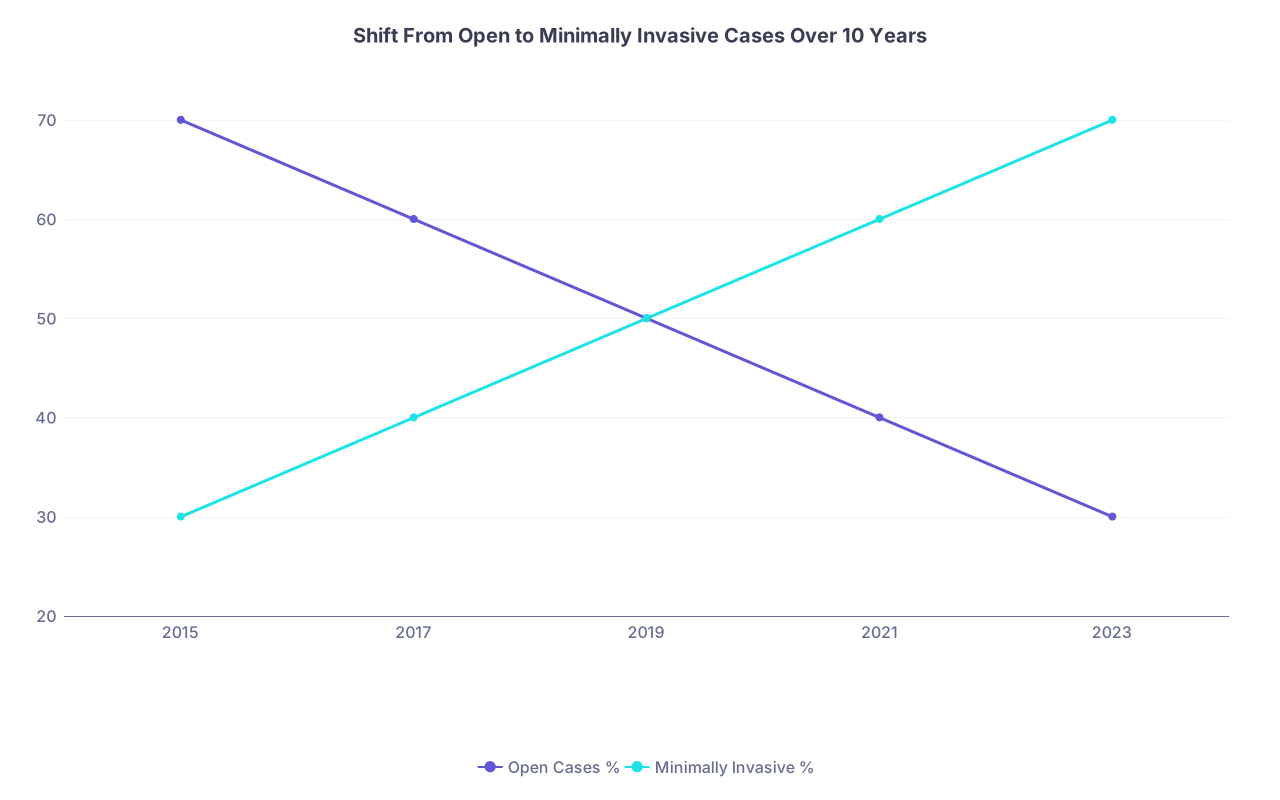
| Category | Open Cases % | Minimally Invasive % |
|---|---|---|
| 2015 | 70 | 30 |
| 2017 | 60 | 40 |
| 2019 | 50 | 50 |
| 2021 | 40 | 60 |
| 2023 | 30 | 70 |
No residency can fully prepare you for how your specialty will look in 15–20 years. That’s a gross truth.
So even if you don’t feel under-prepared at graduation, fast-forward a decade and you might again.
Which means: long term, the most important skills aren’t specific procedures. It’s your ability to:
- Learn new techniques
- Admit what you don’t know
- Seek out training after residency
- Adapt without getting defensive or stuck in “this is how I was trained”
That sounds like inspirational garbage until you talk to older surgeons having to learn robotic surgery in their 40s/50s. Some do it. Some refuse and slowly get pushed to the margins.
Your worst-case scenario might not be “I graduate under-prepared.” It might be “I stop learning later and become unsafe.”
That’s scarier, honestly.
So What Can You Actually Do If You’re Afraid of Being Under-Trained?
You can’t control everything, but you’re not powerless either. There are levers you can pull even as a student or early resident.
As a med student / applicant
You can’t fix the system, but you can at least stop walking into obviously bad situations blind.
Watch for red flags on the interview trail and on sub-Is:
- Residents saying, “We don’t get to close” or “Attendings don’t let us do much.”
- Complaints about “service over education.”
- Case logs that barely scrape ACGME minimums.
- Chiefs who look exhausted but not particularly skilled.
And green flags:
- Seniors running portions of cases with attendings genuinely acting as assistants.
- Explicit graduated autonomy: “By PGY-4 you are doing X independently.”
- Programs transparent about case numbers, not defensive.

| Step | Description |
|---|---|
| Step 1 | Visit or Interview |
| Step 2 | Be Skeptical |
| Step 3 | Consider Other Programs |
| Step 4 | Potential Under-training |
| Step 5 | Stronger Option |
| Step 6 | Residents Honest? |
| Step 7 | Good Case Volume? |
| Step 8 | Senior Autonomy Shown? |
If you’re already in med school: use away rotations to see real resident autonomy, not just ask about it.
As a resident who’s already in a less-than-ideal situation
This is where the anxiety spikes: “I matched where I matched. What now?”
You still have options:
- Call your PD’s bluff. Be very explicit: “I’m worried about my operative readiness. I want more primary surgeon experience in X and Y. How can we adjust my schedule?”
- Track your own cases aggressively and identify gaps early (PGY-2/3, not five months before graduation).
- Ask to scrub with certain attendings known to give autonomy.
- Trade call/clinic coverage with co-residents in exchange for more OR time when possible.
- Use simulation labs like it’s your second home. Laparoscopy boxes, suturing labs, robotic simulators. People underrate how much this helps when real OR reps are limited.
- Moonlight later in residency in safe, supervised environments if allowed (small procedures, urgent care laceration clinics, etc.).
None of that fully replaces volume, but it’s not nothing.
What If I’ve Already Graduated and Realize I’m Under-Prepared?
This is the part nobody talks about openly, but it happens.
You’re out. You feel it in your bones: “I’m not where I need to be.”
Options are limited, but not zero:
Be brutally honest about your scope.
Narrow what you do. Stick to the cases you can do safely. Refer out borderline stuff. That’s not weakness; that’s being a grown-up.Find a mentor at your job.
Ask a senior colleague, “Can I scrub more with you for a bit? I want to solidify my skills with XYZ.” The good ones will say yes. They know residency quality is variable.Courses and mini-fellowships.
Cadaver labs, industry courses, short advanced courses. They’re not magic, but they make a difference.Actual fellowship, even late.
It’s not common, but people do go back for fellowship after being in practice if they feel underpowered. It’s humbling, but absolutely possible.Switch practice settings.
Move from solo/rural to group/academic/community with more support. Again, your ego will scream. Your patients won’t care; they’ll just be safer.
Your worst fear is you’ll be exposed as an imposter and lose everything. What actually tends to happen is more subtle: you quietly adjust your practice, seek help, and grow into the surgeon you were supposed to become during residency—but a little later.
The Real Question Underneath Your Fear
I’m going to say the quiet thing out loud.
A lot of this anxiety isn’t truly about case numbers or robots or fellowships. It’s: “What if I’m not good enough to ever feel competent, no matter how many chances I get?”
Because if you believe that, every discussion about “you can catch up” feels fake. Like people are handing you participation trophies while you drown.
So here’s the honest take:
- If you have basic technical aptitude, work ethic, and the ability to self-criticize without collapsing, you can absolutely become a safe surgeon even if your path is messy and delayed.
- If you ignore your deficits, overestimate yourself, blame everyone else, and never seek help… then yeah, you can absolutely be dangerous.
Your anxiety, annoying as it is, actually pushes you toward the safer path. The person not worrying about being under-prepared is a bigger hazard than you.
You’re not doomed by a single imperfect residency. You’re only doomed if you decide “this is who I am forever” and stop adjusting.
FAQs
1. How many cases do I really need to feel “ready”?
There’s no magic number that flips a switch from terrified to confident. ACGME minimums are honestly… minimums. A lot of residents feel functional well above those thresholds.
What matters more than the raw number is:
- How many cases you were the primary surgeon on.
- How often you handled the hard parts (dissection, hemostasis, managing complications), not just skin closure.
- Whether your senior years gave you real autonomy.
You could do 100 of something as “second pair of hands” and feel useless, or 30 with full responsibility and feel competent.
2. What if my co-residents are better than me technically?
There will always be that one person who seems born with perfect tissue handling and instrument skills. If you compare yourself to them, you’ll always feel behind.
Being a safe surgeon isn’t about being the fastest or flashiest. It’s:
- Knowing your limits.
- Preparing obsessively.
- Staying calm when things go sideways.
- Asking for help early instead of trying to be a hero.
A technically gifted but arrogant surgeon can harm more patients than a slower, careful one who knows when to call for backup.
3. Can simulation really make up for low operative volume?
It doesn’t fully replace real OR time, but I’ve seen it move people from “dangerous” to “decent” and from “decent” to “solid.”
Simulation helps you:
- Build dexterity and muscle memory safely.
- Practice steps of procedures until they’re automatic.
- Make the real OR time you do get more productive because you’re not fumbling with basics.
You won’t become a master laparoscopic surgeon on a box trainer alone. But if your volume is borderline, sim can be the difference between “barely functioning” and “relatively competent.”
4. What if residency and fellowship both fail me—am I just stuck?
No. You’re stuck only if you insist on doing procedures you’re not good at and refuse to narrow your practice or seek extra help.
You can:
- Redefine your practice scope.
- Shift to a more supported environment.
- Double down on specific areas of training through targeted courses and mentorship.
- In extreme cases, redirect your career partially or fully (clinical leadership, education, non-op roles).
Is that the dream you started with? No. But it’s also not the catastrophic failure you’re imagining alone at 2 a.m.
Open whatever program list, rotation plan, or career notes you have right now and circle one thing: either a program you’re worried about, a rotation you fear won’t train you, or a skill you know is weak. Then write down one concrete step you can take this week to address that specific gap—not “fix everything,” just that one.