
You’re standing in the call room at midnight, scrolling through your ACGME case log. Again. You filter by role and your stomach drops: “Assistant” and “Second Assistant” everywhere. The “Surgeon Junior” column looks embarrassingly thin. You start doing mental gymnastics: “Are fellowship directors going to think I never actually did anything? Does this make me look like dead weight in the OR? Did I just… waste my residency?”
Let’s drag all of that panic into the light and pick it apart.
First, the ugly thought you’re afraid to say out loud
You’re not worried your case log is “a little light.”
You’re worried that when some fellowship PD opens your case report, they’ll think: “Wow, this person never led a case. Pass.”
Or that when board eligibility comes, someone will actually say: “Yeah… these numbers don’t show enough primary surgeon experience.”
And there’s that added dagger: you know co-residents who’ve been primary on a ton of cases. They casually drop, “Oh yeah, I was surgeon junior on that Whipple,” while you’re logging yet another lap chole as second assist because the chief took it.
So you’re stuck in that awful comparison loop:
- Same program.
- Same year.
- Same ORs.
- But their “Surgeon Junior” column looks like a forest and yours looks like a house plant.
Here’s the thing nobody really tells you out loud: your case role distribution is not just about you. It’s about rotation structure, attending preferences, who’s on service with you, call patterns, what months you had which chiefs, and dumb luck. And yes, sometimes your own passivity or hesitancy. But not only that.
Let’s separate three different anxieties here, because they’re not the same problem:
- “Will this hurt my fellowship chances?”
- “Will my program/ACGME say I don’t meet requirements?”
- “Am I actually less prepared and less competent than my co-residents?”
Different answers. Different level of danger.
What programs and PDs actually look at in case logs
They don’t sit there counting how many times you were second assist on an appy versus first. They don’t have that kind of time, and honestly, they don’t care that much.
For most PDs and boards, they’re looking for:
- That you meet minimum numbers in key categories
- Some evidence of progression in role (more primary toward the end)
- That nothing is wildly off or obviously padded
Here’s the blunt truth: the distinction between “assistant” and “second assistant” is largely meaningless to most people reading your log. Both say: “You’re not primary.” That’s it.
Where the anxiety comes from is this imaginary PD voice saying, “Why were they never the surgeon junior?” So let’s ground that with how they actually think:
- They know some programs are chief-heavy or attending-heavy.
- They know case volume varies wildly by institution and rotation.
- They know some residents are earlier loggers and some backfill their logs in clumps.
- They know that the report isn’t pure truth; it’s a rough sketch.
Fellowship programs in surgery rarely reject people solely based on the detailed breakdown of “assistant” roles. They care far more about:
- Letters from surgeons who say, “This person can run a case and make safe decisions.”
- How you talk through a case on interview day.
- Whether you seem technically confident when you describe your experience.
- Procedural exposure relevant to their field (e.g., colorectal cares more about your colon cases than your hernia count).
If they do look at logs, it’s usually a quick sanity check:
- Is this person roughly at or above what we expect for this specialty and year?
- Do they at least have a subset where they were clearly the primary/first surgeon?
That’s it. Nobody is printing out a PDF and circling every “assistant” line in red ink.
The real risk: not the second assists, but the pattern
Here’s where your fear might have a tiny foothold in reality.
If your case log shows all of these at once:
- Total numbers barely scraping minimums
- Very few “surgeon junior/primary” cases, even late in residency
- No clear evidence of progression in responsibility
…then yes, that’s a red flag. Not because “second assist looks weak,” but because it suggests you might not have had enough independent hands-on operating.
Let’s make that concrete.
| Pattern | Total Volume | Primary Cases Late PGY | How It Looks |
|---|---|---|---|
| A | High | Moderate-High | Normal, strong |
| B | High | Low | Possible concern about autonomy |
| C | Low | Low | Major concern / needs explanation |
| D | Moderate | Moderate | Fine, typical resident log |
Most anxious people like you are actually in Pattern B or D. You’ve got volume. You just obsess over how many times you were “primary.”
Pattern C is where someone really needs an intervention: low volume plus low autonomy.
If you’re already feeling your stomach twist reading that, pause and actually look at your data before you assume you’re Pattern C. Anxiety loves assuming the worst case without checking.
Why you keep ending up as second assist (and what’s actually your fault)
You probably have a whole mental list of reasons you’re always the second assist:
- The chief always scrubbed in and took primary.
- This attending doesn’t let residents do much.
- The fellow runs everything on that service.
- You’re on tough cases that always have two residents.
Some of this is completely legitimate. Certain services are notorious for being fellow-driven. Certain attendings hoard cases or trust only a specific PGY level. Some rotations are just bad luck.
But I’m going to say the uncomfortable thing: sometimes we hide behind that as a shield, instead of asking for the case.
I’ve seen this play out:
- Scrub tech sets up.
- Attending strolls in.
- Chief quietly positions themselves as primary.
- You just… stand where there’s space left, and boom: second assist.
And you never say: “Dr. X, do you mind if I take primary on the gallbladder and [chief] supervises?” Or: “I’d really like to be surgeon junior on this one if that works.”
You know who does say that? The slightly annoying but undeniably effective co-resident who now has 200 more primary cases logged than you.
Sometimes you weren’t given the chance. But sometimes you also didn’t fight for it. And I don’t mean in a rude way—I mean in a clear, direct, professional way. The system rewards the ones who ask.
That’s not fair. It’s just how it is.
How much second-assisting is actually “normal”?
Let’s be real: almost every surgical resident looks at their logs and thinks, “Why wasn’t I primary on more of these?”
Early years? You’re supposed to be assisting a ton.
Middle years? Mix of assistant and primary.
Late years? Heavier on primary/autonomous cases.
The key question isn’t: “Do I have too many second assists?”
The question is: “Did my role evolve over time, or did I flatline as ‘just another pair of hands’?”
If you can see a trend where by PGY-4/5 you’re logging more cases as surgeon junior/primary, your log probably looks fine to anyone reading it.
If that trend is absent, that’s where you don’t just sit and worry—you use it as a signal to act now, not later.
Concrete things you can actually do about this (not just catastrophize)
You don’t have to just hope this all magically looks better by graduation. You can be tactical.
1. Audit your own log with ruthless honesty
Actually sit down and analyze it like a PD might. Not doom-scroll. Analyze.
- Look at year-by-year breakdown of roles.
- Look at your main procedures (e.g., lap chole, hernia, colon resection, appendectomy).
- For each, ask: “Do I have a reasonable mix of primary vs assist for my level?”
If your inner voice is screaming “We’re doomed,” try to quantify it. “Reasonable mix” might be something like:
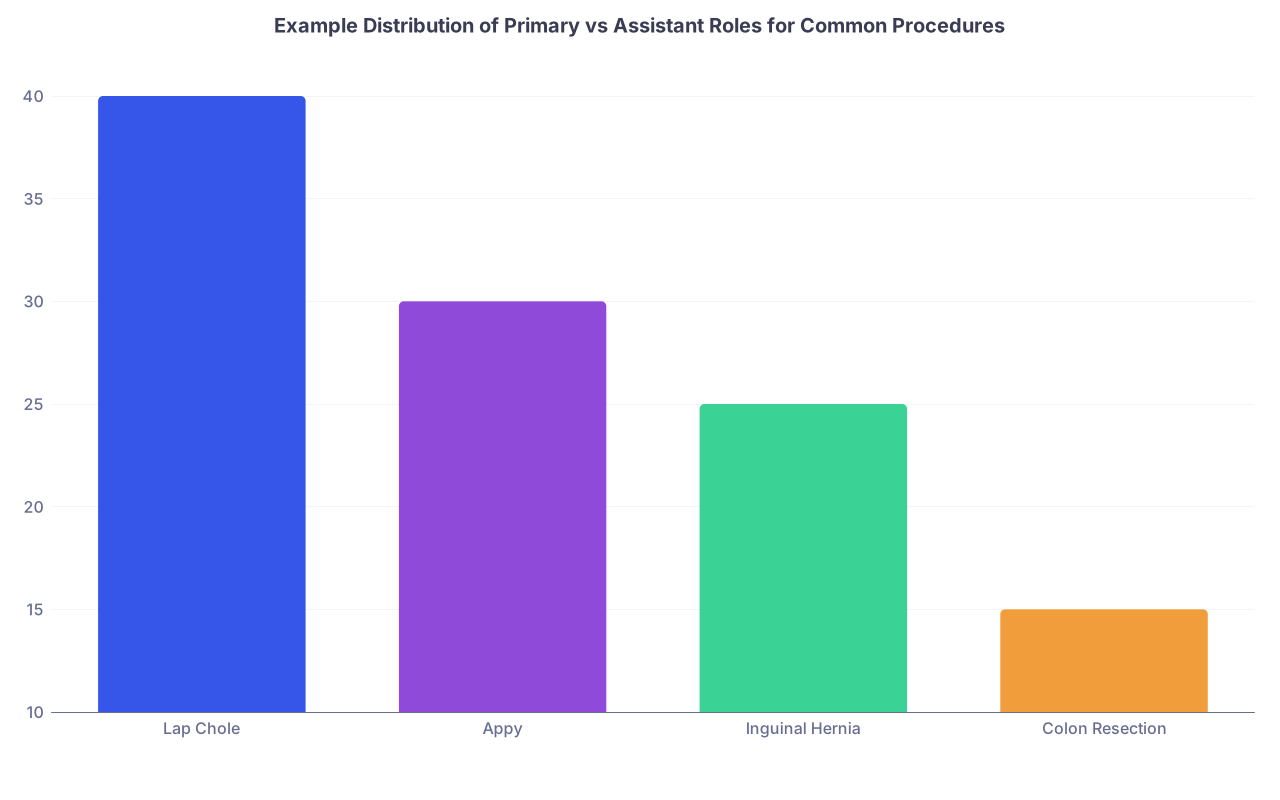
| Category | Value |
|---|---|
| Lap Chole | 40 |
| Appy | 30 |
| Inguinal Hernia | 25 |
| Colon Resection | 15 |
Imagine those numbers represent your primary cases, with your assistant/second assist numbers being higher (which they almost always are). If you’re somewhere in this ballpark, you’re not a disaster. Even if it doesn’t feel like it.
2. Talk to your program leadership like an adult, not a ghost
This is the step anxious residents avoid because it feels like walking into the PD’s office and saying, “Hi, I’m incompetent.”
You’re not. You’re advocating for your training.
Say something like: “Dr. Smith, I’ve been reviewing my case logs and I’m worried that my proportion of primary surgeon cases isn’t where it should be for my level. Can we look at this together and come up with a plan to increase my autonomy?”
Any half-decent PD/PC will:
- Check your data with you
- Compare you to co-residents quietly
- Suggest specific rotations/attendings to target
- Sometimes rearrange schedules or nudge chiefs/attendings
If they brush you off with “you’ll be fine” and no plan whatsoever, that’s on them, not you. But at least you created a record that you raised the concern.
3. Be explicit with attendings and chiefs before the case
Not in the OR when everyone is already scrubbed.
On rounds or at the board: “On tomorrow’s open hernia, can I plan to be primary and have [chief] be first assist? I really want more primary experience with open cases.”
Yes, it feels uncomfortable. Yes, you might get turned down sometimes. But you will get more yeses than if you say nothing.
How this looks to fellowship programs
You’re imagining a colorectal PD squinting at your logs and saying, “Only 17 colectomies as primary? Weak.” Then drawing a big red X across your app.
That’s not how this works.
They look at:
- Your total colon case volume (assistant + primary)
- How your letter writers describe your independence
- How you talk through management and intraoperative decision-making
- Whether your experience aligns with the rest of your application story
Case logs are rarely the deciding factor. They’re background noise unless something is really off.
If you’re worried, you can even preempt it in your personal statement or, better, in a letter request. For example, ask a trusted attending to address your operative autonomy directly:
“Although our program’s structure often results in shared cases at the assistant level, I have routinely trusted them to lead cases such as X, Y, Z, and they have demonstrated independent operative skill appropriate for fellowship.”
That carries far more weight than a column of numbers.
The deeper fear: “Am I actually undertrained?”
Forget fellowship and PDs for a second. This is the thing that gnaws at you at 3 a.m.:
“What if I finish residency or fellowship and I’m the attending who’s secretly unsafe? What if I don’t know what I don’t know because I never really operated enough?”
That fear is unpleasant but not useless. It’s the one that should drive your behavior now.
Ask yourself, for your target practice/fellowship area:
- Could I safely run a bread-and-butter case start-to-finish right now, if someone forced me to?
- Do I understand not just the steps, but what to do when things go a little wrong?
- Could I talk a junior through the operation logically?
If the answer is “honestly… not really” for the bread-and-butter stuff, then yes, you need more primary experience. That’s not a moral failing. It’s a training gap. And gaps can still be fixed while you’re in training.
Use the anxiety as fuel to:
- Ask for specific cases.
- Stick around late for the cases you need, even when you’re exhausted.
- Tell attendings, “I want to lead this one—can you talk less and let me struggle a little, within safety?”
Anxious people tend to assume they’re always behind. The loud confident ones assume they’re fine when they’re not. I’ve seen both in the OR. The scared ones usually end up better because they try to fix it.
Quick reality check vs your catastrophic brain
Let’s fact-check your internal narrative.
“Everyone else is primary way more than me.”
Maybe. But often, not as dramatically as you think. People brag about the insane cases, not the 8th lap appy they mostly assisted on.
“Fellowship PDs will reject me the second they see my logs.”
Unlikely. They care more about letters, reputation of your program, and how you perform on interview day.
“My case log makes me look weak.”
It might raise an eyebrow if you have low autonomy late in training. But even that can be explained or mitigated if you show insight, improvement, and get strong letters backing your real skills.
The biggest mistake isn’t having a lot of second assists. It’s doing nothing about it while you still have time.
What you can do today
Open your case log right now and do three things:
- Filter by PGY level and skim: does your primary role increase over time or not?
- Pick two bread-and-butter cases you need more primary experience with.
- Write down the name of one attending and one chief you can talk to this week and say, “I want more primary experience on these specific cases—can you help me plan that?”
That’s it. Don’t just sit here and re-read this in a panic loop. Go look at the numbers, and then have one uncomfortable conversation that might actually change them.
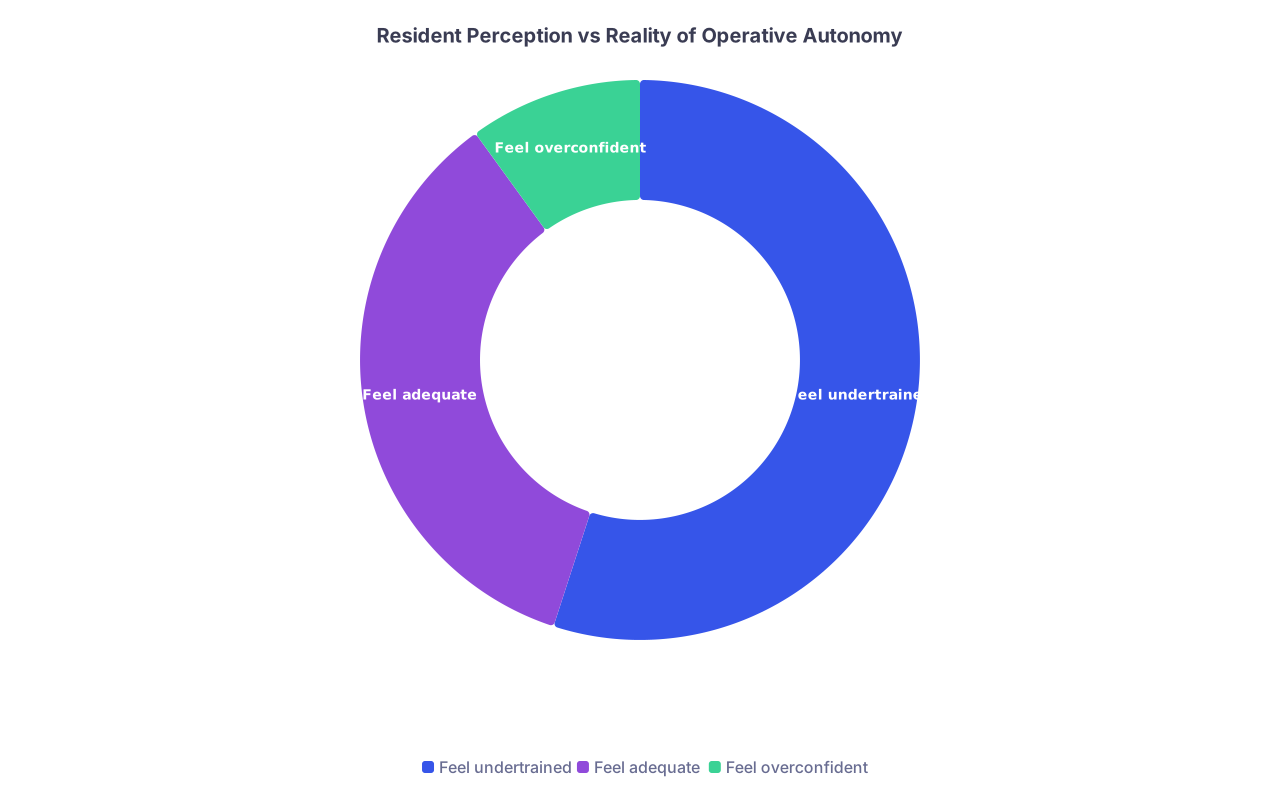
| Category | Value |
|---|---|
| Feel undertrained | 55 |
| Feel adequate | 35 |
| Feel overconfident | 10 |

| Step | Description |
|---|---|
| Step 1 | Review Case Log |
| Step 2 | Target Specific Procedures |
| Step 3 | Meet With PD |
| Step 4 | Ask Attendings For Primary Role |
| Step 5 | Adjusted Rotations Or Assignments |
| Step 6 | Monitor Logs Monthly |
| Step 7 | Progression in Role? |