What happens when you pull up your ACGME case log and realize you’re 40–60 cases below your co-residents in the exact area your dream fellowship cares about most?
That’s the sick-to-your-stomach moment a lot of us hit somewhere in PGY-4 or early PGY-5. You hear everyone flexing, “Yeah, I’ve got like 200 lap choles” or “I’m already at 120 scopes,” and you’re sitting there with… half that. And you’re about to apply to a fellowship that lives and dies by those exact numbers.
Let’s talk about that.
Because you’re not actually worried about “the numbers.” You’re worried about what those numbers say about you — to people who will decide your entire next step.
Will Fellowship Directors Notice Low Case Numbers?
Yes. They’ll notice.
They don’t always say it out loud. But they look. Especially in procedural subspecialties: MIS, colorectal, hepato-pancreato-biliary, vascular, thoracic, orthopedic sports, GI fellowships, cardiology interventional, etc.
They look at three things:
- Total volume – Are you roughly in the range of a typical graduate?
- Distribution – Do your numbers make sense for your claimed interest?
- Trajectory – Are you stagnant, or did you ramp up later?
Here’s the part that calms people down a bit: they aren’t sitting there with a ruler marking you “pass/fail” because you have 72 of something instead of 100. They’re pattern-recognizing.
They care way more if your numbers tell a coherent story than if they hit some magic threshold.
Still, if you’re, say, applying to advanced GI and your colonoscopy numbers are embarrassingly low, you’re completely normal for spiraling about it.
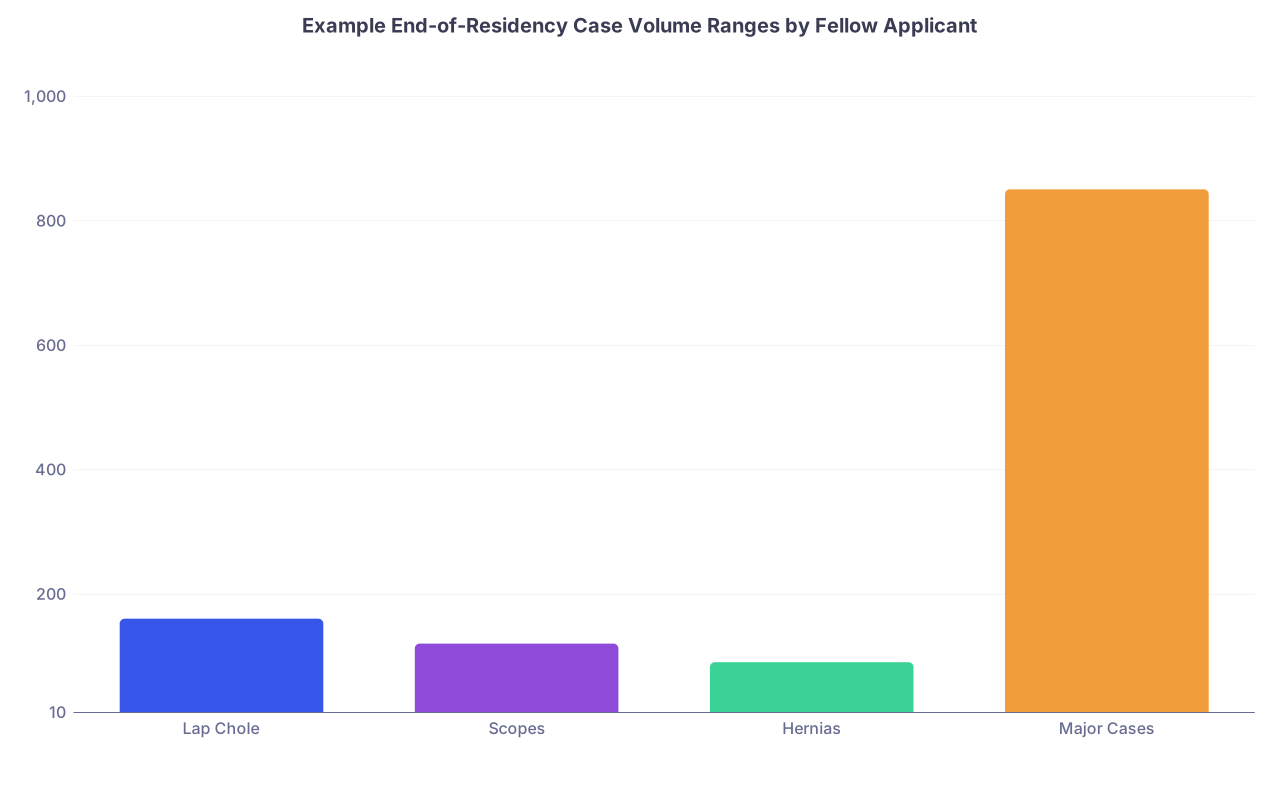
| Category | Value |
|---|---|
| Lap Chole | 160 |
| Scopes | 120 |
| Hernias | 90 |
| Major Cases | 850 |
But here’s the harsh-but-true part: they’re not blind. If you have a glaring hole in the exact domain you’re claiming is your passion, they will notice and they will ask themselves why.
Your job is to make sure:
- There’s an understandable reason, and
- You control that narrative, not your raw log.
What “Low Case Numbers” Really Signal To Them
Fellowship directors don’t see “88 colonoscopies instead of 150.”
They translate that into questions in their head:
- Did this program not offer enough volume in this area?
- Did this resident avoid certain cases?
- Did they have performance issues or need remediation?
- Did they choose research/admin/other stuff instead of the OR?
- Are they going to show up to fellowship underprepared?
Low numbers in a key area raise concerns, but they don’t answer anything by themselves. They just trigger: “We need context.”
That’s actually good news.
Because “we need context” is miles better than “hard no.”
Here’s what I’ve seen spook directors:
- Someone applying to colorectal with 15 major colon resections and almost no scopes.
- An “I want MIS more than anything” applicant with very average general lap numbers and no complex lap work.
- A future vascular surgeon with low open vascular numbers and no documentation of simulation or extra exposure.
On the flip side, here’s what they’ll usually accept as totally reasonable:
- Low volume in one niche because your program is insanely strong in another, and you’re compensating with electives/away rotations.
- Big bump in volume in PGY-4/5 (late blooming after being slower early on).
- High-complexity cases but slightly lower raw count (think heavy transplant or oncologic load).
So yeah, your numbers are going to get looked at. But they’re being read as signals, not final verdicts.
When Are Low Numbers Actually a Problem?
Some scenarios are just universally bad. I’m not going to sugarcoat these.
Low numbers start becoming a real red flag when:
The key area is essential to basic competence in your field
Example: finishing general surgery with barely above minimum lap choles. Not “fellowship interest” problem — “safety” problem.You’re dramatically below your co-residents in the same area
Everyone in your class has 130+ endoscopies and you have 40. That’s going to look like a you problem unless there’s a good explanation.You’re applying to a hyper-procedural fellowship and your log doesn’t show clear commitment to that skillset
Saying “I love interventional cardiology” with minimal cath lab exposure is like saying “I love running marathons” and listing “did a 5K once” on the CV.
| Situation | How Directors Likely Read It |
|---|---|
| You’re far below peers at same program | Possible avoidance or performance problems |
| Low in core bread-and-butter cases | Question about basic readiness |
| Low in niche of your intended fellowship | Concern about skill mismatch |
| Low overall but strong recent growth | Later development but potentially okay |
The worst is when low case numbers line up with something else negative:
- Mediocre letters
- No real research or academic involvement in that area
- Vague personal statement without a specific angle
- Interview answers that sound generic
That combination screams: “Didn’t really commit to this field.”
If all you have is a number problem but the rest of your application is rock solid, people are surprisingly willing to give you the benefit of the doubt — if you help them understand what happened.
Reasons That Actually Make Sense To Fellowship Directors
You probably already have a story in your head:
“My program under-books scopes.” “The chief took everything that moved.” “I rotated on transplant all year.” “I was on night float when all the cool cases happened.”
Some of these sound like excuses. Some of them are completely legitimate. The trick is framing.
Here are reasons I’ve heard directors accept without blinking:
Program structure:
“Our residency is extremely heavy in trauma and acute care; elective MIS and bariatric volume was limited, so I used electives and outside rotations to get more exposure.”Case mix quirks:
“We serve a low colorectal cancer population; to strengthen my experience, I did an away at X program and spent time in Y’s clinic.”Late switch in interest:
“I initially thought I’d do acute care surgery, so my earlier rotations reflect that. Once I realized I was drawn to MIS, I focused all my later rotations and extra time on that — you’ll see that trajectory in the case logs.”Pandemic or service disruptions:
“During COVID, electives were significantly reduced and we staffed emergency-only cases for several months, which depressed my early numbers in endoscopy.”
You know what doesn’t land well?
- “We just didn’t have enough cases.” (Full stop. No evidence you tried to fix it.)
- “My seniors took everything.” (Reads as passive and a little whiny.)
- “The system was against me.” (Even if partly true, directors want problem-solvers.)
You need to show:
“I recognized this gap, I cared about it, and here’s what I did about it.”
What You Can Do If You’re Still in Training
If you’re reading this and you’re not PGY-5 in the final month yet, you still have levers to pull. Not magical ones — but real ones.
Figure out which category you’re really in:
- You’re a bit low but not catastrophic → salvageable.
- You’re seriously low and graduating soon → you need to be very intentional.
Concrete moves that actually help:
Ask for targeted rotations:
“I’d like to spend an extra 2–4 weeks on GI/MIS/vascular/endoscopy to strengthen my experience for fellowship applications.”Be aggressively proactive with staff:
“I’m working on my case numbers in ___; can you page me when you have X type of case?”
Some attendings genuinely don’t realize how much you care about that area unless you say it.Use electives for skill-building, not just break time.
Directors don’t care that you took a “fun” elective. They care that you took an intentional one that matches your stated goals.Document simulation and focused training.
If your real case volume is low but you’ve done 50+ hours of simulation or skills labs, put that in your CV. It doesn’t replace cases, but it helps the story: “I didn’t just shrug and accept my deficit.”

| Step | Description |
|---|---|
| Step 1 | Notice Low Numbers |
| Step 2 | Request Focused Rotations |
| Step 3 | Emphasize Other Strengths |
| Step 4 | Increase Targeted Cases |
| Step 5 | Explain Context In Application |
| Step 6 | Still Time In Training |
You might not fully “fix” your numbers, but you can absolutely show direction: “Once I realized this, I moved.”
Directors love that. They know life happens. They want to see persistence and intentionality, not perfection.
What If You’re Already Applying Or Graduating?
Here’s the nightmare scenario:
You open your ERAS/NRMP application, upload your case log, and your stomach drops.
Too late to change the numbers. So now what?
You can still manage how those numbers are interpreted.
Use these levers:
Personal Statement
Don’t ignore the elephant in the room. You don’t need to apologize for your log, but you can subtly weave in the reality.Example:
“Coming from a trauma-heavy program with modest elective MIS volume, I sought out additional opportunities in ___ through electives, extra call, and close collaboration with Dr. X in clinic and the OR…”Letters of Recommendation
This is huge. Your best sponsor in that weak area is a strong attending saying something like:- “Although our institutional MIS exposure is limited, [Name] has demonstrated excellent technical aptitude and proactive effort to gain additional experience.”
- “Despite case volume constraints, [Name] has progressed to operating at a fellow-like level on the cases available.”
That kind of line directly counters what your case log might suggest.
CV and interview talking points
You can highlight:- Focused elective time in that area
- Courses (SAGES, ATLS, endoscopy bootcamps, cadaver labs)
- Research that shows real engagement in that field
- QI projects targeting that domain
Then, in interviews, when someone says, “Tell me about your case experience in X,” you’re ready:
“Our raw volume in X is lower than many high-volume centers, but here’s what I did to maximize every opportunity, and here’s where my skills are now…”
That’s worlds better than staring at the floor mumbling:
“Yeah, our numbers weren’t great.”
When Should You Actually Be Worried About Competitiveness?
Let’s be honest: if you’re aiming for a very competitive fellowship and your case numbers are both:
- Clearly below peers, and
- In the exact key area for that specialty
…it will hurt you.
Not necessarily doom you, but you need to:
- Make your program list realistic (include a range, not just the name brands).
- Overcompensate with every other part of your file: letters, research, fit, narrative.
- Genuinely consider whether an extra year (research, non-accredited training, or a different practice path first) might make you stronger.
But here’s what’s driving your anxiety:
“What if every program sees my low numbers and assumes I’m incompetent?”
They don’t. Most of them have seen:
- COVID-era cohorts with weirdly low elective numbers.
- Programs with lopsided case mixes.
- Residents who started slow then accelerated.
They know the log is an imperfect tool.
What they will question is silence.
No explanation. No pattern of effort. Just: low numbers + vague application.
That’s the scenario that truly hurts.
Quick Reality Check
Three grounding truths:
Your numbers are probably not as catastrophic as they feel in your head.
You’re comparing yourself to the loudest/highest person in your class. Directors see entire national spreads.There is no single “kill number” below which no one matches.
I’ve seen people with very modest logs land solid fellowships because everything else was aligned and they had a believable story.You’re allowed to be a work in progress.
Fellowship is training. They’re not expecting you to show up as a finished product. They just don’t want to start from zero in their core domain.
So yes, fellowship directors will notice. Your job is to control what they conclude from what they notice.
FAQs
1. Should I bring up my low case numbers in interviews, or wait for them to ask?
If the gap is obvious and directly relevant to that fellowship, don’t wait. You don’t need to open with it, but when talking about your training you can say something like:
“While our endoscopy numbers are lower compared with some programs, that pushed me to be very deliberate about each case and to supplement with X, Y, and Z…”
You want to sound aware and proactive, not oblivious or defensive.
2. Can strong letters and research really offset low case volume?
They can’t erase a huge deficit, but they absolutely soften it. A letter from a respected surgeon or proceduralist directly vouching for your technical potential carries far more weight than a raw number. Combine that with real, topic-specific research and a coherent narrative, and a lot of programs will at least keep you in the serious pile.
3. Should I add simulation hours or lab courses to my CV to make up for low operative numbers?
Yes — as long as you’re honest and clear. Don’t oversell sim as equal to live cases, but absolutely mention them as evidence of effort and focused skill development. Something like: “Completed 40 hours of dedicated laparoscopic simulation focused on suturing and advanced camera skills” is concrete and helpful.
4. Is it ever better to delay applying a year to improve case numbers?
Sometimes, yes. If:
- You’re significantly below typical graduates in your area of interest,
- You have limited other strengths (weak letters, minimal research), and
- You have a realistic pathway to meaningfully improve your log (extra year, non-accredited fellowship, focused hospital job),
…then waiting can be smarter than rushing into an application that will likely underperform. But that’s a big move — it’s worth discussing honestly with mentors who know both you and your field’s competitiveness.
Key takeaways:
- Fellowship directors will notice low numbers in key areas, but they’re reading them as context, not automatic rejection.
- Your job is to show that you recognized the gap, did something about it, and still built real skills and commitment in that domain.
- Low case numbers alone rarely kill an application; low numbers plus no story, no effort, and no advocates is what actually sinks people.