Maximizing surgical case volume on community rotations is not about luck. It is about running a deliberate, aggressive system while everyone else treats the month like a vacation from the academic grind.
Most students show up to community sites assuming they will “see fewer complex cases” and “just do bread-and-butter.” That is the wrong mental model. Community rotations are where motivated students quietly rack up real operative experience—hands on skin, scope in hand, running the camera—while others are still retracting or watching from the corner.
You want numbers. You want reps. You want actual operative responsibility. Here is how you get it.
1. Understand the Game You Are Playing
Before you optimize anything, you need a clear picture of the environment you are walking into.
Community rotations are different from academic centers in four key ways:
| Factor | Academic Center | Community Hospital |
|---|---|---|
| Learner Competition | Med students + multiple residents | Often no residents; maybe 1–2 learners |
| Case Mix | Tertiary, complex referral cases | High-volume bread and butter |
| Surgeon Time | Fragmented, many learners/meetings | Fewer meetings; more direct OR time |
| Student Role | Observer/retractor-heavy | Can escalate to first assist if you push |
If you treat a community month like it is “lighter,” you will miss the opportunity. The leverage here is simple:
- Fewer learners → more potential cases per learner.
- Bread-and-butter pathology → faster turnover → more cases per day.
- Less rigid teaching structure → more room to hustle and design your own day.
Your job on day one is to:
- Map the OR environment.
- Identify high-volume surgeons.
- Make yourself the obvious default assistant.
You are not “going to your assigned case.” You are building a personal mini-fellowship in “anything with an incision.”
2. Day 1–2: Set Up the System That Prints Cases
You cannot improvise your way to high volume. You need structure from the start.
Step 1: Meet the OR power players (not just the attendings)
Within the first 24 hours, you should know by name:
- OR charge nurse
- OR front desk clerk / board coordinator
- Scrub techs for general surgery, ortho, OB/GYN
- PACU charge nurse
- At least 3–4 surgeons who operate most frequently
These people control access to information and opportunity.
Script for the OR charge nurse, early morning on day 1:
“Hi, I am [Name], the medical student on surgery this month. My goal is to help in the OR as much as possible and not slow anyone down. Is there a way I can see the full day’s OR schedule every morning, so I can plan which rooms to cover and pre-round appropriately?”
Be specific. You are not asking “if” you can see cases. You are asking “how.”
Step 2: Secure access to the OR schedule
You want daily and preferably weekly visibility. Options:
- Get read-only EMR access to the surgery schedule.
- If blocked, ask the clerk to print you:
- The next day’s OR block by noon each day.
- A weekly overview if possible.
Then you build your own tracking system. That can be a simple notebook or spreadsheet.

| Category | Value |
|---|---|
| Low | 2 |
| Adequate | 3 |
| Strong | 4 |
| Aggressive | 5 |
Aim for:
- Minimum: 3 cases/day.
- Strong: 4–5 cases/day regularly.
- Aggressive: 6+ on heavy days (short scopes, hernias, plastics, etc.).
Step 3: Run an evening planning ritual
Every afternoon before you leave:
- Pull tomorrow’s schedule.
- Mark:
- Which patients you are rounding on.
- Which cases you will attend.
- Where there are conflicts / overlaps.
- Decide:
- “Primary room” (the surgeon who knows you, where you are expected).
- “Secondary room” (quick cases you can slide into).
You should not show up at 6:30 a.m. trying to decide what to do. You should show up executing a plan you made at 4 p.m. the previous day.
3. The Daily Algorithm: How to Structure Your Day for Maximum Cases
Community rotations can become chaotic unless you impose a predictable framework. Here is a daily template that works.
Morning: Pre-round + prep for first cases
Pre-round efficiently (not sloppily)
- Focus:
- Overnight events
- Vitals and labs that matter for the OR:
- Hgb/Hct, platelets
- Cr for contrast or anesthesia
- Coags if relevant
- New issues that could cancel/postpone surgery.
- Write short, focused notes if expected.
- Focus:
Look ahead to the first two OR cases For each:
- Confirm consent and site in chart.
- Check key labs/imaging.
- Skim the op note of any prior relevant surgery.
- Be prepared to answer:
- “Why is this patient getting this operation?”
- “What alternatives did they have?”
- “Main risks we warned them about?”
Be physically present early in the OR
- In the room before the patient rolls in.
- Gowning/gloving only after asking scrub where they want you.
- Help position the patient and apply SCDs, foley, etc. Surgeons remember who helps early.
Between cases: Do not disappear
The most common way students lose volume: they vanish between cases “to chart” or “to go see something else,” and then someone else grabs their spot.
Between cases, your baseline behavior:
- Stay in or near the room unless:
- You must pre-round on a new post-op.
- You are explicitly sent elsewhere.
- Offer to:
- Help turn over the room (strip linens, move equipment).
- Help position for the next case.
- Quietly ask the scrub/anesthesia:
- “How many more cases for Dr. X today?”
- “Anything especially long or quick coming up?”
You are signaling: “I am here, reliable, and ready. You do not have to go hunt down another body.”
4. Make Yourself the Surgeon’s Default Assistant
Being “the student who is always around” is not enough. You have to become the obvious choice when an attending glances up and asks, “Who is in here with me?”
Step 1: Pick 2–3 surgeons to anchor to
You cannot chase everyone. Identify:
- 1–2 high-volume general surgeons.
- 1 other surgeon in a field you like (ortho, OB/GYN, vascular, ENT, etc.).
Your goal is to:
- Be present for most of their lists.
- Learn their preferences:
- Where they like hands.
- How they like the camera.
- Their pet peeves.
You are building trust. Trust = more responsibility = more meaningful case volume.
Step 2: Establish expectations directly
Script—say this to your main surgeon on day 2–3:
“Dr. [Name], I am trying to get as much operative experience as possible this month. I really appreciate being in your room. If it is alright with you, I would like to prioritize your cases when there are conflicts. Does that work for you?”
Most community surgeons will say something like, “Sure, if you want to work, I will keep you busy.” Perfect. That is your license.
Step 3: Do not fumble the basics
You want surgeons thinking: “Having this student in my room makes my life easier, not harder.”
Non-negotiables:
- Know how to:
- Gown and glove without contaminating.
- Open sterile items without touching the inside.
- Move the light without the surgeon telling you three times.
- Handle the camera correctly:
- Horizon straight.
- Target structure centered.
- Zoomed in enough that they are not operating from across the room.
- Retract intelligently:
- Anticipate where tissue will need exposure.
- Adjust quickly when the surgeon moves.
Mess up once or twice? Fine. Everyone does. Repeat the same basic error five times? You will get sidelined.
5. Maximize Volume on Short Cases and Scopes
Long oncologic cases and complex revisions are great for learning, but they kill your raw case count. Community hospitals are perfect for stacking quick wins.
Identify high-yield, short-duration cases
Common short cases in community settings:
- Laparoscopic cholecystectomy
- Inguinal/umbilical hernias
- Port placements
- Carpal tunnel, trigger finger, simple hand cases
- C-sections (once you have a stable OB team relationship)
- D&Cs, LEEPs, hysteroscopies
- Basic ENT: tonsillectomy, ear tubes
- Simple ortho: hardware removals, arthroscopies
Your planning trick:
- On days with many short cases → aim for volume (4–6 cases).
- On days anchored by one long open vascular case → accept lower count but push for deep involvement.
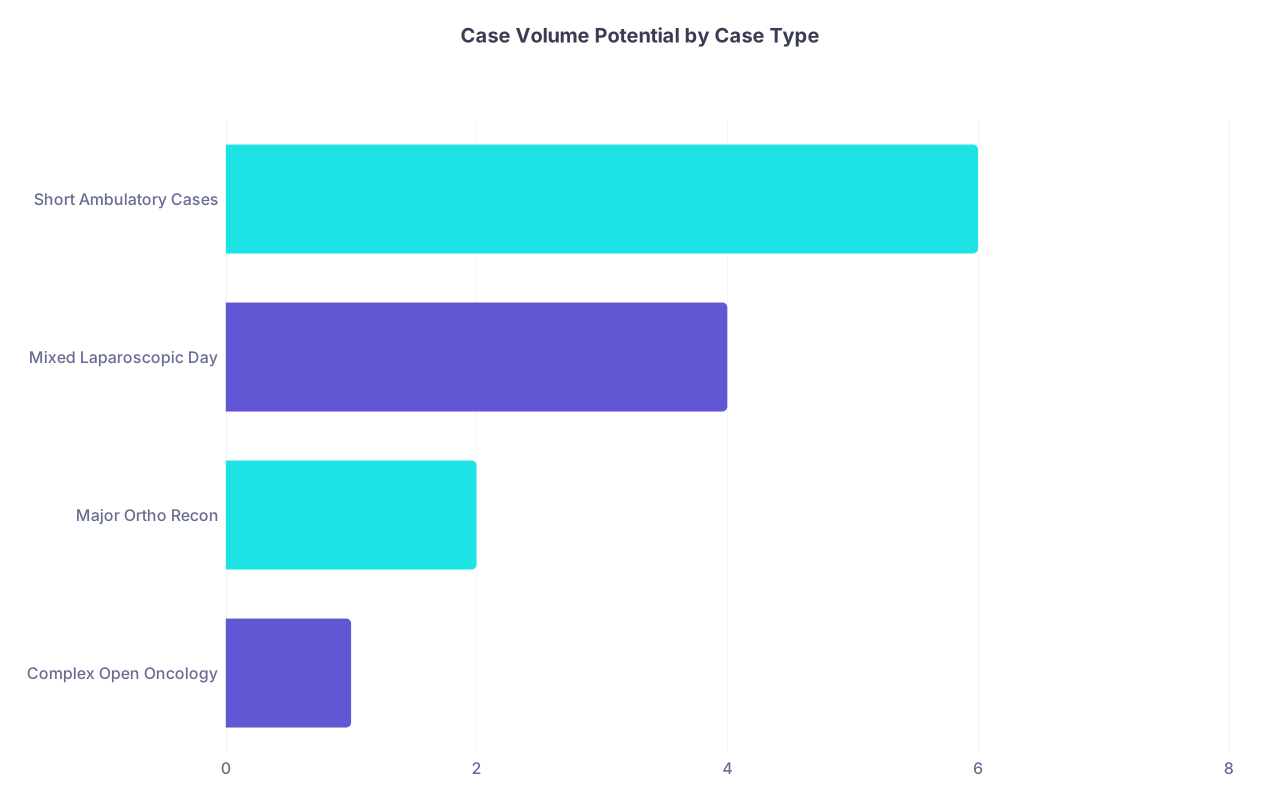
| Category | Value |
|---|---|
| Complex Open Oncology | 1 |
| Major Ortho Recon | 2 |
| Mixed Laparoscopic Day | 4 |
| Short Ambulatory Cases | 6 |
Use that when you choose which room to be in.
Exploit endoscopy lists
Many students ignore GI rooms. Mistake.
Yes, you might not be “operating.” But you are:
- Learning sedation workflow.
- Seeing a wide range of pathology quickly.
- Racking up procedure numbers (even as observer/assistant).
- Building relationships with another surgical-adjacent team.
Your goal in endoscopy:
- Start by:
- Handling scope controls for patient entry/exit.
- Controlling suction/air under direct guidance.
- After showing you are competent:
- Ask, “Could I try advancing the scope through the esophagus under your guidance?”
Some GI docs in community hospitals are extremely willing to teach, especially if you help move patients, place bite blocks, and are not on your phone.
6. Use Clinic and Floor Time Strategically (Not as an Escape)
Community rotations often have more clinic and floor coverage. If you trade OR time for clinic every day, your case numbers will suffer.
Rule of thumb
- When in doubt → OR > clinic.
- Use clinic/floor:
- When OR volume is low (e.g., afternoons with few cases).
- When explicitly required by your eval structure.
- To tighten relationships with surgeons on their non-OR days.
Be transparent:
“Dr. [Name], I am prioritizing OR time to maximize my operative experience, but I also want to respect your clinic requirement. Are there particular clinic days that would be most useful for me to join you?”
Then:
- Front-load clinic requirement early in the rotation if possible.
- Free late rotation days to chase ORs when you know the system better.
Do not waste dead time on the floor
If you are on the floor and there are cases going:
- Check the OR board.
- Ask your team:
“If there is any room needing an extra set of hands, can I head down between floor tasks?”
As long as notes and orders are not delayed, most teams do not care where you physically stand.
7. Boost Your Responsibility: From Observer to First Assist
Volume alone is meaningless if your role never advances beyond “third pair of hands.” On community rotations, you can often escalate quickly—if you do it right.
Step 1: Signal readiness in small ways
Before your first big jump in responsibility, show you can handle:
- Closing simple skin with interrupted or running sutures.
- Tying knots confidently (two-handed and one-handed).
- Using electrocautery safely without burning everything.
Practice on:
- Practice boards and foam pads at home.
- Suture kits in call rooms.
- Pigs’ feet or bananas if you are desperate.
Then, ask for specific responsibilities:
“Next time we close, could I try placing some deep dermals if it does not slow you down?”
Not “Can I do more?” That is vague. Ask for something tangible.
Step 2: Take ownership of parts of the operation
Progression I have seen work repeatedly:
Start:
- Camera control in laparoscopic cases.
- Simple retraction and suction.
Move to:
- Port placement under guidance.
- Basic steps (e.g., dividing omentum, dissecting the hernia sac).
Then:
- You perform defined segments:
- Opening and closing.
- Skin/subcutaneous dissection.
- Ligation of small vessels.
- You perform defined segments:
Once a surgeon trusts you with part of the case, your presence shifts from “optional” to “useful.” That is where the real teaching starts.
8. Track Your Numbers Aggressively and Honestly
If you do not measure, you will drift. You want cold numbers.
Build a simple case log
Minimum fields:
- Date
- Surgeon
- Procedure
- Your role:
- Observer
- Assistant
- Primary for a defined portion (e.g., “closed fascia and skin”)
- Notes:
- Key learning points
- Complications / interesting anatomy
Digital works best (Excel, Google Sheets, Notion).
| Date | Procedure | Surgeon | Role | Notes |
|---|---|---|---|---|
| 6/3 | Lap Chole | Smith | Assistant | Camera + helped dissect |
| 6/3 | Inguinal Hernia | Smith | Assistant | Closed skin with 4-0 Monocryl |
| 6/3 | EGD/Colonoscopy | Patel | Observer | Practiced scope handling entry |
At the end of each week, summarize:
- Total cases.
- Distribution:
- General, ortho, OB/GYN, GI, etc.
- Your role progression.
Use this to course-correct:
- If you see too many “observer only” entries:
- Time to push for roles.
- If you see only one specialty:
- Consider branching out 1–2 days to broaden exposure, if it does not tank your main volume.
9. Common Mistakes That Quietly Destroy Your Case Volume
You want to avoid the traps that make you invisible.
Mistake 1: Leaving early “when cases are done”
Community ORs often run late. There is almost always an add-on or late case.
If the official list is done by 3 p.m., do this:
- Check with the OR desk:
“Any add-on cases this evening that might need an extra pair of hands?”
- Check with your main surgeons:
“Are you on call tonight? Any chances I can scrub later?”
Sometimes it is nothing. Sometimes you walk into:
- An appy at 7 p.m.
- A stat C-section.
- A trauma washout.
Those add-ons stick in people’s memory more than the routine 9 a.m. lap chole.
Mistake 2: Being too passive about conflicts
If you do not advocate, others will assign you where it is most convenient for them, not best for your learning.
Wrong approach:
- “I will just go where they tell me.”
Better:
- “I am primarily assigned to Dr. X’s room this morning, but if they do not need me for this first case, I would like to help in Dr. Y’s colon resection. Does that work?”
You are still respectful. But you guide the decision.
Mistake 3: Acting like a tourist
No phones out in the OR except to answer pages. No zoning out during cases you find “boring.” If you are disengaged 80% of the time and suddenly want to do the fun part, no one will hand you the needle driver.
10. Use Relationships to Multiply Your Access
The best case volume hack is simple: people like you and trust you.
Build micro-alliances
- With scrub techs:
- Ask them:
- “What do you usually set up for Dr. X’s lap hernias?”
- Help tear down quickly.
- Ask them:
- With anesthesia:
- Offer to help with:
- Basic positioning.
- Placing nasal cannulas, moving patients, etc.
- Ask short, focused questions:
- “You used [drug] here—was that for blood pressure or pain?”
- Offer to help with:
These are the people who will say, when a surgeon asks, “Anyone available to help?”:
“The med student is still here; they have been helpful.”
That one sentence is often the difference between being sent home and scrubbing one more case.
Follow the work
Once you have a good rapport with 2–3 surgeons, ask:
“If you are operating at the surgery center or another site on Friday, is there any way I can join as a student observer/assistant?”
Some community surgeons cover multiple facilities. If your admin allows it and the surgeon wants you there, you can sometimes double-dip.
Check:
- Liability/credentialing rules for outside sites.
- Whether your school/hospital permits off-site experience during that month.
Do not skip this. This is how some students get huge case numbers quietly.
11. Protect Yourself from Burnout While Running Hot
There is a difference between working hard and being stupid. If you try to scrub 10 cases/day for 4 weeks without a system for rest, you will flame out and start making errors.
Basic rules:
- Sleep: Guard a minimum 6 hours whenever possible. Volume without brain function is worthless.
- Food/water:
- Keep protein bars in your white coat.
- Drink water between cases. Not optional.
- Weekly reset:
- One half-day per week where you leave when cases end and do:
- Laundry
- Groceries
- Review your logs and reading
- One half-day per week where you leave when cases end and do:
You are not a hero if you stay until midnight every day and then make a dumb mistake reading a consent or mixing up a side later. You are a liability.
12. Tie It All Together for Letters and the Match
High case volume is great. High volume plus visible growth and strong relationships is how you convert this into something that actually helps your career.
End-of-rotation steps:
Summarize your log:
- Total case count.
- Number where you assisted meaningfully.
- Particular milestones:
- “First full fascial closure.”
- “Ran camera independently for multiple laparoscopic cases.”
-
- Briefly remind the attending:
- “I assisted on [X] of your cases this month, often as camera operator and helping close. We also worked together on several emergencies/add-ons.”
- Briefly remind the attending:
Reflect honestly:
- Where did you grow?
- Where were you still hesitant or underprepared?
- What will you fix before your sub-I or intern year?
Do not just walk away with a vague sense of “that was a busy month.” Extract the lessons and the documentation.
You want a concrete next step? Do this today:
Open a blank page—digital or notebook—and sketch a one-page “Community Rotation Case Plan” for your next block: who you will meet on day 1, how you will access the OR schedule, and how many cases per day you are targeting. If that plan does not clearly tell you what you will do at 6 a.m., 10 a.m., 2 p.m., and 5 p.m. on a typical day, tighten it until it does.
Then when you hit that rotation, you are not just “on community.” You are running a system that turns every single day into more cases, more responsibility, and better training.