Microsurgery and Flap Volume: Logging the Details That Actually Matter
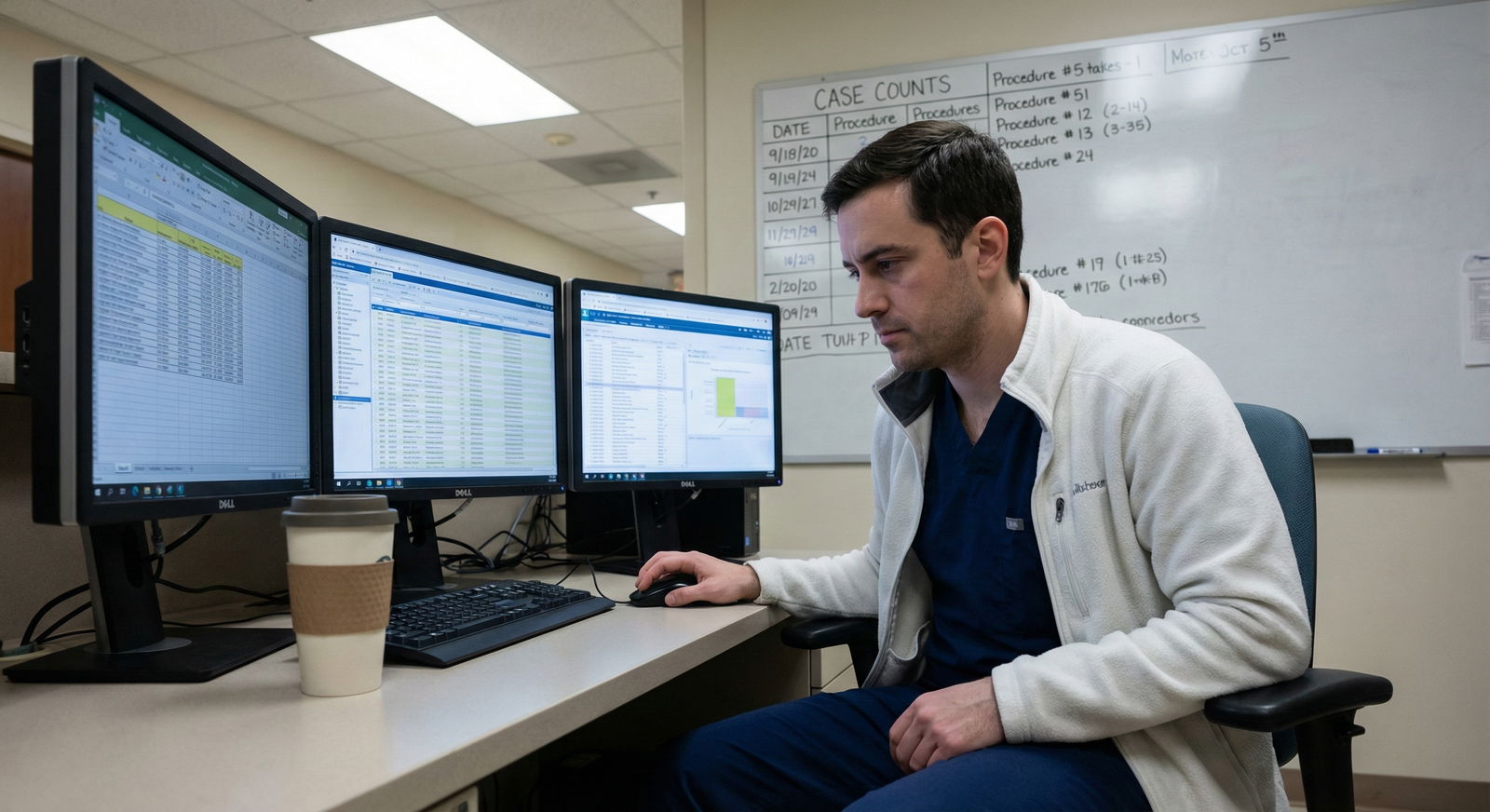
It is 11:45 p.m. You are post‑call, sitting at a resident workroom computer, scrolling through your case log. Your ACGME numbers look “fine” on paper—more than enough free flaps, lots of “assist” entries—but you know half those entries are garbage for actually describing what you did.
One free flap entry says: “ALT flap to lower extremity, assist.”
That covers a 6‑hour case. You harvested the flap, dissected 3 perforators, divided 2, thinned the flap, did one of the vein anastomoses, and inset a tricky distal corner around exposed tendon.
None of that nuance survives in your official log.
Two years from now, when you are interviewing for a microsurgery fellowship or trying to convince a hospital committee you can run a perforator flap program, no one will see what you actually did—unless you start logging the right details, right now.
Let me break this down specifically: in microsurgery, raw “flap count” is a blunt instrument. The value is in the granularity of what you did, for which defects, with which techniques, and under what constraints. That is what makes you safe, hireable, and credible.
This is the article you read before you waste another year doing superficial case logging.
1. Why “Flap Volume” Is a Terrible Primary Metric
Most institutions still talk about microsurgical “volume” as if a free TRAM and a 2‑vessel ALT are interchangeable as long as they count as “1 free flap” each. They are not.
The standard log problem
Typical resident/fellow logs capture:
- CPT code
- General procedure description (“free flap to leg”)
- Role (primary / assist)
- Sometimes laterality and time
That is it. It tells you:
- Nothing about the vessels anastomosed
- Nothing about perforator work
- Nothing about complexity (radiated field, post‑trauma, vein grafts)
- Nothing about decision‑making (planned vs bailout flap change)
I have reviewed logs from graduating fellows showing “>150 free flaps” where they had barely done more than one or two genuine intramuscular perforator dissections, and had never done a true superthin flap. On paper, they looked “experienced.” In reality, they were narrow.
If you keep logging like everyone else, you will look the same.
What actually builds microsurgical competence
Competence tracks with task‑level repetition, not just case‑level repetition. That means:
- Number and spectrum of anastomoses you personally performed
- Number and types of perforators dissected and preserved
- Frequency of technical variants (couplers vs sutured, end‑to‑side, flow‑through)
- Exposure to complications and salvage (re‑exploration, thrombectomy)
- Range of reconstructive problems solved (post‑oncologic head and neck vs trauma leg vs breast vs trunk)
You can do 50 “free flaps” and still be underexposed to real perforator work or difficult vessel scenarios if you are not intentional about what you record and review.
So yes: total flap volume matters. But it is a threshold metric. Past a certain point, it is the composition of that volume that matters.
2. The Core Data Elements You Should Be Logging
Forget what the official case log template lets you enter. You need a parallel log that captures microsurgery‑specific details. Spreadsheet, Notion, custom app—does not matter. The content matters.
Here is the minimal skeleton of a useful microsurgery/flap log.
| Category | Fields to Capture |
|---|---|
| Identification | Date, MRN (or anonymous ID), attending, institution |
| Region & Indication | Region (breast, head/neck, LE, UE, trunk), oncologic vs trauma vs other |
| Flap Type | ALT, DIEP, MS‑TRAM, fibula, radial forearm, LD, etc. |
| Perforator Details | Number, intramuscular vs septocutaneous, skeletonized vs bundled |
| Anastomoses | Arterial/venous targets, technique (suture vs coupler), end‑to‑end vs end‑to‑side |
| Your Role | Harvest, flow‑through design, supercharging, venous coupler, all micro vs part |
| Complexity | Radiated bed, vein grafts, previous flap failure, vessel size issues |
| Outcome | Takeback, salvage, failure, partial loss, key complication notes |
Now I will go through those and tell you exactly what to record and why it matters.
2.1 Flap type and indication
Do not just write “ALT free flap.”
At minimum, log:
- Flap: ALT vs DIEP vs MS‑TRAM vs fibula vs radial forearm vs SCIP vs PAP vs LD, etc.
- Indication:
- Oncologic – breast / head and neck / sarcoma / skin
- Trauma – open fracture, degloving, crush, ballistic
- Chronic wound – osteomyelitis, pressure, diabetic
- Defect site: tongue, mandible, lateral skull base, mid‑tibia, distal third leg, foot dorsum, heel, sternum, etc.
Pattern recognition in microsurgery is defect‑driven. An interviewer asking about “coverage options for a distal third tibia defect with exposed hardware in a smoker with peripheral vascular disease” wants to hear that you have seen that kind of problem repeatedly and handled it with appropriate flaps.
You cannot reconstruct that narrative later if your log just says “free flap to lower extremity” fifty times.
2.2 Perforator details: this is where people get lazy
Most logs do not care how many perforators you took or how you dissected them. That is precisely why your personal log should.
At minimum:
- Number of perforators included: 1, 2, 3+
- Course: septocutaneous vs intramuscular
- Dissection:
- Epifascial only
- Through muscle but not fully skeletonized
- Fully skeletonized intramuscular perforator to source vessel
- Perforator diameter (rough estimate): e.g., 0.8 mm, 1.2 mm, etc.
- Any major intra‑op deviation: perforator injured → switched to another/perforator bunch, converted to different flap.
Why this matters:
- A log of 80 ALTs without intramuscular skeletonization is a very different skill set from 30 ALTs with tight intramuscular perforator work.
- Fellowship directors care more about whether you can safely isolate a small perforator in scarred muscle than whether you can harvest yet another thick fasciocutaneous paddle.
So you should be able to say, based on your data: “I have performed 45 ALT flaps, 22 with true intramuscular perforator dissection down to the descending branch, and 12 of those were in previously radiated or scarred thighs.”
That is a real volume statement.
2.3 Anastomosis details: “I did the anastomosis” is not enough
You need to break this down in your log:
For each flap, document:
- Recipient artery: e.g., facial, superior thyroid, internal mammary, anterior tibial, posterior tibial, dorsalis pedis, profunda, etc.
- Recipient vein(s): internal mammary venae comitantes, cephalic, external jugular, venae comitantes of PTA/ATA, etc.
- Technique:
- Arterial: hand‑sewn vs coupler (rarely coupler, but if so, note)
- Venous: coupler vs hand‑sewn
- Configuration: end‑to‑end vs end‑to‑side; flow‑through design; supercharging or turbocharging
- Your actual role (be honest):
- Harvest only
- Artery + 1 vein
- Only 1 or 2 veins
- Revision of attending anastomosis
- All anastomoses under indirect supervision
The reason is simple: You can “assist” on 100 flaps and still have personally done very few full sets of anastomoses. When you are signing off on micro privileges, you should know, not guess, how many arterial and venous anastomoses you have done.
Now layer that with site. A surgeon with:
- 60 breast flaps (mostly IM vessels, couplers for veins) and
- 10 limb flaps with hand‑sewn tibial vein anastomoses in scarred, traumatized fields
is very different from someone with the opposite mix. Neither is “better”; they are built for different problems. Your log should reflect that.
3. Complexity Signals: What Turns Volume Into Credibility
Microsurgery in a controlled environment with pristine vessels and healthy patients is training wheels. The real profession lives in:
- Radiation fields
- Heavily scarred or infected beds
- Post‑trauma contamination
- Tiny vessels or mismatched caliber
- Multilevel vascular disease
You need to consciously log those complexity factors.
3.1 Condition of the recipient site
Record binary markers:
- Radiated (yes/no, pre‑ or post‑op radiation)
- Infected/contaminated vs clean
- Prior flap or graft failure at same site
- Presence of hardware / exposed bone / exposed tendon
- Vascular status: known PAD, prior bypass, proximal occlusions, previous angioplasty
That matters when you later analyze your own complication trends. Flap congestion in a radiated neck with prior neck dissection is simply not the same as congestion in a young trauma leg with good angiography.
3.2 Technical complexity
Specific items to log:
- Need for vein grafts (arterial, venous, length approximations)
- Need for arteriovenous loops
- Use of flow‑through flap design (e.g., fibula for segmental bone plus reconstituted artery)
- Supercharged or turbocharged flaps (additional arterial or venous inflow/outflow)
- Combined flaps (chimeric designs with bone + soft tissue, multi‑paddle flaps)
These special situations disproportionately accelerate your skill set. Having 10 flaps with vein grafts teaches more about planning and troubleshooting than 50 straightforward ALT to IM anastomoses.
Keep a separate tally of:
- Cases with vein grafts
- Cases requiring revision of anastomosis intra‑op
- Cases converted from one flap option to another due to intra‑op findings
Those are your decision‑making reps, not just your technical reps.
4. Outcome Logging: Not Just “Success” vs “Failure”
A binary “flap survived / flap failed” button is crude. You need something more granular, for yourself.
At minimum:
- Flap status:
- Complete survival
- Partial distal necrosis (estimate %)
- Complete failure
- Takeback:
- None
- Early (<48 hours) vs late
- Reason: arterial thrombosis, venous thrombosis, hematoma, pedicle kinking, unknown
- Salvage outcome (if taken back):
- Successful salvage
- Partial salvage
- Loss
- Major wound complications: infection, dehiscence, hardware exposure, need for secondary flap or revision
Then retrospectively, ask: were there recurrent patterns?
I have seen fellows realize, once they did this, that almost every congested flap in their logs had one of two features:
- Very small recipient veins with high reliance on couplers
- Or flaps super‑thinned aggressively in radiated beds
You will not see that pattern with generic logging. You will see it if you track the details that matter.
5. Turning Your Log Into Something That Actually Helps You
Data is only useful if you can query it. That is where most people drop the ball.
Let me be explicit on how to structure and use this.
5.1 A simple, practical schema
You do not need a full analytics platform. A well‑designed spreadsheet works.
Columns for each case (rows = flaps):
- Date
- Attending
- Institution
- Region (breast / head & neck / LE / UE / trunk)
- Indication (oncologic / trauma / chronic wound / other)
- Defect site (short text; e.g., “distal third tibia lateral”)
- Flap type (ALT / DIEP / MS‑TRAM / fibula / SCIP / PAP / LD / others)
- Perforator count (integer)
- Perforator course (septocutaneous / intramuscular)
- Dissection type (epifascial / partial intramuscular / full skeletonization)
- Artery recipient (short code: IM, facial, STA, ATA, PTA, DP, etc.)
- Vein recipient(s) (IMVC, EJ, IJ, cephalic, venae comitantes, etc.)
- Arterial technique (suture vs coupler)
- Venous technique (coupler / suture / mixed)
- End‑to‑end vs end‑to‑side
- Special techniques (flow‑through, AV loop, vein graft, supercharge) – small coded field
- Your role (H=harvest, A=all anastomoses, V=veins only, R=revision only, etc.)
- Recipient bed complexity (radiated yes/no, infected yes/no, previous flap yes/no)
- Flap outcome (survived / partial loss / failed)
- Takeback (none / early / late + reason)
- Salvage (full / partial / fail)
Is this a lot? Yes. That is the point. You can fill most of it in 2 minutes per case while the dressing is being applied or in the workroom after.
5.2 What to extract from it every 3–6 months
Every few months, sit down and answer some specific questions using filters or pivot tables.
Examples:
- How many ALTs have you done, and of those, how many included full intramuscular perforator skeletonization?
- How many tibial vessel anastomoses (ATA/PTA) have you personally sutured?
- How many flaps in radiated head and neck fields have you performed, and what is your partial loss rate there vs non‑radiated?
- What proportion of your flaps involved vein grafts, and what were their outcomes?
- What is your total number of arterial anastomoses personally performed across all flaps?
You are trying to convert “I think I have done a lot of X” into “I have done 37 cases of X, in Y contexts.”
If you are ambitious, you can visualize some of this.
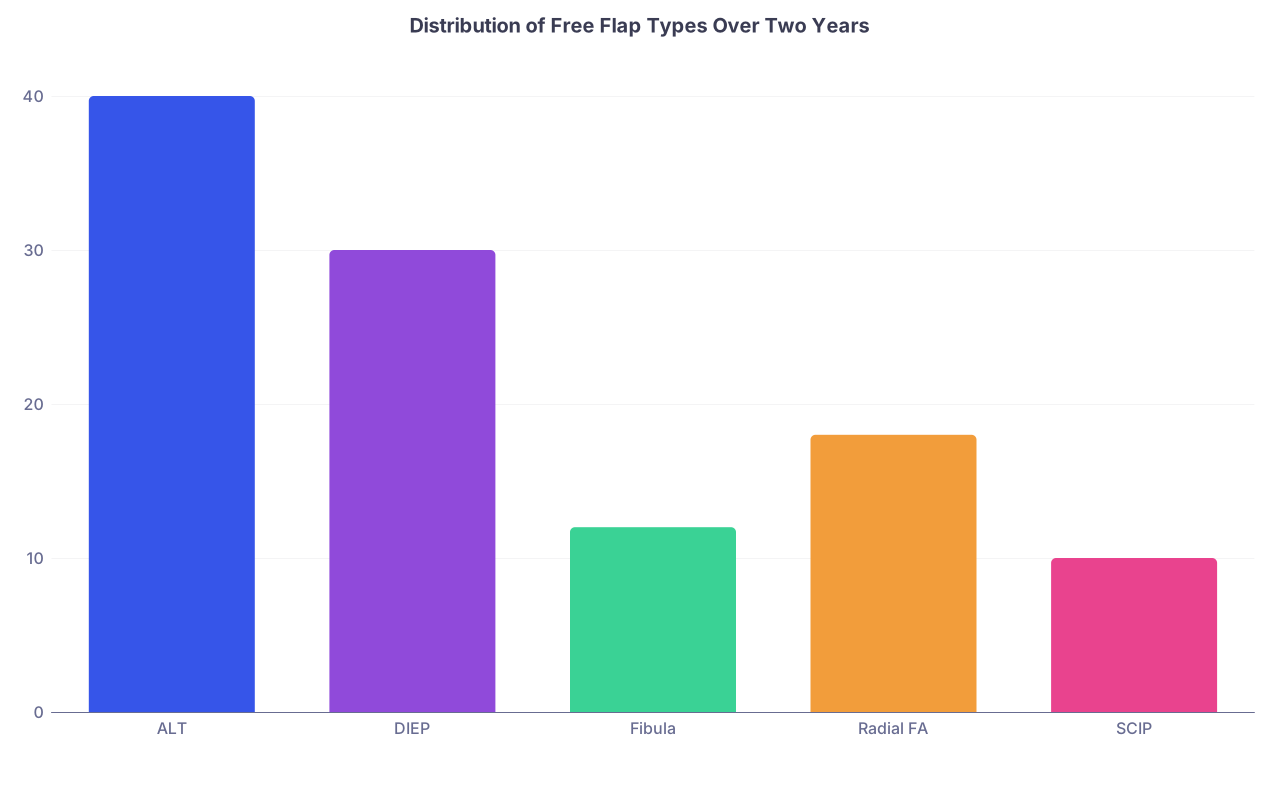
| Category | Value |
|---|---|
| ALT | 40 |
| DIEP | 30 |
| Fibula | 12 |
| Radial FA | 18 |
| SCIP | 10 |
When you are preparing for fellowship applications or credentialing, you are then pulling hard numbers, not vague memories.
6. How This Plays With Credentialing, Privileges, and the Future
Let us be blunt. The current system of “minimum case numbers” and crude logs will not survive the next decade.
Hospitals and payers are already pushing toward competency‑based evaluation and outcomes‑linked credentialing. Microsurgery will not be immune.
6.1 Your log as a personal defense file
When you apply for:
- Microsurgery fellowship
- Hospital micro privileges at a new institution
- Or to lead a specialized program (e.g., lymphedema, perforator flap center)
You will be asked some version of:
- How many free flaps have you done?
- How many independent cases?
- What flaps do you do most commonly?
- What is your flap loss rate?
If all you can say is “about 80” and “loss rate around 1–2% maybe,” that is weak. If you can hand over a structured, anonymized log that shows:
- 95 consecutive free flaps, stratified by region and type
- A breakdown of vessels and techniques
- Complications with context (e.g., 3 losses, all in radiated, previously operated fields, 2 with vein grafts)
you are speaking a different language. Administrators and micro‑fellowship directors will understand that you take your practice seriously.
6.2 Anticipating structured, digital micro‑log systems
We are moving toward automated OR feeds, integrated with electronic health records and possibly even device‑level data (operating microscope logs, anastomotic coupler IDs, video capture).
Expect, over the next 10–15 years:
- Automatic OCR or structured data capture of:
- Flap type
- Recipient vessels
- Use of couplers vs suture
- Intra‑op times (ischemia time, micro time)
- Optional linkage to:
- Safe OR video snippets of key steps (e.g., final anastomosis run)
- Ultrasound/angiography images
- Post‑op outcomes
Your personal log is basically a low‑tech precursor of this. If you are already used to thinking in those data fields, you will adapt quickly when formal systems appear.
7. Common Logging Mistakes That Make Your “Volume” Useless
I see the same errors repeatedly.
7.1 Logging only by CPT or generic description
“Free flap to leg.” “Free flap breast.” That is it. No defect, no flap type, no vessels.
Problem: when you later want to understand your experience with:
- Distal third tibia vs proximal third
- ALT vs latissimus for sarcoma defects
- IM vs thoracodorsal vs circumflex scapular vessels
you have nothing.
Fix: categorize by region + specific flap type + site, not just the billing code.
7.2 Inflating “primary” role when you did not truly own the key steps
Anyone who has trained microsurgical fellows has seen this. The log says “primary surgeon, 120 free flaps.” The truth: they harvested a lot, but the attending did most of the micro and critical decision‑making.
You are not helping yourself by pretending. So structure your log to be explicit:
- Harvest only
- Harvest + entire micro
- Harvest + 1 anastomosis
- Revision of anastomosis
- Independent case (attending unscrubbed for key steps)
That way, as you gain trust and independence, your log will show that progression.
7.3 Not logging complications in detail
People under‑document takebacks and partial losses in their personal logs because it feels like self‑indictment. That is childish.
Complications are where you learn. And selection committees know that. A microsurgeon who has never had a flap takeback or necrosis after 80+ flaps is either lying, sheltered, or severely under‑exposed to complex cases.
Better to show:
- 5 takebacks in 70 flaps
- 3 successful salvages
- 2 complete losses, both in high‑risk contexts, with clear learning points
That looks real. And it helps you track whether your own complication rate is improving as your technique and judgment mature.
8. A Practical Way to Implement This Without Burning Out
You have limited time. You do not want a second job as a data entry clerk. So here is a realistic workflow.
8.1 Build a micro‑specific template once
Create:
- A spreadsheet with the columns I listed.
- Or a micro‑note template in Notion / OneNote / similar, with checkboxes and dropdowns.
Lock it. No more re‑designing.
8.2 Capture immediately, in shorthand
Right after each flap (in PACU or at the workroom):
- Enter only:
- Date
- Flap type
- Region / site
- Flap name (ALT, DIEP, fibula, etc.)
- Your role
- Complication flags (if immediate)
Takes 30–60 seconds.
Later that day or week, fill in:
- Perforator details
- Vessels used
- Special techniques
- Complexity flags (radiated, prior flaps)
This delay is fine. The big anchor data (which case, which flap) is already recorded.
8.3 Monthly 20‑minute review
Once a month, sit down, sort your log by date, and quickly:
- Fill any missing fields while cases are still fresh.
- Mark “unknown” deliberately if you truly cannot remember.
- Glance at complication rows and jot a one‑line lesson.
Over time, that 20 minutes turns your raw case volume into a real, evolving profile of your skill set.
9. The Future: Analytics, Simulation, and Proficiency Benchmarks
Where this is going:
9.1 From “number of flaps” to “demonstrated proficiency”
Surgical education is moving toward:
- Proficiency‑based metrics (e.g., time to complete anastomosis without errors, patency rates in simulation)
- Video‑based technical assessments (structured rating tools for anastomotic technique)
- Case mix‑adjusted outcome metrics

| Step | Description |
|---|---|
| Step 1 | Simulation anastomosis metrics |
| Step 2 | Supervised simple flaps |
| Step 3 | Supervised complex flaps |
| Step 4 | Independent simple flaps |
| Step 5 | Independent complex flaps |
| Step 6 | Program or service leadership |
Your personalized log will be a bridge between simplistic case counts and these more sophisticated proficiency assessments.
9.2 Integration with simulation and AR/VR
Imagine:
- Your simulation platform logs number of high‑fidelity anastomoses performed on 1.0 mm vessels with <5 micro‑errors.
- Your clinical log shows how those skills translate to real flaps.
- Future platforms correlate simulation proficiency with live OR complication rates.
We are not fully there yet, but early systems exist. When that becomes standard, your habit of structured self‑logging will make you comfortable living in a data‑rich environment.
9.3 Benchmarking yourself honestly
Even now, with simple tools, you can benchmark against yourself over time:
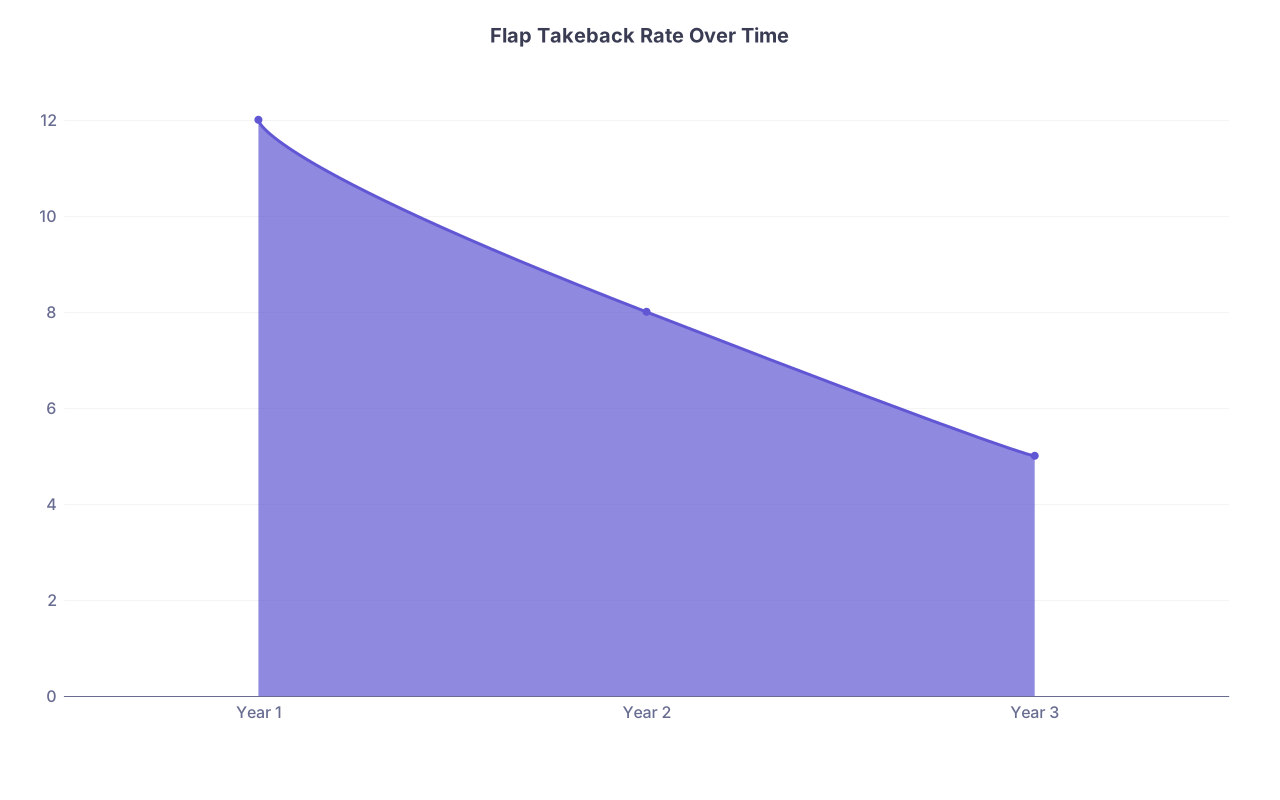
| Category | Value |
|---|---|
| Year 1 | 12 |
| Year 2 | 8 |
| Year 3 | 5 |
You see whether your takeback rate is dropping as your micro exposure increases, or whether you are taking on more complex cases with stable complication rates. That is far more meaningful than just boasting, “I do a lot of free flaps.”
10. What To Start Doing Tomorrow
You do not need institutional permission to become rigorous about your own volume and complexity.
Here is the minimal, concrete commitment:
- Create a personal microsurgery case log tonight with the fields we discussed.
- For the next 10 flaps you are involved in, capture:
- Flap type
- Perforator count and type
- Recipient vessels
- Your exact micro role
- Any complexity factors
- Outcome and takebacks
- At 10 cases, pull basic stats:
- How many arterial anastomoses did you truly do?
- How many intramuscular perforator dissections?
- How many radiated fields?
If that little snapshot is enlightening—or embarrassing—you are on the right track. Keep going.

Key Takeaways
- Raw “flap count” is a blunt, often misleading metric. The real value is in logging perforator details, anastomosis specifics, complexity factors, and your actual role in each case.
- A structured personal micro log—parallel to the official case log—turns your experience into analyzable data that supports honest self‑assessment, stronger applications, and eventually, safer independent practice.
- The field is moving toward competency‑ and data‑driven evaluation. If you start capturing the details that actually matter now, you will be ahead of the curve when everyone else is scrambling to catch up.