
What happens when you come back from an unexpected leave and your surgical case log looks like a black hole?
You are back. Badge reactivated, pager buzzing again, your name back on the call schedule. But your case numbers? Frozen. Program director talking about “competency” and “meeting minimums.” Co-residents a year ahead in the OR. That knot in your stomach every time someone says, “So, where are you with your case volume?”
Let’s walk through how you actually rebuild surgical volume after an unexpected leave of absence without lighting yourself on fire in the process.
Not theory. What to do, who to talk to, and how to play the game so you can graduate, be safe, and not get sidelined again.
Step 1: Get brutally clear on your numbers and requirements
You can’t fix what you vaguely understand.
Pull your actual data. Not vibes. Not “I think I’m behind.” The real numbers.
- Log into ACGME/Case Log system (or your specialty’s equivalent).
- Export your current case log.
- Compare it against your program’s graduation targets and ACGME minimums.
If you do not know the exact targets, you need them in writing. Ask your program administrator or PD for the latest ACGME and program-specific numbers. Then build a simple comparison.
| Category | ACGME Minimum | Current Cases | Gap |
|---|---|---|---|
| Total Major Cases | 850 | 540 | 310 |
| Chief Year Cases | 150 | 20 | 130 |
| Endoscopy | 85 | 40 | 45 |
| Hernia (all types) | 60 | 30 | 30 |
| Laparoscopic Chole | 40 | 18 | 22 |
Do this for each critical category. Circle anything where:
- You’re below the minimum
- Or barely above and your leave paused any progress
Then answer these questions honestly:
- How many months of training do you have left?
- How much OR time do you realistically get per week on your current schedule?
- If you kept your current pace, where would you end up at graduation?
You will almost always find this: if you do nothing intentional, you will miss some categories or barely scrape by. That’s unacceptable. You need margin.
Step 2: Have the unpleasant-but-necessary meeting with your PD
Do not “see how it goes.” That’s how you wake up three months before graduation with a panic email from the Clinical Competency Committee.
You need a structured meeting with your PD within the first 2–3 weeks back.
Here’s what you bring:
- Your case log with gaps highlighted
- ACGME/program minimums
- Your remaining time in training
- A draft idea of what you think you need (extra months? specific rotations? focused OR time?)
Walk in and say something like:
“Since my leave, I’ve gone through my case log. I’m currently at 540 major cases with 12 months left. If I keep the current pace from before my leave, I’ll probably end up just at or slightly under the ACGME minimum in a few categories. I’d rather plan intentionally now. Can we map out a concrete plan to safely reach and exceed the required volume?”
You’re sending three messages:
- You’re not in denial.
- You care about competency and patient safety.
- You want a plan, not hand-waving reassurance.
What you want to leave with:
- A written remediation or “individualized educational plan” (even if they don’t call it that)
- Clear expectations: required categories, target numbers, and rough timeline
- Agreement on whether training time may need to be extended (and who decides when)
If your PD is vague—“Let’s just see how this year goes”—push gently but firmly:
“I appreciate that. I’m worried that if we wait and then discover gaps later, it will be much harder to fix. Could we at least outline which rotations or services should be prioritized to build my case volume in [laparoscopy, vascular, endoscopy, etc.]?”
You’re not being annoying. You’re preventing a future disaster for both of you.
Step 3: Fix your schedule before it fixes you
Your rotation schedule is your volume engine. If that engine is misaligned with your gaps, no amount of “working hard” will save you.
Look at the next 6–12 months of your schedule:
- Which rotations are high-volume operative months?
- Which are mostly clinics or floor work?
- Which rotations routinely give juniors more hands-on time than seniors?
Then cross-match with your gaps. If you’re short on laparoscopic cases but are scheduled for two straight months of clinic-heavy endocrine, that’s a problem.
You need proactive schedule surgery.
Common moves I’ve seen work:
- Swapping a low-op month for a high-op one with a co-resident
- Adding or repeating a key rotation (e.g., trauma, acute care surgery, vascular, colorectal)
- Pushing some nonessential elective time into later months and front-loading operative months now
Approach your chief residents and program leadership like this:
“I’ve identified I’m behind in [X, Y categories]. I’m currently scheduled for two months of consults and clinic. Is there any way to swap one of those for acute care or trauma this year so I can address those gaps?”
You are not asking for “more interesting” cases. You’re asking for graduation-critical volume. Different conversation.
Step 4: Build a targeted OR strategy, not just “more cases”
Not all cases count the same. And not all roles in the case (assistant vs primary surgeon) advance you the same way.
After a leave, your goal is not random volume. It’s targeted, logged, and meaningful.
Break this down into three categories:
- Must-hit ACGME minimums
- Scary-low categories (where you’re way under your peers)
- Bread-and-butter you should be comfortable with by graduation (even if not an official minimum)
For each category, answer:
- Which service(s) in your hospital actually generate these cases?
- Which attendings reliably let residents operate as primary surgeon?
- On which days/times do those cases typically run?
Then you actively insert yourself there.
This means:
- Showing up early in pre-op holding, asking, “Any chance I can be primary on this [lap chole, hernia, ex-lap] today? I’m working on rebuilding my volume after my leave.”
- Asking chief residents, “If you have to give up a case today, I’d really appreciate consideration, especially for [your gap categories].”
- Volunteering to stay late or come in on your post-call day (yes, consistently, within duty hours rules) for high-yield cases—when safe and allowed in your program.
You are not begging. You’re being explicit that you’re on a clock and that your education suffered an interruption.
Most decent attendings will respond to that if they see effort and humility.
Step 5: Use data weekly, not yearly
Residents who dig out of a leave successfully all do one thing: they track their cases obsessively for a while.
You need a simple weekly check-in:
- Total cases this week
- Target cases per week (based on your ACGME gap and remaining months)
- Cases in each critical category
Make it visual.
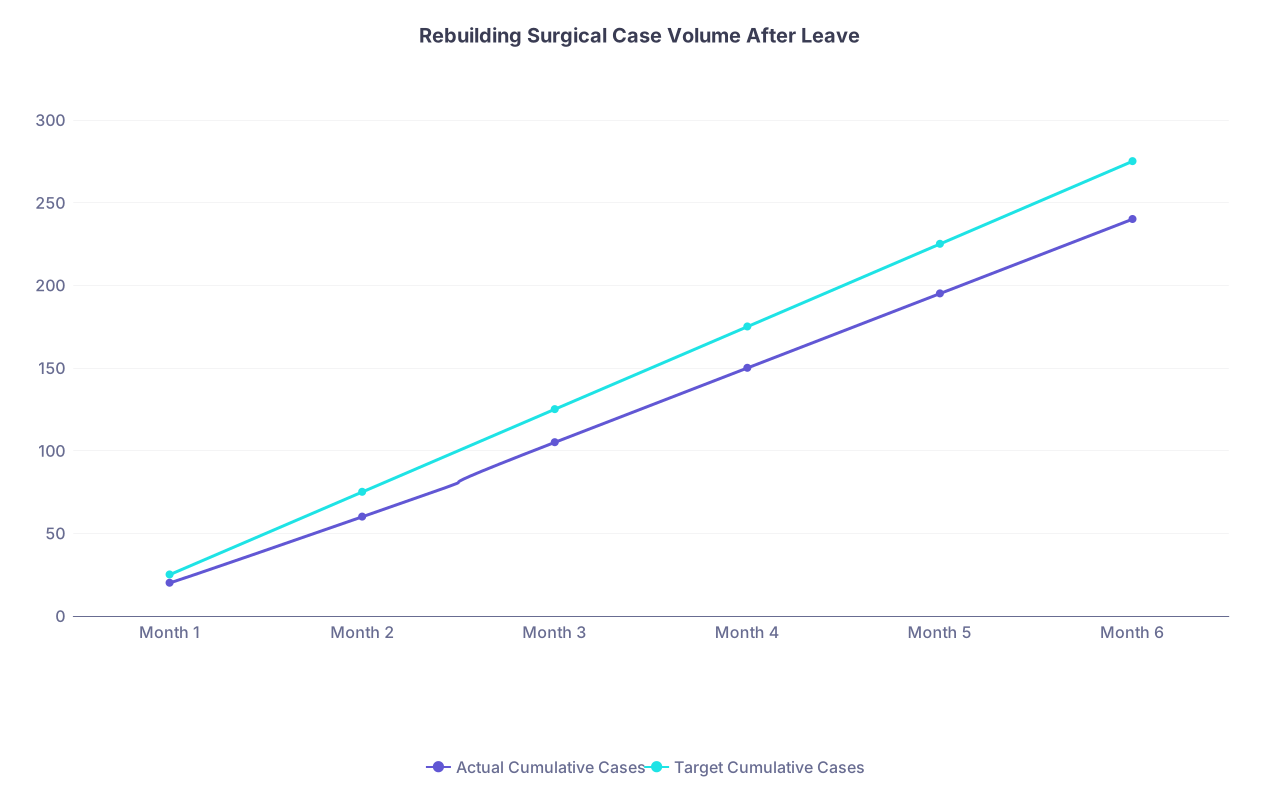
| Category | Actual Cumulative Cases | Target Cumulative Cases |
|---|---|---|
| Month 1 | 20 | 25 |
| Month 2 | 60 | 75 |
| Month 3 | 105 | 125 |
| Month 4 | 150 | 175 |
| Month 5 | 195 | 225 |
| Month 6 | 240 | 275 |
If you see that your line is consistently below target for 4–6 weeks, you do not wait. You go back to your PD or APD and say:
“I’ve been tracking my volume weekly as we discussed. I’m consistently undershooting the target we estimated. We may need to tweak my rotations or consider an extra month on [high-yield service]. Can we adjust now while we still have time?”
Program leadership would much rather you say this in January than in May.
Step 6: Rebuild trust and comfort in the OR
Volume is not just about numbers. It’s about the unspoken belief of attendings and chiefs: “I trust this person with the knife again.”
An unexpected leave—especially for health, mental health, or family reasons—can shake that trust, even if no one says it out loud.
You fix this with:
- Preparation that’s very obviously solid
- Humility without self-erasure
- Steady, safe execution
On case days, especially early in your return:
- Know the steps cold. Not just “lap appy” but “how this attending likes lap appy done.” Ask seniors if needed.
- Say out loud in the pre-op room or scrub sink, “I reviewed your preferred technique for this case. I know you like to [port placement, dissection plane, closure method]. I’ve also re-read the indications and pitfalls.”
- In the OR, ask for responsibility: “If you’re comfortable with it, I’d like to do the initial access and port placement.”
If you hit a cognitive wall because you’ve been off for months, own it:
“I’m a bit rusty on the exposure here. Can you walk me through how you’d like this plane developed?”
What you do not do: pretend you’re at your pre-leave peak when you’re not. That’s how patients get hurt and attendings shut you down.
The more you show you’re self-aware and safe, the more OR trust you get back—and with that, case volume.
Step 7: Use off-service and “non-OR” time strategically
You’re going to lose some OR days to clinic, wards, ICU, or consults. That’s residency. You can still squeeze education and even volume out of these.
Options:
- Endoscopy or minor procedures: If your program allows, offer to cover add-on endoscopies, bedside procedures, or minor ops when your floor work is under control.
- Weekends: Some services have high-yield weekend lists staffed by skeleton teams. If duty hours allow, showing up and volunteering can bump your numbers.
- Cross-coverage: If another service is absolutely slammed and your day is light, offer to float to their OR for specific high-yield cases—but coordinate this with chiefs so you’re not abandoning your actual responsibilities.
You are not trying to be a martyr. You’re trying to convert useless hours into logged, meaningful cases—without breaching duty hours or burning out.
Step 8: Decide early if you need (or want) extra time
Sometimes the honest answer after a substantial leave is: you probably need to add months. For volume, for comfort, for safety.
This is not failure. This is adulthood.
Here’s how you think about it:
Signs you likely need extra time
- Even with an aggressive plan, your projections barely reach ACGME minimums.
- You or your attendings feel you’re unsafe doing bread-and-butter independently.
- Critical categories (like endoscopy, trauma, laparoscopy) are still thin late in training.
- Your leave was long (6+ months) and spanned high-value operative years.
Financial and career reality
You need straight talk on:
- Who pays your salary for extended time (GME vs department vs you)?
- How that affects your fellowship start date (if any).
- Visa implications if you’re an international graduate.
- Board eligibility timing.
This is where you talk not just to your PD, but to GME, HR, and possibly your future fellowship director.
The question I’d ask myself:
“Five years from now, will I regret being a year late but fully trained and confident? Or will I regret rushing out undercooked and terrified every time I scrub?”
Most people know the right answer. They just don’t like it. Be one of the residents who has the spine to choose safety and competence.
Step 9: Script how you’ll talk about this to fellowship or job programs
You will have to explain the leave. You will have to explain any extra time. It’s survivable if you’re not sloppy.
Keep it short, honest, and forward-focused:
“I took a medical/family/personal leave during residency between [dates]. I returned with full clearance and completed an individualized plan to ensure my training was not compromised. That included [extra operative months / focused rotations / additional time in program]. My current case volume is [X], and my attendings can speak to my operative competency. The experience actually made me more deliberate about my training and my operative preparation.”
What you do not do:
- Overshare details that no one needs.
- Sound defensive or ashamed.
- Blame the program or leadership.
If you’ve rebuilt your numbers and have strong letters backing your competence, this becomes a footnote, not your defining feature.
Step 10: Protect your health while you rebuild
You got forced into some kind of stop. Burnout, illness, family collapse, injury, mental health crisis—something destabilized your life enough to pull you out of the OR.
If you come back and try to “fix” that by simply red-lining yourself—extra calls, every weekend, no sleep—you’re setting up Leave 2.0.
You need guardrails:
- Non-negotiable sleep floors: “I do not go below X hours of real sleep for more than Y nights in a row.”
- A real doctor or therapist if your leave was for health or mental health. Not optional. You’re operating on people.
- One or two non-medical anchors per week that you don’t bail on unless someone is dying (your kid’s game, a run, religious service, whatever your brain needs).
You will feel pressure to be “perfect” and “make up for lost time.” That mindset will kill you or your career. The goal is sustainable intensity, not martyrdom.

| Step | Description |
|---|---|
| Step 1 | Return from Leave |
| Step 2 | Audit Case Log |
| Step 3 | Meet with PD |
| Step 4 | Adjust Schedule |
| Step 5 | Target High Yield Cases |
| Step 6 | Weekly Volume Tracking |
| Step 7 | Maintain Plan |
| Step 8 | Revise Rotations or Extend Time |
| Step 9 | Graduate Competent |
| Step 10 | On Track? |
Two things you absolutely cannot outsource
Let me end this cleanly.
First: No one will care about your case volume as much as you do. Not your PD, not your chiefs, not your co-residents. They may support you, but they’re not tracking your numbers weekly. You have to own the data and the plan.
Second: Competence beats speed. If the choice is between rushing out “on time” with shaky hands and thin experience, or taking the long route and walking into your first attending job actually ready, choose readiness. Your future patients—and frankly, your future self—will not care that your name was on a graduation list one year earlier.
Rebuild intentionally. Talk to the right people. Track ruthlessly. Operate safely. That’s how you come back from an unexpected leave without your case volume—and your career—falling apart.