
It’s 10:47 p.m. You’re back in your tiny sublet after a draining day on your US clinical elective/observership. You keep replaying one moment over and over: that heated exchange with the resident. The sharp tone. The awkward silence after. The attending nearby who might have heard.
And now the spiral starts:
“Is this going in my evaluation?”
“Will this ruin my LOR?”
“Is this going to follow me into ERAS?”
“Will PDs whisper about me on some secret blacklist?”
Let’s walk through this slowly and honestly. Not with fake “you’ll be fine” energy, but with what actually happens behind the scenes.
First: Will Program Directors Automatically Hear About Every Conflict?
Short answer: No.
Longer, more realistic answer: It depends what actually happened, and how big it really was in the eyes of the people there.
Here’s the thing applicants never believe: residents and attendings see minor conflict all the time. Miscommunications. Snappy responses. Someone looks defensive after feedback. A resident feels overworked and talks too fast and comes off rude. This is daily life in a hospital.
Most of that never makes it into:
- Your evaluation
- Your letter of recommendation
- Any “official” reporting system
For PDs to hear about it in a real, concrete way, one of these usually has to happen:
- It was serious enough to be reported formally (unprofessional behavior, patient safety issue, harassment, etc.).
- The attending or clerkship director decided you were a professionalism concern and wrote it into your evaluation or letter.
- You’re applying to that same institution, and someone specifically remembers you negatively and mentions it when your name comes up.
That’s the actual bar.
One tense exchange where the resident raised their voice, you looked flustered, maybe you said something defensive or awkward? That’s usually background noise on a busy service.
Residents vent about students all the time: “That student doesn’t read much,” “They seem checked out,” “They’re slow on prerounding.” But venting is not the same thing as building a case to sabotage your career.
If your mind is jumping straight to “This single conflict will make me unemployable in the US,” that’s your anxiety talking, not reality.
What Actually Goes Into Your Evaluation and LOR?
Let’s be blunt: most people writing evaluations are tired, behind, and doing them at 10 p.m. on a Sunday.
They’re not documenting every small awkward interaction.
They’re thinking:
“Did this student show up? Were they safe? Were they respectful? Did they try? Would I work with them again?”
Not:
“On 10/12 at 8:43 a.m., student seemed annoyed when I corrected them in front of the team.”
Most USCE evals and LORs focus on:
- Reliability (did you show up on time, follow through?)
- Work ethic
- Attitude and teamwork
- Ability to accept feedback
- Basic clinical reasoning / interest in learning
One conflict only becomes a big deal if it fits a pattern. For example:
- You were repeatedly late and defensive.
- Multiple residents complained that you were rude, dismissive, or argued constantly.
- You made a patient care mistake and refused to take responsibility.
- You talked badly about other team members or the program in front of staff.
If your anxiety is: “I pushed back once on being unfairly blamed” or “I replied in a slightly sharp tone once when I was stressed,” that’s not usually going to be “pattern-level.”
Most residents don’t want drama. They want the path of least resistance. Filling in “professional, pleasant, teachable” is easy. Going out of their way to tank you takes effort, and most people simply don’t care enough to do it unless you were truly awful or dangerous.
How Often Do PDs Hear About This Stuff, Really?
Let me be harsh and reassuring in the same breath: PDs are not sitting around obsessing about your one resident conflict. They’re drowning in:
- Service coverage
- Accreditation requirements
- Trying to find night float coverage for next week
- Interview season logistics
- Their own research and admin garbage
Your one USCE month is a tiny dot in their universe.
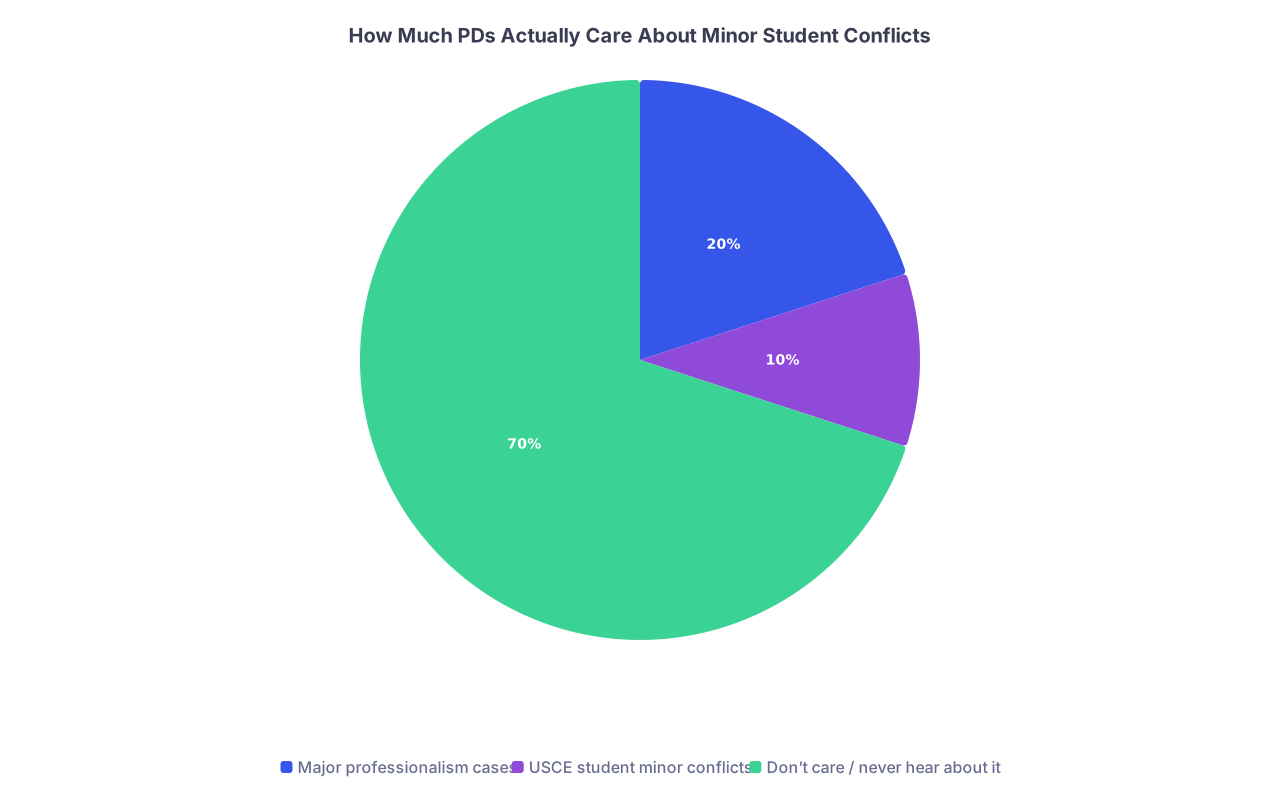
| Category | Value |
|---|---|
| Major professionalism cases | 20 |
| USCE student minor conflicts | 10 |
| Don’t care / never hear about it | 70 |
Most PDs only hear about you in two structured ways:
- Your letters of recommendation
- Your official evaluations (if you rotated at their institution and they bother to check)
If there was no formal documentation, no professionalism committee involvement, no email from the clerkship director about your behavior, and no catastrophic incident:
It usually dies there.
Could a resident remember you and say: “Oh yeah, that student was kind of defensive”?
Sure. Humans gossip.
But is that the same as torpedoing your application? No. Interview and ranking decisions are made on patterns, not random single data points.
Worst-Case Scenarios (Because Your Brain Is Going There Anyway)
Let’s walk right into the ugly “what ifs” your brain is chewing on.
Scenario 1: The resident clearly disliked you and was cold the rest of the month
Annoying? Yes.
Career-ending? No.
Possibilities:
- They’re burnt out and dislike everyone.
- They had a bad day, week, or month that had nothing to do with you.
- They may have given you a slightly lukewarm evaluation.
But a lukewarm eval is not a death sentence. Programs know not every rotation is magical.
Scenario 2: You pushed back verbally and it got a bit heated
For example:
Resident: “Why didn’t you follow up on that CT?”
You: “I did, but radiology hadn’t read it yet, like I told you earlier.”
Resident: “You need to just say ‘I’ll follow up,’ not argue.”
You walk away thinking: “I’m done. They’ll label me argumentative.”
Here’s what usually happens:
By tomorrow, that resident barely remembers the details. They’re slammed. Unless you screamed, swore, or completely lost control, they file it under “meh” and move on. You obsess for weeks; they forget in hours.
Scenario 3: The attending overheard and looked annoyed
This one stings. You imagine them writing:
“Student is unprofessional and combative. Do not recommend.”
Reality check: most attendings have seen actual unprofessional behavior. You having a slightly tense back-and-forth doesn’t hit that bar. If you were otherwise:
- On time
- Respectful
- Decent with patients
- Seemed teachable
One tense moment won’t erase all of that.
Scenario 4: It turned into a formal thing (email/meeting)
This is the only one I’d truly flag as serious. If any of these happened:
- You were called into a meeting specifically about your behavior
- Someone used phrases like “professionalism concern,” “report,” or “documentation”
- You were removed from the rotation or warned officially
Then yes, this is something that might reach PD-level radar, especially if it’s at their institution.
Even then: one documented issue isn’t always fatal. It depends on what it was, whether you owned it, and whether you repeated the behavior elsewhere.
If none of that happened? You’re very likely inflating a normal bad day into a career apocalypse.
Concrete Steps You Can Take Now (So You Don’t Just Spiral)
You can’t control what’s already been written or said. But you can still do a few smart things.
1. Reality-check the severity
Ask yourself plainly:
- Was anyone threatened, harassed, or disrespected in a big way?
- Were patients harmed or placed at risk?
- Did anyone use words like “incident report,” “filed,” or “unacceptable”?
If the answer is no to all three, you’re probably dealing with small human conflict, not a catastrophic professionalism event.
2. If you’re still on the rotation: repair what you can
You don’t need an Oscar-level script. Something tiny can go a long way.
Example:
“Hey, I just wanted to say—I realized I came off a bit defensive earlier when we were talking about the labs. That wasn’t my intention. I appreciate your feedback and I’m working on how I respond when I’m stressed.”
You’re not begging. You’re showing self-awareness. That’s gold in medicine.
Even if the resident brushes it off (“It’s fine”), they heard it. It shifts their narrative from “defensive student” to “student who tries to learn from conflict.”
3. Focus hard on the rest of your rotation
You can’t erase a moment, but you can outweigh it.
For the rest of the rotation:
- Be extra on time.
- Volunteer for small tasks: calling consults, checking labs, updating notes.
- Ask focused, not annoying, questions: “I read about X last night—can I run it by you?”
- Show clear improvement in anything you were criticized on.
Medicine has a short attention span. People remember trajectories more than single data points.
4. Be strategic with letters of recommendation
If you’re worried this specific resident or team didn’t love you, you don’t have to chase a letter from that attending unless:
- You absolutely crushed the rest of the month
- You have no other USCE letters
If you have another rotation where you clicked better with the team and got very positive vibes, prioritize that attending for an LOR.
| Situation | Should You Use That LOR? |
|---|---|
| Strong rapport with attending despite conflict with resident | Probably yes |
| No idea what they think, mixed signals | Maybe, but not first choice |
| Clear tension, no repair, felt avoided | Probably no |
| You have 3+ stronger LORs | No need |
Will This Follow Me To Every Program I Apply To?
You’re imagining a secret backchannel where all PDs text each other:
“Don’t rank this IMG, had a conflict with a PGY2 in 2024.”
That world doesn’t exist.
Here’s where your past conflict can realistically show up:
- In a letter of recommendation from that specific attending
- In an internal note at that institution if you’re applying there
- During a phone call reference check if your application is borderline and they want more info
But widespread broadcasting? No.
Hospitals barely communicate cleanly about patient information, let alone systematically spreading gossip about one former visiting student.
Where you should be a bit more cautious is if:
- You’re applying to the same department where the conflict happened
- It was a small program where everyone seems to know everything
- You know for a fact this resident is tight with leadership and is openly negative about you
Even then, that’s one program, not 250.
How PDs Actually Interpret “Less-Than-Perfect” Comments
Let’s say worst-case: a resident or attending did write something slightly negative. Something like:
- “Tends to get defensive with feedback.”
- “Needed reminders about communication with the team.”
- “Improved over the rotation after feedback.”
Here’s what PDs do with that:
- If everything else in your application is strong, they file it under “normal human.”
- If you have multiple letters saying similar things, they see a pattern and worry more.
- If it’s framed as “they improved,” it can actually be a positive spin: teachable, coachable.
Most PDs know that visitors, especially IMGs, are under extreme pressure. They expect some awkwardness, some communication gaps, some anxiety behaviors.
What they really fear is the combo of:
Arrogant + unsafe + refuses feedback.
If you’re here beating yourself up, catastrophizing, replaying small mistakes in your head? You’re probably the opposite of the person they worry most about.
If This Still Haunts You During Interview Season
You might be worried they’ll ask something like: “Tell me about a conflict you had with a resident.” And your brain immediately jumps to this exact incident.
You can actually use it—carefully—as a growth story, if (and only if) you frame it well and don’t sound bitter.
Skeleton version:
- “On one rotation, a resident gave me feedback in a way that caught me off guard, and I responded more defensively than I wanted to.”
- “I realized later that my reaction was the problem, not the feedback itself.”
- “I went back, clarified, and apologized for my tone.”
- “Since then I’ve been trying to pause for a second before I respond and focus on understanding the feedback first.”
That shows maturity, not disaster.

| Step | Description |
|---|---|
| Step 1 | Conflict with Resident |
| Step 2 | Initial Defensive Reaction |
| Step 3 | Self-Reflection |
| Step 4 | Repair Conversation |
| Step 5 | Behavior Change |
| Step 6 | Interview Story of Growth |
What You Should Not Do
A couple traps I’ve seen people fall into:
Emailing the attending weeks later with a novel about the conflict
This often reactivates something they’d already forgotten. If you already finished the rotation and left without major drama, don’t drag it back up unless there was something truly serious or unfair.Badmouthing the resident to others at that institution
Your frustration is valid, but complaining up the chain can backfire if it looks like you can’t handle feedback or conflict.Letting this one episode define your whole USCE experience
You probably did lots of things right: stayed late, read about patients, helped families understand plans. Don’t erase all of that in your mind because of a 3-minute bad interaction.
Quick Sanity Snapshot
Here’s the blunt checklist version. If this is your situation:
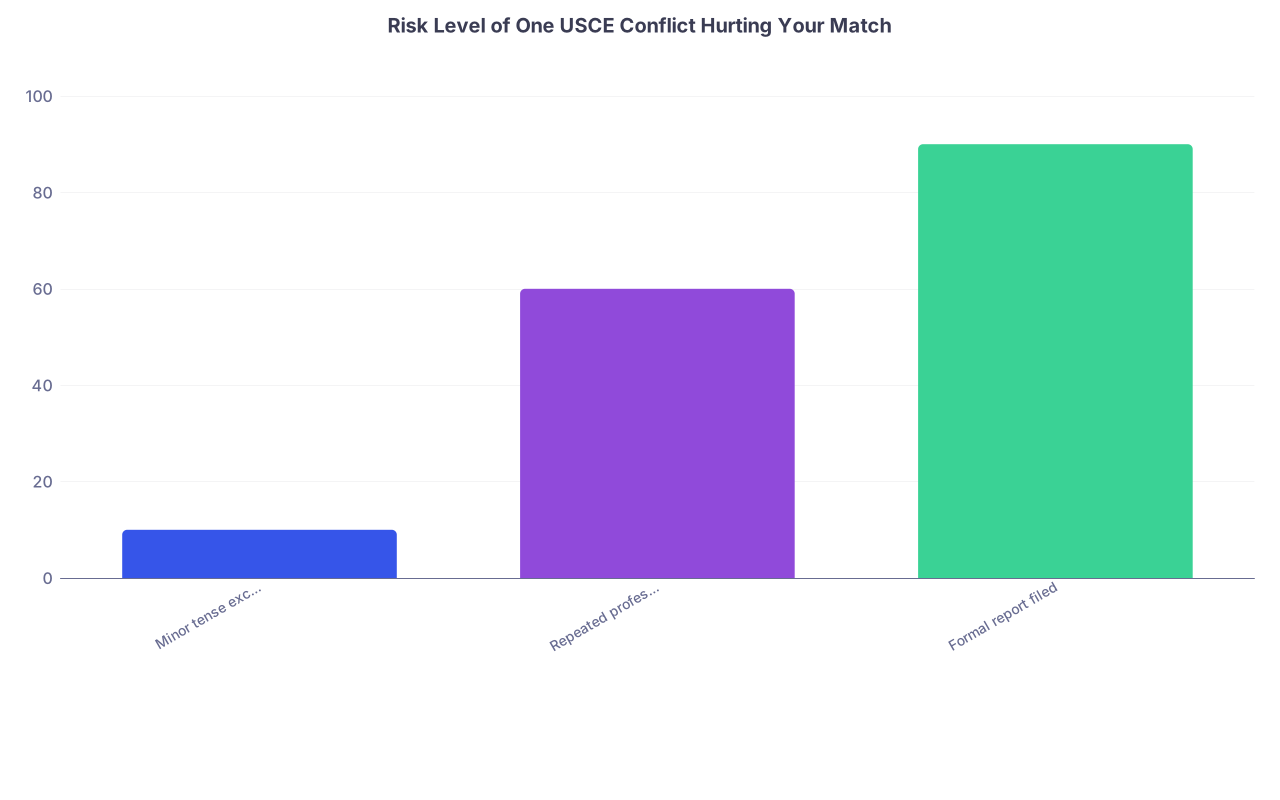
| Category | Value |
|---|---|
| Minor tense exchange | 10 |
| Repeated professionalism warnings | 60 |
| Formal report filed | 90 |
Minor tense exchange, no formal meeting, no one said “report,” you finished the rotation normally?
→ Risk to your overall match: very low.
Repeated warnings, documented issues, removal from rotation?
→ Okay, that’s serious. Needs strategy, explanation, and stellar performance elsewhere.
Most people reading this fall into that first category. Anxiety just doesn’t believe it.
FAQ (Exactly 5 Questions)
1. Should I ask the resident directly if they’re going to write something bad about me?
Usually no. That puts them in an awkward spot and makes you look more anxious and insecure than you already feel. If you want feedback, you can ask near the end of the rotation in a calm way: “Is there anything you think I should work on moving forward?” Listen. Don’t push them to make promises about your evaluation.
2. If I didn’t get asked for my ERAS ID or told about a letter, does that mean they hated me?
Not necessarily. Some sites don’t routinely write LORs for visitors. Some attendings are just lazy about it. Read too much into silence and you’ll drive yourself insane. If you felt somewhat okay by the end and want a letter, you can send a short, polite request later. Worst case: they ignore you or say no. That’s not the same as sabotage.
3. Can I ask someone else on the team for a letter if I had conflict with one resident?
Yes, and you should. Letters usually come from attendings, sometimes senior residents or fellows. If you got along better with one attending or fellow, prioritize them. Just don’t request a letter from someone you know for sure didn’t like working with you.
4. Will this hurt me more because I’m an IMG?
You already feel extra scrutinized as an IMG, which makes this feel heavier. But the basic logic is the same: minor conflicts are common, major professionalism issues are rare and serious. Programs won’t blacklist you across the country over one tense moment. Focus on solid LORs and strong, consistent performance in your other rotations.
5. If I’m still obsessing over this months later, what should I do?
That’s a sign it’s your anxiety latching on, not the event itself being catastrophic. Write down exactly what happened, in objective terms. Then write the worst possible realistic consequence (e.g., “Maybe that one attending doesn’t write me a glowing letter”). Then ask: “Can I still match with that happening?” The answer, almost always, is yes. Redirect your energy into things you can actually control: personal statement, Step scores, targeted applications, and nailing future rotations.
Bottom Line
- One conflict with a resident during USCE almost never destroys an application, unless it escalated into formal, documented professionalism trouble.
- Residents and attendings forget small conflicts faster than you do; they care much more about overall attitude, effort, and growth.
- Your best move now is simple: repair what you can, learn from it, pick your LOR writers strategically, and stop letting a 3-minute moment control your whole career story.