
Last month an IMG pulled me aside after rounds, eyes wide, voice shaking. “I think I messed up. I called the attending by her first name. Everyone went quiet. Am I done?”
If you’re reading this, I’m guessing your brain does that too—takes one awkward moment and turns it into “I will never match in the US, my life is over.” Let’s talk about what actually matters with cultural mistakes during USCE, and what’s just your anxiety lying to you.
The Fear Underneath: “One Mistake Will Ruin Everything”
Let me start with the part you’re probably too scared to say out loud:
“I’m terrified I’ll do something ‘wrong’ culturally, and they’ll label me as ‘the weird foreign doctor’ and I’ll never match.”
You’re scared you’ll:
- Interrupt the attending
- Stand in the wrong place on rounds
- Fail to “small talk” correctly
- Say “Madam” or “Sir” and they’ll think you’re mocking them
- Not advocate for yourself enough
- Advocate too much and seem arrogant
And then you imagine the attending going home, opening ERAS, and personally blacklisting you from every program in the country.
Here’s the uncomfortable truth: you will make cultural mistakes. Everyone does. US grads do too. The question is never “Will I be perfect?” It’s:
How do you look when you’re wrong?
Because that—way more than your awkward phrasing or stiff smile—is what programs are really judging.
What Programs Actually Care About (More Than Perfect Cultural Behavior)
Programs are not expecting you to magically be fluent in every unspoken US norm on day one. They’ve had IMGs before. They know.
There are four things that matter way more than whether you use the “correct” greeting or stand at the “right” spot on rounds.
1. Are you safe?
If you mispronounce a nurse’s name, nobody is writing a scathing letter about it.
If you:
- Ignore a critical vital sign because you’re scared to bother the resident
- Don’t clarify an order you don’t understand
- Pretend you understood a plan when you didn’t
—then yes, they worry. A lot.
Cultural awkwardness is tolerable. Unsafe behavior is not.
So if you’re going to obsess about anything, obsess about:
“Do I double-check orders? Do I ask when I’m unsure? Do I escalate concerns appropriately?”
Not: “Did I bow too much when I met the attending?”
2. Are you coachable?
Translation: can they correct you without you getting defensive, shutting down, or repeating the same thing again.
I’ve watched an IMG say “Madam” to a female attending. She smiled and said, “You can just call me Dr. Smith.” The student flushed, nodded, and the next time said, “Dr. Smith, I have a question about the labs.”
Perfect. That’s what they want.
I’ve also seen someone respond to feedback with, “But in my country we…” and then argue for five minutes. You can guess how that evaluation went.
If you’re corrected and you:
- Listen
- Acknowledge
- Adjust
you’ve just increased their trust in you, not decreased it. Even if the original mistake was cringe.
3. Are you respectful in intent?
Sometimes your words will be off. Your tone may sound “too direct” or “too formal” or “too quiet.” But people can usually tell if you’re trying to be respectful or if you’re just… rude.
Example:
You say to a nurse, “You need to do this now.” That can sound harsh.
Better: “Could we please give this medication now? The patient’s pressure is dropping and I’m concerned.”
If they see you trying to be respectful—even if your phrasing is clumsy—they’ll often help guide you. Secretly, most nurses and residents are actually rooting for you, especially if you’re clearly working hard and not acting superior.
4. Are you improving over time?
Let me be blunt: it’s okay if your first week feels like a disaster. What worries people is if week four looks exactly like week one.
They’re scanning for:
- Less confusion about hierarchy each week
- Fewer repeated misunderstandings
- More comfort speaking up
- Better sense of when to talk, when to listen
You don’t need to show up “culturally perfect.” You just need a clear upward curve.
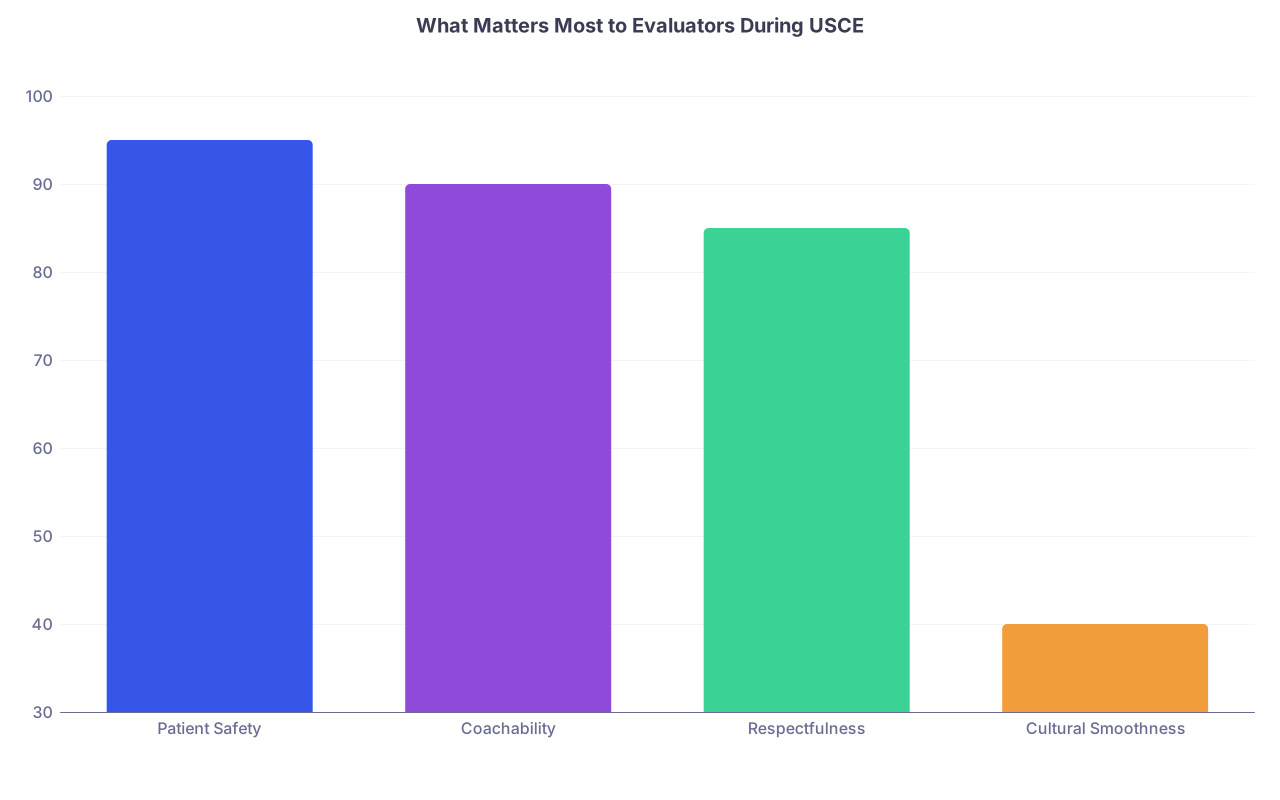
| Category | Value |
|---|---|
| Patient Safety | 95 |
| Coachability | 90 |
| Respectfulness | 85 |
| Cultural Smoothness | 40 |
That last bar? Cultural smoothness? Nice to have. Not a dealbreaker unless it’s tied to arrogance or unsafe behavior.
Common Cultural “Mistakes” That Feel Huge But Usually Aren’t
Let me walk through some things that feel catastrophic in your head but usually register as “minor” to everyone else.
Calling people the “wrong” thing
You say: “Good morning, Sir” to a male attending.
He replies: “Just call me Dr. Jones.”
Your brain: He hates me, I sound like a servant, I’ll never get a letter.
Reality: He’ll forget in 5 minutes if you’re otherwise solid.
General safe default:
- Attendings: “Dr. [Last Name]”
- Residents: “Dr. [Last Name]” or whatever they introduce themselves as
- Nurses: “First name” (unless they introduce differently)
- Patients: “Mr./Ms./Mx. [Last Name]” until they invite you to use first name
If you’re unsure: “How would you like me to address you?” is totally fine.
Standing in the “wrong” place on rounds
You stand too close to the attending. Or too far away. Or somehow end up blocking the view of the computer.
People might shift uncomfortably. Someone might say, “Let’s have students over here.” That’s not a fatal blow. Just move and mentally log: “Ok, stand slightly behind and to the side. Don’t block the screen.”
I’ve literally watched US students do the exact same thing. It’s not an IMG-exclusive problem.
Being too quiet… or too talkative
You’re terrified of interrupting, so you say nothing. Then you get feedback: “Needs to speak up more.”
Or you’re scared of seeming “weak,” so you overcompensate and start answering everything, including questions clearly directed at residents. Then you get: “Needs to read the room.”
Annoying? Yes. Permanent damage? No—if you adjust.
You can literally say to your senior:
“I’m not used to the communication style here yet. If I’m too quiet or too talkative on rounds, can you let me know? I really want to match the team’s expectations.”
That sentence alone shows emotional intelligence many people don’t have.
Small talk and “personality”
You think, “I’m not funny. I don’t watch American football. I don’t understand their jokes. They’ll think I’m boring.”
Here’s the thing: programs are not ranking you based on your Netflix preferences.
What works:
- Being kind
- Showing interest in learning
- Smiling occasionally
- Not acting miserable every second
If they’re discussing a game you’ve never heard of, you don’t have to fake knowledge. You can say, “I don’t really follow sports, but it sounds intense.” That’s enough. You’re not auditioning to be their best friend.
Mistakes That Do Matter (And How to Fix Them Fast)
There are cultural missteps that can hurt you if you keep repeating them. The good news: they’re fixable if you’re willing to be a bit uncomfortable.
1. Not speaking up about concerns
A classic IMG fear: “If I speak up, they’ll think I’m challenging them.”
So you see something wrong—like a rising creatinine on a patient getting contrast—and you say nothing. Because you don’t want conflict.
This is where programs get nervous. They want doctors who will protect patients, even if it means a slightly awkward conversation.
You can soften your approach without staying silent:
“Dr. Lee, I might be misunderstanding, but I noticed his creatinine went from 1.0 to 1.8. Is contrast still okay, or should we re-check?”
That’s respectful, not aggressive. And way better than silence.
2. Repeatedly ignoring feedback
If someone gives you specific feedback—“Try to present more concisely,” or “Please don’t examine patients without gloves”—and a week later you’re doing the same thing, that’s not “cultural difference.” That’s a problem.
When you get feedback, say something like:
“Thank you for telling me. I’m used to a different style, but I want to adjust to how it’s done here. I’ll work on that.”
Then actually change. And if you’re struggling, admit it:
“I’m still working on making my presentations shorter. Could you tell me if this one is better than yesterday’s?”
That kind of vulnerability? Residents and attendings respect it a lot.
3. Coming across as arrogant or dismissive
Sometimes what you think is “being confident” reads as “I know better than all of you.” Especially if you lean too hard on “In my country we…” in a way that sounds like criticism.
Sharing your background can be great. But if every suggestion is, “Well, back home we did it like this,” people will stop listening.
You can still contribute, just frame it differently:
“Where I trained previously, we often did X for these cases. I’m curious how you approach it here?”
Curiosity, not superiority. Big difference.
How to Recover From a Cultural Screw-Up (Without Spiraling)
You will have that moment when you go home and replay something over and over in your head. Let’s say you think you offended a nurse or attending.
Here’s a simple 4-step recovery that works in most situations:
Acknowledge it (to yourself first).
“Yeah, that probably came out wrong. That was awkward. Okay.”Own it briefly, don’t monologue.
Next time you see them:
“Hey, about what I said earlier—I realized it might have sounded rude. That wasn’t my intention, and I’m sorry about that.”Clarify your intention (short).
“I’m still learning the communication style here. I really respect you and appreciate your help.”Then move on and prove yourself with your behavior.
Be helpful. Be respectful. Be consistent.
Most people will respect you more because you took responsibility. Honestly, that’s rarer than it should be.
What Actually Ends Up in Your Letter vs What Stays in Your Head
This is the part you need drilled into your brain.
What you obsess over:
- That time you said “Goodnight” at 2 pm
- The joke you didn’t understand
- The phrase you mispronounced during oral presentation
- The time you laughed a half-second too late at an attending’s joke
What attendings actually write in letters:
- “Hardworking”
- “Reliable”
- “Excellent improvement throughout rotation”
- “Works well with team”
- “Advocates appropriately for patients”
And yes, sometimes:
- “Quiet but receptive to feedback”
- “Initial communication barriers but improved significantly and works very well in team settings”
No one is writing: “On day 3, student stood in wrong corner of room. Do not rank.”

| Your Panic Thought | What They Actually Remember |
|---|---|
| Called attending by first name | Showed up early, read about patients |
| Awkward small talk at lunch | Took initiative on patient follow-up |
| Misused a title (“Sir/Madam”) | Accepted feedback and adapted quickly |
| Stood in wrong place on rounds | Wrote clear, thoughtful progress notes |
| Didn’t understand a joke | Asked good clinical questions |
A Simple Script for When You’re Lost Culturally
If you’re on a rotation and constantly thinking, “I don’t know if what I’m doing is correct,” use this line early with your senior or attending:
“I trained in a very different system, and I’m still learning the culture and expectations here. If you ever notice me doing something that doesn’t fit how things are usually done, I’d really appreciate you telling me so I can adjust. I want to get this right.”
That one paragraph:
- Admits you’re learning
- Invites feedback
- Signals humility
- Lowers the threshold for them to correct you before it affects your evaluation
It also takes some pressure off you, because now if something is off, you can mentally file it as “data to improve,” not “evidence that I’m doomed.”

| Step | Description |
|---|---|
| Step 1 | Make Awkward Cultural Mistake |
| Step 2 | Brief Apology if Needed |
| Step 3 | Clear Apology + Behavior Change |
| Step 4 | Adjust and Move On |
| Step 5 | Show Improvement Over Time |
| Step 6 | Unsafe or Disrespectful? |
FAQ: Cultural Mistakes During USCE
1. Can one cultural mistake ruin my chances of getting a strong LOR?
Almost never, unless it’s tied to something serious like blatant disrespect, repeated unprofessional behavior, or patient safety issues. One awkward phrase or misused title by itself is not tanking your letter. Patterns do. Not one-off moments.
2. I’m very shy and scared to speak up. Will that hurt me more than cultural mistakes?
Chronic silence is more damaging than small cultural slip-ups. Programs worry about doctors who won’t speak up for patients. You don’t need to be loud or extroverted, but you do need to ask necessary questions and present your patients. Start small and build up; tell your senior you’re working on this.
3. What should I do if I think I offended a nurse or staff member?
Don’t hide and overthink it for three days. When you see them next, say something simple: “I’m worried what I said earlier may have sounded rude. That wasn’t my intention, and I’m sorry if it came across that way.” Then be consistently respectful afterward. Most people will let it go.
4. Is it okay to tell people I’m still learning US culture?
Yes, and honestly it’s smart. Saying, “I’m still adjusting to how things are done here, so please tell me if I do something odd,” shows self-awareness. Just don’t use it as a shield to never improve. You say it once, then you show them growth.
5. How can I practice “reading the room” before my USCE?
Watch US-based clinical videos, virtual rounds, or case discussions. Pay attention not just to content, but timing: who talks when, how students address attendings, how residents disagree respectfully. If possible, talk to IMGs already in US residencies and ask for specific do/don’t examples from their first months.
6. I had a rotation where I felt constantly out of place. Does that mean I’m not fit for US training?
No. It probably means you were thrown into a new system with almost no orientation and sky-high pressure. That’s brutal for anyone, especially across cultures. If you showed up, worked hard, didn’t endanger patients, and improved even a little, you’re more “fit” for US training than you think. The discomfort doesn’t mean you failed—it means you were adapting.
Years from now, you won’t remember whether you stood on the left or right side of the bed on rounds. You’ll remember that you showed up scared, out of place, and still chose to learn, to adjust, and to keep going. That’s the part that actually counts.