
It’s 7:03 a.m. You’re on a US hospital ward for your very first USCE. The team stops at the first patient. The attending looks straight at you and says, “Okay, why is this patient on heparin and not enoxaparin?”
Your brain? Static.
Your mouth? Nothing.
You can literally feel your face getting hot under the mask.
And the only thing running through your mind is: “That’s it. I’m done. I’ve ruined my chances of matching in the US.”
Let’s talk about that fear. Because I know exactly how loud it is.
The Fear: “If I Freeze Once, I’m Finished”
This is the nightmare script, right?
You imagine:
- You freeze on one question.
- The attending thinks you’re incompetent.
- They write a terrible evaluation.
- Word spreads. No one takes you for observerships.
- Programs see your bad LOR.
- You never match.
Your brain skips from “awkward silence” to “career over” in about 0.4 seconds.
Here’s the blunt truth: freezing on rounds is normal. Especially as an IMG on your first USCE. The system is new, the expectations are weirdly specific, and often you’re working in a second language while jet-lagged and terrified.
Every team has seen a student freeze. US MD, DO, IMG—doesn’t matter. Nobody gets through clinical training without that moment where they’re just… blank.
What actually matters isn’t “Did you ever freeze?”
It’s: “What did you do right after?”
And yes, that’s both the scary part and the good news.
What Freezing Really Looks Like From Their Side
Let me flip the camera for a second. You’re stuck inside your own head, but what does the team actually see?
Most attendings aren’t thinking:
“This person is hopeless. I will destroy their career.”
They’re thinking something much more boring like:
“First week. New system. Nervous. Okay.”
I’ve watched this play out so many times:
Attending: “So what’s the most likely cause of his acute kidney injury?”
Student: stares, panics, stammers, says nothing helpful
Attending, shrugs: “Okay, think about pre-renal vs intrinsic. We’ll come back. Next person?”
And then they forget about it 5 minutes later because they’re worried about bed availability and discharge summaries, not your inner collapse.
There are only a few ways freezing becomes a real problem:
- You freeze and then shut down the rest of the day.
- You freeze, get flustered, and start sounding defensive or argumentative.
- You freeze repeatedly but never show improvement, curiosity, or follow-up.
But a single freeze? Even multiple freezes early in the rotation? That’s not automatically “bad eval, no LOR, no match.”
Residents and attendings EXPECT you to be rough at the beginning. What freaks them out isn’t silence. It’s a lack of growth.
What To Do In The Exact Moment You Freeze
Let’s deal with the worst-case: you’re on rounds, you get a question, your brain just… flatlines.
You’re standing there like: I’ve never heard of medicine before in my life.
Here’s the move. You need a script, because your brain won’t improvise well under panic.
Something like:
- “I’m honestly not sure. I’d like to look that up after rounds and get back to you.”
- “I’m blanking right now, but I think it might be related to X. I’ll read about it and follow up.”
- “I don’t know the answer yet, but I’d like to find out and present it tomorrow.”
That’s it. You’re not trying to magically become brilliant. You’re proving three things:
- You’re not trying to fake your way through.
- You’re willing to learn.
- You’ll actually do something about not knowing.
Then the key: you MUST follow up.
If you tell an attending, “I’ll look it up,” and the next day you say nothing? That’s when their brain quietly tags you as “passive” or “not engaged.”
But if the next morning you say:
“Yesterday you asked why this patient was on heparin instead of enoxaparin. I read about it last night—given her renal function and the need for closer monitoring, unfractionated heparin was chosen. I also reviewed the dosing adjustments in CKD.”
That? That’s gold. You turned a bad moment into a positive data point: this student learns, cares, and follows through.
The Part You’re Really Afraid Of: Evaluations and Letters
Let’s be honest. You’re not actually scared of the silence itself. You’re scared of the consequences on paper.
You’re picturing an evaluation that says: “This IMG doesn’t know anything, don’t rank them.”
Here’s what most written evals actually care about:
| Category | How Much One Freeze Matters |
|---|---|
| Work ethic | Basically none |
| Teamwork | None |
| Communication | Only if you withdraw |
| Knowledge | Very little if improving |
| Professionalism | Matters if defensive |
If you’re:
- On time.
- Respectful to everyone (nurses, staff, patients).
- Hungry to learn.
- Reading outside of rounds.
- Getting visibly better each week.
Then a few frozen moments literally get absorbed into the background noise.
The only time I’ve seen freezing ruin an eval was when the student ALSO:
- Didn’t read.
- Didn’t follow up on missed questions.
- Spoke minimally to the team.
- Looked like they didn’t want to be there.
In other words, freezing wasn’t the issue. It was the pattern.
One more comforting thing: most letters do not say, “On October 5th at 7:12 a.m., this applicant failed to answer a basic question about COPD.”
They say things like, “Shows steady improvement,” “Hard-working,” “Strong clinical reasoning,” “Pleasure to work with.”
Nobody has space—or time—to document every time a student choked on a question.
How To Recover Over the Rest of the Rotation
You can’t avoid freezing 100% of the time. But you can absolutely control the arc of your rotation.
Think of it as: Day 1 you’re scared and clunky. By the end, you’re still not perfect, but you’re clearly more confident, organized, and engaged.
That arc is what they remember.
Here are concrete ways to create it:
Use the “I don’t know, but I’ll find out” line + follow-up.
This alone can take you from “weak” to “teachable and motivated.”Start small with contributions.
If answering big pimp questions terrifies you, focus on nailing the basics: vitals, overnight events, meds, labs, “today we should focus on…”. Get reliable at those. Teams love “reliable.”Pre-round like your life depends on it.
The more intimately you know your patients, the more sentences you’ll have ready that don’t depend on random recall. “Yesterday he was on 3L, today 1L,” “Creatinine is trending down,” “He’s tolerating PO diet now.” This builds confidence.Have 1–2 teaching points ready per day.
After your shift, pick one topic that came up—COPD exacerbation, DKA, cellulitis antibiotics—watch a 10–15 minute video or read a quick review, and be ready with: “I read that…” the next day. Tiny, consistent learning looks very good.Tell your resident you’re nervous.
Not in a dramatic way. Just: “I’m still getting used to US rounds and I get nervous when I’m cold-called, but I really want to improve. If you have any feedback, I’d love it.” Most residents will actually help you.
But What If I Freeze Repeatedly?
This is the darker question you’re probably not saying out loud:
“What if it’s not just once? What if I keep freezing? What if I’m just… bad at this?”
Let’s separate two things:
- Freezing because of knowledge gaps.
- Freezing because of anxiety / language / culture shock.
If it’s mostly knowledge: that’s fixable with a plan. Read every day. Use AMBOSS, UpToDate, the little pocket books. You don’t have to know everything. You just need to steadily know more than you did last week.
If it’s mostly anxiety: again, fixable. But not by waiting. You have to attack it.
Some very unglamorous but effective tactics:
- Practice out loud. Literally stand in your room and present an imaginary patient: “Mr. Smith is a 65-year-old male with a history of…” It feels stupid. It works.
- Script your opening lines for rounds. “Overnight, no acute events. This morning, patient reports…” If you have a reliable starting point, your brain can catch up.
- Accept silence for a second. Sometimes you’re so afraid of the pause that you panic. Buy yourself 3–4 seconds. Breathe. Say, “Let me think for a moment.” Then answer or admit you don’t know.
- Ask for a question style that helps you. You can say to a resident after rounds: “Sometimes when I’m asked broad questions I freeze. Would it be okay if I clarify the question or break it down?” Reasonable people will understand.
If your English is part of the problem, that’s not an indictment of your intelligence. You’re literally doing medicine in a foreign language. That’s already impressive. If you need to say, “Could you please repeat the question?” or “I’m not familiar with that term, could you clarify?”—that’s fine.
You’re not expected to be a walking USMLE answer key in flawless native-speaker English on day one.
Will One Bad USCE Kill My Chances of Matching?
This is the catastrophic thought: “What if I mess up my only USCE? Then what?”
A few reality checks:
- Not every USCE has to result in a letter.
- Not every letter has to be “the best letter I’ve ever written in my career.”
- Programs look at patterns, not single moments.
If you have a rotation where you felt off, frozen, awkward, and not your best—it doesn’t automatically mean you’ll get a terrible letter. Often, you get a “solid, generic but positive” one. Those are not death sentences.
And even if you feel the attending didn’t love you, you still have choices:
- Don’t use that letter.
- Do more USCEs and build a better track record.
- Improve and have later letters clearly show growth.
People match all the time with one mediocre USCE, one lukewarm letter, or one rotation that just wasn’t the right fit.
If a program sees:
- First USCE: okay-ish.
- Later USCEs: strong comments, better letters.
They think: this person grew. They adapted to the system. They didn’t stay stuck.
That story is actually very believable and even reassuring to PDs.
A More Honest Worst-Case Scenario (And It’s Still Not Fatal)
Let me actually push the worst-case out to its real edge.
Worst case on a rotation:
- You freeze often.
- You get overwhelmed and withdrawn.
- You don’t ask for feedback.
- You don’t visibly improve.
- The attending writes a lukewarm or “meh” eval and doesn’t offer a strong letter.
What does that mean?
- You probably shouldn’t use that attending as your star LOR.
- You should do another USCE and approach it very differently—with intentional prep and maybe even coaching from someone.
Does that mean “no match ever”? No. It means your path is a bit less smooth and a bit more work. That’s annoying. Not terminal.
The only truly dangerous pattern is: you have a rough experience, you internalize “I’m just bad,” and then you never fix any of it. That’s when it becomes self-fulfilling.
But the fact that you’re reading something like this, worrying about freezing, planning how to handle it? That already puts you in a different category. You care.
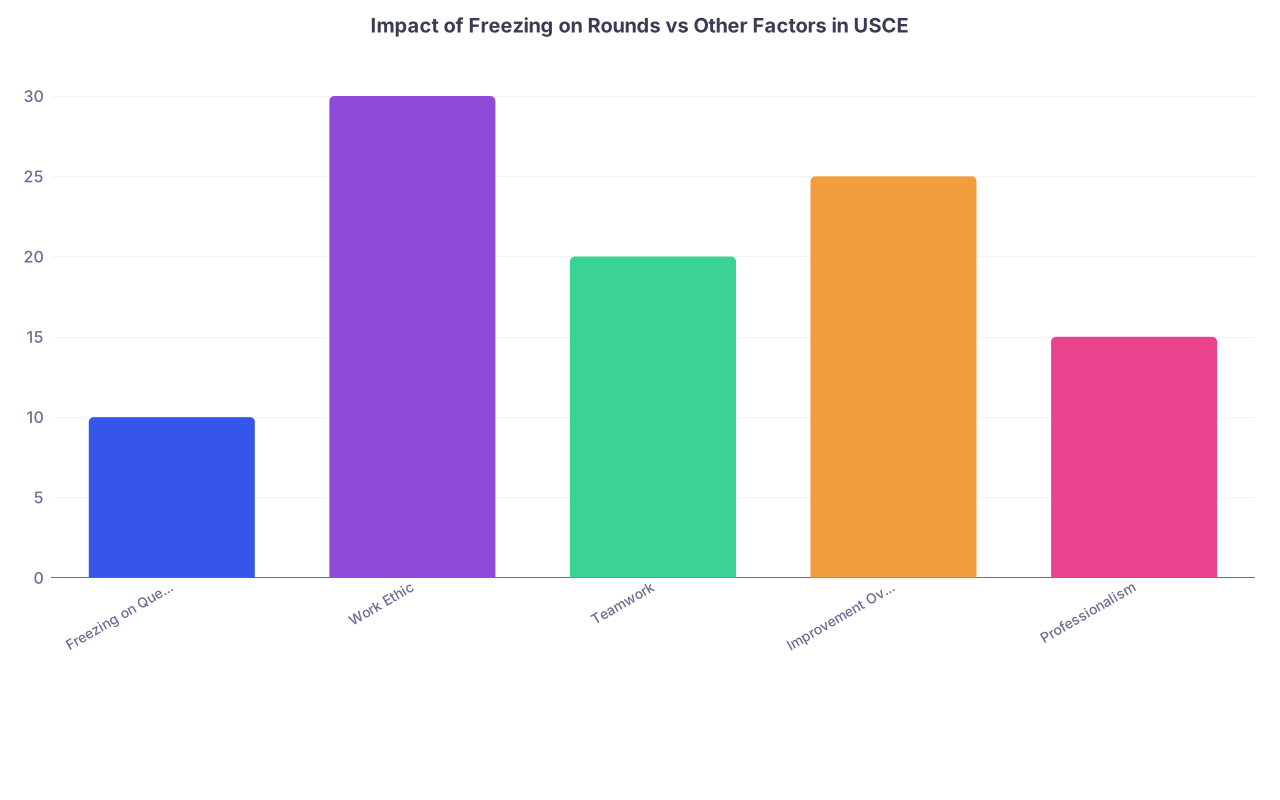
| Category | Value |
|---|---|
| Freezing on Questions | 10 |
| Work Ethic | 30 |
| Teamwork | 20 |
| Improvement Over Time | 25 |
| Professionalism | 15 |

| Step | Description |
|---|---|
| Step 1 | Freeze on rounds |
| Step 2 | Say youll look it up |
| Step 3 | Read about it after shift |
| Step 4 | Bring back answer next day |
| Step 5 | Perceived as engaged and improving |
| Step 6 | Give wrong/confusing answer |
| Step 7 | Attendings lose trust |
| Step 8 | Worse eval than simple I dont know |
| Step 9 | Admit you dont know? |

How To Quiet the Voice Saying “You’re Not Good Enough”
That voice is going to show up on rounds. On your first day. On your last day. Before your interview. Before Match Week.
You don’t have to “erase” it. You just have to stop letting it run the entire show.
A few things that actually help:
- Normalize the experience. Every resident has a story about a time they completely bombed a question. If you ask them, you’ll hear some wild, embarrassing stuff. You’re not unique in this.
- Focus on competence, not performance. You’re not on a game show. The goal isn’t to impress every second. The goal is to become safe, thoughtful, and reliable with patients. That’s a long game.
- Track small wins. Did you explain something clearly to a patient today? Did a nurse compliment you for being responsive? Did you answer one question better than yesterday? Write it down. Your brain only remembers the humiliation unless you force it to see the progress.
- Tell yourself the more accurate story. Not “I froze, so I’m stupid.” But “I froze once, then I followed up, learned the topic, and tomorrow I’ll handle it better.”

FAQ: Freezing on Rounds as an IMG in USCE
1. If I freeze on a basic question (like HTN management), will they think I don’t know anything?
They’ll think you were unprepared in that moment, not that you’re fundamentally incompetent. What they care about is what happens next. If you freeze, then later clearly manage similar questions better and show you read about it, they file it under “early nerves,” not “permanent flaw.”
2. Should I guess an answer or admit I don’t know?
Admit you don’t know. Guessing wildly or trying to bluff is how you lose trust. Something like, “I’m not sure. I think it might be related to X, but I’d like to read about it and confirm,” is honest and still shows you’re thinking. Pure nonsense answers annoy attendings a lot more than “I don’t know yet.”
3. Will freezing ruin my chance of getting a strong LOR from that rotation?
Not by itself. Strong LORs are based on how you work over the whole block: effort, growth, attitude, reliability. I’ve seen students who froze repeatedly in week 1 still get excellent letters because by week 3–4 they were engaged, prepared, and clearly improved. One or two awkward moments won’t erase four weeks of solid performance.
4. How do I explain a “meh” USCE if I feel like I didn’t shine?
You usually don’t have to explain it unless someone directly asks. Most applications don’t dissect USCE performance in detail. If it comes up, you frame it as: “My first USCE was a big adjustment and I realized I needed to improve my clinical communication and confidence. On later rotations, I focused on that and got much stronger feedback.” Show growth, not excuses.
5. What if my accent or English makes me freeze or hesitate?
Then you’re dealing with an extra layer of difficulty, not lack of intelligence. Ask people to repeat questions if needed. Practice presenting out loud. Ask a resident: “If my accent or word choice is ever unclear, please let me know so I can fix it.” Most reasonable people respect the fact you’re doing medicine in a second language. Clarity matters more than sounding perfect.
6. How do I know if I’m doing “badly” or if I’m just being hard on myself?
Ask for concrete feedback. Not “Am I okay?” but “Is there one specific thing I could do next week to be more helpful to the team?” or “How are my presentations compared to what you expect for a student at my level?” Vague anxiety tells you nothing. Specific feedback will usually show you it’s not as dire as your brain is insisting—and give you something real to work on.
Key Takeaways
You’re going to freeze at some point. Everyone does. What matters is that you admit it honestly, follow up, and improve.
A single awkward silence on rounds is not the thing that will decide your Match. How you work, learn, and grow over weeks and months—that’s what programs actually see.