
Last week I was on a Zoom call with an IMG who graduated in 2019. She stared at her ERAS draft, then said quietly: “I have a five‑year gap and almost no US clinical experience. Be honest… do I just not stand a chance?”
If you’re reading this, I’m guessing your stomach just tightened, because that’s exactly the kind of thing you’re afraid someone will say to you out loud.
Let me say it plainly: a gap after graduation + minimal USCE does not automatically kill your match chances. But. Program directors will absolutely notice it, and they will absolutely judge it. The real question isn’t “Is this bad?” It’s “How bad is it in my specific situation, and what can I do now so it stops being a silent red flag?”
Let’s walk through this like someone who’s already imagining the rejection emails piling up.
First: How Bad Does a Gap + Minimal USCE Actually Look?
You know that moment when you scroll to the “medical school graduation year” section and you hesitate? Or you look at your CV and there’s this wide empty canyon between graduation and now? That’s not in your head—programs do look there.
Here’s the ugly truth and then the slightly less ugly truth.
- PDs are suspicious of unexplained gaps.
- They’re wary of applicants who’ve been “away from clinical medicine” too long.
- They strongly prefer recent US clinical experience, especially for IMGs.
But it’s not binary. It’s not “gap = death.” It’s more like a sliding scale: how long is the gap, what were you doing, and how does the rest of your application look?

Here’s roughly how PDs tend to see it:
| Gap Length | Typical PD Reaction | How Damaging By Itself? |
|---|---|---|
| < 1 year | Common, usually fine | Mild concern if unexplained |
| 1–3 years | Noticeable, needs explanation | Moderate, depends on story & USCE |
| 4–5 years | Major question mark | Significant, needs strong mitigation |
| > 5 years | High concern | Very significant, but not always fatal |
Now layer in minimal USCE:
- Recent grad + solid USCE: “Okay, normal.”
- Older grad + strong recent USCE: “Some concerns, but seems active.”
- Older grad + minimal or no USCE: “Risky—are they clinically rusty? Do they understand US system?”
So yeah, your combo (gap + minimal USCE) is not “invisible.” It’s one of the first things your application will communicate. But that also means you know exactly where to hit back.
The Worst‑Case Fears You Have (And How Real They Are)
Let me actually spell out the nightmares, because pretending we’re not thinking them doesn’t help.
Fear #1: “Program directors will assume I’m lazy or incompetent.”
Some will. Especially if the gap is blank, vague, or looks like you’ve been sitting at home doing nothing.
But there’s a huge difference between:
- “2019–2023: No listed activities”
versus - “2019–2020: Full‑time caregiver for ill parent; 2020–2023: Clinical researcher & telemedicine physician in home country.”
If you don’t give them a story, their brain will make one up. And it usually won’t be generous.
Fear #2: “Minimal USCE means I won’t get any interviews.”
Not automatically. I’ve seen:
- A 2016 grad with 2 observerships and solid home‑country clinical work match IM.
- A 2018 grad with 0 USCE first cycle → added 3 months USCE → got 4 interviews second cycle and matched community FM.
- And yes, also people with similar profiles get 0 interviews.
The pattern is more like this:
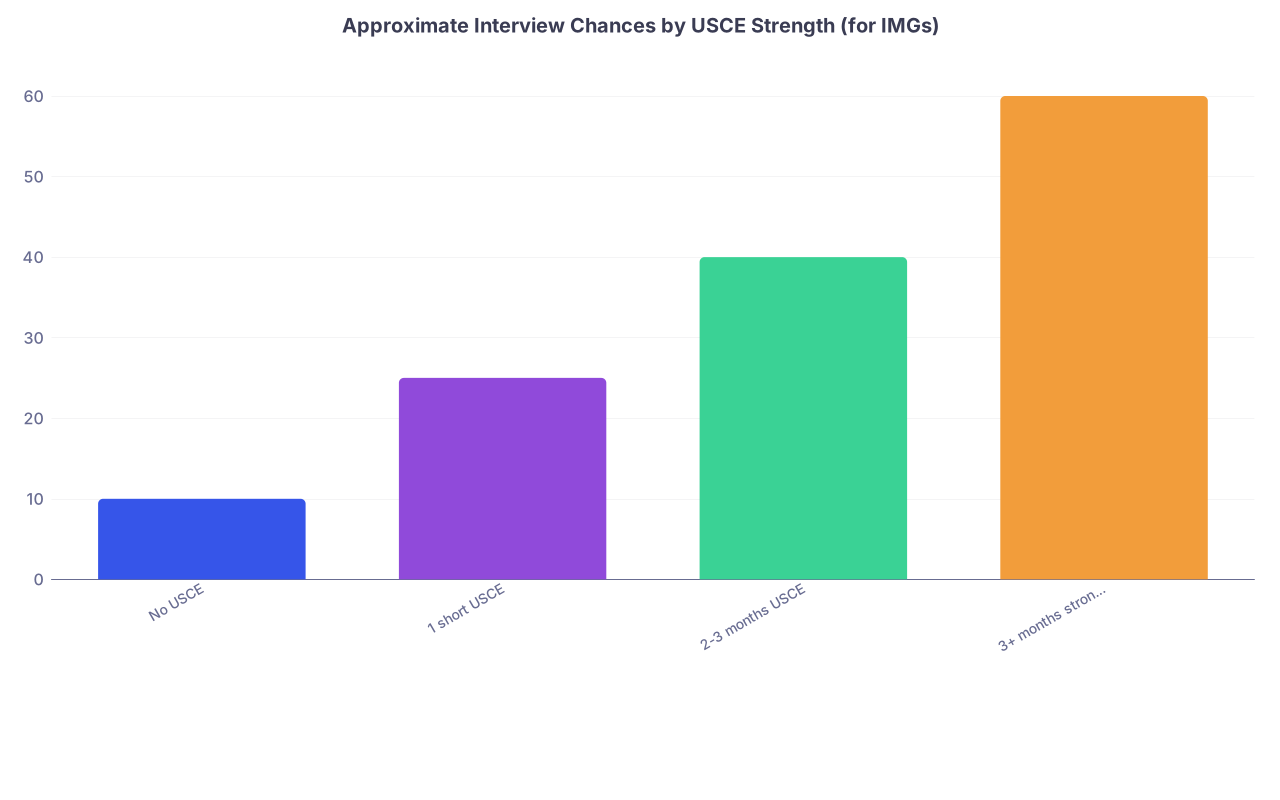
| Category | Value |
|---|---|
| No USCE | 10 |
| 1 short USCE | 25 |
| 2-3 months USCE | 40 |
| 3+ months strong USCE | 60 |
Numbers are illustrative, not official. But the relationship is real: more recent, meaningful USCE improves the odds that someone will take a chance on you, especially with a gap.
Fear #3: “The gap branded me forever; it’s too late to fix this.”
This one is loud at 2 a.m.
You can’t erase the graduation year. But you can absolutely:
- Make the last 12–18 months look active and clinical.
- Turn an unexplained gap into a coherent narrative: “Here’s what happened, here’s what I did about it, here’s why I’m stronger now.”
- Re‑enter as a “non‑traditional” or “returning” candidate rather than a “ghost since graduation.”
Programs care a lot more about what you’ve done recently than what you did five years ago—if you can prove you’re current.
What Programs Actually Want to See From Someone Like You
Residency programs are busy and slightly paranoid. They want to know three things about your gap and minimal USCE:
- Are you clinically safe and up‑to‑date?
- Do you understand how US medicine works (workflow, documentation, communication, hierarchy)?
- Can you handle the workload, or will you implode halfway through PGY‑1?
So if you’re an older grad with minimal USCE, you have to overdo demonstrating those three things.

| Step | Description |
|---|---|
| Step 1 | IMG with Gap & Minimal USCE |
| Step 2 | High Risk - Often Screened Out |
| Step 3 | Concern about Clinical Rustiness |
| Step 4 | Limited Understanding of US System |
| Step 5 | Borderline - Maybe Interview |
| Step 6 | Interview Candidate |
| Step 7 | Is Gap Explained? |
| Step 8 | Recent Clinical Work? |
| Step 9 | Any USCE? |
| Step 10 | Strength of Letters? |
Your job is to push yourself as far down that right‑hand side of the diagram as you can before you apply.
Damage Control: What You Should Do Before You Click “Submit”
If your chest tightens every time you think about your ERAS, this is the part that matters.
1. Get any real, structured USCE you still can
I don’t mean a random shadowing day your cousin arranged.
I mean:
- Observerships with clear schedule, responsibilities, and a supervising physician.
- Externships (rare but gold).
- Hands‑on positions if you’re allowed: clinical research coordinator, medical assistant, scribe (some IMGs do this on certain visas or before moving).
Aim for:
- 2–3 months minimum.
- At least one US letter from a physician who actually observed your work ethic and clinical thinking.
And yes, even if it’s “late.” I’ve seen people add 4–8 weeks of USCE in Aug–Oct and still have those experiences mentioned in letters or updated in ERAS.

2. Plug the gap with real activities, not fluff
If your CV has empty months or years, fill them honestly with things that show:
- You were clinically engaged.
- You were developing skills relevant to residency.
Examples that help:
- Clinical practice in your home country, with specific departments or roles.
- Telemedicine work.
- Formal research positions (not just “I read some papers”).
- Teaching roles: tutor, lecturer, workshop leader.
- Public health or NGO clinical work.
- Even non‑clinical jobs, if you frame the transferable skills (leadership, communication, handling stress).
What doesn’t help:
- Vague “self‑study” with zero output.
- Overinflated “positions” with no proof.
- 100 tiny “volunteer” roles that look like padding.
Be precise. “General practitioner, outpatient clinic, 30–40 patients/day” is 10x more convincing than “Worked in clinic.”
How You Explain the Gap Without Wrecking Yourself
This is the part everyone dreads: how do you talk about it without sounding like you’re making excuses?
You need a short, clear, factual explanation that hits three beats:
- What happened.
- What you did.
- Why you’re ready now.
Example 1 – Family/Personal:
“After graduating in 2018, I spent 18 months as the primary caregiver for my mother during her chemotherapy, while working part‑time in a local clinic. When her condition stabilized, I returned to full‑time clinical work and more recently completed US observerships to prepare for US residency.”
Example 2 – Exam Struggles / Late US Decision:
“I graduated in 2019 and initially planned to practice in my home country. While working full‑time in internal medicine, I decided to pursue US training, which required significant time to prepare for and complete licensing exams as an IMG working without local prep resources. Over the past year, I added US observerships and ongoing clinical work to ensure I remain current and ready for residency.”
Short. Honest. Not dramatic. Not defensive.
You can do a slightly expanded version in your personal statement and a tight 1–2 line version for interviews when they ask, “Walk me through your timeline since graduation.”
How Much Does Minimal USCE Alone Hurt You?
Let’s isolate this: say you had no big gap, but still minimal USCE. Or you’re older with a now‑explained gap, but USCE is thin.
Programs don’t reject you for “not enough USCE” in some checkbox way. But it affects three big things:
Screening:
Some programs literally filter by “any USCE Y/N.” If you have zero, you’re out at that step. If you have at least something real and recent, you pass that filter.Trust:
They feel more comfortable with someone who’s already seen US notes, Epic, interdisciplinary rounds, patient expectations, insurance nonsense.Letters:
USCE is often where the strongest “This person would do well in a US residency” letters come from. Without that, your letters skew generic or foreign, which PDs read with more caution.
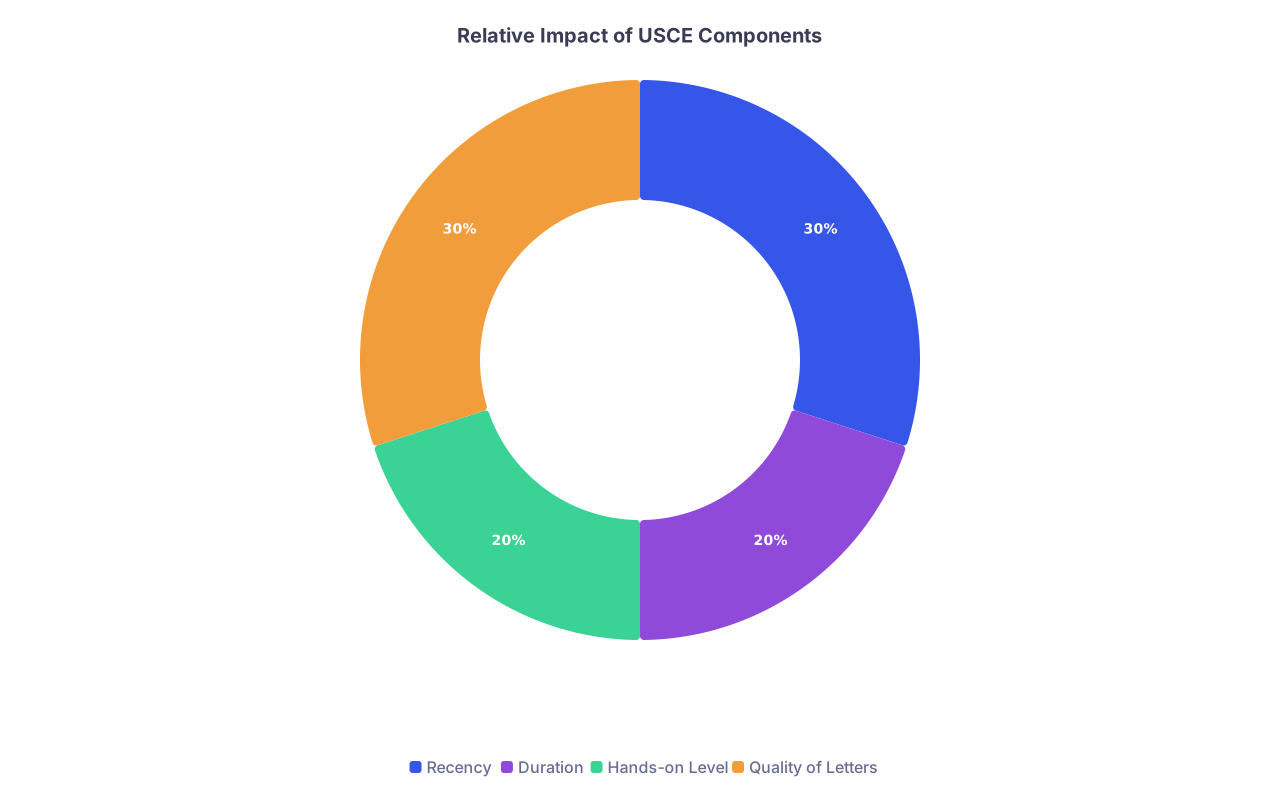
| Category | Value |
|---|---|
| Recency | 30 |
| Duration | 20 |
| Hands-on Level | 20 |
| Quality of Letters | 30 |
If your USCE is minimal, you can’t magically make it massive. But you can:
- Make sure it’s recent (within the last year or so).
- Squeeze every drop of value out of it: show up early, be memorable, get a detailed letter.
- Describe it concretely on ERAS, not like a line item you barely remember.
Strategy for Matching When You Feel “Behind”
Let’s be honest: if you have a big gap + minimal USCE, you’re not playing on easy mode. You do not have the luxury of a narrow application strategy.
Concrete moves that actually shift odds:
- Apply broadly. 100+ programs for IM/FM is not overkill for a high‑risk profile.
- Target community and smaller university‑affiliated programs, especially those with a track record of taking older grads or IMGs.
- Seriously consider less competitive specialties (FM, IM, psych in some regions, peds depending on year) unless you have a uniquely strong profile.
- Use your personal statement and experiences to draw a straight line:
“Gap explained → continuous clinical engagement → recent USCE → clear reason for this specialty now.”

| Step | Description |
|---|---|
| Step 1 | Gap + Minimal USCE |
| Step 2 | Strengthen Last 12-18 Months |
| Step 3 | Add USCE & Clinical Work |
| Step 4 | Get Strong US Letters |
| Step 5 | Explain Gap Clearly in PS |
| Step 6 | Apply Broadly to Appropriate Programs |
| Step 7 | Target Community & IMG-Friendly Sites |
| Step 8 | Improve Each Cycle if Needed |
And yes, sometimes it takes more than one cycle. That doesn’t mean you’re doomed. It means your timeline is just not the clean, brochure version.
When Is It Actually Too Late?
Ugly question, but you’re already thinking it, so let’s not pretend.
I’d worry about “too late” if:
- You’re >7–8 years from graduation
- You’ve had long stretches with no clinical work at all
- You have no USCE and you’re not realistically able to get any
- Your exams are weak and you have these gaps
Even then, there are people who match. Usually because:
- They work intensely in their home country clinically.
- They finally get USCE and strong US letters.
- They apply very broadly in more forgiving specialties and programs.
If you’re under that 7–8 year mark and have any real, recent clinical activity? I would not call it “too late.” Harder, yes. Impossible, no.
FAQ – Exactly 6 Questions You’re Probably Still Asking
1. How long a gap is “too long” for US residency as an IMG?
There’s no universal cutoff, but beyond 5 years from graduation, many programs start getting nervous, and some have hard filters like “YOG ≤ 5 years.” Past 7–8 years, options shrink further, and you must show continuous clinical work to stay competitive. But even then, some community and IMG‑heavy programs will still look if the rest of your profile is strong and recent.
2. Is 1 observership enough USCE if I have a 3–4 year gap?
“Enough” is relative. One solid, recent observership with a strong letter is infinitely better than zero. But with a 3–4 year gap, I’d be aiming for 2–3 months total if you can manage it. If you truly can only do one, then you compensate with: active home‑country clinical work, exams done and strong, and applying very broadly.
3. Should I delay applying a year to fix my gap/USCE, or apply now?
If right now you have: no USCE, a multi‑year gap with weak explanation, and no strong recent clinical work—waiting a cycle to build those up is usually smarter. One more year of random inactivity doesn’t help. One year of structured USCE + solid home‑country clinical work + maybe research absolutely can change your trajectory.
4. Do programs actually read my explanation of the gap, or is it just filtered out?
They do read it—if you make it succinct and put it where they expect: in your personal statement and/or described briefly in the experiences section. They won’t read a long, dramatic essay buried under fluff. But a clear, 2–4 sentence explanation connected to what you did afterward? That absolutely shapes how they see your gap.
5. Will my older graduation year always put me behind newer grads, no matter what?
It’s a disadvantage, yes. Newer grads with similar stats and better USCE will often be chosen first. But if you’re an older grad with strong, recent clinical work, good USCE, and strong letters while the “newer grad” is weak or disorganized, you can still win that comparison. You can’t control your year; you can control how “current” you look.
6. If I’ve already had one failed match cycle with this gap, am I basically done?
No, but you can’t submit the same application and expect different results. After a failed cycle, you need tangible changes: new USCE, stronger letters, added clinical or research work, clearer gap explanation, and maybe a broader or more realistic specialty/program list. I’ve seen people go from 0 interviews one year to 4–6 interviews the next because they treated the gap and minimal USCE as problems to actively fix, not just tolerate.
Key points, so you can finally close all those tabs:
- A gap + minimal USCE is a real red flag, but not an automatic death sentence if you explain it honestly and show recent, meaningful clinical activity.
- Your last 12–18 months matter more than your perfect‑world timeline—fill them with real work and real USCE wherever you can.
- You’re not powerless here; you can’t change your graduation year, but you can absolutely change what your application looks like when someone asks, “So what have you been doing since then?”