
Programs judge you long before they ever meet you. And yes, they will judge you on the fact that your USCE is “only” observerships.
But that doesn’t automatically mean you’re doomed.
If your chest tightens every time you see “hands-on clinical experience required/preferred,” I’m right there with you. You read forums where people say “observerships don’t count,” and you start mentally mourning your entire match cycle before it even starts.
Let’s unpack this properly. No sugarcoating, but no unnecessary panic either.
What Programs Actually Think About Observerships
Here’s the ugly truth first: a lot of program directors don’t love observerships.
They know exactly what they are:
- You’re shadowing.
- You’re not writing orders.
- You’re not managing patients.
- Your name isn’t on notes.
- You’re not getting evaluated in the same way as a sub‑I or extern.
So when they see “observership,” their brain doesn’t go, “Wow, solid clinical training.” It goes, “Okay, they’ve at least seen the US system… but have they functioned in it?”
That’s the gap.
But that’s not the whole story. I’ve seen people match with:
- Only observerships
- Observerships + research
- A single short observership and nothing else in the US
And they don’t all have crazy unicorn CVs. Many are just… decent applicants who compensated well in other areas.
The real question isn’t “Are observerships worthless?”
It’s “Are observerships enough by themselves for me to be taken seriously?”
Sometimes yes. Sometimes absolutely not. It depends who you’re trying to impress.
Where Observership-Only USCE Hurts You (And Where It Doesn’t)
Let me be specific, because vague advice is useless when you're spiraling at 2 a.m.
| Program Type | Likely View of Observership-Only USCE |
|---|---|
| Big academic university | Weak, usually not enough alone |
| Mid-tier university | Possible if other areas are strong |
| Community with IMG history | Often acceptable, depends on letters |
| IMG-heavy community | Frequently okay, especially with strong scores |
| Highly competitive specialties | Almost always insufficient alone |
If you’re aiming for:
- Dermatology, plastics, ortho, ophtho, radiation oncology → observership‑only is basically a nonstarter unless you’re some outlier with insane research and connections.
- Internal Medicine, Family Med, Psychiatry, Pediatrics → observership‑only is risky but not impossible, especially in IMG‑friendly programs.
- Surgery → they’ll really want hands-on; observership‑only = steep uphill.
The biggest problem isn’t that observerships are bad.
It’s that they’re weak evidence of how you’d function as a resident.
Programs care about:
- Can you survive on call?
- Can you write notes that don’t get them sued?
- Can you communicate with nurses and patients?
- Can you function in the chaos of a US hospital?
Observerships don’t answer those questions well. That’s the issue.
The Myth That’s Quietly Making You More Anxious
You’ve probably seen this line thrown around: “USCE must be hands‑on: sub‑internship, externship, or clerkship. Observerships don’t count.”
That’s… oversimplified.
What programs usually mean is:
- If we have a choice between two IMGs:
- One did US electives with real responsibility.
- One just shadowed. → We prefer the one with hands‑on, obviously.
But not every program has a deep pool of IMGs with 6 U.S. electives and 4 glowing letters from big‑name attendings. Especially community programs in non‑major cities. A lot of them use:
- “US experience preferred” or
- “US experience strongly preferred” as flexible filters, not absolute laws.
Are there programs that truly mean “observerships don’t count at all”?
Yes. Some are super strict. They’ll toss your app if it’s not hands-on USCE.
But others are basically thinking: “Okay, they came here, they saw the system, they tried. What else do they bring?”
You’re not automatically invisible. You’re just starting a step behind.
The LOR Problem: Why Observerships Really Sting
The worst part of observership‑only USCE isn’t the observership itself.
It’s the kind of letter of recommendation you tend to get out of it.
Here’s what most observership letters sound like (and I’ve seen a lot of them):
“Dr. X observed in our clinic and showed interest and professionalism. They were punctual and eager to learn.”
Translation to a jaded PD reading 1000 apps:
“You were physically present and not annoying.”
That doesn't move the needle.
Programs love letters that say things like:
- “They took ownership of patient care.”
- “Their notes were thorough and clinically useful.”
- “They worked at intern level on our busy inpatient service.”
- “I would rank this student in the top 5% of trainees I’ve worked with.”
And it’s very hard for an attending to write that when you literally weren’t allowed to touch the computer or place an order.
So even if an observership is technically better than nothing, if your letters are all generic observer fluff, it hurts you.
The hack here: you have to force specificity.
Not in a manipulative way. In a “give them material to work with” way.
Can I Still Be Taken Seriously With Only Observerships?
Yes—but only if other parts of your application compensate. Let me spell out what “compensate” actually looks like, not just “be strong in other areas” nonsense.
You become serious in their eyes if you have some combination of:
- Recent, solid step scores (Step 2 especially), ideally:
- Internal Med/Psych/FM: 230+ is competitive at many IMG‑friendly programs; 240+ helps a lot.
- Pediatrics: similar ranges.
- No major red flags (no repeated years without explanation, not ancient YOG).
- A consistent story that actually makes sense:
- Not “I just like helping people,” but “I’ve been working in X for Y years, and my observerships matched that.”
- Concrete proof of functioning in clinical environments, even if not US:
- Strong home hospital letters that say you act at intern level.
- Real responsibilities where you actually led patient care.
If your profile is something like:
- Step 2: 246
- Recent graduate (0–3 years out)
- 3 observerships in Internal Medicine at US community hospitals
- Home country IM residency or strong internship with real responsibility You’re not some fantasy long‑shot. You’re actually quite reasonable for a lot of IMG-friendly IM programs.
Where you’re in trouble is:
- Old grad (7–10+ years out)
- Average scores
- Only observerships
- No real current clinical work anywhere
That mix makes programs nervous. Not because you’re a bad person. Because they’re not sure you can hit the ground running in July without falling apart.
Concrete Ways To Make Observerships Actually Help You
If all you’ve got is observerships, fine. Stop wishing they were something else and squeeze everything out of them.
1. Change How You Function During the Observership
Most observers float around like quiet ghosts: nodding, following, staying “out of the way.”
You don’t have that luxury if this is your only USCE.
You need to:
- Show up early and help pre‑round in a non-invasive way.
- Read the chart beforehand so you can ask specific questions.
- Volunteer to give super short presentations:
- “Can I present a 2‑minute summary of this patient, just for practice?”
- Ask for feedback: “Is there anything I can do differently to be more helpful or show you how I think?”
Yes, you’ll feel awkward. Yes, you’ll feel like you’re begging.
Do it anyway. You’re not there to blend into the wallpaper. You’re there to give them a reason to remember you as more than “That observer from overseas.”
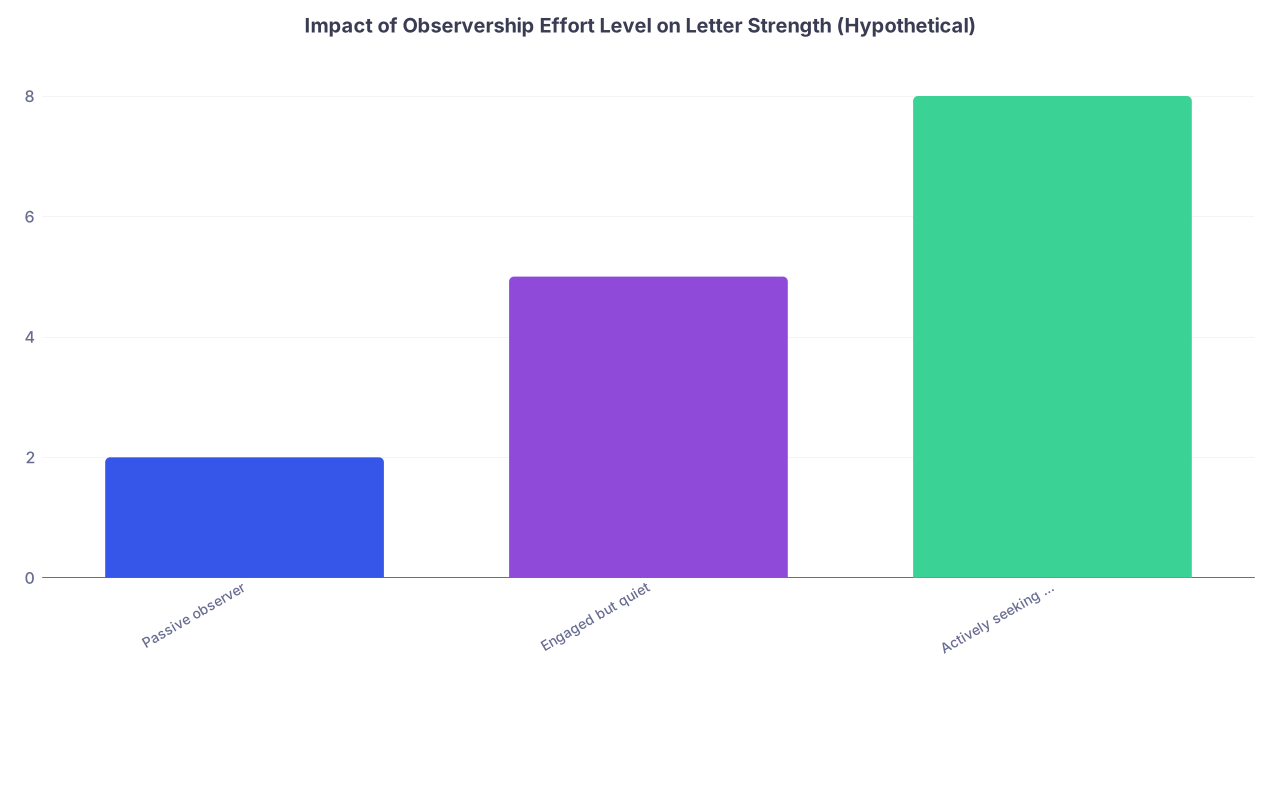
| Category | Value |
|---|---|
| Passive observer | 2 |
| Engaged but quiet | 5 |
| Actively seeking feedback | 8 |
(Think of those numbers as rough “letter quality” out of 10.)
2. Script Your LOR Ask Properly
Don’t just say, “Can you write me a letter?” and hope for the best.
Say something like:
“I know as an observer I couldn’t do as much as a sub‑I, but I tried to show you how I think clinically. If you feel you’ve seen enough of my work ethic and clinical reasoning to write a strong letter, I’d be really grateful. If not, I completely understand.”
That word—strong—matters. It gives them an out if they only remember you vaguely and would write something lukewarm.
Also: offer them material.
- A brief CV
- A paragraph on your career goals
- Specific cases you worked on with them that stood out to you
You’re not writing your own letter. You’re refreshing their memory so they can actually say something more detailed than, “They were punctual and pleasant.”
3. Translate Observerships Into Your Personal Statement Properly
Don’t just list them like trophies:
“I completed observerships at Hospital A, B, and C.”
Boring. Weak. Everyone says that.
Instead, pick 1–2 moments that show:
- You understand how US medicine actually works (insurance, documentation, team hierarchy, communication).
- You grew in some clear way (comfort with EHR, different patient population, new perspective on continuity of care).
For example:
“During my observership at XYZ Community Hospital, I realized how critical concise documentation is in the US system. I watched residents struggle to complete notes while handling pages, and I started practicing writing mock notes that the attending later reviewed with me. His feedback on structure and clarity shaped how I now approach written communication in my home clinic.”
That feels real. That shows you weren’t just standing around. It gives programs a reason to think, “Okay, they were an observer, but they actually paid attention to the right things.”
If You Still Have Time Before Applying
If you’re not in ERAS season yet and you’re panicking reading this, here’s the harsh but helpful part: you might still be able to upgrade.
Options that are better than only observerships:
- A hands‑on externship (even if it’s paid and kind of painful financially).
- A research position that includes clinic time (some IM or neuro departments do this).
- Clinical work in your home country that you can spin as “current, active practice” with strong letters.
If you can add even:
- 1 month of an externship
on top of: - 3 months of observerships
Your application reads very differently. Now they can say, “They’ve at least written notes, interacted with nurses, seen real workflow pressure in the US.”
If you truly have no way—financial, visa, time-wise—to get hands‑on USCE, then your strategy has to shift:
- Apply more broadly.
- Target IMG‑friendly community programs.
- Lean on things you can control now: Step 2 timing, personal statement clarity, letter quality, research output.
Realistic Expectation Setting (So You Don’t Self-Destruct)
If your USCE is only observerships, you need to be brutally clear with yourself about two things:
Your target program tier
You can’t be only-observership and then mainly apply to big-name university programs with a 5% IMG rate and act surprised when no one bites. That’s not self-belief. That’s delusion, and it’ll wreck your mental health.Your mindset for rejection
You might do everything right and still get ghosted by places you thought you were perfect for. It won’t always be because of your observerships. But they will sometimes be the tiebreaker against someone with hands‑on USCE.
That doesn’t mean you’re unworthy of being a doctor in the US. It means the system is skewed, risk‑averse, and likes applicants it can understand easily on paper.
You are not an easy applicant to understand. That’s all.

| Step | Description |
|---|---|
| Step 1 | Applicant Profile |
| Step 2 | Exam Scores |
| Step 3 | Clinical Experience |
| Step 4 | Letters of Recommendation |
| Step 5 | Recency/YOG |
| Step 6 | Observerships Only |
| Step 7 | Hands-on USCE |
| Step 8 | Need Strong Scores + LORs |
| Step 9 | More Flexibility with Scores |
So… Will Programs Take You Seriously?
Some will. Some won’t. And you’ll never get a perfectly clear list of who’s who.
But here’s the line I’d write on a Post-it if I were you:
“Observerships don’t make me a joke. They just mean I have to prove myself in other ways.”
If your plan right now is:
- Only-observership USCE
- Average scores
- Narrow list of reach programs
Then yes, your anxiety is trying to save you from a bad strategy.
If your plan becomes:
- Only-observership USCE (because that’s all you could get)
- Strong, recent Step scores
- Carefully chosen IMG‑friendly programs
- Maximized letters and personal statement
Then you’re no longer just a “desperate IMG with shadowing.” You’re a serious, if imperfect, candidate.
Years from now, you won’t remember the exact wording of your observership certificates. You’ll remember whether you adapted, adjusted, and pushed anyway when it felt like the whole system was stacked against you.