
It’s exactly 6 months before your Step 1 date.
You just logged into Prometric to confirm the exam, stared at that date for a solid 30 seconds, and felt your stomach drop.
You’ve got some lecture notes, a half-hearted Anki routine, maybe you “did some UWorld questions that one weekend,” and every M3 you know keeps saying the same thing: “Start earlier than you think you need to.”
This is that earlier.
Here’s the month‑by‑month, then week‑by‑week, then zoomed‑in milestones. If you’re 6 months out, here’s what you should actually be hitting.
6 Months Out: Lock the Foundations and Build the Machine
At this point you should:
- Have your exam month/date chosen (or at least a target)
- Pick your core resources
- Start a realistic but firm study “engine” (QBank + Anki + content)
Core decisions you should make this week
Do this in 2–3 days. Not spread over three weeks.
Set your resource stack and stop shopping around.
You do not need six QBanks and four review books. You need one main of each:- Main content:
- Boards & Beyond or Pathoma + Sketchy combo
- First Aid/Boards-style book for reference, not for underlining every word
- Main QBank:
- UWorld (non-negotiable in 2026)
- Flashcards:
- Anking deck (or your school’s vetted Step 1 deck) in Anki
If you’re still debating resources 2 months from now, you’re already behind.
- Main content:
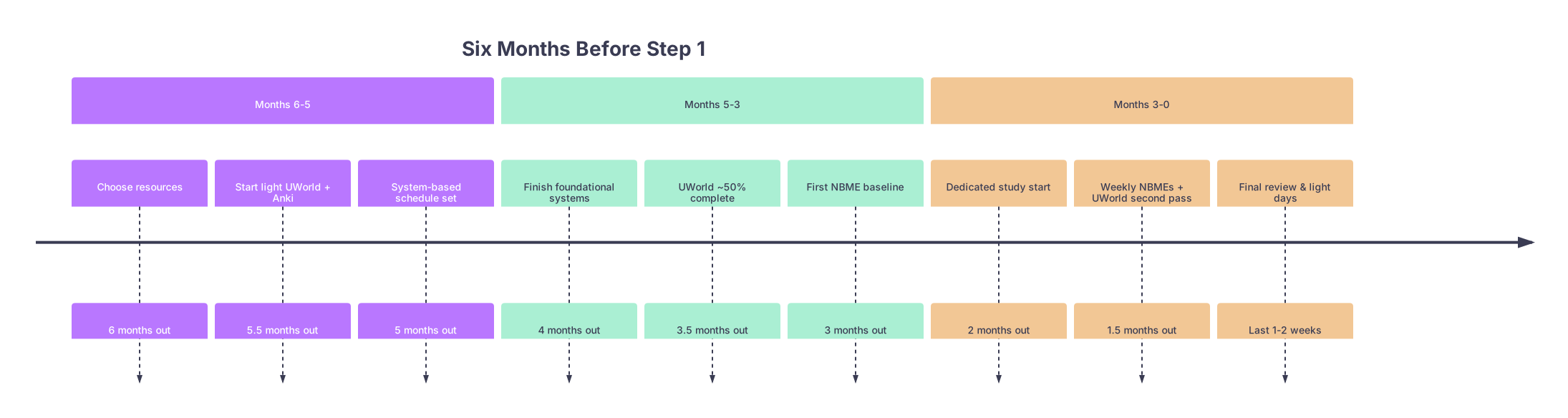
Create a 6‑month macro plan.
Not perfect. Just defined.- Months 6–4: Systems/content-heavy + start UWorld slowly
- Months 4–2: Full first pass of UWorld + NBME baseline + fill gaps
- Months 2–0: Dedicated: intensive QBank, NBMEs, final review
Sketch this on paper or in Notion. I don’t care where. Just visible.
Fix your Anki situation.
At 6 months out you should:
- Have Anki installed and functioning
- Have a consistent daily review habit (even if small)
- Be using tags/suspension, not just “do all 40,000 cards raw”
Target: 200–300 review cards/day at a minimum, plus new cards tied to what you’re studying.
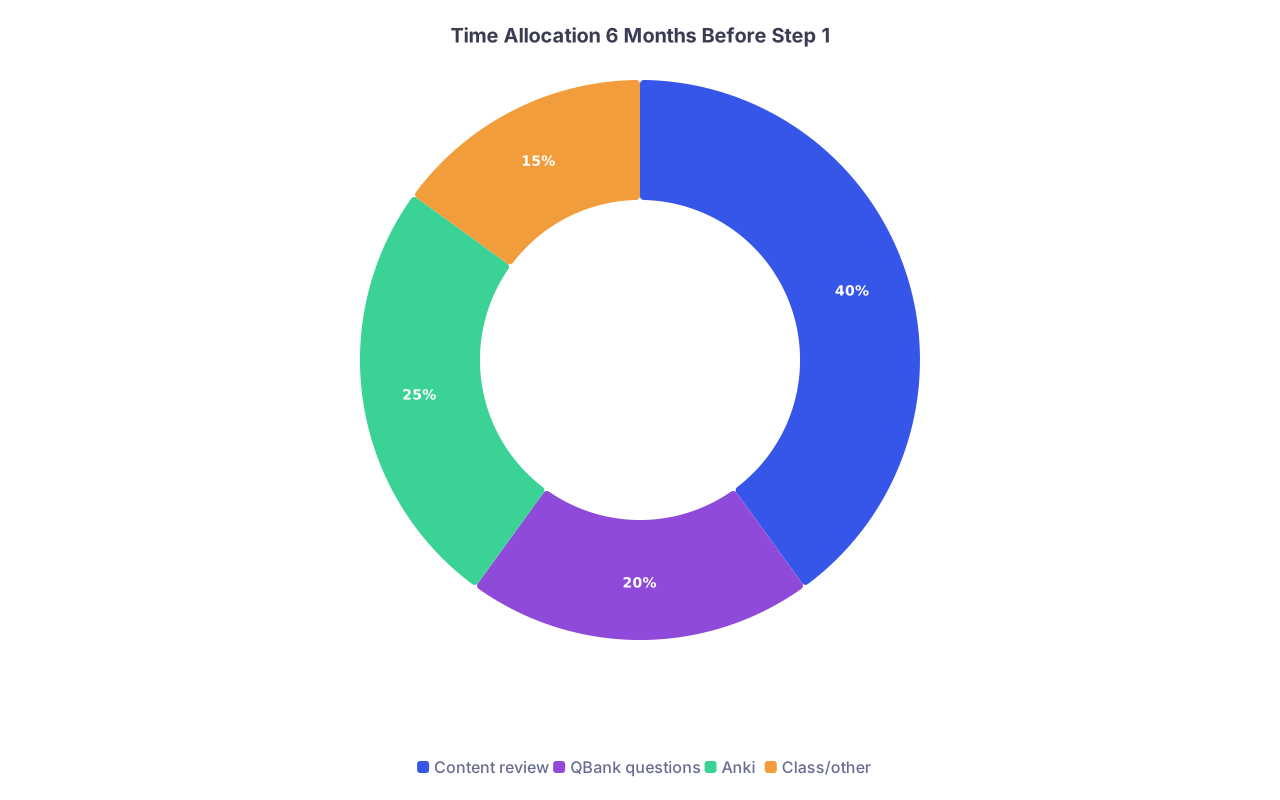
| Category | Value |
|---|---|
| Content review | 40 |
| QBank questions | 20 |
| Anki | 25 |
| Class/other | 15 |
Weekly structure at 6 months out
You’re still in classes, so your life is split. Aim for:
- 5 days/week of Step‑focused work
- 2 lighter days (call them “maintenance days”)
A typical week should look like:
Per weekday (during non-exam school weeks):
- 1–2 hours: Boards-style content (video + notes)
- 20–40 UWorld questions (tutor mode is fine this early)
- Anki reviews (200–300) spread across the day
Per weekend day:
- 40–60 UWorld questions
- Longer content block (e.g., one full system lecture set)
- Clean up missed Anki
At this point you should not:
- Be doing full-length practice tests yet
- Be obsessing over percentages
- Be bouncing between resources every other day
5 Months Out: Systems Schedule Set and UWorld Meaningful
At 5 months out, you should stop thinking “I’ll get to that system later.” You need a written systems schedule by now.
Build a system-by-system timeline (and stick to it)
You want every major system slotted on a calendar between now and 2 months before your test:
- Cardio
- Pulm
- Renal
- GI
- Heme/Onc
- Endo/Repro
- MSK/Skin
- Neuro/Psych
- Micro
- Immuno
- Biochem/genetics
- Behavioral/ethics/biostats
Block them like this:
- Big systems: 7–10 days each
- Smaller/“misc” topics: 3–5 days
By 5 months out you should:
- Have the next 8 weeks mapped to specific systems
- Know this week’s system and next week’s system without looking
| Period | Event |
|---|---|
| Months 6-5 - Choose resources | 6 months out |
| Months 6-5 - Start light UWorld + Anki | 5.5 months out |
| Months 6-5 - System-based schedule set | 5 months out |
| Months 5-3 - Finish foundational systems | 4 months out |
| Months 5-3 - UWorld ~50% complete | 3.5 months out |
| Months 5-3 - First NBME baseline | 3 months out |
| Months 3-0 - Dedicated study start | 2 months out |
| Months 3-0 - Weekly NBMEs + UWorld second pass | 1.5 months out |
| Months 3-0 - Final review & light days | Last 1-2 weeks |
UWorld benchmarks at 5 months out
At this point you should:
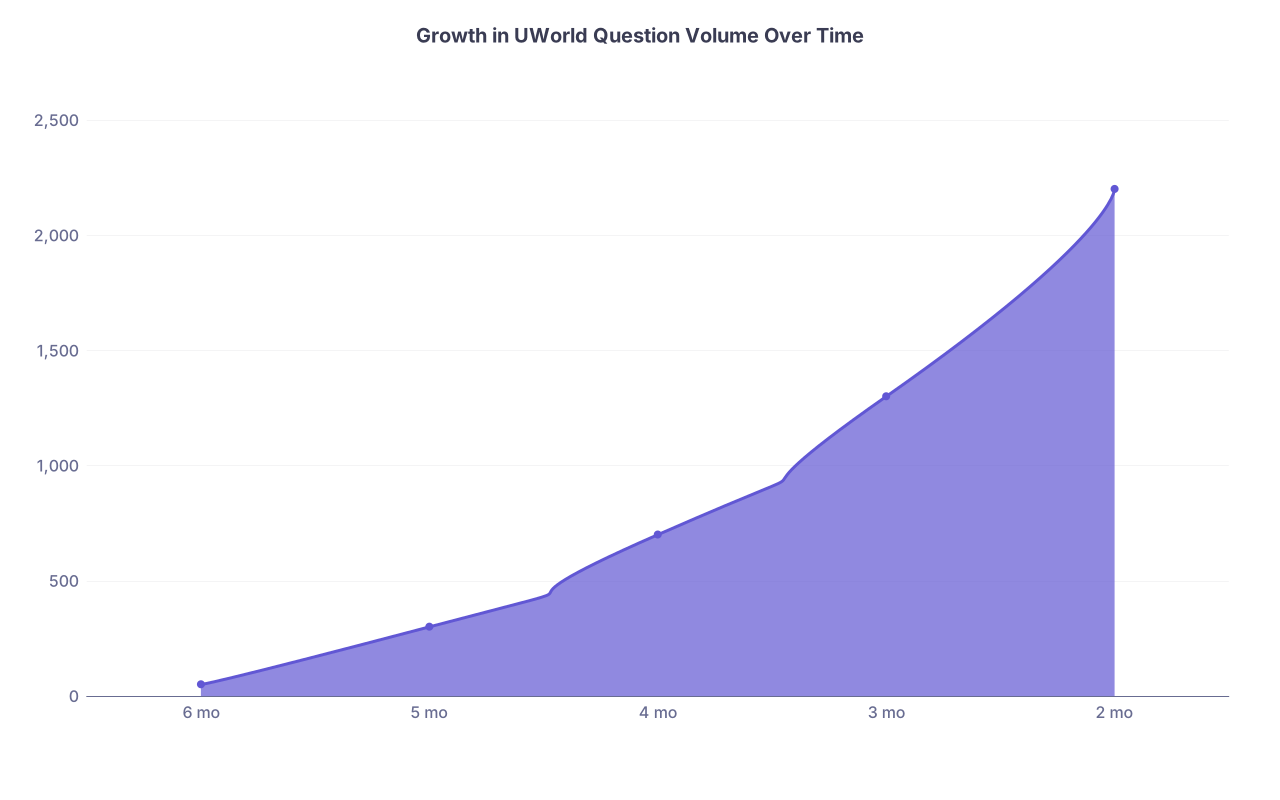
- Have at least 200–400 questions completed (doesn’t have to be pretty)
- Be doing 20–40 questions most days
- Be reviewing your questions properly, not just checking the percentage
If you’re under 200 questions done by 5 months out, you need to:
- Increase to 40 questions/day on weekdays
- Add a 60‑question block one weekend day
Weekly milestones now
Each week should have:
- 1 specific system focus (e.g., “Cardio week”)
- 120–200 UWorld questions
- 20–30% of that system’s Anki cards learned or unsuspended
At this point you should be able to say:
“This week I’m doing Pulm. I’ll cover B&B Pulm 1–5, 160 UWorld Pulm cards, and unsuspend 300 Anki Pulm cards.”
If you can’t describe your week in that level of detail, your plan is still too vague.
4 Months Out: Finish Core Systems and Hit First “Mini Check”
This is the month where people either solidify or drift.
At 4 months out, you should:
- Be finishing your first pass through the major systems
- Have a non-laughable UWorld count
- Take your first low-stakes assessment (not necessarily a full NBME yet, but some formal test)
UWorld progress by 4 months out
Here’s where you want to be:
| Months Before Step 1 | UWorld Completed | Daily Question Range |
|---|---|---|
| 6 months | 0–5% | 10–20 |
| 5 months | 5–15% | 20–40 |
| 4 months | 15–30% | 40–60 |
| 3 months | 35–60% | 60–80 |
| 2 months | 80–100% (first pass) | 60–120 |
At 4 months out you should:
- Have at least 500–800 UWorld questions done
- Be trending upward in daily volume
- Be shifting more to timed blocks (still maybe system-based)
If you’re below 500 at this point, you can still recover, but your next 4–6 weeks have to be tighter. No more “I’ll skip today and catch up tomorrow.” That lie kills scores.
First real assessment (but don’t overreact)
Around 4 months out, you should do one of the following:
- NBME “sample test” style exam
- Or school-provided CBSE/COMSAE equivalent
- Or a full UWorld self-assessment if you really want numbers
Goal is not to be proud of the score. Goal is to:
- See where you’re hemorrhaging points (biochem? micro? pharm?)
- Get used to a 4‑block or 7‑block testing day
- Identify content holes early enough to fix them
At this point you should:
- Have a written list of your bottom 3 weak areas
- Add extra time each week to those areas (e.g., 3 extra hours of biochem this week)
3 Months Out: Transition to Exam-Mode Thinking
Three months sounds like a lot of time until you start counting weekends.
At 3 months out, you’re crossing from “laying foundations” to “training for the test itself.”
You should:
- Be halfway or more through your first UWorld pass
- Have a baseline NBME under your belt
- Start blocking off dates for dedicated
Hard numbers for 3 months out
At this point you should:
- Have 800–1,400 UWorld questions completed (depending on how early you truly started)
- Be doing 60–80 questions most days when not in crazy exam weeks
- Have at least 1 NBME or CBSE score written down somewhere
And your study should look more like the exam:
- More mixed blocks, not just single systems
- More timed mode, not just tutor
- More review focused on patterns, not one-off facts
| Category | Value |
|---|---|
| 6 mo | 50 |
| 5 mo | 300 |
| 4 mo | 700 |
| 3 mo | 1300 |
| 2 mo | 2200 |
Weekly structure at 3 months out
If school is lighter or you’re approaching dedicated, you should aim for:
- 5–6 days/week of serious Step 1 prep
- Each “real” day:
- 60–80 UWorld questions (timed, mixed or mostly mixed)
- 2–3 hours of focused review (wrong questions + weak topics)
- Full Anki reviews (300–500 depending on your deck)
By the end of this month you should:
- Have your dedicated period start date locked
- Know how many days of pure Step prep you’ll get before the exam
If dedicated is only 3–4 weeks, you must be more aggressive now.
Zooming In: Sample Week-by-Week Milestones (6 → 3 Months)
You don’t need perfection. You need trajectory.
Weeks 1–4 (6 months out)
By the end of week 4, you should:
- Have:
- Picked your main resources
- Established Anki as a daily non-negotiable
- Completed:
- 150–250 UWorld questions (mostly system-based, tutor mode)
- Finished:
- 1–2 full systems in your content videos (e.g., Cardio + Pulm)
Weekly checklist at this stage:
- 5 days of Anki reviews
- 5–6 blocks of 10–20 UWorld questions
- 1–2 “long” study blocks on the weekend
- Next week scheduled (system + target Q count)
Weeks 5–8 (5 months out)
By the end of week 8, you should:
- Be halfway through your systems list
- Have 300–500 UWorld questions completed
- Start sprinkling in mixed blocks (e.g., 10 mixed, 10 system-based)
Weekly checklist here:
- 150–200 UWorld questions
- 3–4 hours targeted to weakest content area
- At least 1 block done in strict timed mode
- One half-day “catch-up block” for Anki
What About NBMEs? When They Enter the Picture
You’re not doing full NBME marathons at 6 months. That’s dumb. You don’t have the knowledge yet and you’ll just scare yourself for no reason.
Here’s the rough flow:
- 4 months out – Optional first assessment:
- Could be a CBSE/CBSSA or UWorld SA. Treat it as a diagnostic.
- 3 months out – First NBME that matters:
- Full NBME, timed, serious environment. Use this to set realistic target ranges.
- 2 months out and closer – Regular NBME cadence:
- Every 1–2 weeks, depending on mental stamina and time
At 6 months out, the “milestone” is not “take NBMEs.”
It’s “be on track so that when you start NBMEs, you’re not scoring in the absolute basement.”
Red Flags at 6–4 Months Out (And How to Fix Them Quickly)
If you see these, don’t ignore them.
Red flag #1: “I’ll start UWorld in dedicated.”
Wrong. You’ll get wrecked.
If you’re still telling yourself this 6 months out:
- Start 10–20 questions/day TODAY
- System-based, tutor mode
- Accept that early scores will be trash. That’s fine. This is learning, not flexing.
Red flag #2: You “do Anki” but your reviews are piling up
If your Anki review number makes you nauseous (800, 1200, etc.):
- Immediately suspend:
- Old, low-yield decks you never really committed to
- Any cards you truly don’t want to maintain
- Focus on:
- Today’s reviews
- New cards only from what you’re actively studying
Your milestone at 6–5 months out is clean daily reviews, not “own every card ever made.”
Red flag #3: You can’t tell me what you’re studying this week
If someone asks “What’s this week about?” and your answer is “Uh… a little of everything”… that’s a problem.
Fix it:
- Tonight, choose:
- 1 primary system (e.g., Renal)
- 1 secondary topic (e.g., Biochem)
- Write:
“This week = Renal + Biochem. Goal: 150 UWorld Qs, finish Renal B&B, + 3 hours of biochem.”
Put it on your wall, not just in your head.
Micro-Level: What a Solid “6 Months Out” Day Looks Like
Let’s say you have a normal class day, nothing insane, 8am–3pm-ish.
A realistic Step‑focused day at 6 months out:
Morning (before or between classes, 45–60 min):
- Anki reviews (100–150 cards)
- 5–10 UWorld questions (tutor, same system)
Afternoon (1–1.5 hours):
- 1–2 videos from your main content resource
- Light notes / link concepts to Anki
Evening (1.5–2 hours):
- 10–20 more UWorld questions
- Review every question you missed or guessed
- Short Anki cleanup (additional 50–100 reviews)
Daily milestone:
- 20–30 UWorld questions
- 200–300 Anki reviews
- 1–2 focused content chunks
If you’re doing substantially less than this most days at 6 months out, your dedicated period will have to carry more weight. Which means more stress. Your call.
Where You Should Be Mentally at 6 Months Out
You don’t need to feel “ready.” You won’t.
But by 6 months out you should feel:
- Like you have a direction, not just vague dread
- Like you’re building a habit, not cramming
- Like Step 1 is a large project with phases, not a monster cloud
And you should be okay with being “bad” in UWorld right now. I’ve seen plenty of students sitting at 40–50% early on who crushed it later because they used those painful wrong answers as fuel.
Your Next Step Today
Don’t just nod along and click away.
Do this right now:
- Open a calendar (Google Calendar, Notion, paper, anything).
- Block the next 4 weeks into systems:
- Week 1: System A
- Week 2: System B
- Week 3: System C
- Week 4: System D
- Under this week, write:
- “Target: ___ UWorld questions, ___ Anki reviews/day, finish ___ videos.”
Then open UWorld and start your next 10‑question block. Timed or tutor, I don’t care. But at this point, 6 months out, you should not end today with “0 questions done” again.