
Trying to “wait until dedicated” to start Step 1 prep is how strong students end up mediocre.
If your school runs systems-based blocks in MS2 and you are not integrating Step 1 prep into those blocks, you are wasting effort and forgetting 70% of what you learn by the time dedicated starts. I have watched this play out over and over: great in-class exam scores, then genuine shock at mediocre NBMEs because nothing was built for Step 1.
Here is the fix: you turn your systems blocks into your Step 1 curriculum. On purpose. Week by week, month by month.
I will walk you through an entire MS2 year assuming a standard sequence like:
- Aug–Sep: Cardiovascular
- Oct: Respiratory
- Nov: Renal
- Dec: Endocrine/Repro
- Jan: GI/Hepatobiliary/Nutrition
- Feb: Heme/Onc
- Mar: MSK/Derm/Rheum
- Apr: Neuro/Psych
- May: Dedicated starts
If your order is different, you can shift the months, but keep the structure.
Month 0 (The Month Before MS2 Starts): Set the Infrastructure
At this point you should stop thinking vaguely about “doing UWorld early” and actually build the system that will carry you through the year.
Your goals this month:
- Pick and set up core resources
- Build a realistic time budget
- Decide your Anki and question-bank rules
Core resources (decide now, do not keep shopping)
You need:
- One primary review text:
- First Aid or Boards & Beyond outlines printed / PDF
- One question bank:
- UWorld preferred; AMBOSS if UWorld not available yet
- One flashcard system:
- Anking or Lightyear (pick one; do not mix decks randomly)
| Item | Decision Rule |
|---|---|
| Review Text | First Aid or B&B, not both in full |
| Qbank | UWorld primary, AMBOSS optional |
| Anki Deck | AnKing or Lightyear, never both |
| Videos | B&B or Pathoma per system |
At this point you should:
- Install and sync Anki
- Suspend every card except your school’s current system and a small daily “foundations” set (biochem, immunology, pharm basics)
- Block 2–3 hours per weekday on your calendar labeled “Boards Block” before anything social goes in
Time budget (what your week will actually look like)
For MS2, a stable target that works for most:
Weekdays
- 1–1.5 h: New Anki + reviews
- 60–80 UWorld/AMBOSS questions per week (about 15 per weekday)
- 30–45 min: Review text/high-yield video tied to that system
Weekends
- 1–2 h: Longer question blocks and missed Anki reviews
- 1–2 h: Catch-up on system lectures if needed
If you are already drowning before school starts, that is a red flag. Fix schedule or expectations now.
Months 1–2: Cardiovascular System Block
This is where you build the habits you keep all year. If you blow cardio, you will chase yourself the entire year.
Week 1 of Cardio: Build the Cardio Spine
At this point you should:
- Unsuspend only the cardiology subsection of your Anki deck
- Watch / skim: B&B cardio anatomy + physiology; Pathoma ch. 9 intro
- Read quickly through First Aid cardiovascular chapter once, not studying, just orienting
Daily structure (Mon–Fri):
- 30–40 min: New cardio Anki (no more than 30–40 new cards/day at first)
- 30–40 min: Anki reviews (cap yourself ~250 reviews; adjust new cards accordingly)
- 10–15 question UWorld cardio block (untimed, tutor mode, organ system filter = cardio)
- 15–20 min: Review questions (write 2–3 key error notes in a running Google Doc or Notion table)
You are not chasing question volume yet. You are training workflow.
Weeks 2–3 of Cardio: Question Density Up, Tight Integration
Now you should:
- Increase cardio new Anki to 40–60/day if reviews are under control
- Move questions to timed, random order within cardio (still 10–15/day)
- Start mapping each lecture topic to First Aid or B&B sections that match
Example:
- School lecture: “Valvular Heart Disease”
- Same day: UWorld “Cardio → Valvular” questions (3–5 stems)
- Next morning: Add Anki tags for any repeated misses (e.g., “AS vs MR maneuvers”)
Week 4 of Cardio: First “System Mini-Dedicated”
At this point you should simulate a very small dedicated week for that system.
Task list:
- 2–3 days: 40-question cardio-only UWorld blocks each day (timed)
- One day: Re-watch Pathoma cardio pathology at 1.25–1.5x speed
- Every day: Clear Anki reviews; keep adding 20–30 new cardio cards
End of Month 2, you should be:
- At or near 50–70% of available cardio questions done
- Able to handle a 40-question cardio block in 1 hour without panic
- Not letting Anki reviews exceed 250–300/day consistently
If your Anki reviews are >350 and you feel behind, reduce new cards by 10–20/day for two weeks. Do not just stop reviews.
Month 3: Respiratory Block
Cardio habits now become the template. You are stacking systems.
Week 1 Respiratory: Add Without Dropping
At this point you should:
- Unsuspend respiratory cards while keeping cardio reviews active
- Commit to no system amnesia: do not turn off old systems entirely
Daily split:
- 30–40 min: Cardio reviews only (no new)
- 20–30 min: New respiratory cards (20–30/day to start)
- 10–15 questions: Respiratory-focused UWorld on lecture topics
Week 2–3 Respiratory: Introduce Mixed Blocks
Once you have ~150–200 respiratory questions seen:
- Switch to mixed cardio + respiratory UWorld blocks (still 10–15/day)
- Track performance by system (UWorld has this by default – look weekly, not daily)
You want to see:
- Cardio performance stable or improving despite reduced focus
- Respiratory climbing from “random guess” territory into legitimate reasoning
Week 4 Respiratory: Combined System Checkpoints
At this point, you should mimic what Step 1 actually feels like:
- 2 days: 40-question mixed cardio/resp blocks (timed, single sitting)
- 1 day: Revisit First Aid cardio + resp margins and Pathoma high-yield tables
- Ongoing: Anki reviews for cardio + resp, new cards only in resp
If your mixed-block performance drops >10% below your single-system scores, you are overestimating how “solid” a system is. You need spaced review, not just confidence.
Month 4: Renal Block
Renal is where a lot of students crack. Acid–base, electrolyte disorders, and glomerulonephritides show up everywhere.
Week 1 Renal: Front-Load the Painful Stuff
At this point you should:
Unsuspend renal cards, but prioritize:
- Nephron physiology
- Diuretics pharmacology
- Acid–base patterns
Re-watch or read: B&B renal physiology early; do not “save it for later”
Daily:
- 30 min: Cardio + resp reviews (no new)
- 30–40 min: Renal new + initial reviews
- 10–15 questions: Renal-only UWorld early (even if you are weak)
Week 2–3 Renal: Build Pattern Recognition
Your focus these two weeks:
- Ramp renal questions to 15–20/day (still mostly renal-heavy)
- Create or tag a small set of “pattern cards” in Anki for:
- Nephrotic vs nephritic syndromes
- Types of renal tubular acidosis
- Diuretic side effects and contraindications
At this point you should start:
- 40-question multi-system blocks once weekly (cardio/resp/renal)
These hurt at first. Good. Step 1 will not ask politely organized blocks.
Week 4 Renal: First Full NBME or Comprehensive Assessment
By now you are about 3 systems in. Time for your first real temperature check.
- Take: NBME Comprehensive Basic Science or school-provided CBSE
- Conditions: 4 blocks, timed, realistic (no pausing every 5 questions)
If your score is:
- Strong: At or above your program’s typical Step 1 average – keep the current plan, small refinements only
- Mediocre: 10–20 points below target – you probably need more question volume and to clean up weak preclinical foundations (biochem, immuno, micro)
- Weak: >20 points below target – you must carve more time for Step work; reduce extra-curriculars and aim for 60–80 questions/week minimum
Month 5: Endocrine / Reproductive Block
Now you layer endocrine logic into your framework.
Weeks 1–2 Endo/Repro: Hormone Logic First, Details Second
At this point you should:
- Focus initial time on:
- Feedback loops (pituitary–thyroid, pituitary–adrenal, pit–gonadal)
- Diabetes pharmacology and complications
- Menstrual cycle, pregnancy physiology
Daily:
- 20–30 min: Old systems reviews (cardio, resp, renal)
- 30–40 min: Endo/Repro new cards
- 15–20 questions: Heavily skewed to endocrine early
Weeks 3–4: High-Yield Micro and Path Overlays
Endo/Repro is where infections and tumors sneak back in.
You should now start:
- One weekly block that is micro-heavy but still related (STIs, TORCH infections, postpartum infection, etc.)
- Re-integrate pathology by re-watching Pathoma selective chapters:
- Endocrine
- Female genital system
- Male genital system
At this point, your weekly Anki time is likely around:
- 1–1.5 h/day reviews + new
- 15–20 min/day of tagging missed concepts from UWorld into Anki
If Anki is regularly >2 hours/day, you are doing too many new cards or using inefficient settings. Tighten.
Month 6: GI / Hepatobiliary / Nutrition
This month is about raw volume and clinical integration (think Step-style vignettes).
Weeks 1–2 GI: Anatomy + Path First
At this point you should:
- Unsuspend GI cards, emphasize:
- Blood supply and anatomy of gut
- Liver pathology, cirrhosis, portal hypertension
- Malabsorption syndromes
- Start mixed QBank blocks including all prior systems plus GI, at least 3x/week
Weeks 3–4: “Clinical Month” Style
Your best move now:
- Shift UWorld to Random + All Systems allowed, but accept the fact that some topics are not yet covered. Use “mark” and move on without spiraling when you have never seen content.
- Keep one or two GI-heavy blocks for confidence each week.
At this point, Step 1 prep is no longer “extra”. It is the lens you see every system through.
Month 7: Heme/Onc Block
This month you integrate pathology, pharmacology, and physiology all at once.
Weeks 1–2 Heme/Onc: Hit the Foundations Immediately
You should:
- Re-watch Pathoma Chapters 1–3 (big-picture pathology principles), not just the heme chapter
- Unsuspend heme/onc cards, focus on:
- Coag cascade, anticoagulants, bleeding disorders
- Leukemias/lymphomas classification
- Solid tumor hallmarks and common mutations
Daily:
- ~1 h Anki (reviews now span 4–5 systems)
- 20–25 questions: mixed blocks, but add heme/onc tagged questions as possible
Week 3–4: Second Formal Assessment
At this point, take another NBME/CBSE.
Use it this way:
- Identify 2 weakest systems (or disciplines like pharmacology, biostats)
- For the next 2 weeks, assign:
- 5–10 extra daily Anki cards from each weak area
- 5–10 extra daily UWorld questions from those systems
You are now past the halfway point. Any major content holes must be confronted, not ignored until dedicated.
Month 8: MSK / Derm / Rheum
Students chronically underestimate these. Step 1 does not.
Weeks 1–2 MSK/Derm/Rheum: Structure and Syndromes
At this point you should:
- Unsuspend MSK/Derm/Rheum cards
- Give specific deliberate time to:
- Rashes and their classic descriptions
- Autoimmune rheumatologic diseases
- Bone tumors and bone physiology
Question strategy:
- Add at least 2 mixed blocks/week that you do in full-test conditions:
- 40 questions, 1 hour, minimal breaks
Weeks 3–4: Pharm Clean-Up
MSK/Derm/Rheum is a good place to:
- Consolidate pharmacology:
- NSAIDs, DMARDs, biologics
- Dermatologic drugs (isotretinoin, steroids, etc.)
At this point:
- Do a pharmacology-only custom block (20–30 questions) once per week
- Tag any “always forget” drugs in a separate pharm tag in Anki; review that tag twice weekly
Month 9: Neuro / Psych
Neuro/Psych will crush you if you try to “memorize everything” without structure.
Weeks 1–2 Neuro: Pathways and Localizations
You should:
Prioritize:
- Brainstem lesions and localizing features
- Movement disorders
- Seizure types and treatments
Watch a concise neuroanatomy review video if your school’s course is weak
Daily:
- 30–40 min: Neuro new cards
- 30–40 min: Old system reviews (now heavy)
- 20–25 questions: Mostly random, but ensure 1–2 neuro-heavy blocks/week
Weeks 3–4 Psych: Diagnosis and Treatment Pairs
At this point you should:
- Map each major psychiatric diagnosis → first-line and second-line medications
- Focus on side effects that Step 1 adores:
- NMS, serotonin syndrome, lithium toxicity, agranulocytosis, etc.
Do:
- 1 psychiatry-only block/week
- 2–3 fully random blocks/week (all systems, timed)
At the end of Month 9, you should feel:
- Comfortable sitting for 4–5 blocks/week at 40 questions each
- Less emotionally reactive to bad blocks; able to extract lessons instead of panic
Month 10: Pre-Dedicated Transition Month
Your systems blocks are basically done. Now the question is how well they will hold through dedicated.
First Half of Month 10: Consolidation Push
At this point you should:
Aim for:
- 60–80 questions/day, 5–6 days/week
- 1.5–2 h/day Anki (mostly reviews, very few new cards)
Take a full NBME or CBSE under true test conditions
Map performance:
- Any system <55–60% correct on UWorld or flagged as low on NBME → scheduled mini-dedicated (3-day intensive) before dedicated begins
3-day mini-dedicated example for weak Renal:
Day 1:
- Re-watch renal physiology and outlined Pathoma
- 2 x 40-question renal-heavy blocks + review
Day 2:
- 2 x 40-question mixed blocks with heavy renal representation
- Anki: all renal tags, plus 20–30 new if needed
Day 3:
- 1 x 40-question all-random block
- Target review of every missed renal item in last 2 weeks
Second Half of Month 10: Dedicated On-Ramp
At this point:
- Your systems integration should be done. No brand-new content.
- Switch all QBank usage to Random / All Systems.
- Keep Anki reviews only; cap new cards at a very low number (0–20/day) unless there is a glaring hole.
You are now ready to start formal dedicated without re-learning entire systems from scratch. You will be reinforcing, not rescuing.
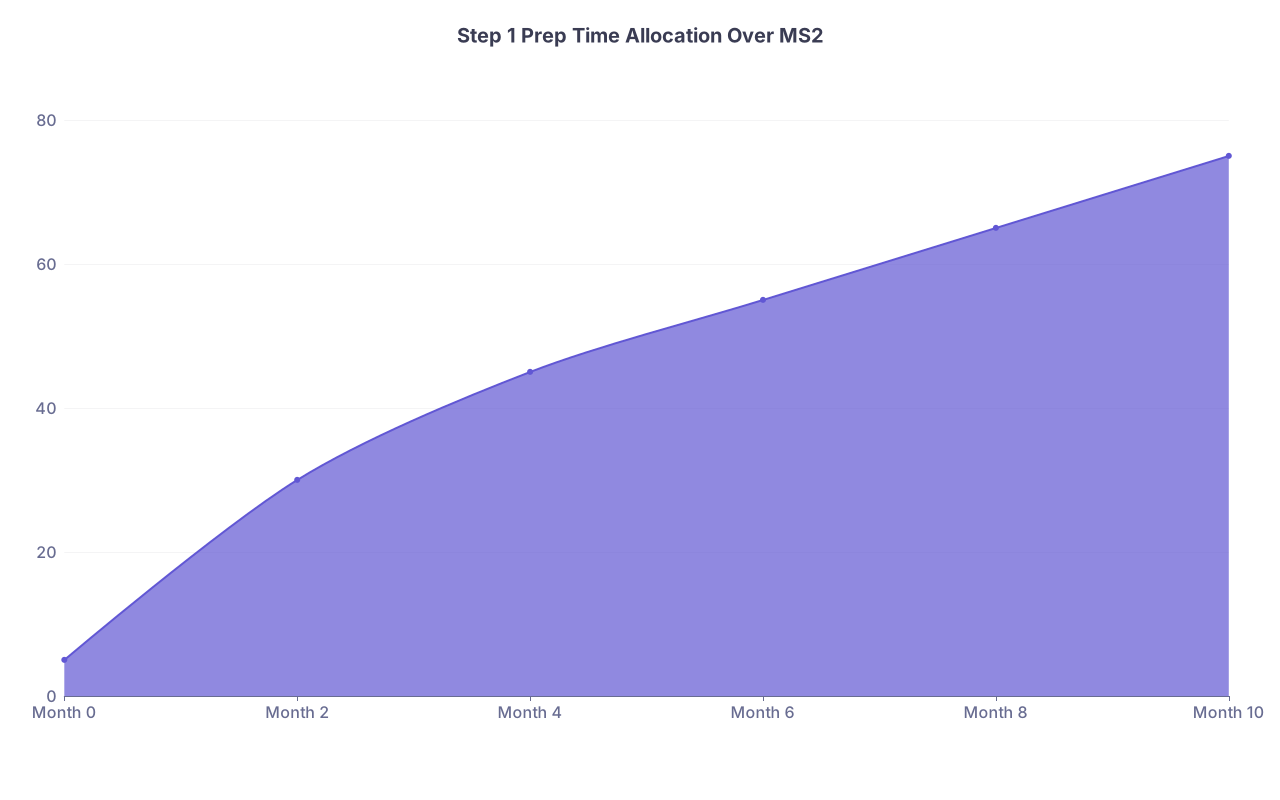
| Category | Value |
|---|---|
| Month 0 | 5 |
| Month 2 | 30 |
| Month 4 | 45 |
| Month 6 | 55 |
| Month 8 | 65 |
| Month 10 | 75 |
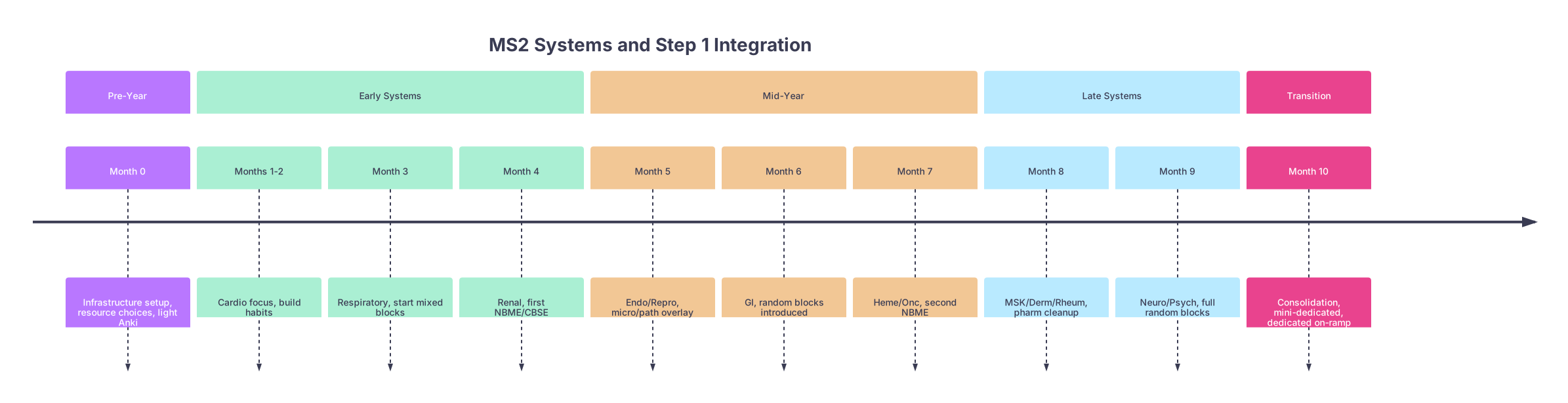
| Period | Event |
|---|---|
| Pre-Year - Month 0 | Infrastructure setup, resource choices, light Anki |
| Early Systems - Months 1-2 | Cardio focus, build habits |
| Early Systems - Month 3 | Respiratory, start mixed blocks |
| Early Systems - Month 4 | Renal, first NBME/CBSE |
| Mid-Year - Month 5 | Endo/Repro, micro/path overlay |
| Mid-Year - Month 6 | GI, random blocks introduced |
| Mid-Year - Month 7 | Heme/Onc, second NBME |
| Late Systems - Month 8 | MSK/Derm/Rheum, pharm cleanup |
| Late Systems - Month 9 | Neuro/Psych, full random blocks |
| Transition - Month 10 | Consolidation, mini-dedicated, dedicated on-ramp |
Quick Month-by-Month Checklist
Use this to sanity-check where you are.
| Month | Main Focus | Questions/Week | NBME/CBSE? |
|---|---|---|---|
| 0 | Setup + light Anki | 0–40 | No |
| 1–2 | Cardio systems + habits | 60–80 | No |
| 3 | Resp + first mixing | 80–100 | No |
| 4 | Renal + first NBME | 100–120 | Yes |
| 5–6 | Endo/Repro + GI | 120–160 | Maybe |
| 7 | Heme/Onc + NBME | 140–180 | Yes |
| 8–9 | MSK/Derm/Rheum + Neuro | 160–200 | Maybe |
| 10 | Consolidation + ramp | 200–280 | Yes |
Numbers here are ranges, not commandments. But if you are consistently at half these numbers with no strong alternative, your integration is probably too light.
FAQ (Exactly 2 Questions)
1. What if my school’s schedule is brutal and I cannot hit these question or Anki numbers?
Then you adjust down intelligently, but you do not abandon the structure. Cut new Anki cards first. Keep reviews daily, even if it is just 15–20 minutes. Drop to 40–60 questions/week but keep them strictly tied to your current system and one older system. The worst move is doing nothing Step-related for weeks, then trying to cram later. Preserve the habit pattern, even at lower volume.
2. Should I finish all of UWorld before dedicated if I am integrating during the year like this?
Ideal: yes, at least once. Realistic for many: 70–90% completion before dedicated, then finish and reset (or switch to a second bank like AMBOSS) during dedicated. What you must avoid is doing only organ-specific blocks all year and never training with fully random blocks under time pressure. A half-completed UWorld used in a disciplined, random, timed way beats a “completed” UWorld that was all untimed, system-only, and barely reviewed.
Open your calendar for the next four weeks right now. Block a daily 60–90 minute “Boards Block” during your most reliable study time and label it with your current system. That time is non-negotiable. Everything in your Step 1 year builds on that one protected block.