
Autonomic pharmacology is not “a list of drugs.” It is a wiring diagram. If you do not see the wiring, you will keep memorizing and keep forgetting.
Let me walk you through the wiring.
This is the part of Step 1 where strong students crush questions because they think in receptor patterns, organ by organ, not in isolated factoids. The exam writers lean heavily on a small, predictable set of receptor–effect–drug relationships and they test them in slightly disguised clinical vignettes.
You want to get to the point where, when you see a receptor, your brain instantly fills in:
- where it is,
- what it does when stimulated,
- what happens when you block it, and
- which 2–3 prototypical drugs matter.
I will organize this as “logic maps”: start with the receptor, then the physiologic target, then the drug class, then the Step 1 style traps.
1. The Core Receptor Map: Start With the Big 8
Most of autonomic pharmacology on Step 1 collapses to eight receptors:
- α1, α2
- β1, β2 (β3 exists but is almost never tested pharmacologically)
- M1, M2, M3
- Nicotinic (Nm, Nn, but usually just conceptually “ganglionic vs neuromuscular”)
If you can wire these eight to locations and effects, the drug questions become mechanical.
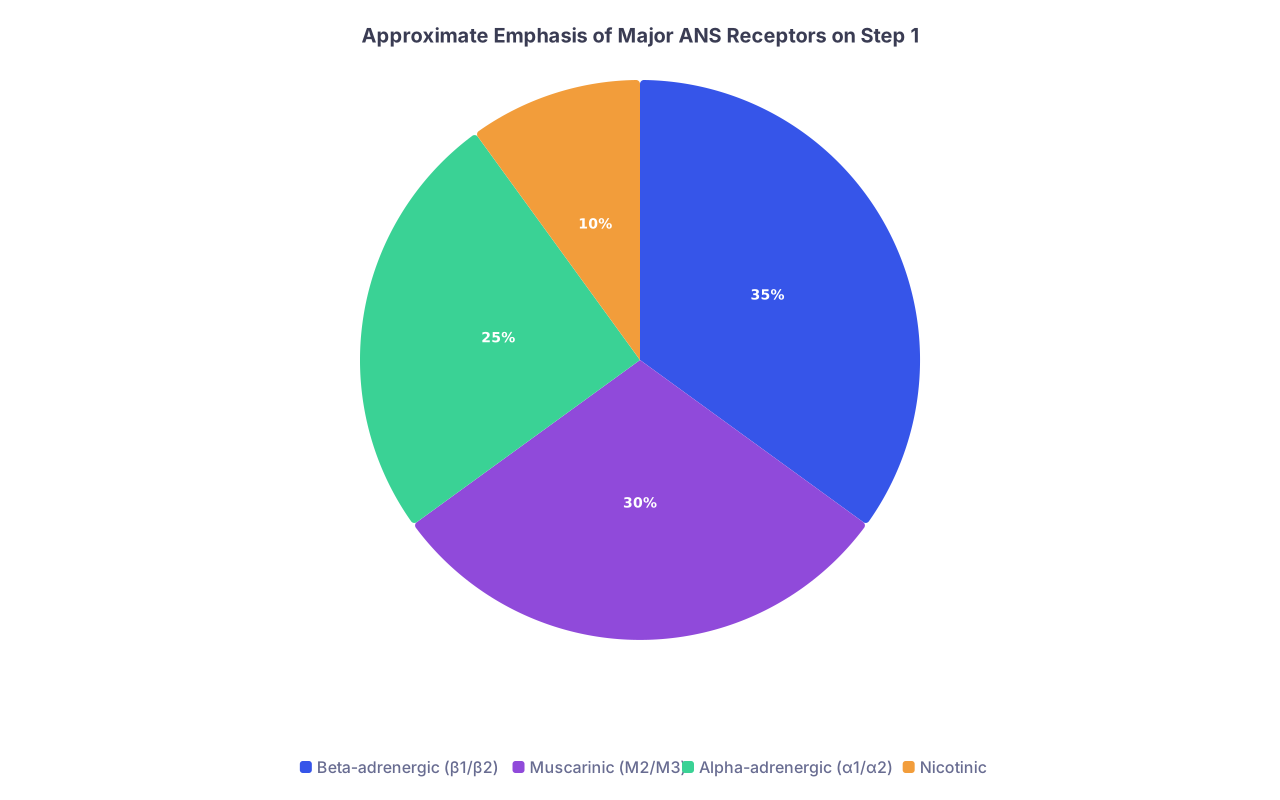
| Category | Value |
|---|---|
| Beta-adrenergic (β1/β2) | 35 |
| Muscarinic (M2/M3) | 30 |
| Alpha-adrenergic (α1/α2) | 25 |
| Nicotinic | 10 |
1.1 Alpha receptors
α1: “Vasoconstrict and tighten things.”
Major targets:
- Vascular smooth muscle (skin, splanchnic, renal)
- Pupillary dilator (radial) muscle
- Bladder trigone and sphincter
- Uterus (pregnant state more relevant clinically than for Step 1)
Effects when stimulated (agonist):
- ↑ Peripheral vascular resistance → ↑ BP (especially diastolic)
- Mydriasis (no cycloplegia; that is ciliary muscle, not α1)
- Urinary retention (tight sphincters)
Blockade (antagonist):
- Vasodilation → ↓ BP → reflex tachycardia
- Miosis (relative)
- Relaxed bladder sphincter → can help with urinary retention from BPH (α1A in prostate)
Representative drugs:
- Agonists: phenylephrine, midodrine
- Antagonists: prazosin, terazosin, doxazosin, tamsulosin (α1A selective)
Clinical “logic” examples:
- Phenylephrine eye drops → mydriasis without affecting accommodation. Key phrase.
- Prazosin → first-dose orthostatic hypotension. Because you blocked vascular α1 suddenly.
α2: “Turn down sympathetic outflow / decrease NE release.”
Location:
- Presynaptic nerve terminals (sympathetic)
- CNS (especially brainstem)
Effects when stimulated:
- ↓ NE release (negative feedback)
- ↓ Sympathetic outflow from CNS → ↓ BP, sedation
Drugs:
- Agonists: clonidine, α-methyldopa, guanfacine
- Antagonist: yohimbine (rarely tested)
Logic map:
- α2 agonist in the brainstem = centrally acting antihypertensive.
- Key Step 1 association: α-methyldopa in pregnancy-induced hypertension.
2. Beta Receptors: Heart, Lungs, and Vessels
β1: “Heart and renin.”
Locations:
- Heart (SA node, AV node, myocardium)
- Juxtaglomerular (JG) cells in kidney
Effects of stimulation:
- ↑ HR (chronotropy)
- ↑ contractility (inotropy)
- ↑ conduction (dromotropy)
- ↑ renin release (→ RAAS activation → ↑ BP)
Blockade:
- ↓ HR, ↓ contractility, ↓ renin
- Less O2 demand, useful in chronic stable angina, post-MI, heart failure (selective use)
Drugs:
- β1 agonists: dobutamine (main example), low-dose dopamine (via β1)
- β1-selective blockers ("A–M" except carvedilol, etc.): metoprolol, atenolol, bisoprolol, esmolol
β2: “Bronchodilate and vasodilate.”
Locations:
- Bronchial smooth muscle
- Vascular smooth muscle (skeletal muscle beds)
- Uterine smooth muscle
- Liver (glycogenolysis, gluconeogenesis)
Effects of stimulation:
- Bronchodilation
- Vasodilation in skeletal muscle vasculature → ↓ diastolic BP
- Tocolysis (relaxed uterus)
- Metabolic: ↑ glycogenolysis, gluconeogenesis, some lipolysis
Drugs:
- Agonists: albuterol, salmeterol, formoterol, terbutaline (uterine)
- Nonselective β-agonist: isoproterenol (β1 = β2)
Classic Step 1 logic pattern:
- Isoproterenol → big drop in diastolic BP (β2 vasodilation) + ↑ HR (β1 + reflex tachy)
- β2 agonist adverse effects: tremor, tachycardia, hypokalemia
| Drug | Primary Receptor Action | Key Step 1 Use/Association |
|---|---|---|
| Phenylephrine | α1 agonist | Nasal decongestant, mydriasis, hypotension |
| Clonidine | α2 agonist | Resistant hypertension, ADHD |
| Dobutamine | β1 > β2 agonist | Acute heart failure, stress testing |
| Isoproterenol | β1 = β2 agonist | Historical; hemodynamic physiology Qs |
| Albuterol | β2 agonist | Acute asthma exacerbations |
3. Muscarinic Receptors: Parasympathetic “End-Organs”
You do not need to memorize fifty muscarinic receptor subtypes. For Step 1, focus: M1, M2, M3.
M2: “The brake on the heart.”
Location:
- SA node
- AV node
- Atria
Stimulation:
- ↓ HR (SA node)
- ↓ conduction velocity (AV node)
Classic antagonist: atropine.
- Atropine → blocks M2 → tachycardia (first noticeable effect often mild tachycardia and dry mouth).
M3: “Secretions and smooth muscle.”
Locations:
- Exocrine glands (salivary, sweat via sympathetic cholinergic, lacrimal, bronchial)
- Bronchial smooth muscle
- GI tract smooth muscle
- Bladder detrusor muscle
- Pupillary sphincter (circular) muscle
- Ciliary muscle (accommodation)
- Vascular endothelium (NO-mediated vasodilation)
Stimulation:
- ↑ Glandular secretions: salivation, lacrimation, sweating, bronchial secretions
- Bronchoconstriction
- ↑ GI motility, cramps, diarrhea
- Bladder: detrusor contraction + sphincter relaxation → urination
- Eye: miosis (sphincter) + accommodation for near vision (ciliary)
- Endothelium: NO → vasodilation (theoretical in intact endothelium)
M1: “CNS and enteric nervous system.”
More conceptual for Step 1, less tied to a specific prototype drug. Occasionally shows up with cognitive effects (e.g., central anticholinergic toxicity).
Key muscarinic drug patterns
Muscarinic agonists:
- Direct: bethanechol (post-op ileus, urinary retention), carbachol (eyes), pilocarpine (glaucoma, xerostomia), methacholine (asthma challenge test)
- Indirect (AChE inhibitors): neostigmine, pyridostigmine, physostigmine, edrophonium, organophosphates, donepezil, rivastigmine
Muscarinic antagonists:
- Atropine (prototype, nonselective)
- Ipratropium/tiotropium (M3 block in lungs)
- Benztropine, trihexyphenidyl (CNS M1, Parkinson disease)
- Oxybutynin, solifenacin, tolterodine (bladder M3)
- Scopolamine (motion sickness, vestibular)
Core logic:
- Muscarinic stimulation = “wet”: DUMBBELSS (Diarrhea, Urination, Miosis, Bronchospasm, Bradycardia, Excitation of skeletal muscle/CNS, Lacrimation, Sweating, Salivation).
- Muscarinic blockade = “dry, hot, blind, red, mad”: anticholinergic toxicity.
4. Nicotinic Receptors: Ganglia vs Neuromuscular Junction
Nicotinic receptors are ligand-gated ion channels. Two functional sites for Step 1:
- Nn (neuronal) – autonomic ganglia and adrenal medulla
- Nm (muscular) – neuromuscular junction on skeletal muscle
Patterns:
- Ganglionic blockers (historical: hexamethonium, mecamylamine) show up in physiology questions to separate sympathetic vs parasympathetic dominant tone in different organs.
- Nm blockers (nondepolarizing: rocuronium, vecuronium, pancuronium; depolarizing: succinylcholine) show up in anesthesia and surgery-related questions.
Logic:
- Succinylcholine → depolarizing block. Phase I (fasciculations, sustained depol, potentiated by AChE inh) vs Phase II (desensitization, reversed by AChE inh).
- Nondepolarizing → competitive antagonists at Nm, reversed by AChE inhibitors like neostigmine.
5. Receptor Logic by Organ: The “Map” You Actually Use on Step 1
Now, instead of memorizing receptor → effect in isolation, map them organ by organ. This is exactly what shows up in vignettes.
5.1 Eye
Main players:
- α1: radial (dilator) muscle → mydriasis
- M3: sphincter muscle → miosis; ciliary muscle → accommodation and aqueous humor outflow (trabecular meshwork)
Patterns:
Agonism:
- α1 agonist (phenylephrine): mydriasis without cycloplegia (accommodation unaffected).
- M3 agonist (pilocarpine, carbachol): miosis and accommodation (“ciliary spasm”), ↑ outflow in open- and closed-angle glaucoma.
Antagonism:
- M3 antagonist (atropine, tropicamide, homatropine): mydriasis with cycloplegia (loss of accommodation).
- β-blockers (timolol, betaxolol) decrease aqueous humor production via ciliary epithelium.
Step 1 angle:
Patient with acute angle-closure glaucoma precipitated by mydriatic agent: almost always antimuscarinic (e.g., atropine-like) or adrenergic (α1).
5.2 Heart and Blood Vessels
Heart:
- β1 stimulation: ↑ HR, ↑ contractility, ↑ conduction.
- M2 stimulation: ↓ HR, ↓ conduction (SA, AV).
Vessels:
- α1: vasoconstriction (skin, GI, renal).
- β2: vasodilation (skeletal muscle vasculature).
- M3 on endothelium: NO-mediated vasodilation (again, theoretical; in sepsis and some experiments).
Classic hemodynamic patterns:
- Norepinephrine (α1 > α2 > β1):
- ↑ systolic and diastolic BP (α1)
- Reflex bradycardia partially counteracts β1 tachycardia
- Isoproterenol (β1 = β2):
- ↓ diastolic BP (β2 vasodilation)
- ↑ systolic from β1 and reflexes
- Net: huge ↑ HR
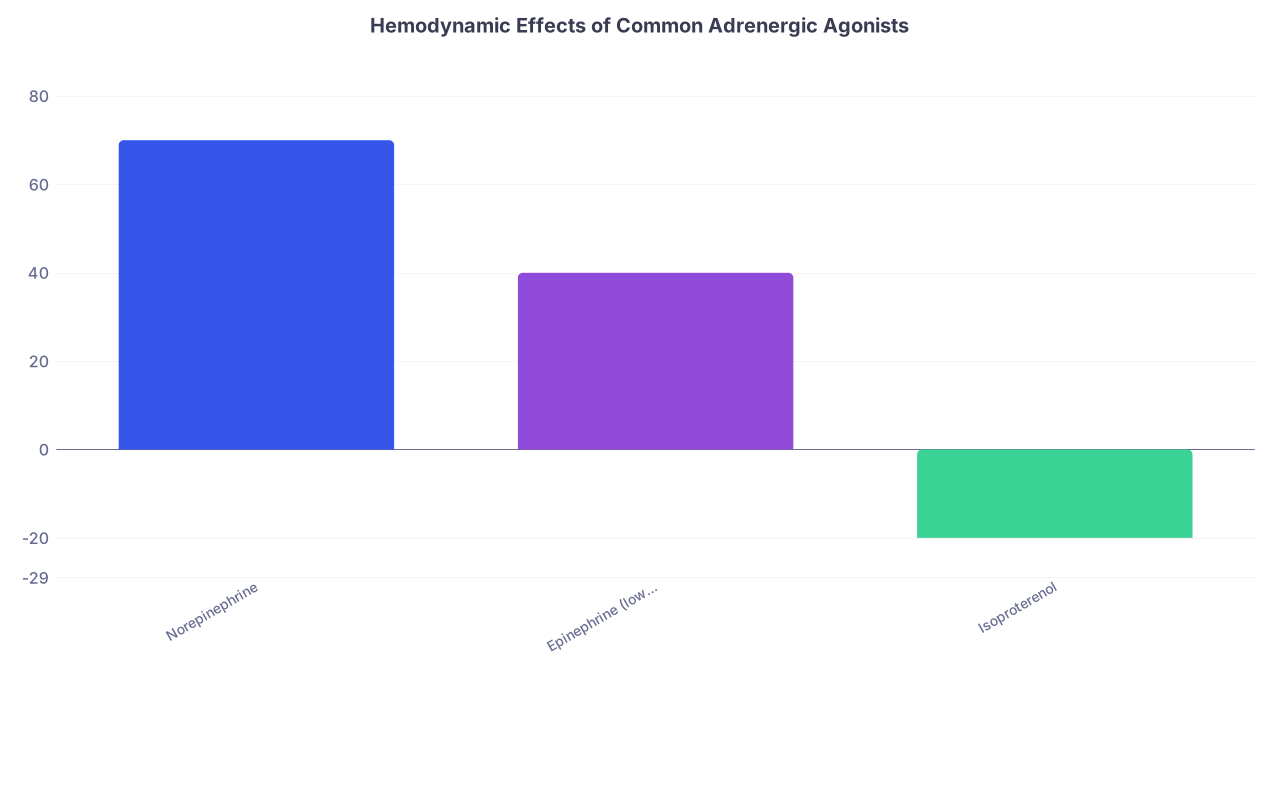
| Category | Value |
|---|---|
| Norepinephrine | 70 |
| Epinephrine (low dose) | 40 |
| Isoproterenol | -20 |
(Values here represent approximate change in diastolic BP in mmHg vs baseline; direction and relative magnitude are what matter for exam questions.)
These patterns show up in “drug X is infused and following changes are observed…” type questions with graphs of BP and HR.
5.3 Lungs
Receptors:
- β2: bronchodilation
- M3: bronchoconstriction + secretions
Logic:
- Asthma/COPD treatment: β2 agonists (albuterol, salmeterol) and M3 antagonists (ipratropium, tiotropium).
- Adverse effect pattern: β2 agonists → tremor, tachycardia, hypokalemia; muscarinic antagonists → dry mouth, possible urinary retention.
Step 1 twist:
Methacholine challenge test uses a muscarinic agonist to provoke bronchoconstriction in asthma diagnosis. Positive test = large decrease in FEV1.
5.4 GI Tract and Bladder
Receptors:
- M3: ↑ motility, ↑ secretions, relax sphincters (overall “move and poop”). Contract detrusor, relax sphincters (urinate).
- α1: contract internal urethral sphincter “hold it”.
- β2: relax intestinal smooth muscle (minimal direct exam impact, more physiology).
Drug patterns:
- Bethanechol (M3 agonist): post-op ileus, neurogenic bladder (urinary retention).
- Neostigmine: ileus, myasthenia gravis (via nicotinic action at NMJ, but GI effect is M3 via increased ACh).
- Oxybutynin/tolterodine (M3 antagonists): urge urinary incontinence by reducing detrusor contraction.
Classic Step 1 trap: Elderly patient on oxybutynin develops acute urinary retention and confusion → anticholinergic toxicity. The receptor logic is M3 blockade in bladder + central muscarinic block.
6. Mapping Drug Classes Onto This Receptor Wiring
Now join the wiring with “what classes matter” for Step 1. You do not need every obscure sympathomimetic. You do need the prototypes and their receptor logic.
6.1 Direct adrenergic agonists
Norepinephrine: α1, α2, β1.
Use: hypotension, shock. Reflex bradycardia in physiology questions.Epinephrine: low dose – β1 & β2; high dose – α1 dominates.
Use: anaphylaxis, asthma, cardiac arrest.
Logic: Low dose → β2 vasodilation in skeletal muscle, ↓ diastolic; high dose + α1 → ↑ BP.Isoproterenol: β1 = β2, no alpha.
Classic physiology drug.Dobutamine: β1 > β2, α.
Use: acute heart failure, cardiogenic shock, cardiac stress testing.Phenylephrine: α1 agonist.
Use: hypotension, decongestant, mydriatic.Albuterol/salmeterol: β2 agonists.
Use: asthma, COPD.Terbutaline: β2 agonist.
Use: tocolysis (relax uterus; preterm labor).
6.2 Indirect sympathomimetics
Mechanisms: increase NE (and dopamine) in synapse.
- Displacement/release: amphetamine, tyramine
- Reuptake inhibition: cocaine, TCAs
- Mixed: ephedrine
Step 1 logic:
- Cocaine blocks reuptake of NE, dopamine, serotonin. If patient on cocaine, do not give a pure β-blocker for chest pain → risk of unopposed α stimulation and severe hypertension, coronary vasospasm.
7. Receptor Logic in Classic Step 1 Vignettes
Let me spell out the kind of pattern recognition the exam expects.
Vignette type 1: “Drug effect with BP and HR changes”
Example: They show a graph:
- Systolic BP ↑
- Diastolic BP ↑
- HR ↓
Receptor logic:
- α1 agonism → ↑ SVR → ↑ both systolic and diastolic BP.
- Reflex response via baroreceptors → ↑ vagal tone → bradycardia.
Match to drug: norepinephrine, phenylephrine (if HR falls, the drug is likely pure α1 or α1 + some β1 overshadowed by reflex).
Another pattern:
- ↓ diastolic BP
- Slight ↑ systolic BP
- Large ↑ HR
Think β2 vasodilation (↓ diastolic) plus β1 cardiac stimulation and reflex: isoproterenol.
Vignette type 2: “An old lady on many drugs comes in confused, flushed, with dry skin, mydriasis, urinary retention”
This is textbook anticholinergic toxicity.
Receptor logic:
- Blockade of M3 → dry skin, dry mouth, urinary retention, decreased sweating → hyperthermia, flushed skin.
- Blockade of M2 in heart → tachycardia.
- CNS muscarinic block → confusion, delirium, hallucinations.
Culprits:
- Older antihistamines (diphenhydramine),
- TCAs,
- Antipsychotics with strong antimuscarinic action,
- Antispasmodics,
- Anti-Parkinson (benztropine),
- Oxybutynin, etc.
Antidote:
- Physostigmine (AChE inhibitor that is CNS-penetrant) – explicitly used for anticholinergic toxicity. Neostigmine does not cross BBB.
Vignette type 3: “Organophosphate poisoning on a farm”
Farmer, pesticide exposure, bronchospasm, wheezing, copious secretions, miosis, diarrhea, urination, bradycardia, muscle fasciculations → cholinergic excess via AChE inhibition.
Receptor logic:
- Excess ACh at M and N receptors.
- M3 → bronchoconstriction, secretions, miosis, GI cramps, diarrhea, urination.
- M2 → bradycardia.
- Nm → fasciculations, muscle weakness, paralysis.
Treatment:
- Atropine: blocks muscarinic receptors only (M1–M3).
- Pralidoxime (2-PAM): regenerates AChE at both nicotinic and muscarinic synapses if given early (before “aging”).
Step 1 trap: Atropine alone will not fix neuromuscular weakness (nicotinic). They love that.
Vignette type 4: “Hypertensive pregnant woman treated with drug X; fetus unaffected”
Think α-methyldopa (α2 agonist) or labetalol. For pure receptor logic, α-methyldopa is the star here.
8. Memory Hooks That Actually Work
Most mnemonics are noise. You need a few strong ones that align with receptor logic.
“Qiss, Qiq, Siq, Sqs” – G-protein coupling of receptors
- α1, α2, β1, β2, H1, V1, M1, M3 → Gq or Gi? Let us strip it to what you need.
Quick table:
Key Autonomic Receptors and G-Protein Coupling Receptor G Protein Second Messenger Core Effect (Step 1 level) α1 Gq ↑ IP3, DAG, Ca²⁺ Smooth muscle contraction α2 Gi ↓ cAMP ↓ NE release, ↓ sympathetic outflow β1 Gs ↑ cAMP ↑ HR, contractility, renin β2 Gs ↑ cAMP Smooth muscle relaxation (bronchi, vessels) M2 Gi ↓ cAMP ↓ HR, ↓ conduction M3 Gq ↑ IP3, DAG, Ca²⁺ Gland secretion, smooth muscle contraction (except endothelium NO) You do not need to be poetic. Just link:
- Gs → ↑ cAMP → usually stimulation in heart or relaxation in smooth muscle.
- Gq → “C for Ca²⁺”: IP3/DAG → contraction of smooth muscle or secretion.
- Gi → ↓ cAMP → inhibitory.
“DUMBBELSS” – for muscarinic excess, yes it is cliché, but it works.
Just internalize that this is M receptor overstimulation, not nicotinic.“Hot as a hare, blind as a bat, dry as a bone, red as a beet, mad as a hatter” – anticholinergic syndrome.
9. How to Practice This Efficiently for Step 1
Here is how I tell students to drill autonomic pharm in a weekend and keep it.
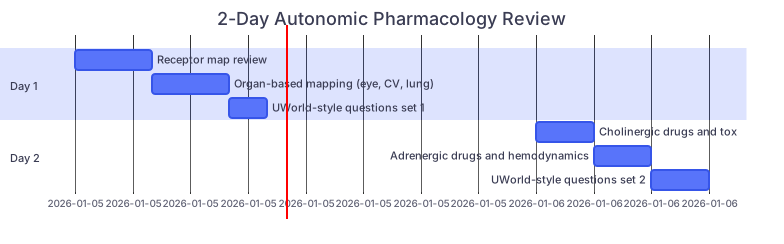
| Task | Details |
|---|---|
| Day 1: Receptor map review | a1, 2026-01-05, 4h |
| Day 1: Organ-based mapping (eye, CV, lung) | a2, after a1, 4h |
| Day 1: UWorld-style questions set 1 | a3, after a2, 2h |
| Day 2: Cholinergic drugs and tox | b1, 2026-01-06, 3h |
| Day 2: Adrenergic drugs and hemodynamics | b2, after b1, 3h |
| Day 2: UWorld-style questions set 2 | b3, after b2, 3h |
Day 1:
- Draw the receptor–organ map from memory, without drugs first.
- Then add 1–2 prototype drugs per receptor.
- Do 30–40 targeted questions on ANS physiology and basic pharm.
Day 2:
- Run through cholinergic agents and toxicities (organophosphates, anticholinergics) focusing on what is muscarinic vs nicotinic.
- Hit adrenergic agonists and blockers, doing especially the hemodynamic graphs.
- Another 30–40 targeted questions.
Do not passively read Katzung or Costanzo for four hours. Actively redraw the maps until you can sketch:
- Heart: β1 vs M2
- Bronchi: β2 vs M3
- Eye: α1 vs M3
- Vessels: α1 vs β2 vs M3 (endothelium)
- Bladder/GI: M3 vs α1
You want to reach “reflex-level” answers.
10. Quick Integrated Cases to Test Yourself
Run these internally. If you cannot answer in 5–10 seconds, you need another round with the map.
A 70-year-old male is started on a medication for BPH. Two days later he syncopizes after standing suddenly. What receptor is primarily blocked?
→ α1.A COPD patient is given a new inhaler and later complains of dry mouth and difficulty with urination. What receptor is blocked?
→ M3 (ipratropium/tiotropium-type effect).A child ingests a plant containing atropine-like alkaloids. HR 130, dry skin, flushed, mydriasis, decreased bowel sounds, delirium. Which drug will reverse both central and peripheral symptoms?
→ Physostigmine (AChE inhibitor that crosses BBB).During a cardiac stress test, an IV infusion causes ↑ HR and ↑ systolic BP but ↓ diastolic BP. Which receptor profile best fits?
→ β1 = β2 agonist (isoproterenol pattern).Asthma challenge test with inhaled agent causes significant drop in FEV1. Which receptor is this drug stimulating?
→ M3 (methacholine).
Key Takeaways
- Autonomic pharmacology on Step 1 is mostly eight receptors mapped onto a handful of organs. If you cannot draw that map from memory, start there.
- Tie every prototype drug to a receptor and an organ-level effect, then to a clinical vignette pattern (BP and HR changes, eye findings, secretions, mental status).
- Distinguish clearly between muscarinic vs nicotinic, and between α/β receptor subtypes; most “hard” questions are just disguised checks of whether that distinction is actually in your head.