
Most students are getting renal physiology questions wrong for the same three reasons: they do not actually understand pressure relationships, they fake their way through clearance equations, and they never practice graph-reading under time pressure.
Let me fix that.
You are not going to beat renal physiology on Step 1 by memorizing Starling equations and hoping the curve looks familiar on test day. The exam writers are not dumb. They are deliberately twisting pressure–volume relationships and clearance logic to see who actually understands what is happening along the nephron and who just memorized, “FF = GFR / RPF.”
I am going to walk through how Step 1 really tests:
- Glomerular pressure-volume relationships
- Filtration fraction and Starling forces
- Renal blood flow, GFR, and autoregulation
- Clearance, PAH, creatinine/inulin, and Tm systems
- Classic trap questions and how to recognize them in 5 seconds
And I am going to do it the way you need it: as if we are standing in front of the whiteboard, and I am saying, “No, look here—this is what that graph actually means.”
Core Framework: What Step 1 Actually Cares About
Forget the full physiology textbook for a moment. For Step 1 renal, the question writers mainly care about two big pillars:
- Pressure and volume handling along the renal vasculature and nephron
- Clearance and how to use it to infer what the kidney is doing to a substance
If you know those cold, you can usually infer the rest in the moment.
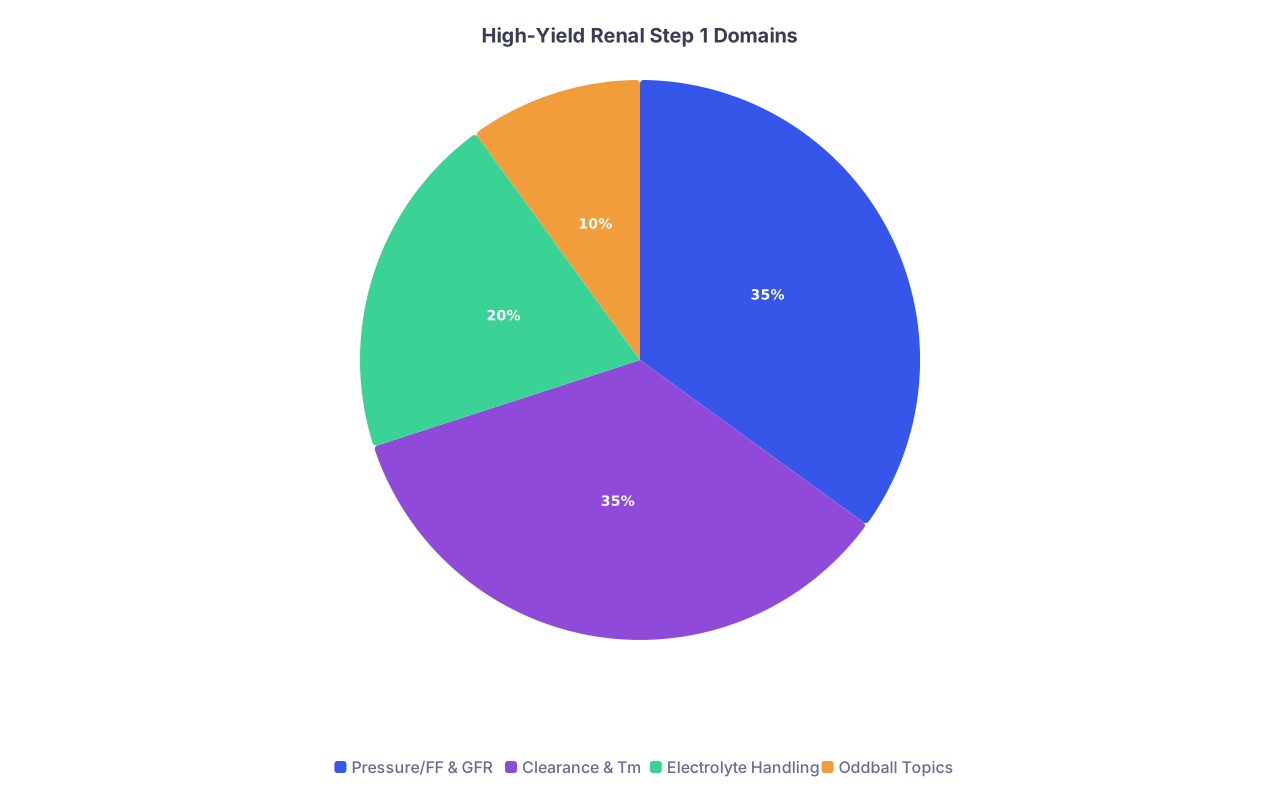
| Category | Value |
|---|---|
| Pressure/FF & GFR | 35 |
| Clearance & Tm | 35 |
| Electrolyte Handling | 20 |
| Oddball Topics | 10 |
Pressure/GFR + clearance is ~70% of the thinking for renal questions that are more than “what transporter is here?”
So we start there.
Pressure–Volume Relationships: Stop Waving Your Hands
1. Starling Forces at the Glomerulus
Everyone “remembers” this, but half of students cannot apply it.
At the glomerular capillary:
- P_GC = glomerular capillary hydrostatic pressure (pushes fluid out → filtration)
- P_BS = Bowman space hydrostatic pressure (pushes fluid in → opposes filtration)
- π_GC = oncotic pressure in the glomerular capillary (pulls fluid in → opposes filtration)
- π_BS ≈ 0 (no significant protein there in normal physiology)
Net filtration pressure (NFP):
NFP ≈ (P_GC − P_BS) − (π_GC − π_BS)
On boards, they simplify and just throw you:
NFP ≈ P_GC − P_BS − π_GC
What they change in vignettes:
- Afferent and efferent arteriolar tone → P_GC
- Obstruction (stone, BPH) → P_BS ↑
- Plasma protein concentration / protein loss → π_GC
They rarely ask you to compute NFP numerically. Instead, they ask: “Does GFR go up or down and what happens to RPF and FF?”
That is your actual job.
2. Effector Changes: Afferent vs Efferent – Think Directionally
Let me break down the most testable manipulations. Put numbers to it so it sticks.
Assume starting baseline:
- GFR = 100 (arbitrary units)
- RPF = 500
- FF = GFR / RPF = 0.20
Now:
Afferent constriction
- RPF ↓ (less blood into glomerulus)
- P_GC ↓ → GFR ↓
- Both GFR and RPF fall, but RPF usually falls more proportionally → FF tends to ↓
- Boards point: “NSAID use” → afferent constriction → GFR down
Afferent dilation
- RPF ↑
- P_GC ↑ → GFR ↑
- FF usually ~same or slightly ↑ (depends on magnitude, but exam uses “increased GFR, increased RPF”)
- Example: “Prostaglandins, ANP”
Efferent constriction
- RPF ↓ (blood slowed leaving glomerulus)
- P_GC ↑ → GFR ↑ (at least initially)
- So GFR ↑, RPF ↓ → FF ↑
- Classic: “Low-dose ACE inhibitor withdrawal” or “angiotensin II effect”
Efferent dilation
- RPF ↑
- P_GC ↓ → GFR ↓
- GFR ↓, RPF ↑ → FF ↓
- Example: ACE inhibitor started in bilateral renal artery stenosis → GFR crashes
| Change | GFR | RPF | FF |
|---|---|---|---|
| Afferent constriction | ↓ | ↓ | ↓ |
| Afferent dilation | ↑ | ↑ | ~ |
| Efferent constriction | ↑ | ↓ | ↑ |
| Efferent dilation | ↓ | ↑ | ↓ |
You must be able to do that table from memory with no thinking. Step 1 will not give you that chart; they will describe:
“A drug is administered that selectively constricts the efferent arteriole. Which of the following changes is most likely?”
You need the right pattern in under 10 seconds.
3. Obstruction and Protein Changes: The Underrated Traps
Two very common scenarios:
Postrenal obstruction (stone, BPH, ureter tumor)
- P_BS ↑ (back-pressure)
- NFP ↓ → GFR ↓
- RPF initially unchanged
- FF ↓
Chronic obstruction: you start losing nephron function, RPF can drop as well, and numbers start to blur, but Step 1 usually cares about the acute change.
Hypoproteinemia (nephrotic syndrome, liver disease)
- π_GC ↓ (less plasma oncotic pressure)
- NFP ↑ → GFR ↑
- RPF unchanged → FF ↑
They might frame it as “a patient with low serum albumin, which pressure changes in the glomerular capillary and how does that impact filtration?” The correct mental picture: lower oncotic opposition → more filtration → higher FF.
4. “Pressure-Volume” Curves in Renal Context
Renal “pressure-volume” on Step 1 usually means one of three things:
- Pressure–natriuresis curves
- Tubuloglomerular feedback/autoregulation curves
- Renal function curves in obstruction or heart failure
You will see axes like:
- X-axis: renal perfusion pressure or arterial pressure
- Y-axis: GFR, RBF, urine output, sodium excretion
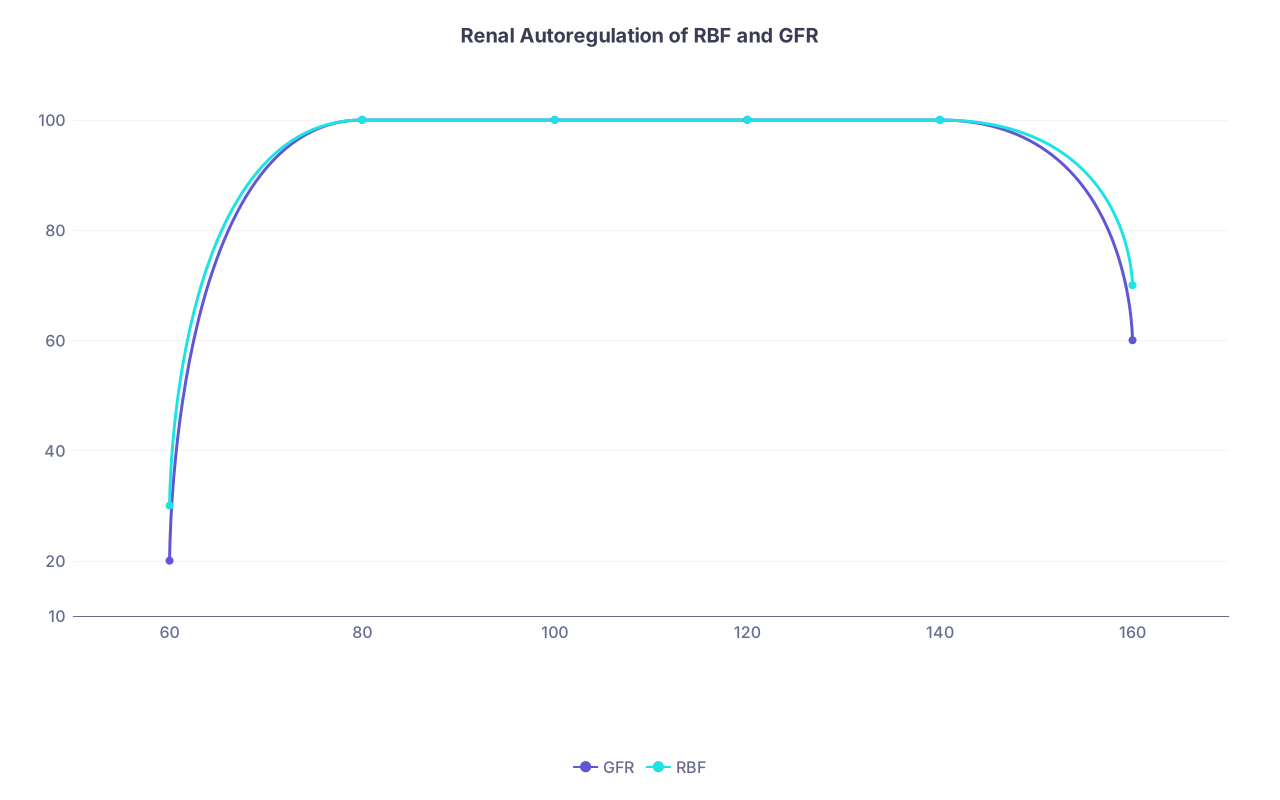
| Category | GFR | RBF |
|---|---|---|
| 60 | 20 | 30 |
| 80 | 100 | 100 |
| 100 | 100 | 100 |
| 120 | 100 | 100 |
| 140 | 100 | 100 |
| 160 | 60 | 70 |
Interpreting a classic autoregulation curve:
- Between ~80–180 mmHg → both GFR and RBF relatively flat (“autoregulated”)
- Below 80 → both drop off (kidney cannot maintain GFR)
- Above 180 → damage risk, curves go up then down
Board-style questions:
“A new antihypertensive shifts the renal pressure-natriuresis curve to the left. What happens to long-term blood pressure?”
Translation: At any given arterial pressure, the kidney now excretes more Na+ and water → BP tends to reset to a lower level. That is the actual physiology behind why the kidney determines chronic BP set point.
You are not required to derive the formula. You are required to know what a left or right shift means.
Left shift: more excretion at a given pressure → lower steady-state BP
Right shift: less excretion → higher steady-state BP (think chronic kidney disease, renal artery stenosis)
Clearance Questions: Where Step 1 Separates Memorization from Understanding
This is where people fake it. And lose points for no reason.
1. Core Clearance Formula and Interpretations
Basic clearance:
C_x = (U_x × V) / P_x
- U_x: urine concentration of substance X
- V: urine flow rate (mL/min)
- P_x: plasma concentration of X
Interpretation:
- If C_x = GFR → substance is freely filtered, not reabsorbed or secreted (e.g., inulin)
- If C_x < GFR → net reabsorption
- If C_x > GFR → net secretion
They love to give you some made-up molecule and ask if it is reabsorbed or secreted.
Example:
- P_x = 1 mg/mL
- U_x = 100 mg/mL
- V = 1 mL/min
C_x = (100 × 1) / 1 = 100 mL/min
If GFR (measured by inulin) = 125 mL/min → C_x < GFR → net reabsorption.
Nothing fancy. But they will bury that in a paragraph.
2. GFR and RPF from Inulin, Creatinine, and PAH
You must know which marker does what. Not negotiable.
- GFR: inulin (gold standard), creatinine (approximate)
- RPF: PAH (para-aminohippuric acid) at low plasma concentration (assumed to be almost completely cleared in one pass)
Formulas:
- GFR = C_inulin = (U_in × V) / P_in
- Estimate GFR with creatinine similarly: C_cr ≈ GFR (slight overestimate because some secretion)
- RPF ≈ C_PAH = (U_PAH × V) / P_PAH
- FF = GFR / RPF
| Marker | Approximates | Board Relevance |
|---|---|---|
| Inulin | GFR | Conceptual gold standard |
| Creatinine | GFR | Clinical estimate |
| PAH | RPF | Effective RPF at low [PAH] |
Two frequent moves:
- They give you P_inulin, U_inulin, V and ask you to compute GFR. Then they give you P_PAH, U_PAH, V and ask FF. Do it stepwise: calculate GFR, calculate RPF, then FF.
- They give you clearance values directly: “GFR = 125 mL/min, C_x = 300 mL/min.” Ask: reabsorption vs secretion → C_x > GFR → net secretion.
You should not hesitate here. These are “paycheck” points.
3. When They Twist Creatinine
Creatinine has two roles on Step 1:
- As a GFR estimator
- As a lab test with a hyperbolic relationship to GFR
Key ideas:
- Early in CKD, large drops in GFR cause small rises in creatinine.
- Later, small drops in GFR cause big creatinine jumps.
Patients with reduced muscle mass (elderly, cachectic) can have “normal” creatinine with significantly reduced GFR.
Common test framing:
“A patient’s serum creatinine rises from 1 to 2 mg/dL.”
That represents about a 50% drop in GFR, not “creatinine doubled so function halved.” The underlying relationship is inverse, not linear.
4. PAH and Tm (Transport Maximum) Questions
PAH questions separate people who know renal physiology from people who memorized the word “secretion.”
At low PAH plasma concentrations:
- Tubular secretion mechanisms are not saturated
- Nearly all PAH entering the kidney is excreted
- So C_PAH ≈ RPF
As plasma PAH increases:
- Secretory transporters saturate (Tm reached)
- Additional PAH cannot be secreted efficiently
- Fraction extracted declines
- C_PAH < RPF
They love giving you a graph:
- X-axis: P_PAH
- Y-axis: excretion or secretion rate
At low P_PAH:
- Filtration line = straight line (filtered load = GFR × P_PAH)
- Excretion line overlaps filtration + secretion
- Secretion line: increases, then plateaus at Tm
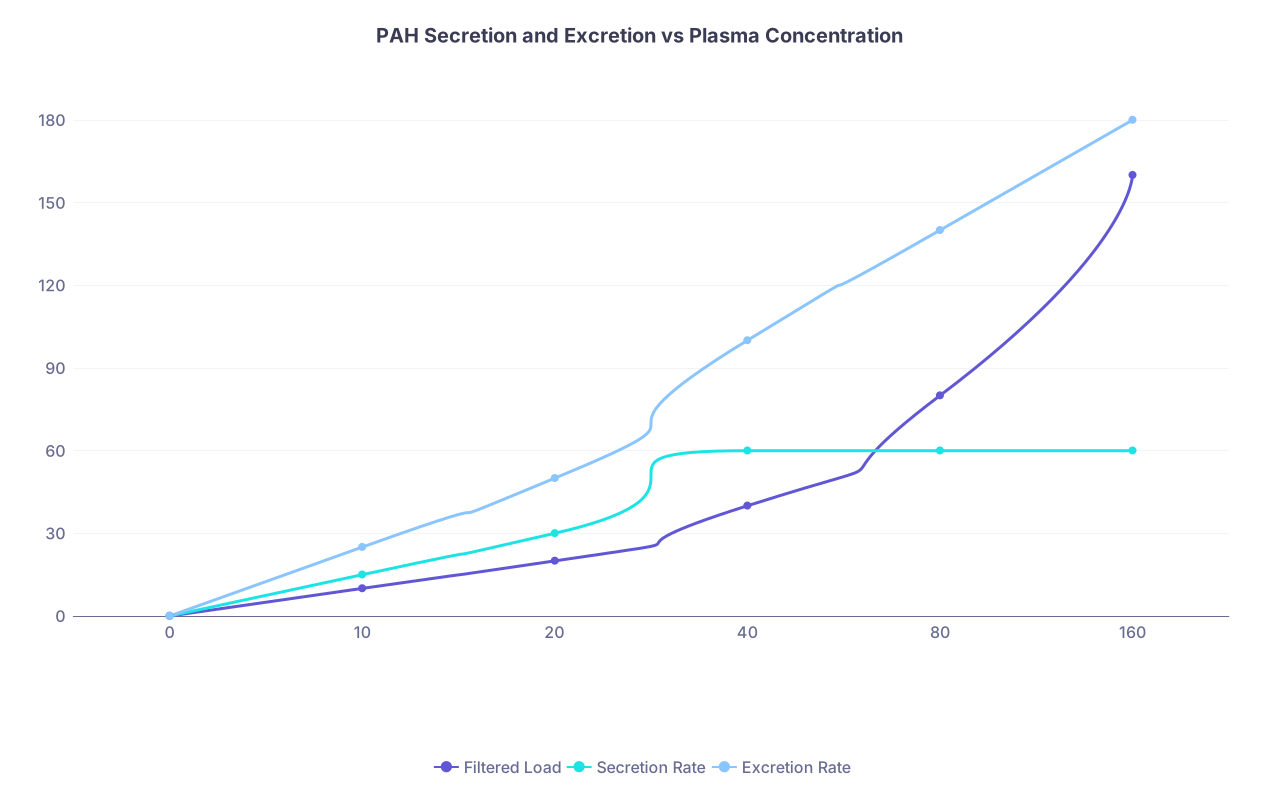
| Category | Filtered Load | Secretion Rate | Excretion Rate |
|---|---|---|---|
| 0 | 0 | 0 | 0 |
| 10 | 10 | 15 | 25 |
| 20 | 20 | 30 | 50 |
| 40 | 40 | 60 | 100 |
| 80 | 80 | 60 | 140 |
| 160 | 160 | 60 | 180 |
Classic question stems:
- “At point B on the graph, which transport process is saturated?” → tubular secretion of PAH.
- “Which part of the curve corresponds to Tm?” → the plateau of the secretion rate.
- “At high plasma PAH levels, clearance of PAH underestimates true renal plasma flow. Why?” → secretory mechanisms are saturated, so not all PAH is excreted in one pass.
If you only memorize, “PAH measures RPF,” you will miss these.
5. Reabsorption Tm: Glucose
This is the twin of PAH, but for reabsorption rather than secretion.
Glucose handling:
- Filtered: proportional to P_glucose × GFR
- Reabsorbed: via SGLT in proximal tubule up to Tm
- Once Tm exceeded → glucosuria
The classic renal function curve:
- At low P_glucose: all filtered glucose is reabsorbed, excretion = 0
- At threshold (~200 mg/dL): some nephrons saturate earlier (splay) → small excretion starts
- At high P_glucose: reabsorption plateaus at Tm, excretion rises linearly with further increases in plasma glucose
You see three lines:
- Filtered load (straight slope from 0)
- Reabsorption (parallels filtered load until Tm, then flat)
- Excretion (0 until threshold + splay, then rising line)

| Step | Description |
|---|---|
| Step 1 | Plasma Glucose |
| Step 2 | Glomerular Filtration |
| Step 3 | Proximal Tubule SGLT |
| Step 4 | Complete Reabsorption |
| Step 5 | Reabsorption Saturated |
| Step 6 | Glucose in Urine |
Board angles:
- Diabetes mellitus → P_glucose so high that filtered load > Tm → glucosuria → osmotic diuresis
- SGLT2 inhibitors (e.g., canagliflozin) → lower Tm artificially → glucosuria at lower plasma levels
Question style: “Which curve best represents urinary excretion of glucose in a patient taking an SGLT2 inhibitor?” Answer: excretion line begins rising at a lower plasma glucose than normal.
Integrating Pressure and Clearance in Real Step 1 Style Questions
Here is how they combine both worlds.
Example 1: ACE Inhibitor and Bilateral Renal Artery Stenosis
Vignette:
- 72-year-old with long-standing hypertension and bruits over both flanks
- Started on ACE inhibitor
- Creatinine rises from 1.0 → 2.5
- What happened to GFR, RPF, and FF?
Mechanism:
- Baseline: renal artery stenosis → low perfusion pressure → kidney relies heavily on angiotensin II–mediated efferent constriction to maintain GFR
- ACE inhibitor → efferent dilation
- Efferent dilation: GFR ↓, RPF ↑, FF ↓
But in this scenario, RPF might not actually increase that much because proximal stenosis still limits flow. The key board takeaway: you remove efferent constriction, so P_GC falls, GFR collapses. They care about GFR and FF dropping.
Most likely test answer pattern: GFR ↓, RPF same or ↑ slightly, FF ↓.
Example 2: Obstruction and FF
Acute unilateral ureteral obstruction:
- P_BS ↑ → GFR ↓ in that kidney
- RPF remains similar or slightly ↓
- FF ↓
They might present:
- Serum creatinine slightly elevated
- Ultrasound: hydronephrosis on one side
- Ask: “In the affected kidney, how are GFR, RPF, and FF changed?”
Correct: GFR ↓, RPF ↓ or unchanged, FF ↓
The trap answer: “GFR and FF increase because back pressure increases.” That is physiologically nonsense but students pick it because they are thinking “pressure up → filtration up.” No. Wrong side of the membrane.
Example 3: PAH Saturation
Question:
“You infuse PAH at increasing doses and measure its plasma and urine concentrations. Which of the following parameters will change the most once the tubular transporters reach saturation?”
Correct concept: After Tm, clearance (C_PAH) starts to decline relative to true RPF; fraction excreted changes; extraction ratio changes.
They like: “The ability of PAH clearance to approximate RPF decreases.”
So you answer that.
How to Read Renal Graphs Fast on Step 1
You are not going to stare at each graph for 90 seconds. You must have a default reading strategy.
Here is the 10-second protocol:
- Read axes first, not the stem.
- X-axis: usually pressure or plasma concentration
- Y-axis: GFR, RBF, excretion, reabsorption, secretion, FF
- Identify the “control” curve vs “experimental” curve.
- Ask: left or right shift? Up or down? Plateau earlier or later?
- Link to physiology story: autoregulation, Tm, obstruction, vasoconstriction/dilation.

If they give you three curves:
- Solid line: normal
- Dashed lines: drug or disease
Look for which parameters changed: threshold, slope, plateau.
Examples:
- Threshold lower → earlier excretion → Tm lower or transporter blocked
- Plateau lower → decreased Tm (fewer transporters or inhibited)
- Slope lower but same plateau → decreased GFR but same Tm
Train yourself to narrate it in one sentence: “This curve shows lower Tm for reabsorption.” Then answer choices become straightforward.
Strategy: How to Practice This For Real
You do not get good at this by rereading the renal chapter. You get good by doing graph and equation problems daily for 1–2 weeks.
- Take a renal block from UWorld or NBME-style questions.
- For each question involving GFR, FF, RPF, or clearance, rewrite the scenario on scrap paper with:
- “What changed: afferent, efferent, obstruction, proteins?”
- “What should happen: GFR, RPF, FF ↑/↓?”
- Redraw any graph in two strokes: axes + shapes. Identify what moved.

If you can explain every renal graph in UWorld out loud, you are already in the top third of test takers for this topic.
Quick Reference: What To Have Memorized Cold
Here is what should be automatic.
| Topic | You Must Know |
|---|---|
| Afferent vs efferent change | GFR, RPF, FF directional changes |
| Obstruction effects | P_BS↑ → GFR↓ → FF↓ |
| Hypoproteinemia | π_GC↓ → GFR↑ → FF↑ |
| Clearance formula | C = U×V / P and interpretation vs GFR |
| Markers | Inulin/Cr → GFR; PAH → RPF |
| Tm concepts | Glucose reabsorption, PAH secretion graphs |
Pin that in your brain. Exam day, you are not deriving. You are pattern-matching from well-understood, rehearsed physiology.
Where This Shows Up In Your Study Timeline
During systems:
- When you first learn renal, do not just memorize. Build the mental “pressure map” of glomerular capillaries and the “clearance toolbox.”
- Week 1–2: Do 20–30 renal questions focused on GFR, FF, PAH, glucose Tm.
- End of dedicated: Retouch them with a single-day renal phys review. Redo a set of clearance questions just before your exam so the equations feel effortless.
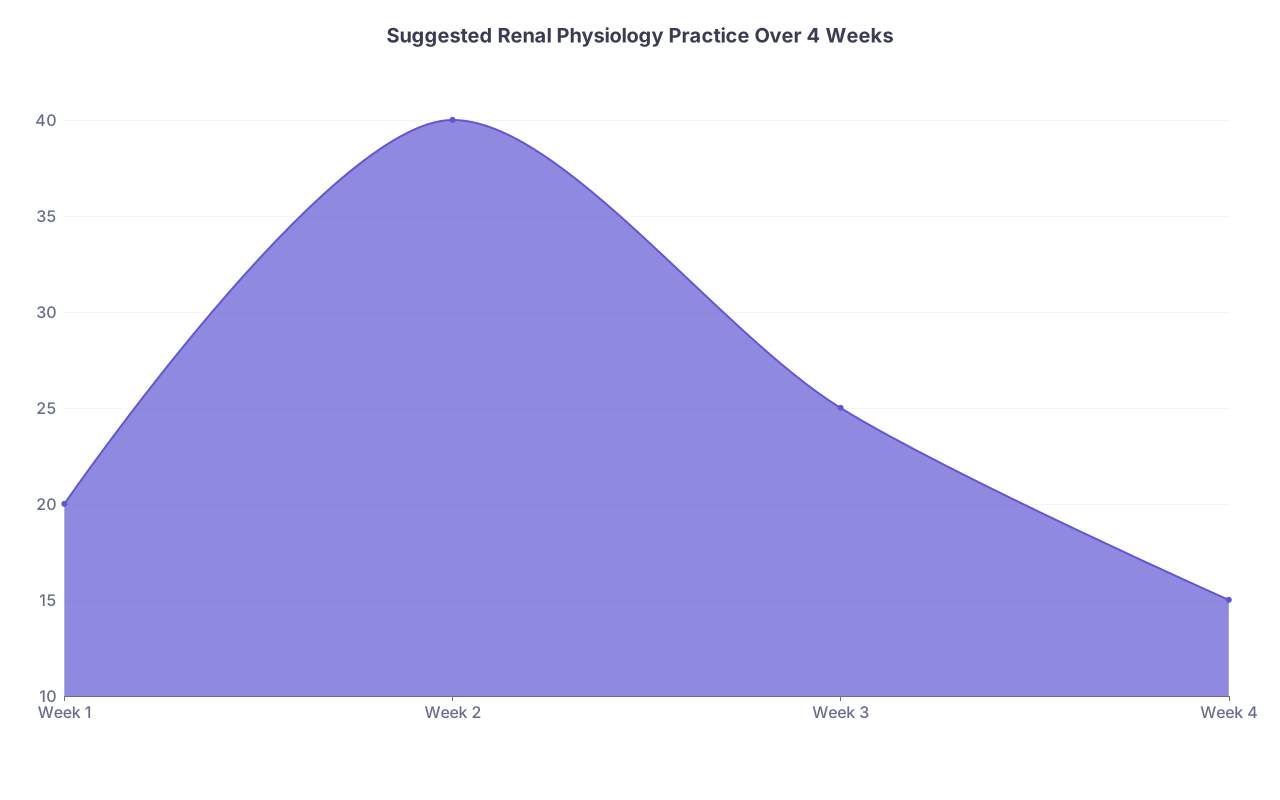
| Category | Value |
|---|---|
| Week 1 | 20 |
| Week 2 | 40 |
| Week 3 | 25 |
| Week 4 | 15 |
Last comment: If you are consistently missing more than 30% of renal phys questions on UWorld, you do not need more flashcards. You need two evenings with a whiteboard going through these exact pressure and clearance relationships until you can draw them from memory.
Once that is done, you will start recognizing the questions for what they are: the same 8–10 physiologic patterns, dressed up in slightly different stems.
With that foundation in place, you are ready to use renal physiology as a scoring opportunity on Step 1 instead of a liability. The next real jump after this is integrating renal with acid–base disorders and electrolyte patterns—but that is another conversation.
FAQ (Exactly 6 Questions)
1. How many renal physiology questions should I expect on Step 1?
Typically 5–10 questions distributed across the exam blocks, depending on the form. Renal often appears embedded in multi-system vignettes: shock, heart failure, liver disease. Expect 2–4 questions that specifically test GFR/FF/clearance logic and several others that use renal physiology to support broader pathophysiology.
2. Do I really need to memorize specific numerical values for GFR and RPF?
You should know ballpark normal values: GFR ≈ 120 mL/min, RBF ≈ 1.2 L/min, RPF ≈ 600 mL/min, FF ≈ 20%. On exam questions they often use simple numbers or give you values to calculate from, but having these anchor points helps you sanity-check answers and recognize nonsense options quickly.
3. How precise do my calculations need to be under exam conditions?
Step 1 is not a math contest. If a question requires numbers, the arithmetic is usually straightforward and differences between answer choices are large. Focus on correct setup: identifying U, P, V, and using the right formula (C = U×V/P). You should be within obvious rounding; they do not require multi-step decimal precision.
4. Are there any high-yield mistakes that students repeatedly make with clearance questions?
Yes. The big three: confusing excretion with clearance (Excretion = U×V, Clearance = U×V/P), assuming creatinine perfectly equals GFR (it slightly overestimates), and forgetting that saturation of PAH secretion makes C_PAH underestimate RPF at high plasma concentrations. If you avoid those, your accuracy jumps immediately.
5. How much time should I dedicate specifically to renal graphs and curves?
You can clean this up in 1–2 focused sessions of 1–2 hours each. One session: Starling forces, autoregulation, pressure-natriuresis. Second session: glucose Tm, PAH secretion, clearance vs plasma concentration curves. Work through 10–15 high-quality questions that use these graphs, and redraw each curve once from memory.
6. What is the best single resource to shore up renal physiology for Step 1?
For most students: a combination of BRS Physiology (renal chapter) for crisp explanations, plus UWorld renal questions for application. If you like videos, the renal sections of Costanzo’s lectures or Boards and Beyond are efficient. Whatever resource you choose, the key is not passive watching; actively pause and predict how GFR, RPF, and FF should change before seeing the answer.