
The way most students “learn” cardiac murmurs for Step 1 is a waste of time.
They memorize long tables, stare at printed phonocardiograms they cannot really interpret, and never actually train their ear. Then they get blindsided by a single question that says: “A blowing holosystolic murmur best heard at the apex and radiating to the axilla…” and they freeze, because all the facts in their head are disconnected.
Let me fix that.
We will build this around three pillars: how the murmur sounds, how it behaves with maneuvers, and what the classic vignette looks like on Step 1. If you connect those three for the major murmurs, you are functionally exam-proof for this topic.
1. The Non‑Negotiable Framework: Systolic vs Diastolic, Shape, and Location
If you do not first lock down the skeleton, all the details are noise.
Start with the basic grid in your head
Every murmur you see on Step 1 can be rapidly classified using:
- Timing: systolic vs diastolic
- Location: where it is best heard
- Radiation: where it goes
- Shape: crescendo–decrescendo vs holosystolic vs early diastolic, etc.
- Maneuvers: louder/softer with preload, afterload, and heart rate changes
- Etiology and classic patient
You must be able to answer these in 3–5 seconds for the big murmurs.
Here is the mental map I’ve seen high scorers use. Not a full textbook, just what actually comes up.
| Murmur | Timing | Best Area | Key Buzzwords |
|---|---|---|---|
| Aortic stenosis | Systolic | Right 2nd ICS | Crescendo–decrescendo, radiates to carotids |
| HOCM | Systolic | Left sternal border | Harsh, louder with Valsalva/standing |
| Mitral regurgitation | Systolic | Apex | Holosystolic, radiates to axilla |
| Tricuspid regurgitation | Systolic | Lower left sternal border | Holosystolic, ↑ with inspiration |
| VSD | Systolic | Left sternal border | Harsh holosystolic, newborn/child |
| Aortic regurgitation | Diastolic | Left sternal border | Early diastolic decrescendo, wide pulse pressure |
| Mitral stenosis | Diastolic | Apex | Opening snap, rumbling late diastolic |
If you do not have this level of clarity yet, stop trying to memorize the weird ones (Austin Flint, Graham Steell, etc.). Step 1 is built on the common, high-yield lesions.
2. Audio Pattern Recognition: What You Should “Hear” In Your Head
No, the exam is not going to play actual audio. But the stems will describe exactly what you would hear. If your brain can’t translate that description into a murmur category, you are stuck.
Think of each major murmur as a specific short description you should recognize instantly.
Systolic ejection vs holosystolic
First divide systolic murmurs into:
- Ejection (crescendo–decrescendo)
- Holosystolic (pansystolic, uniform intensity)
Ejection systolic murmurs (crescendo–decrescendo):
- Aortic stenosis
- Pulmonic stenosis
- Hypertrophic obstructive cardiomyopathy (HOCM) – physiologically similar
These have the “diamond-shaped” intensity curve over systole. Step 1 description: “Crescendo–decrescendo systolic murmur best heard at the right upper sternal border.”
Holosystolic murmurs:
- Mitral regurgitation
- Tricuspid regurgitation
- Ventricular septal defect
These start with S1 and continue up to S2 with essentially uniform intensity. Key phrase: “Blowing holosystolic murmur…” or “Harsh holosystolic murmur.”
If the stem says holosystolic, you should immediately narrow to MR, TR, or VSD, then use location and context to choose.
Diastolic murmurs: always red flags
On exams, “diastolic murmur” should trigger an alert. Almost always pathologic. Two kings:
- Aortic regurgitation: early diastolic, high‑pitched, decrescendo, best heard along left sternal border (3rd/4th ICS), patient leaning forward, end‑expiration.
- Mitral stenosis: opening snap followed by low-pitched, rumbling diastolic murmur best heard at the apex, in left lateral decubitus.
If they tell you it is diastolic and involve the left side, and the question is not about which murmur but about likely cause or complication, they are testing pathophysiology (rheumatic heart disease, chronic volume overload, atrial dilation, etc.).
3. Maneuvers: The Pattern You Actually Need To Memorize
This is where most people drown in detail. You do not need every nuance. You need the pattern.
Think in terms of preload, afterload, or venous return changes. And remember: they care about comparative loudness.
Let me break the key maneuver effects down cleanly.
Preload and venous return maneuvers
Standing up / Valsalva (strain phase)
- Decrease venous return (preload) → decrease LV volume.
- Most murmurs: softer (less blood flow).
- Exceptions: HOCM gets louder, MVP click/murmur gets earlier and louder.
Squatting or passive leg raise
- Increase venous return and afterload → increase LV volume.
- Most murmurs: louder (more flow).
- Exceptions: HOCM gets softer, MVP click/murmur becomes later and softer.
Inspiration
- Increases venous return to right heart → right-sided murmurs louder (“inspiration increases right heart sounds”).
- Classic: tricuspid regurgitation gets louder with inspiration (Carvallo sign).
If you remember only one pair:
- Valsalva/standing: HOCM louder, everything else softer.
- Squat/handgrip: usually intensify regurgitant and VSD murmurs, soften HOCM.
Afterload maneuvers
Handgrip (sustained):
- Increases systemic vascular resistance (afterload). LV must pump against higher pressure.
Consequences:
- MR, AR, VSD: louder (more regurgitant flow back into lower-pressure chamber).
- HOCM: softer (more LV volume reduces obstruction).
- Aortic stenosis: often gets softer or unchanged (gradient changes differently; Step 1 generally wants “decreases AS murmur”).
Amyl nitrite (old, but still appears conceptually):
- Decreases afterload (vasodilator).
- Opposite of handgrip: forward flow murmurs (like AS) louder; MR, AR, VSD softer.
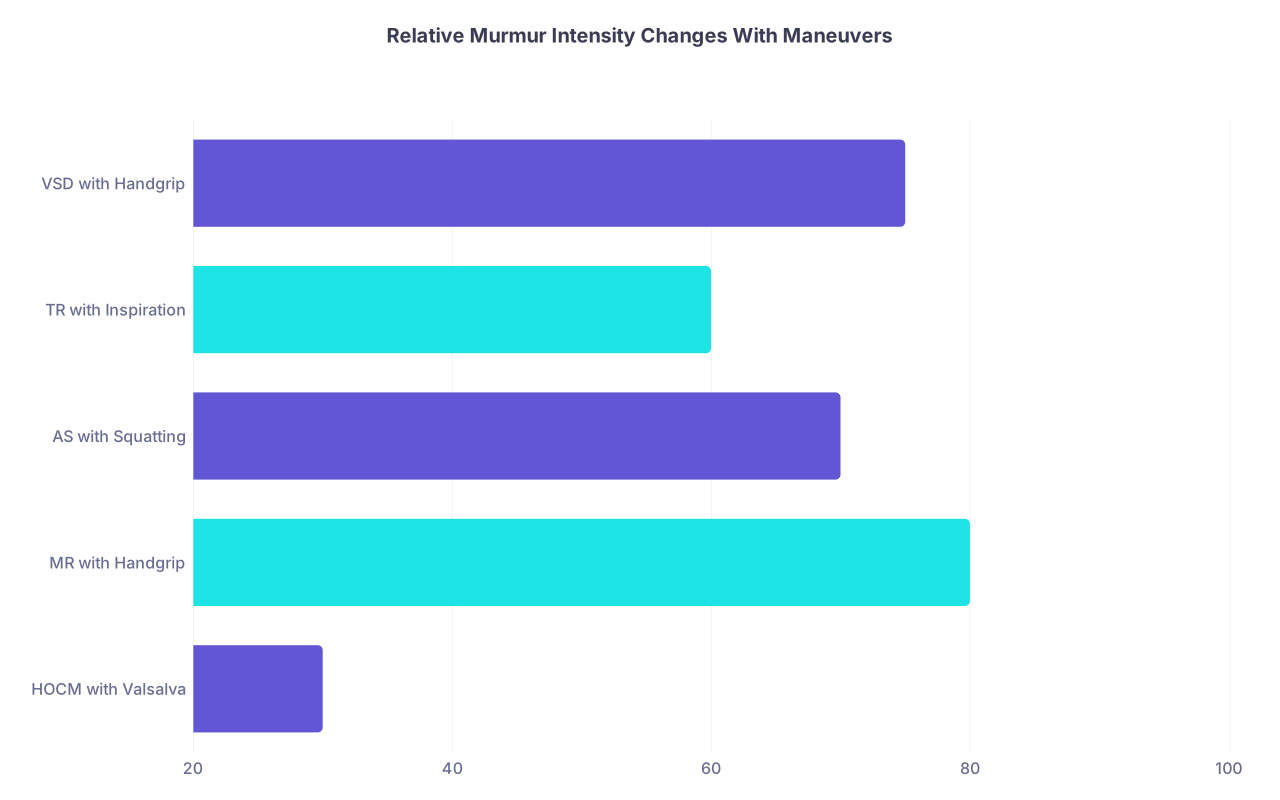
| Category | Value |
|---|---|
| HOCM with Valsalva | 30 |
| MR with Handgrip | 80 |
| AS with Squatting | 70 |
| TR with Inspiration | 60 |
| VSD with Handgrip | 75 |
You do not need exact numbers, but you must know who gets louder where.
4. The Big Murmurs, One by One: Sound, Maneuvers, and Vignettes
Now the part students actually care about: “What will the stem look like?”
I will walk through the core murmurs the way Step 1 uses them: by combining exam descriptions, physical findings, and physiologic reasoning.
Aortic Stenosis (AS)
How it sounds / is described:
- Systolic, crescendo–decrescendo (ejection murmur)
- Best at right 2nd intercostal space (aortic area)
- Radiates to carotids
- Often with soft or paradoxically split S2 in severe cases
- May have ejection click (bicuspid valve in younger patients)
Maneuvers:
- Squatting: murmur louder (↑ preload/afterload, ↑ gradient).
- Handgrip: can soften slightly (↑ afterload reduces net gradient).
- Valsalva/standing: softer (↓ LV volume).
- Distinguish from HOCM: HOCM gets louder with Valsalva; AS does not.
Classic Step 1 vignettes:
Elderly patient with:
- Syncope on exertion
- Angina and dyspnea on exertion
- Harsh systolic murmur radiating to neck
- Likely degenerative calcific AS
Younger patient (40s–50s) with:
- Bicuspid aortic valve history
- Early systolic click
- Same murmur description
Questions can ask:
- Most likely cause (degenerative calcification vs bicuspid).
- Downstream consequences (LV concentric hypertrophy).
- Pressure–volume loop change (increased afterload, high LV pressure, smaller SV).
Hypertrophic Obstructive Cardiomyopathy (HOCM)
If you get one thing out of this section: HOCM behaves opposite of most murmurs.
Audio description:
- Harsh systolic crescendo–decrescendo murmur
- Best at left lower or mid sternal border
- Does not radiate to carotids in the classic Step 1 description (though in real life, can be tricky)
Maneuvers pattern:
- Valsalva / standing: louder (less LV volume, more obstruction).
- Squatting / handgrip: softer (more LV volume, less obstruction).
- Rapid standing from squatting: murmur intensity suddenly increases.
Vignette blueprint:
- Young athlete, syncopal episode during exercise.
- Family history of sudden cardiac death.
- Possibly a systolic murmur that changes with maneuvers as above.
- Genetic: AD mutation in sarcomere proteins (often β-myosin heavy chain or myosin-binding protein C).
Often the question is not “Which murmur?” but:
- What maneuver best increases murmur intensity? (Answer: Valsalva or standing.)
- What structural change? (Asymmetric septal hypertrophy, systolic anterior motion of mitral valve.)
- Mechanism of sudden death? (Ventricular arrhythmia.)
Mitral Regurgitation (MR)
Sound/description:
- Holosystolic (pansystolic) blowing murmur
- Best heard at the apex
- Radiates to the left axilla
- High-pitched
Common etiologies:
- Ischemic heart disease (papillary muscle dysfunction post-MI)
- Mitral valve prolapse degeneration
- Rheumatic heart disease
- LV dilation stretching annulus (dilated cardiomyopathy)
Maneuvers:
- Handgrip: louder (↑ afterload → more regurgitant flow back into LA).
- Squatting: usually louder (↑ preload and afterload → more LV volume).
- Valsalva: softer.
Vignette patterns:
- Patient post-MI with new-onset holosystolic murmur at apex, pulmonary edema → acute MR due to papillary muscle dysfunction or rupture.
- Long-standing MR causing left atrial dilation, atrial fibrillation, and pulmonary congestion.
Exam angles:
- They may describe “left atrial enlargement on echo” and ask which murmur.
- They may ask which maneuver accentuates the murmur (handgrip).
- They might test chronic volume overload effects (eccentric LV hypertrophy).
Tricuspid Regurgitation (TR)
Step 1 uses TR mostly to test your understanding of inspiration and right-sided lesions.
Audio:
- Holosystolic murmur
- Best at left lower sternal border
- Gets louder with inspiration (Carvallo sign)
- Often described as blowing, high-pitched
Etiologies:
- Right ventricular dilation (pulmonary hypertension, left HF)
- Infective endocarditis in IV drug users (especially with S. aureus)
- Carcinoid syndrome (endocardial fibrosis, right-sided valves)
Typical vignette:
- IV drug user with fever, new holosystolic murmur at LLSB that increases with inspiration.
- Septic pulmonary emboli on chest imaging.
The exam might ask:
- Most likely organism (S. aureus).
- Which maneuver intensifies the murmur (inspiration).
- Pathophysiology of carcinoid effect (serotonin-induced fibrosis of right-sided valves).
Ventricular Septal Defect (VSD)
Sound:
- Harsh holosystolic murmur
- Best heard at lower left sternal border
- Often loud and accompanied by a palpable thrill in real life
- Does not follow respiratory variation like TR
Vignette style:
- Infant/child with:
- Poor growth, tachypnea, feeding difficulties
- Harsh holosystolic murmur at LLSB
- Adult with previously undiagnosed congenital lesion sometimes also appears.
Complications they like:
- Eisenmenger syndrome (long-standing L→R shunt→ pulmonary HTN → shunt reversal → cyanosis, clubbing, polycythemia).
They might give:
- Child with cyanosis and clubbing in lower extremities but not upper (PDA with Eisenmenger) vs generalized cyanosis with VSD/ASD Eisenmenger. Know the physiology, not just the labels.
5. The Diastolic Heavy Hitters: AR and MS
Aortic Regurgitation (AR)
Description:
- Early diastolic, high‑pitched “blowing” decrescendo murmur
- Best at left sternal border (3rd–4th ICS) or right 2nd ICS in some texts
- Heard best with patient sitting up, leaning forward, at end expiration
Peripheral signs due to widened pulse pressure:
- Bounding “water-hammer” pulse (Corrigan pulse)
- Head bobbing (de Musset sign)
- Quincke sign (capillary pulsations in nail bed)
- Wide pulse pressure (e.g., 160/40 mmHg)
Etiologies:
- Aortic root dilation (Marfan, syphilitic aortitis)
- Bicuspid aortic valve
- Rheumatic heart disease
- Infective endocarditis
Exam style:
- They love to describe the peripheral signs.
- Then throw in: “Early diastolic decrescendo murmur best heard along the left sternal border.”
Questions may ask:
- Which pressure–volume loop change? (Increased EDV, increased SV, widened pulse pressure, no isovolumic relaxation phase.)
- Chronic consequence: eccentric LV hypertrophy.
Mitral Stenosis (MS)
This is the “rheumatic disease” murmur until proven otherwise.
Audio description:
- Opening snap after S2 (due to stiff opening valve)
- Followed by low-pitched, rumbling mid-to-late diastolic murmur
- Best at apex, with patient in left lateral decubitus, using the bell
- Shorter S2-to-opening-snap interval indicates more severe MS (higher LA pressure).
Etiology:
- Almost always rheumatic heart disease in exam questions.
Vignette framing:
- Young woman from developing country or older patient with history of untreated strep pharyngitis:
- Dyspnea on exertion, orthopnea
- Possibly hemoptysis from pulmonary venous hypertension
- Left atrial enlargement → atrial fibrillation, risk of mural thrombus, stroke.
Step 1 angles:
- They like to connect MS to left atrial enlargement and dysphagia/hoarseness (compression of esophagus and left recurrent laryngeal nerve).
- They may ask about increased risk of thromboembolism from AF.
6. Prototypical Vignette-to-Murmur Mapping
You need to be able to jump from clinical stem to murmur before you even reach the answer choices. Let me give you a few “seen 100 times” patterns.

| Step | Description |
|---|---|
| Step 1 | Read Clinical Stem |
| Step 2 | Aortic Stenosis |
| Step 3 | HOCM |
| Step 4 | Tricuspid Regurg |
| Step 5 | Mitral Stenosis |
| Step 6 | Aortic Regurg |
| Step 7 | Mitral Regurg |
| Step 8 | Age/Context |
Now let me phrase a few like you would actually see:
- Exertional syncope, elderly, crescendo–decrescendo systolic murmur at right 2nd ICS radiating to carotids → Aortic stenosis.
- Young athlete collapses during basketball, harsh systolic murmur that increases with Valsalva, decreases with squatting → HOCM.
- IV drug user with fever, new holosystolic murmur at LLSB louder with inspiration → Tricuspid regurgitation from infective endocarditis.
- Previous strep throat, now with diastolic rumble at apex and opening snap → Mitral stenosis (rheumatic).
- Head bobbing, water-hammer pulses, early diastolic blowing decrescendo at left sternal border → Aortic regurgitation.
- Acute onset dyspnea after MI, holosystolic murmur at apex radiating to axilla → Acute MR, papillary muscle dysfunction or rupture.
Once you see enough of these, you stop “calculating” and just recognize them.
7. How Step 1 Actually Uses Maneuvers in Questions
Most students massively overstudy maneuvers. Let me be very clear about how they test them.
Patterns I keep seeing:
They describe a murmur in words, then ask:
“Which maneuver will most increase the intensity of this murmur?”- For HOCM: answer = Valsalva or standing.
- For MR, AR, VSD: answer = handgrip.
- For TR: answer = inspiration.
- For AS: answer = squatting.
They show a change after a maneuver and ask what lesion is present.
Example:- Murmur louder with standing/Val salva, softer with squatting → HOCM.
- Murmur louder with inspiration → TR.
They may embed maneuvers inside hemodynamic logic.
- Handgrip = ↑ afterload = ↑ LV pressure vs aorta; more regurgitation back to LA; MR louder.
If your understanding is limited to “this maneuver increases venous return” and you cannot apply it, you will miss those questions. So drill a small set of cause–effect relationships.
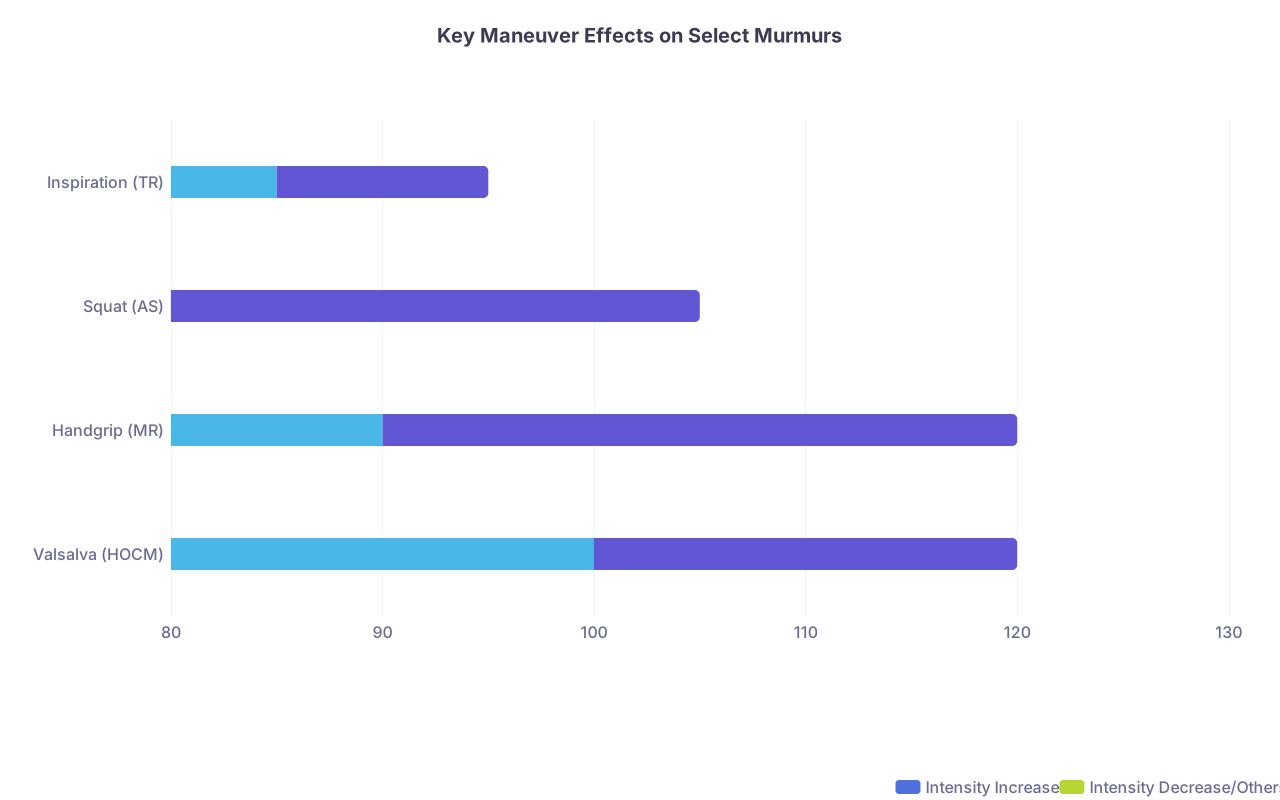
| Category | Intensity Increase | Intensity Decrease/Others |
|---|---|---|
| Valsalva (HOCM) | 100 | 20 |
| Handgrip (MR) | 90 | 30 |
| Squat (AS) | 80 | 25 |
| Inspiration (TR) | 85 | 10 |
You do not care about exact numbers; you care that those bars are obviously “increased” vs “others.”
8. High-Yield Pathophysiologic Connections
Step 1 is less in love with “name the murmur” than with “connect the hemodynamics to the clinical consequences.” So let’s link a few:
- AS → concentric LV hypertrophy → diastolic dysfunction → HF with preserved EF in older adult.
- AR / MR / VSD → volume overload → eccentric hypertrophy → elevated EDV and SV.
- MS → LA enlargement → atrial fibrillation → increased risk of thromboembolism/stroke.
- TR from pulmonary HTN → RV dilation → JVD, hepatomegaly, peripheral edema.
- Large VSD → L→R shunt → pulmonary HTN → Eisenmenger → cyanosis, polycythemia.
They will happily skip the actual murmur description and instead give you downstream findings and ask, e.g.:
- “Which of the following pressure–volume loop changes would be expected?”
- “Which valvular lesion is most likely?”
- “What is the most likely cause of this patient’s atrial fibrillation?”
So yes, memorize the sounds and maneuvers, but tie them back to pressure overload vs volume overload, chamber enlargement patterns, and which side of the heart is impacted.
9. How to Actually Study Cardiac Murmurs for Step 1 (Not the Fluff Version)
You asked for Step 1 prep, not theory, so let me be prescriptive.
1. Build a compact comparison table yourself
Not a 3-page monster. One sheet. By hand. Force yourself to fill it from memory repeatedly.
Columns: murmur, timing, best area, radiation, maneuvers louder/softer, 1–2 classic etiologies, and 1 key complication.
2. Use audio, but with purpose
Passively listening to mp3 files while scrolling your phone does nothing.
- Listen to 5–6 canonical murmurs (AS, HOCM, MR, TR, AR, MS, VSD).
- For each, say out loud: “Timing: X. Location: Y. Maneuver: Z.”
- Then cover the label, listen, and force yourself to identify.
You are not training to be a cardiologist here; you are training to anchor descriptive language to a mental “sound pattern.”
3. Drill UWorld/AMBOSS questions specifically filtered by “Cardiology – Valvular disease”
Do them in small batches:
- After each question, ignore the distractors and jump straight to:
- What was the murmur?
- What did the question actually test—sound, maneuver, or consequence?
You will see the same patterns repeat. Quickly.

4. Practice one-step reasoning under time pressure
You have maybe 90 seconds per question. You cannot spend 45 of those decoding “opening snap followed by a low-pitched diastolic murmur at the apex.”
So do timed blocks where your explicit goal is:
- As soon as you see auscultation description → say the murmur name in your head before reading the options.
- Only then look at the question stem: they may be asking for mechanism, complication, best maneuver, or hemodynamic change.
This is how you turn rote memorization into usable pattern recognition.
10. Edge Murmurs You Should Know Just Enough About
A few come up less often but are still fair game.
Mitral Valve Prolapse (MVP)
- Mid-systolic click followed by late systolic murmur.
- Click and murmur move earlier and longer with decreased LV volume (Valsalva/standing).
- Move later and shorter with increased LV volume (squatting).
Why it matters:
- Can progress to MR.
- Common in Marfan, Ehlers–Danlos.
- Step 1 mostly uses it to test the direction of click movement with maneuvers.
Pulmonic stenosis and regurgitation
Rarely central. Appear more in congenital scenarios.
- Pulmonic stenosis: systolic ejection murmur at left upper sternal border, may radiate to neck.
- Pulmonic regurg: early diastolic murmur at left upper sternal border, usually from pulmonary HTN (Graham Steell).
Know that they exist. Do not obsess.

11. Pressure–Volume Loops: The Step 1 Twist on Murmurs
They like to pair murmur vignettes with PV loops to see if you actually understand hemodynamics.
Quick associations:
Aortic stenosis
- Increased afterload → higher LV systolic pressure, reduced SV
- PV loop: taller, narrower, shifted rightward a bit.
Aortic regurgitation
- No true isovolumic relaxation; LV fills from both LA and aorta
- Huge EDV and SV, wide loop.
Mitral regurgitation
- No true isovolumic contraction; part of stroke volume lost into LA
- Loop has blunted isovolumic phases, enlarged due to increased preload.
Mitral stenosis
- Reduced LV filling → reduced EDV and SV
- Narrower PV loop, left-shifted.
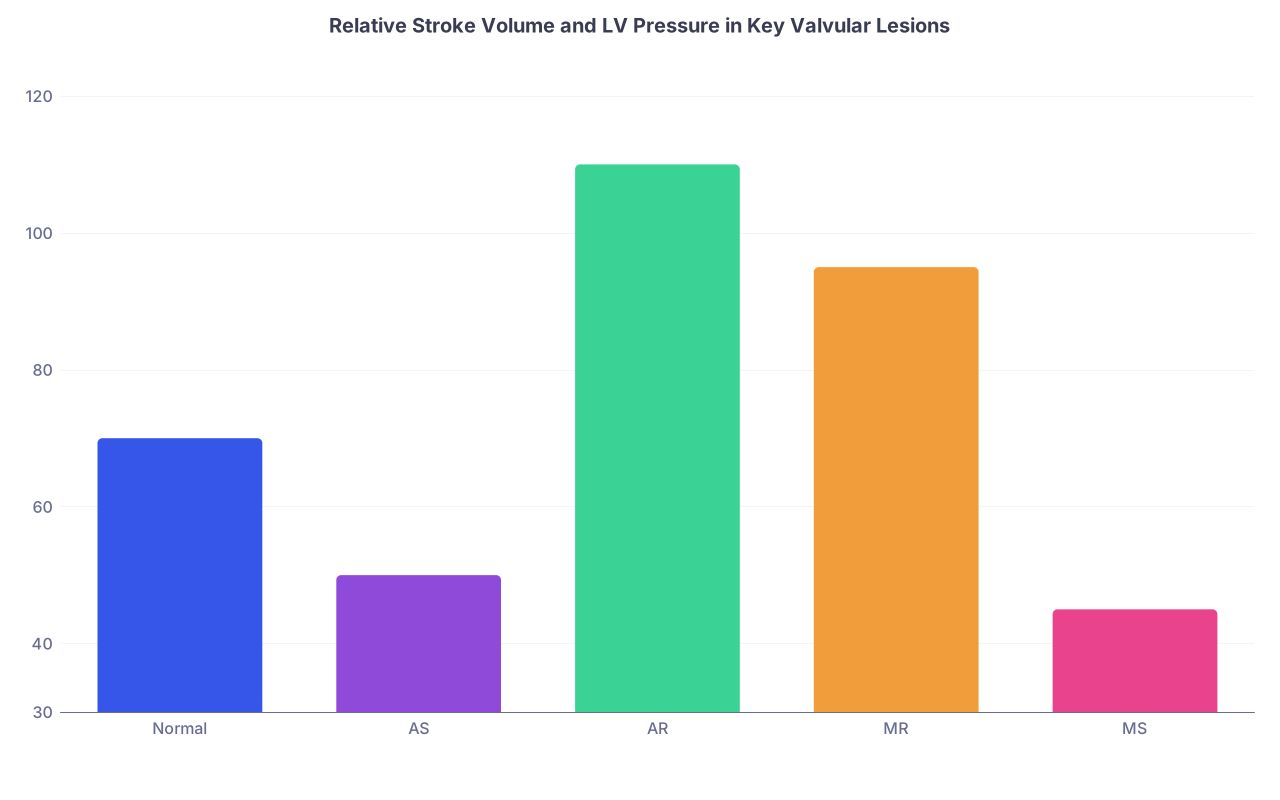
| Category | Value |
|---|---|
| Normal | 70 |
| AS | 50 |
| AR | 110 |
| MR | 95 |
| MS | 45 |
Again, approximate. You are not drawing these from scratch; you just match the scenario to the right curve.
12. Final Tight Summary
Three takeaways, and then you are done:
Anchor every murmur to a three-part identity: precise timing (systolic vs diastolic, ejection vs holo), best auscultation site + radiation, and what happens with a small set of maneuvers (Valsalva, squat, handgrip, inspiration). Anything beyond that is low-yield decoration.
Train yourself to instantly map vignette → murmur → consequence. Elderly syncope + carotid radiation = AS. Wide pulse pressure + early diastolic decrescendo = AR. IV drug user + inspiratory holosystolic LLSB murmur = TR. Young athlete + murmur louder with Valsalva = HOCM. Once you see the pattern, most questions become single-step.
Use audio and questions deliberately, not passively. Short, focused drilling with your own comparison table, repeated under time pressure, will give you functional, testable recognition—not just memorized lists you will forget in 48 hours.
If you master those, “Cardiac murmurs on Step 1” stops being scary and becomes one of the easier points on the exam.