
You’re not crazy for being scared. A “barely passing” Step 1 range does change your reality. But it’s not the automatic death sentence everyone on Reddit makes it sound like.
Let’s be blunt:
Pass/fail Step 1 did not magically make everything fair. Programs still care. PDs still ask, “Can this person handle boards?” And if you’re hovering just above the passing line on practice tests, it feels like you’re standing on a crumbling ledge with a blindfold on.
I’m going to walk through the ugly side of this (because you’re already thinking it) and then what you can actually do so you’re not gambling your entire career on a 1–2 point margin.
1. What “Just Above Passing” Really Means (Not the Sugar-Coated Version)
First, let’s nail down what we’re talking about.
NBME and UWorld self-assessments will usually give you:
- A predicted Step 1 score (even though the test is pass/fail now)
- A predicted probability of passing
If your practice tests are clustering in that terrifying zone where you’re technically “passing” but only barely, it usually looks like:
- NBME score reports near the minimum passing equivalent
- Predicted pass chances like 60–80% (or lower… which feels like Russian roulette)
- UWSA with probability bars that don’t feel comforting at all
Here’s the part no one likes to say out loud:
A “just above passing” practice score doesn’t mean you’ll magically jump on test day. It can go up. It can also go down. Anxiety, bad sleep, one weird block, experimental questions — they all hit harder when you’re on the margin.
So you’re right to worry.
But there’s a difference between:
- “I’m doomed no matter what I do”
vs. - “I’m not safe yet, but I still have levers I can pull”
You’re probably in the second category, even if your brain insists it’s the first.
2. What Program Directors Secretly Think About a Near-Fail Step 1
Here’s the annoying truth: Step 1 is pass/fail on paper; in people’s heads, it’s still a filter.
They can’t see your exact score anymore, but they see clues:
- Did you pass on the first attempt?
- Did you fail and retake?
- How did you do on Step 2 CK?
- Does your transcript flag any board delays, LOA, or remediation?
PDs basically sort applicants into mental bins:
| Step 1 Outcome | How PDs Often Interpret It |
|---|---|
| Pass, strong Step 2 CK | Safe, likely fine |
| Pass, average Step 2 CK | Acceptable, depends on rest of app |
| Pass, weak Step 2 CK | Question mark, needs strengths |
| Fail then pass, strong CK | Risk but with recovery |
| Fail then pass, weak CK | High concern, big red flag |
They don’t see “You got 198 vs 205” — they don’t have that granularity anymore. That part is in your head.
So the real risk is not:
“I’m scoring near passing — PDs will somehow know I was weak.”
The real risk is:
“I’m scoring near passing — I might actually fail, and then this follows me for years.”
Failing Step 1 is the big landmine:
- It forces you to explain it in every interview.
- Some programs auto-screen out re-takers, especially for competitive specialties.
- It makes Step 2 CK turn from “important” into “absolutely must crush.”
That’s why this moment — when you’re barely above passing in practice — matters so much. It’s the last decent chance to avoid that permanent label.
3. Are You Actually Ready to Sit? (Brutally Honest Self-Check)
The question you’re probably too scared to answer:
“If I took Step 1 tomorrow, do I genuinely believe I’d pass?”
Not “hope.” Believe.
Here’s a more structured way to sanity-check yourself instead of vibes and panic.
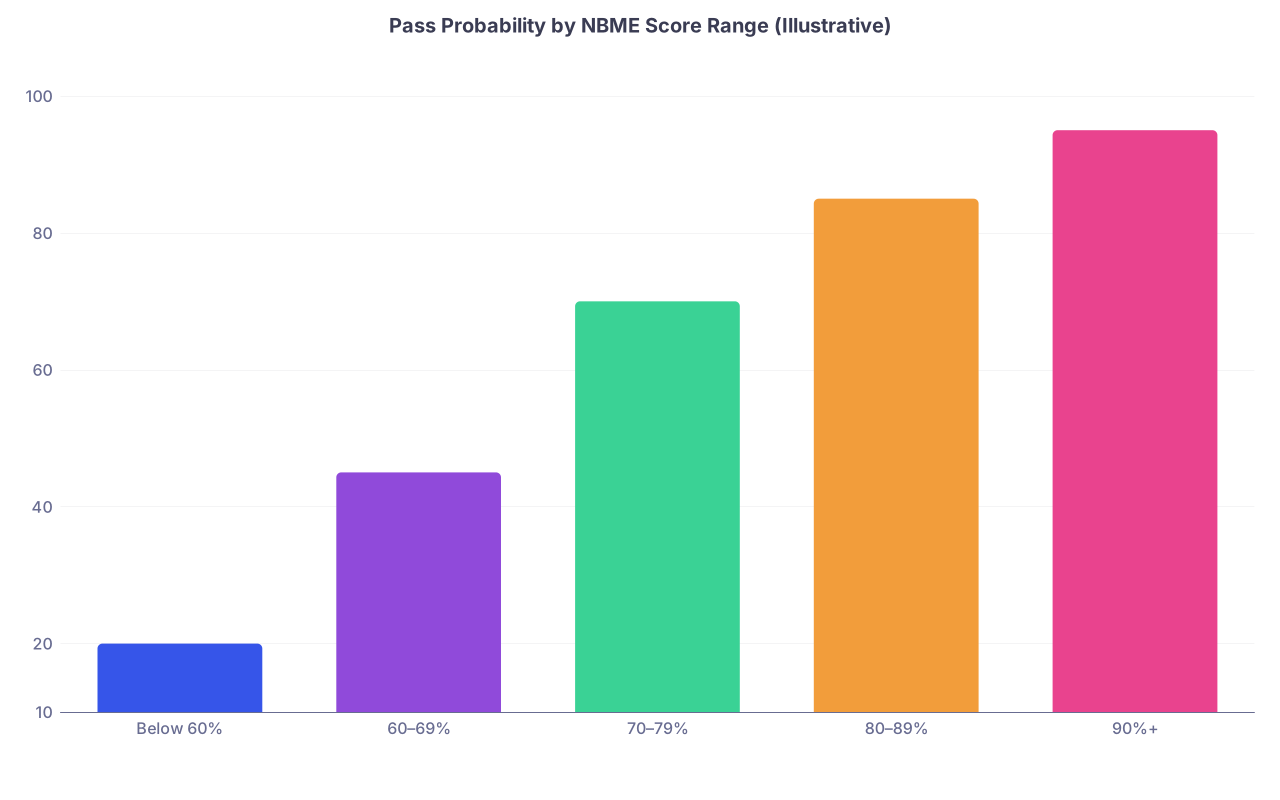
| Category | Value |
|---|---|
| Below 60% | 20 |
| 60–69% | 45 |
| 70–79% | 70 |
| 80–89% | 85 |
| 90%+ | 95 |
If your last 2–3 practice tests look like this:
- All within a narrow band (for example: 62%, 63%, 64%)
- No obvious upward trend
- You’re mentally exhausted and plateaued
You’re not “peaking.” You’re stuck.
And if that band is just barely above the usual pass threshold? That’s risky. Not impossible. Risky.
On the other hand:
- You had a low NBME early, then a modest jump (55 → 63 → 67%)
- You can clearly explain what changed (better Anki consistency, more UWorld, fixed weak subjects)
- You still have 2–4 weeks of dedicated left
That’s not the same situation. That’s someone on an upward curve who might be ok taking a calculated risk.
Here’s the rule I’ve seen most cautious people use (and what I’d want if my entire career was hanging on this):
- At least 2 NBME/UWSA results at or above a comfortable pass-equivalent
- Taken within the last 2–3 weeks before your exam
- No wild fluke scores
If your reality is: “I have one borderline pass and everything else is sketchy”… that’s not peace of mind. That’s gambling.
4. What Happens If You Push the Exam Back?
You’re probably terrified that asking for an extension means you’re weak or lazy or falling behind your class.
I’ve seen this play out a lot of ways. Punting Step 1 can:
- Save you from a fail that wrecks your record
- Or just delay the same disaster by a month if you don’t change anything
The question isn’t “Should I delay?”
The question is “If I delay, what will I do differently that actually changes my score?”
Because here’s the trap:
You:
- Feel borderline → delay 4 weeks
- Keep doing the same half-panicked UWorld grind
- Take NBME again → almost same score
- Now what? You’re out of runway and still scared
So if you’re going to delay, you need a plan shift, not just “more time.” For example:
- 2 weeks of brutal weak area focus (e.g., neuro, renal, biochem)
- Daily mixed timed blocks under test-like conditions
- Concrete review system (like: missed Q → 1–2 sentence summary → Anki card)
Delaying makes sense if:
- Your school allows it without putting you on academic probation or blowing up your schedule
- You’re clearly learning from each week of studying (not just re-reading the same wrong facts)
- Your last practice test was still moving upward, just not where you want yet
It’s less helpful if:
- You’re emotionally burned out and getting diminishing returns
- You’re already forgetting stuff you “mastered” a month ago
- Delay = isolation + more anxiety + spinning in circles
Sometimes the harsh but true answer is:
“I’m not magically going to become a 90th-percentile test-taker. I just need a solid shot at passing and then I’ll aim to crush Step 2.”
That’s a valid decision. You don’t have to be a hero. You do have to not fail.
5. If You Have to Sit Soon: How to Survive the Margin
Let’s say your date is close, extension is hard, and you’re stuck in this near-pass zone. What then?
No sugar-coating: your odds are mixed. But there are ways to tilt things.
Last 1–2 Weeks: Stop Doing Everything, Start Doing the Right Things
This is where panicked students go wrong. They:
- Start random question banks they’ve never used
- Try to re-read First Aid cover-to-cover like a novel
- Watch hours of videos to “fix” entire systems in 2 days
That’s fantasy.
Instead, you need a tight, boring, high-yield routine:
- Mixed, timed blocks (like the real exam)
- Ruthless, targeted review of weak subjects
- Short, fast content bursts, not long passive marathons
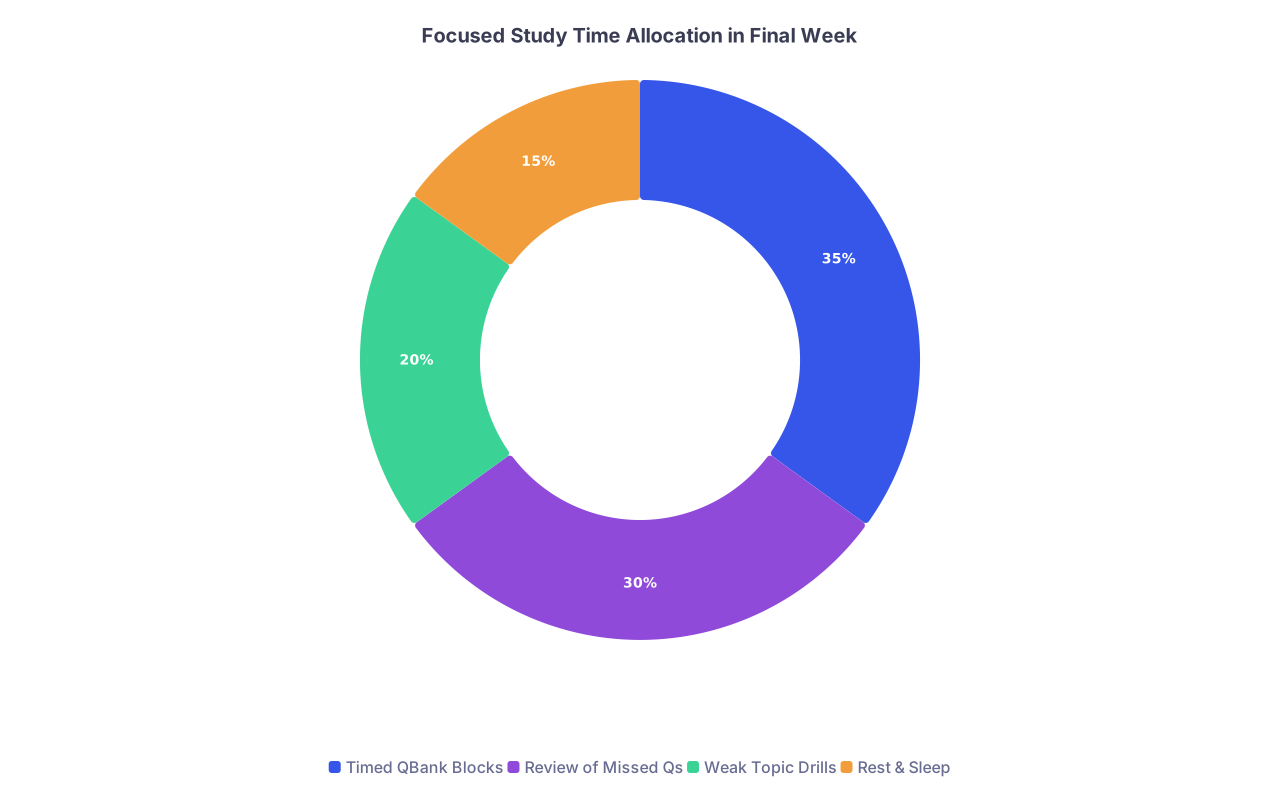
| Category | Value |
|---|---|
| Timed QBank Blocks | 35 |
| Review of Missed Qs | 30 |
| Weak Topic Drills | 20 |
| Rest & Sleep | 15 |
If you’re hovering just above passing, test-taking mechanics might save you:
- Guess and move when you’re stuck — don’t die on one question
- Flag fewer questions; don’t plan to reread every block
- Don’t change answers unless you have a real reason, not just fear
You’re not trying to get a 260. You’re trying to avoid unforced errors that drag you below the pass line.
The Psychological Side (Yes, It Matters)
When you’re borderline, anxiety can literally take you from pass → fail:
- Rushing because “I’m behind”
- Second-guessing every question
- Tunnel vision on one phrase while missing the big clue
You don’t fix that with “just relax.” That’s useless advice.
You fix it by practicing like the real thing:
- Full timed blocks, no pausing, no checking answers until the end
- Sitting in silence, phone in another room, fluids and snacks similar to test day
- Doing at least one full test-day simulation if you can
That way, on the real day, your brain goes, “Oh. We’ve done this. This is just another one.”
Is it still scary? Yes. But at least it’s a familiar kind of scary.
6. The “What If I Fail?” Scenario You’re Secretly Obsessed With
Let’s go there, because your brain already is.
Worst case: you take it, you fail. Now what?
Reality, not Reddit-doom version:
- You’ll have to sit again, usually after some remediation period your school forces
- It will go on your USMLE transcript forever
- Some specialties and programs will quietly be off the table
- You’ll feel like absolute garbage for a while
That’s the emotional fallout. It’s real. I’ve watched people cry in quiet corners of the library over this.
But it’s not necessarily the end of medicine:
- Many students with a Step 1 fail later pass on second try, then crush Step 2 CK
- They match into IM, FM, psych, peds, sometimes even into moderate-competitive places with a strong story and good letters
- It does make life harder. It does not automatically end your career.
Here’s why this matters today: you’re not choosing between “perfect outcome” and “fail.” You’re choosing between:
- Taking it borderline and risking the fail + permanent red flag
vs. - Delaying/adjusting so that if you take it, you’re at least reasonably safe
A just-above-passing practice score is a warning light. It’s not a prophecy.
7. How to Decide, Practically, Without Spiraling for 3 Weeks
You don’t need 30 opinions from classmates, Reddit, and your third cousin in residency. You need a small, cold-blooded decision framework.
Use this:
List your last 3–4 practice tests
- Write the raw scores / predicted pass chances
- Note dates — are they trending at all?
Answer these out loud (yes, actually say it):
- “If nothing changed between now and test day, would I bet my entire career on this score?”
- “Do I understand why I’m getting questions wrong?” (Knowledge gap vs. not reading the question vs. rushing?)
- “Can I realistically change that in the time I have?”
Talk to someone with authority, not just vibes
- Your school’s academic dean or Step advisor
- A trusted upperclassman who’s taken Step 1 recently
- Show them actual scores. Not “I think I’m around…”
Pick a deadline for a final NBME/UWSA
- Say: “If I don’t hit X by this date, I will delay.”
- X should be comfortably above pass, not razor-edge

| Step | Description |
|---|---|
| Step 1 | Current Practice Scores Near Pass |
| Step 2 | Take Another NBME |
| Step 3 | Proceed to Exam As Scheduled |
| Step 4 | Delay and Change Study Strategy |
| Step 5 | Intensive Final Prep + Risk Acceptance |
| Step 6 | Reassess With New NBME |
| Step 7 | Score Comfortably Above Pass? |
| Step 8 | Can You Safely Delay? |
Is this process stressful? Obviously. But it’s better than floating in “I don’t know, maybe I’ll be fine” land.
FAQ (exactly 5 questions)
1. What NBME score should I feel comfortable with before taking Step 1?
For most people, multiple assessments in at least the low-to-mid 60s percent range (or equivalent predicted pass with a good margin) feels reasonably safe. The key isn’t one magical number, it’s consistency and trend. If you’ve got two recent NBMEs where you’re clearly above the pass cut and not barely scraping it, that’s where people start breathing a little easier. If you keep bouncing around the threshold, that’s a red flag.
2. Is it better to barely pass on the first try or delay and risk falling behind my class?
Almost always, it’s better to delay than to fail. Programs don’t care if you took it in July instead of June. They do care if you have a Step 1 fail on your transcript. Falling “behind” is mostly in your head — lots of people take time off, extend, or shift schedules. But make delay conditional: only delay if you have a concrete plan to use that time differently, not just “more of the same but longer.”
3. Will programs know if I probably scored near the passing line even if it just says “Pass”?
No, they don’t see your actual Step 1 number anymore, just Pass/Fail and attempts. They’ll infer your test-taking strength more from Step 2 CK and your overall academic record. What they do see is whether you failed and needed a retake. That’s the bigger issue. This is why being on the edge right now matters — the danger isn’t a low hidden score, it’s a possible fail.
4. If I’m weak in certain subjects (like biochem or neuro), can I really fix that this late?
You can’t rebuild an entire foundation in 5 days, but you can patch the biggest leaks. That means: identify your highest-yield, most frequently tested topics in that subject and hammer them. Short, focused bursts: 20–30 targeted questions, quick review, 1–2 sentence summaries. You’re not trying to become a biochem wizard. You’re trying to turn “automatic miss” topics into “I have a fighting chance” ones.
5. If I end up failing Step 1, is matching to a decent residency still realistic?
Painful answer: harder, yes; impossible, no. A Step 1 failure closes some doors and forces you into “damage control mode.” But many students with a fail retake, pass, do well on Step 2 CK, and match into less-competitive but still solid specialties (IM, FM, peds, psych, etc.). You’ll need stronger clinical performance, letters, and a clear story of growth. You won’t be the shiny, risk-free applicant — but you’re not automatically out of the game either.
Bottom line:
- “Just above passing” on practice tests is a warning, not a verdict.
- The real disaster isn’t a low hidden Step 1 score — it’s a fail that follows you.
- If you’re going to sit borderline, do it with your eyes open, a clear plan, and a conscious choice — not blind hope.